towing Peugeot Partner Tepee 2015 User Guide
[x] Cancel search | Manufacturer: PEUGEOT, Model Year: 2015, Model line: Partner Tepee, Model: Peugeot Partner Tepee 2015Pages: 276, PDF Size: 12.76 MB
Page 168 of 276
166
Partner_2_VP_en_Chap08_Aide-rapide_ed02-2014
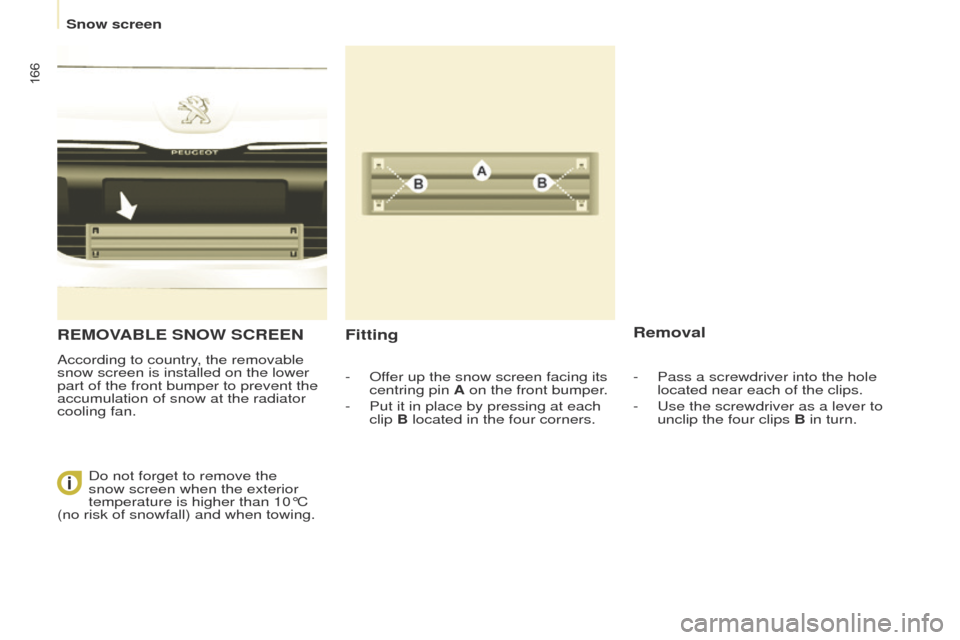
REMOVABLE SNOW SCREEN
According to country, the removable
snow screen is installed on the lower
part of the front bumper to prevent the
accumulation of snow at the radiator
cooling fan.
FittingRemoval
- Offer up the snow screen facing its
centring pin A on the front bumper.
-
Put it in place by pressing at each
clip
B located in the four corners.
Do not forget to remove the
snow screen when the exterior
temperature is higher than 10°C
(no risk of snowfall) and when towing. -
Pass a screwdriver into the hole
located near each of the clips.
-
u se the screwdriver as a lever to
unclip the four clips B in turn.
Snow screen
Page 180 of 276
178
Partner_2_VP_en_Chap08_Aide-rapide_ed02-2014
Without lifting (4 wheels on
the road)
You should always use a towing bar.
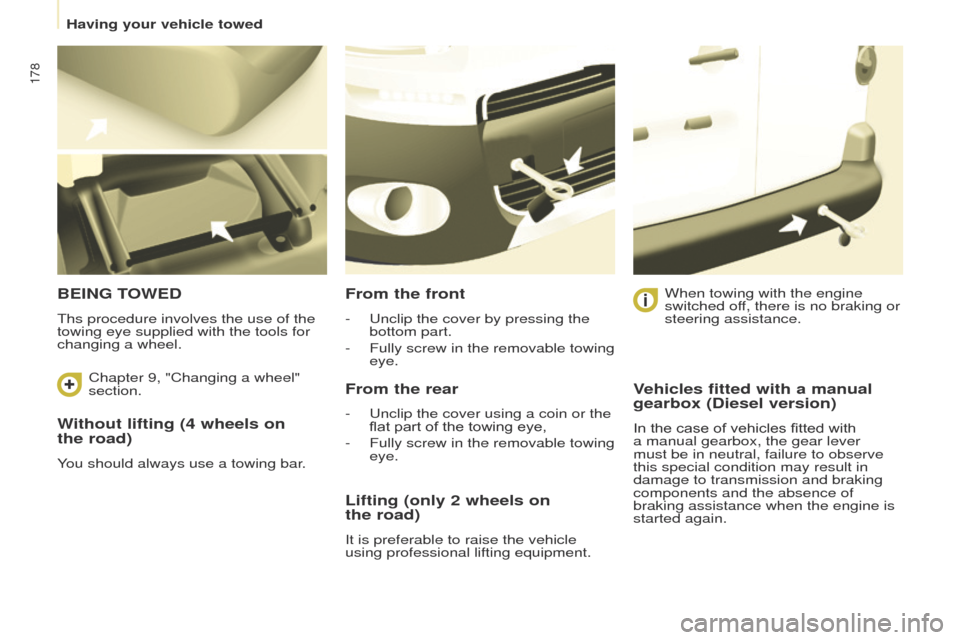
BEING TOWED
ths procedure involves the use of the
towing eye supplied with the tools for
changing a wheel.
From the front
- unclip the cover by pressing the
bottom part.
-
Fully screw in the removable towing
eye.
From the rear
- unclip the cover using a coin or the
flat part of the towing eye,
-
Fully screw in the removable towing
eye. When towing with the engine
switched of
f, there is no braking or
steering assistance.
Lifting (only 2 wheels on
the road)
It is preferable to raise the vehicle
using professional lifting equipment.
Vehicles fitted with a manual
gearbox (Diesel version)
In the case of vehicles fitted with
a manual gearbox, the gear lever
must be in neutral, failure to observe
this special condition may result in
damage to transmission and braking
components and the absence of
braking assistance when the engine is
started again.
Chapter 9, "Changing a wheel"
section.
Having your vehicle towed
Page 186 of 276
184
Partner_2_VP_en_Chap09_Caract-technique_ed02-2014
ENGINE CHARACTERISTICS
the engine characteristics (capacity,
maximum power , maximum power
speed, fuel, CO
2 emissions...) for your
vehicle are given in the registration
document.
t
hese characteristics correspond
to the values type-approved
on a test bed, under conditions
defined in European legislation
(Directive
1999/99/ e C).
For more information, refer to the
manufacturer's website or sales
brochure for the model. Contact
a PEUGEOT dealer or a qualified
workshop.
WEIGHTS AND TOWED LOADS
the weights and towable loads for your
vehicle can be found on the vehicle's
registration certificate.
t
hese values, expressed in kg, are
laos present on the manufacturer's
plate or label.
t
he kerb weight is equal to the weight
without load + driver (75 kg) + fuel tank
filled to 90%.
t
he gt W and towed load values
indicated are valid up to a maximum
altitude of 1000 metres.
t
he value of
the towed load mentioned must be
reduced by 10 % for each additional
1000 metres.
With load transfer, the braked trailer
weight can be increased, on condition
that the equivalent of this load is
removed from the vehicle so that the
gt
W is not exceeded. High ambient temperatures
may result in a reduction in the
performance of the vehicle in
order to protect the engine. When the
ambient temperature is higher than
37
°C, limit the towed weight.
towing with a lightly loaded
vehicle can adversely af
fect road
holding.
towing a trailer increases braking
distances.
When towing, the maximum permitted
speed is reduced (comply with the
legislation in force in the country).
t he recommended nose weight is
the downward force on the towball
(removable with or without tools).
GVW: gross vehicle weight, the
maximum authorised weight.
GTW: gross train weight, the maximum
weight for vehicle plus trailer.
Refer to chapter 9, "Identification
markings" section.
In each country, it is imperative that
the towed loads authorised by local
legislation are complied with. To find
out your vehicle's towing capacities
and its gross train weight, consult a
P
euge O t
dealer
.
Weights