Brake Peugeot Partner Tepee 2015 Owner's Guide
[x] Cancel search | Manufacturer: PEUGEOT, Model Year: 2015, Model line: Partner Tepee, Model: Peugeot Partner Tepee 2015Pages: 276, PDF Size: 12.76 MB
Page 143 of 276
141
Partner_2_VP_en_Chap07_Verification_ed02-2014
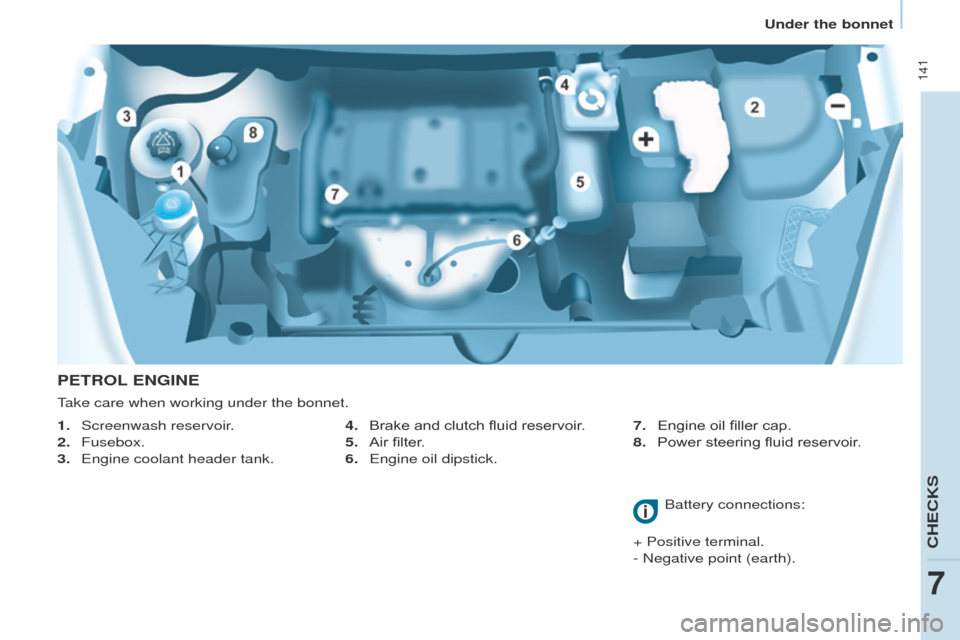
PETROL ENGINE
1. Screenwash reservoir.
2.
Fusebox.
3.
e ngine coolant header tank.
Battery connections:
+ Positive terminal.
- Negative point (earth).
take care when working under the bonnet. 4.
Brake and clutch fluid reservoir .
5.
Air filter
.
6.
e ngine oil dipstick.7.
Engine oil filler cap.
8.
Power steering fluid reservoir
.
under the bonnet
CHeCKS
7
Page 144 of 276
142
Partner_2_VP_en_Chap07_Verification_ed02-2014
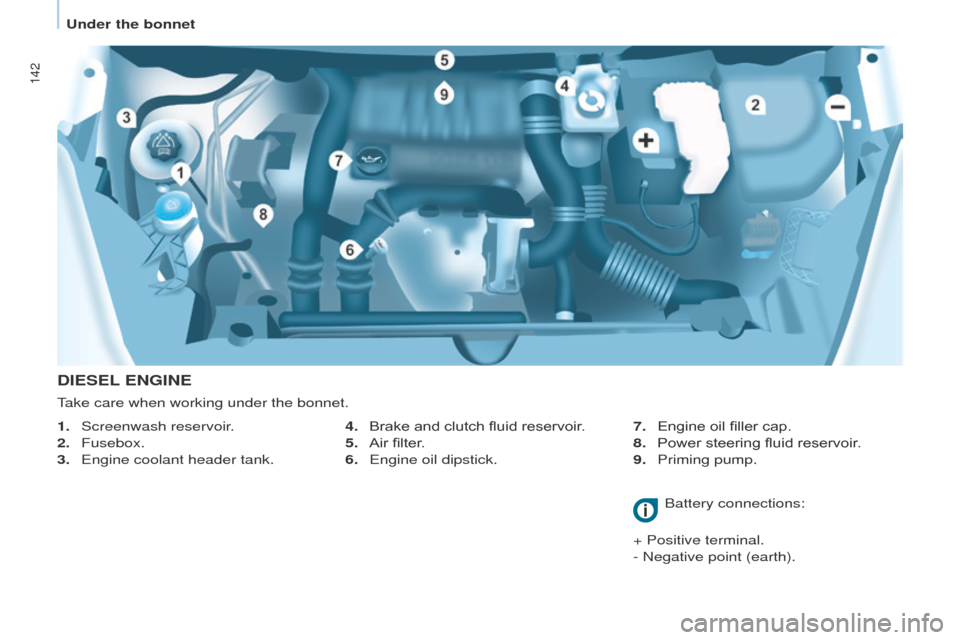
DIESEL ENGINE
4. Brake and clutch fluid reservoir.
5.
Air filter
.
6.
e ngine oil dipstick. 7.
Engine oil filler cap.
8.
Power steering fluid reservoir
.
9.
Priming pump.
1.
Screenwash reservoir
.
2.
Fusebox.
3.
e
ngine coolant header tank.
Battery connections:
+ Positive terminal.
- Negative point (earth).
take care when working under the bonnet.
under the bonnet
Page 145 of 276
143
Partner_2_VP_en_Chap07_Verification_ed02-2014
LEVELSOil change
this must be carried out at
the intervals specified in the
manufacturer's servicing schedule.
Ask
for advice from a P
euge O t
dealer
.
Remove the dipstick before filling.
Check the level after filling (never
exceed the max mark).
Refit the oil filler cap before closing the
bonnet.
Changing the brake fluid
The brake fluid must be changed at
the intervals stated, according to the
manufacturer's servicing schedule.
Use fluids recommended by the
manufacturer, which meet the DO
t 4
standard.
t
he level must be between the MIN
and MAX marks on the reservoir.
If fluid has to be added frequently,
this indicates a fault which must be
checked by a P
euge O t
dealer or
a qualified workshop as soon as
possible.
Warning lamps
If you have to remove / refit the
engine style cover, handle it with care
to avoid damaging the fixing clips.
Oil level
It is recommended that the oil level be
checked every 3 000 miles (5 000 km)
and topped up if necessary between oil
changes.
Check the level with the vehicle level,
engine cold, using the dipstick.
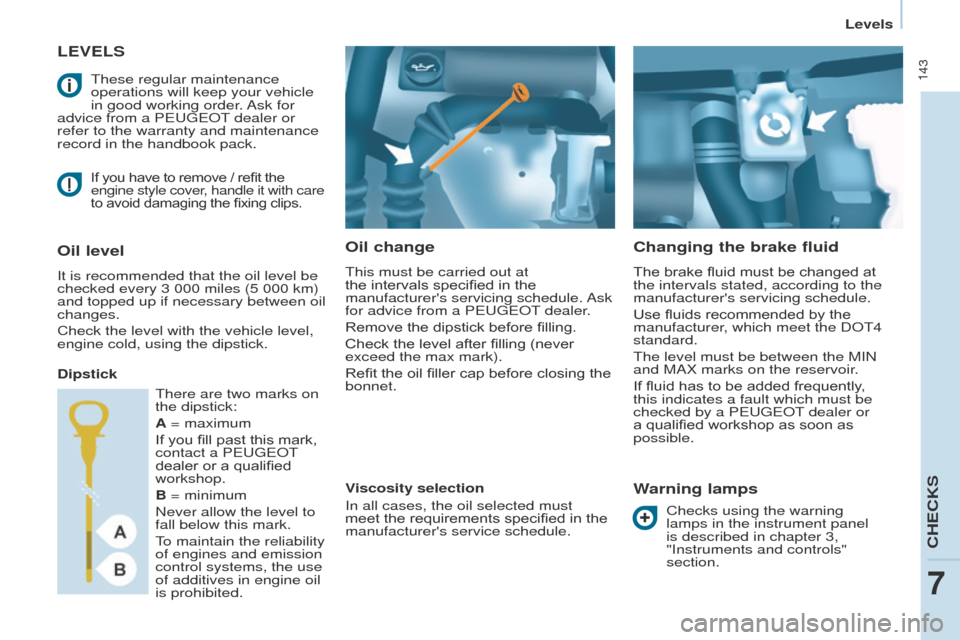
Dipstick
Viscosity selection
In all cases, the oil selected must
meet the requirements specified in the
manufacturer's service schedule.
t
hese regular maintenance
operations will keep your vehicle
in good working order. Ask for
advice from a P euge O t
dealer or
refer to the warranty and maintenance
record in the handbook pack.
Checks using the warning
lamps in the instrument panel
is described in chapter 3,
"Instruments and controls"
section.
t
here are two marks on
the dipstick:
A = maximum
If you fill past this mark,
contact a P
euge O t
dealer or a qualified
workshop.
B
= minimum
Never allow the level to
fall below this mark.
to maintain the reliability
of engines and emission
control systems, the use
of additives in engine oil
is prohibited.
Levels
CHeCKS
7
Page 146 of 276
144
Partner_2_VP_en_Chap07_Verification_ed02-2014
Cooling system
Only use the fluid recommended by the
manufacturer.
Otherwise, you risk seriously damaging
your engine.
When the engine is warm, the
temperature of the coolant is controlled
by the engine fan. As this fan can
operate with the ignition key removed
and because the cooling system is
pressurised, wait for at least one hour
after the engine has stopped before
carrying out any work.
Slacken the cap by 1/4 of a turn to
release the pressure to prevent any
risk of scalding. When the pressure
has dropped, remove the cap and top
up the level with coolant.
If fluid has to be added frequently,
this indicates a fault which must be
checked by a Peuge O t
dealer as
soon as possible.
Power steering fluid level
the vehicle must be parked on level
ground with the engine cold. u nscrew
the cap integrated with the gauge and
check the level which must be between
the MIN and MAX marks. In order to regenerate the filter, you
are advised to drive at a speed higher
than 40 mph (60 km/h) for at least five
minutes as soon as possible, when
traffic conditions permit (until the
message disappears and the service
warning lamp goes off).
During regeneration of the particle
emission filter, the noise of a relay
operating may be heard under the
dashboard.
If the message is still displayed and
if the service warning lamp remains
on, contact a P
euge O t
dealer or a
qualified workshop.
T
opping up
t
he level must be between the MIN
and MAX marks on the expansion
bottle. If more than 1 litre of fluid is
required to top up the level, have
the system checked by a P
euge
O
t
dealer or a qualified workshop.
Screenwash and headlamp
wash level
For best quality cleaning and for your
safety, we would advise that you use
products of the P
euge O t
range.
For optimum cleaning and to avoid
freezing, this fluid must not be topped
up or replaced with plain water
.
Capacity of the screenwash reservoir:
approximately 3 litres.
If your vehicle is fitted with headlamp
washers, the capacity of the reservoir
is 6 litres.
Diesel additive level
(Diesel with particle
emission filter)
Topping up
t
his additive must be topped up by
a PEUGEOT dealer or a qualified
workshop without delay.
Waste products
Avoid prolonged contact of used oil
with the skin.
Brake fluid is harmful to health and
very corrosive.
Do not dispose of used oil, brake fluid
or coolant into drains or into the ground
but into the containers dedicated to this
use at a P
euge O t
dealer (France) or
an authorised waste disposal site.
t
he minimum level of this additive
is indicated by lighting of the service
warning lamp, accompanied by an
audible signal and a message in the
screen.
When this occurs with the engine
running it is due to the start of
saturation of the particle emission filter
(exceptionally prolonged urban type
driving conditions: low speed, long
traffic jams, ...).
Levels
Page 147 of 276
145
Partner_2_VP_en_Chap07_Verification_ed02-2014
CHECKSCarbon filter and passenger compartment filterParticle filter (Diesel)
Maintenance of the particle filter must
be carried out by a Peuge O t dealer .
On acceleration after the vehicle has
been running for a prolonged period
at very low speed or at idle, you may,
in exceptional circumstances, notice
the emission of water vapour at the
exhaust.
t
his water vapour does not
have any adverse effect on vehicle
handling or the environment.
Battery
At the start of summer or winter, have
your battery checked by a P euge O t
dealer or a qualified workshop.
Brake pads
Brake pad wear depends on the style
of driving, in particular for vehicles
which are used in town, over short
distances. It may be necessary to
check the thickness of the pads, even
between services.
u
nless there is a leak on the circuit, a
drop in the brake fluid level indicates
that the brake pads are worn.
Brake disc / drum wear
For information on checking the brake
disc / drum wear, contact a P euge O t
dealer
.
Parking brake
Where the parking brake travel is too great
or there is a reduction in the performance
of the system, the parking brake should be
adjusted, even between services.
Have the system checked by a P
euge O t
dealer or a qualified workshop.
Oil filter
Change the filter regularly in
accordance with the manufacturer's
servicing schedule.
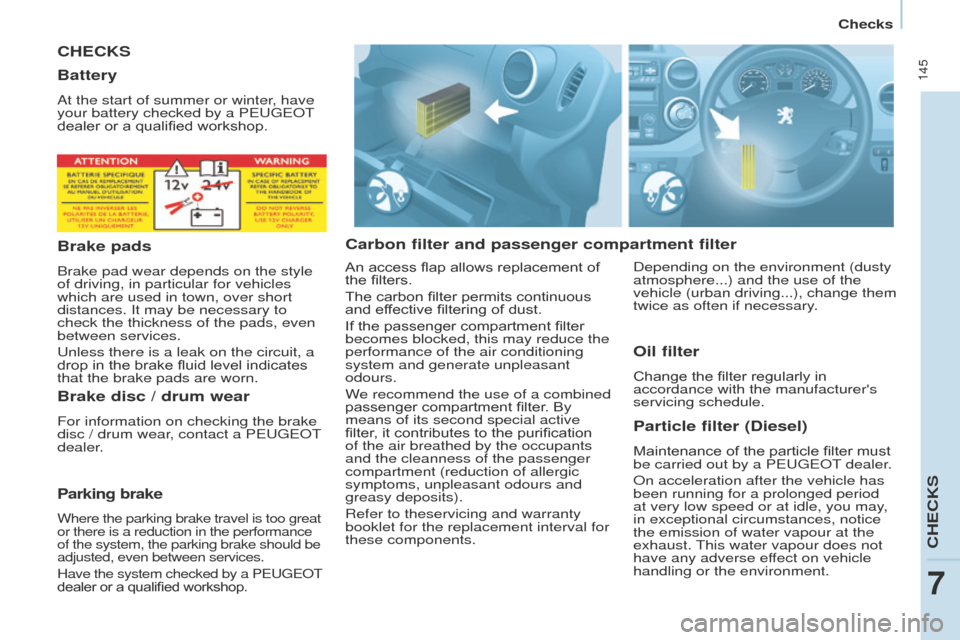
An access flap allows replacement of
the filters.
The carbon filter permits continuous
and effective filtering of dust.
If the passenger compartment filter
becomes blocked, this may reduce the
performance of the air conditioning
system and generate unpleasant
odours.
We recommend the use of a combined
passenger compartment filter. By
means of its second special active
filter, it contributes to the purification
of the air breathed by the occupants
and the cleanness of the passenger
compartment (reduction of allergic
symptoms, unpleasant odours and
greasy deposits).
Refer to theservicing and warranty
booklet for the replacement interval for
these components. Depending on the environment (dusty
atmosphere...) and the use of the
vehicle (urban driving...), change them
twice as often if necessary.
Checks
CHeCKS
7
Page 148 of 276
146
Partner_2_VP_en_Chap07_Verification_ed02-2014
Bleeding water from the Diesel
filterManual gearbox
Have the level checked in accordance
with the manufacturer's servicing
schedule.
Only use products recommended
by P
euge O t
or products
of equivalent quality and
specification.
In order to optimise the operation
of units as important as the braking
system, P
euge O t
selects and of
fers
specific products.
In order to avoid damaging the
electrical units, high pressure washing
to clean the engine compartment is
strictly prohibited.
After washing the vehicle dampness,
or in winter, ice may form on the brake
discs and pads: braking efficiency may
be reduced. Make some light brake
applications to dry and de-ice the
brakes.
If this warning lamp comes
on, bleed the filter. Otherwise
bleed regularly each time the
engine oil is changed.
HDi engines use advanced
technology. All work requires
special training, which is assured
by a P
euge
O
t
dealer
.
Depending on country of sale.
to drain the water
, unscrew the bleed
screw located on the filter.
Operate until all of the water no longer
flows in the transparent pipe, then
tighten the bleed screw.
Checks
Page 162 of 276
160
Partner_2_VP_en_Chap08_Aide-rapide_ed02-2014
1. Parking the vehicle
- the occupants must get out of the
vehicle and wait in a safe location.
-
If possible, park the vehicle on
level, stable and non-slippery
ground.
-
Apply the parking brake, switch
of
f the ignition and engage first or
reverse gear. -
Place a chock under the wheel
diagonally opposite the one to be
changed.
CHANGING A WHEEL
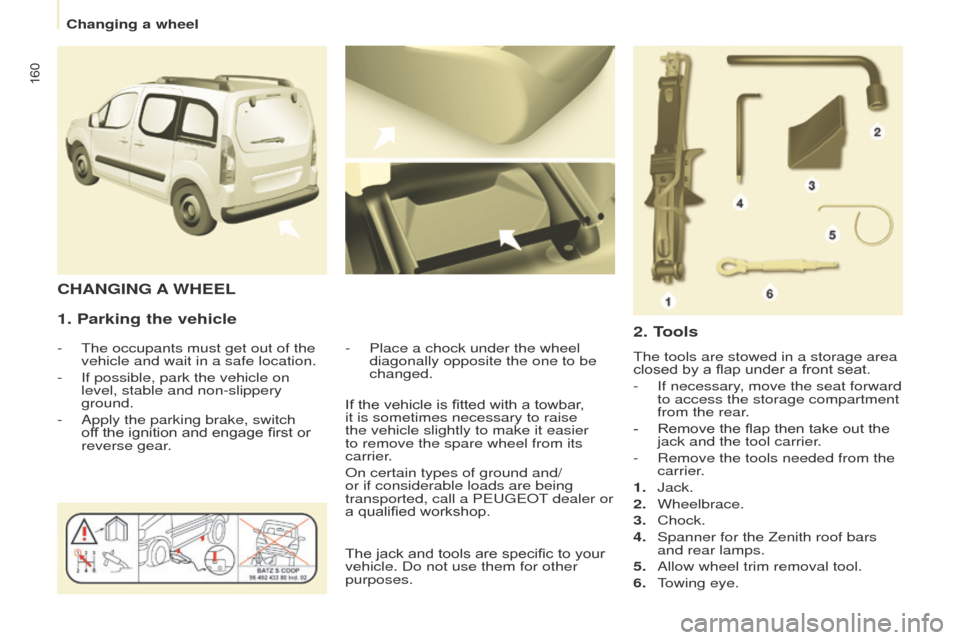
2. Tools
the tools are stowed in a storage area
closed by a flap under a front seat.
-
If necessary
, move the seat forward
to access the storage compartment
from the rear.
-
Remove the flap then take out the
jack and the tool carrier
.
-
Remove the tools needed from the
carrier
.
1.
Jack.
2.
Wheelbrace.
3.
Chock.
4.
Spanner for the Zenith roof bars
and rear lamps.
5.
Allow wheel trim removal tool.
6.
t
owing eye.
If the vehicle is fitted with a towbar
,
it is sometimes necessary to raise
the vehicle slightly to make it easier
to remove the spare wheel from its
carrier.
On certain types of ground and/
or if considerable loads are being
transported, call a P
euge
O
t
dealer or
a qualified workshop.
The jack and tools are specific to your
vehicle. Do not use them for other
purposes.
Changing a wheel
Page 169 of 276
167
Partner_2_VP_en_Chap08_Aide-rapide_ed02-2014
SNOW CHAINS
In wintry conditions, snow chains
improve traction as well as the
behaviour of the vehicle when braking.The snow chains must be fitted
only to the driving wheels.
t
hey
must never be fitted to "space-
saver" type spare wheels.
take account of the legislation in
force in your country on the use
of snow chains and the maximum
running speed authorised. Advice on installation
F
If you have to fit the chains during
a journey
, stop the vehicle on a flat
surface on the side of the road.
F
Apply the parking brake and
position any wheel chocks to
prevent movement of your vehicle.
F
Fit the chains following the
instructions provided by the
manufacturer
.
F
Move of
f gently and drive for a
few moments, without exceeding
30
mph (50 km/h).
F
Stop your vehicle and check that
the snow chains are correctly
tightened.It is recommended that before you
leave, you practise fitting the snow
chains on a level and dry surface.
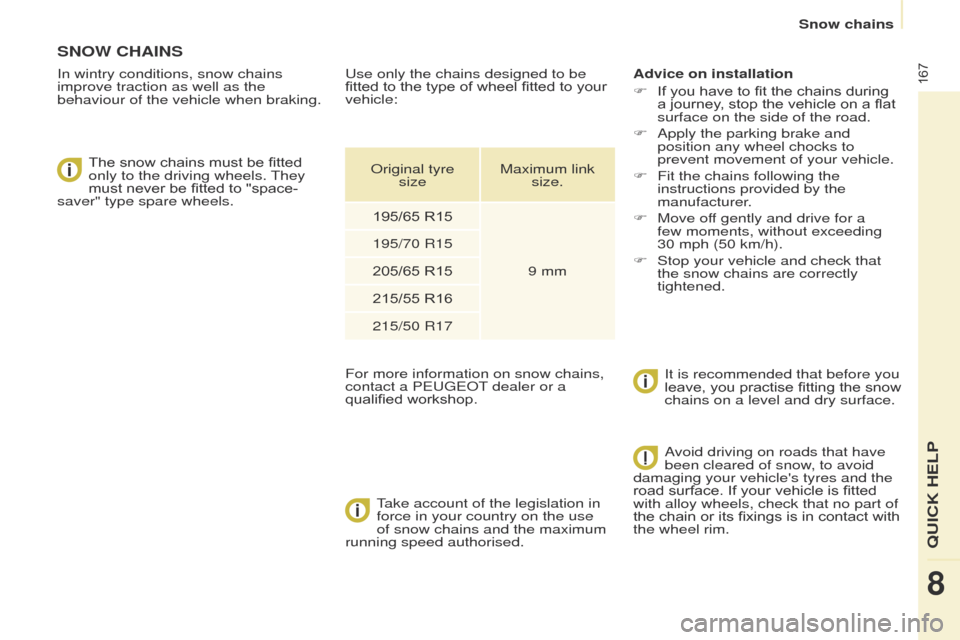
u se only the chains designed to be
fitted to the type of wheel fitted to your
vehicle:
For more information on snow chains,
contact a P
euge O t
dealer or a
qualified workshop. Original tyre
size Maximum link
size.
195/65 R15
9 mm
195/70 R15
205/65 R15
215/55 R16
215/50 R17
Avoid driving on roads that have
been cleared of snow, to avoid
damaging your vehicle's tyres and the
road surface. If your vehicle is fitted
with alloy wheels, check that no part of
the chain or its fixings is in contact with
the wheel rim.
Snow chains
QuICK HeLP
8
Page 173 of 276
171
Partner_2_VP_en_Chap08_Aide-rapide_ed02-2014
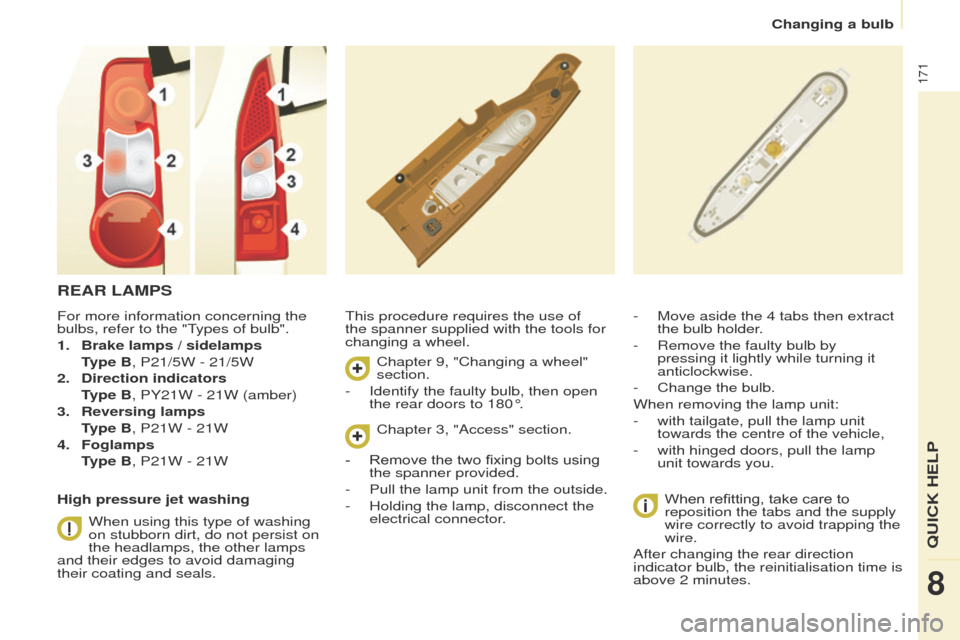
REAR LAMPS
this procedure requires the use of
the spanner supplied with the tools for
changing a wheel.
When refitting, take care to
reposition the tabs and the supply
wire correctly to avoid trapping the
wire.
After changing the rear direction
indicator bulb, the reinitialisation time is
above 2 minutes. - Move aside the 4 tabs then extract
the bulb holder
.
-
Remove the faulty bulb by
pressing it lightly while turning it
anticlockwise.
-
Change the bulb.
When removing the lamp unit:
-
with tailgate, pull the lamp unit
towards the centre of the vehicle,
-
with hinged doors, pull the lamp
unit towards you.
For more information concerning the
bulbs, refer to the "
types of bulb".
1.
Brake lamps / sidelamps
T
ype B, P21/5W - 21/5W
2.
Direction indicators
T
ype B, PY21W - 21W (amber)
3.
Reversing lamps
T
ype B, P21W - 21W
4.
Foglamps
T
ype B, P21W - 21W
High pressure jet washing When using this type of washing
on stubborn dirt, do not persist on
the headlamps, the other lamps
and their edges to avoid damaging
their coating and seals. Chapter 9, "Changing a wheel"
section.
-
Identify the faulty bulb, then open
the rear doors to 180°. Chapter 3, "Access" section.
-
Remove the two fixing bolts using
the spanner provided.
-
Pull the lamp unit from the outside.
-
Holding the lamp, disconnect the
electrical connector
.
Changing a bulb
QuICK HeLP
8
Page 174 of 276
172
Partner_2_VP_en_Chap08_Aide-rapide_ed02-2014
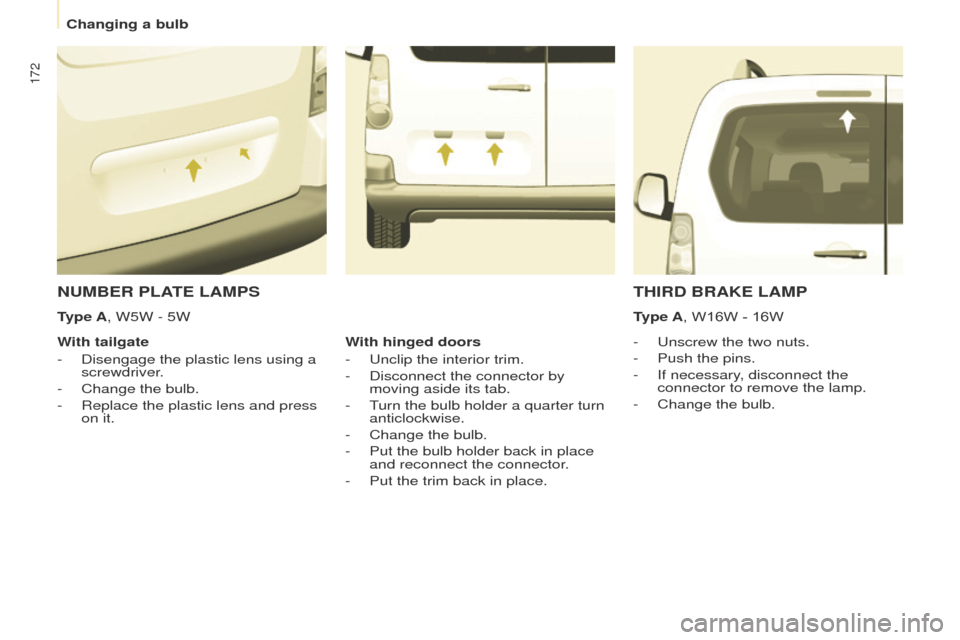
NUMBER PLATE LAMPS
- unscrew the two nuts.
-
Push the pins.
-
If necessary
, disconnect the
connector to remove the lamp.
-
Change the bulb.
W
ith tailgate
-
Disengage the plastic lens using a
screwdriver
.
-
Change the bulb.
-
Replace the plastic lens and press
on it.
THIRD BRAKE LAMP
Type A, W16W - 16W
With hinged doors
-
u
nclip the interior trim.
-
Disconnect the connector by
moving aside its tab.
-
t
urn the bulb holder a quarter turn
anticlockwise.
-
Change the bulb.
-
Put the bulb holder back in place
and reconnect the connector
.
-
Put the trim back in place.
T
ype A, W5W - 5W
Changing a bulb