Changing wheel Peugeot Partner Tepee 2016 User Guide
[x] Cancel search | Manufacturer: PEUGEOT, Model Year: 2016, Model line: Partner Tepee, Model: Peugeot Partner Tepee 2016Pages: 296, PDF Size: 10.76 MB
Page 173 of 296
171
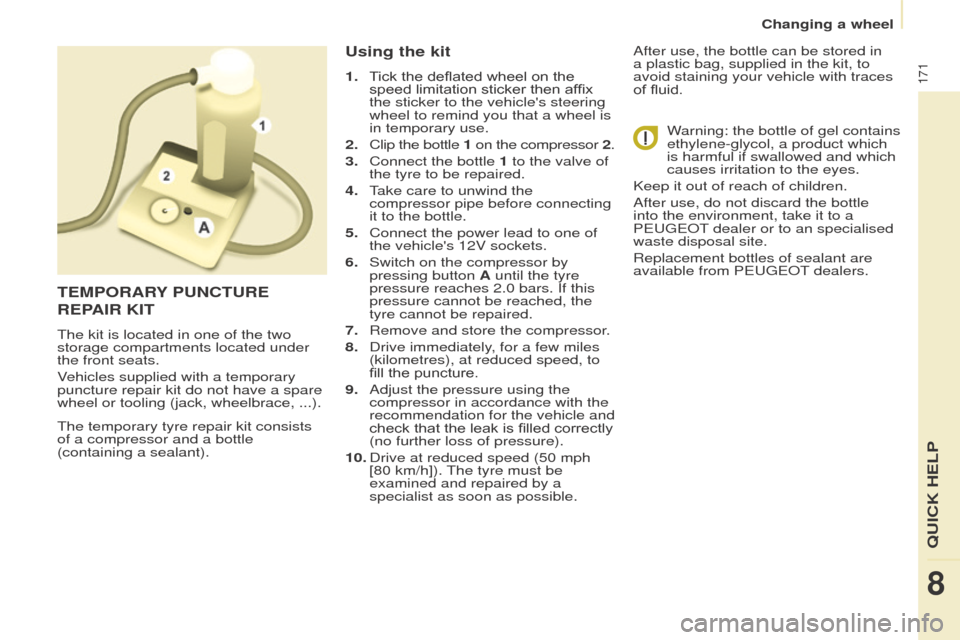
The temporary tyre repair kit consists
of a compressor and a bottle
(containing a sealant).
using the kit
1. Tick the deflated wheel on the speed limitation sticker then affix
the sticker to the vehicle's steering
wheel to remind you that a wheel is
in temporary use.
2.
Clip the bottle
1 on the compressor
2.
3.
Connect the bottle
1 to the valve of
the tyre to be repaired.
4.
T
ake care to unwind the
compressor pipe before connecting
it to the bottle.
5.
Connect the power lead to one of
the vehicle's 12V sockets.
6.
Switch on the compressor by
pressing button
A until the tyre
pressure reaches 2.0 bars. If this
pressure cannot be reached, the
tyre cannot be repaired.
7.
Remove and store the compressor
.
8.
Drive immediately
, for a few miles
(kilometres), at reduced speed, to
fill the puncture.
9.
Adjust the pressure using the
compressor in accordance with the
recommendation for the vehicle and
check that the leak is filled correctly
(no further loss of pressure).
10.
Drive at reduced speed (50
mph
[80 km/h]). The tyre must be
examined and repaired by a
specialist as soon as possible. After use, the bottle can be stored in
a plastic bag, supplied in the kit, to
avoid staining your vehicle with traces
of fluid.
Warning: the bottle of gel contains
ethylene-glycol, a product which
is harmful if swallowed and which
causes irritation to the eyes.
Keep it out of reach of children.
After use, do not discard the bottle
into the environment, take it to a
P
eugeo T dealer or to an specialised
waste disposal site.
Replacement bottles of sealant are
available from P
eugeo T dealers.
teMPoRARY P u NC tu R e
R
e PAIR KI t
The kit is located in one of the two
storage compartments located under
the front seats.
Vehicles supplied with a temporary
puncture repair kit do not have a spare
wheel or tooling (jack, wheelbrace, ...).
8
QuICK HeLP
Changing a wheel
Page 174 of 296
172
1. Parking the vehicle
- The occupants must get out of the
vehicle and wait in a safe location.
-
If possible, park the vehicle on level,
stable and non-slippery ground.
-
Apply the parking brake, switch
of
f the ignition and engage first or
reverse gear. -
Place a chock under the wheel
diagonally opposite the one to be
changed.
CHANgINg A WH
ee L
2.
t
ools
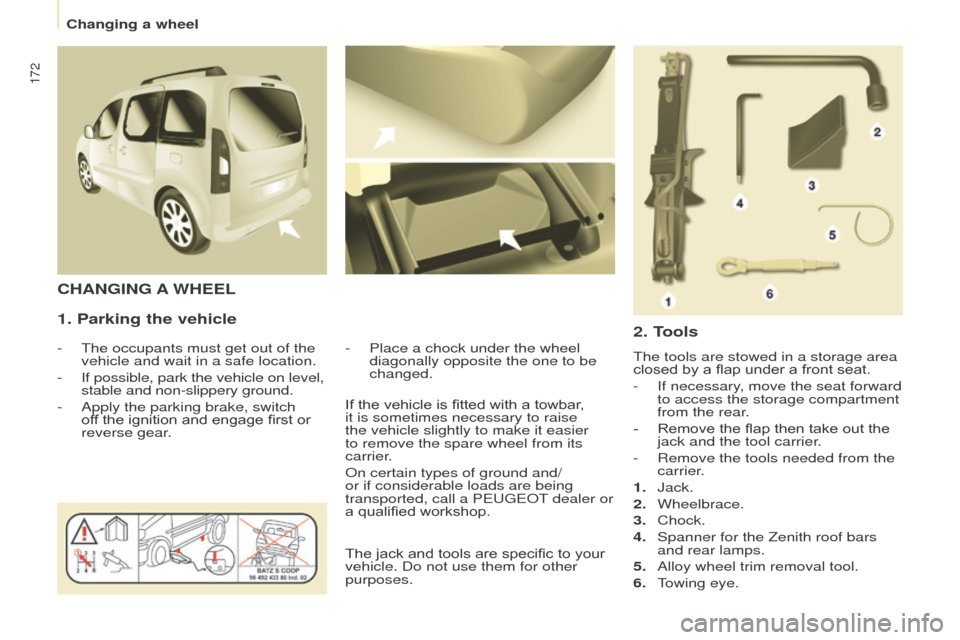
The tools are stowed in a storage area
closed by a flap under a front seat.
-
If necessary
, move the seat forward
to access the storage compartment
from the rear.
-
Remove the flap then take out the
jack and the tool carrier
.
-
Remove the tools needed from the
carrier
.
1.
Jack.
2.
Wheelbrace.
3.
Chock.
4.
Spanner for the Zenith roof bars
and rear lamps.
5.
Alloy wheel trim removal tool.
6.
T
owing eye.
If the vehicle is fitted with a towbar,
it is sometimes necessary to raise
the vehicle slightly to make it easier
to remove the spare wheel from its
carrier.
o
n certain types of ground and/
or if considerable loads are being
transported, call a P
eugeo
T dealer or
a qualified workshop.
The jack and tools are specific to your
vehicle. Do not use them for other
purposes.
Changing a wheel
Page 175 of 296
173
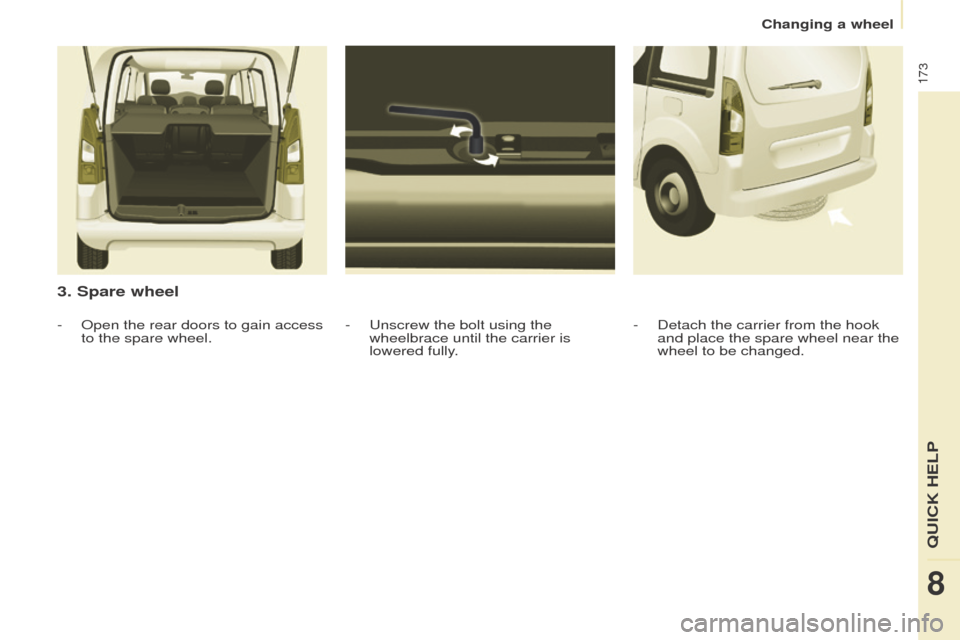
3. Spare wheel
- unscrew the bolt using the
wheelbrace until the carrier is
lowered fully
.
-
o
pen the rear doors to gain access
to the spare wheel. -
Detach the carrier from the hook
and place the spare wheel near the
wheel to be changed.
8
QuICK HeLP
Changing a wheel
Page 176 of 296
174
4. Procedure
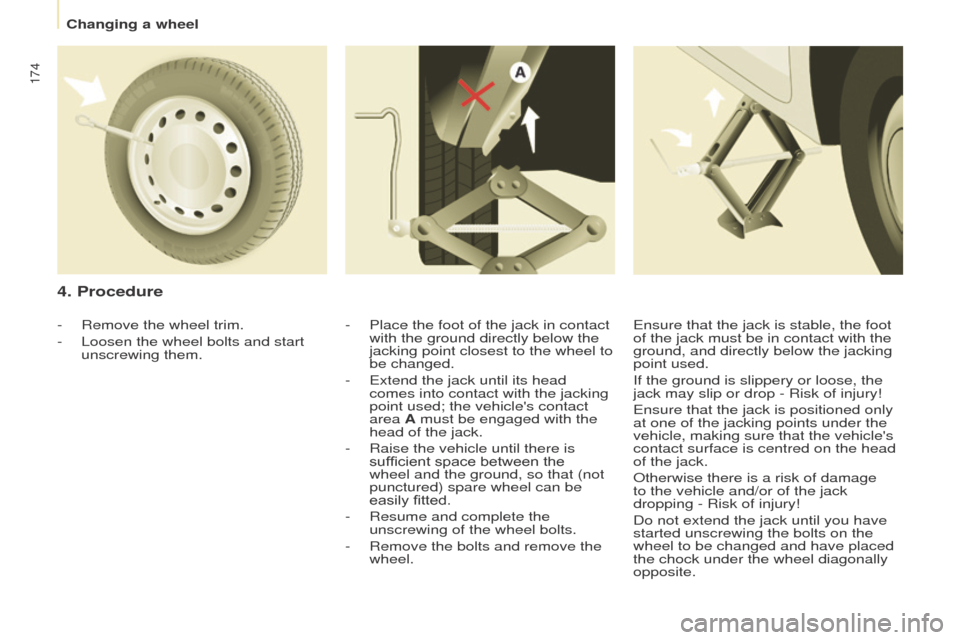
- Place the foot of the jack in contact
with the ground directly below the
jacking point closest to the wheel to
be changed.
-
e xtend the jack until its head
comes into contact with the jacking
point used; the vehicle's contact
area A must be engaged with the
head of the jack.
-
Raise the vehicle until there is
sufficient space between the
wheel and the ground, so that (not
punctured) spare wheel can be
easily fitted.
-
Resume and complete the
unscrewing of the wheel bolts.
-
Remove the bolts and remove the
wheel.
-
Remove the wheel trim.
-
Loosen the wheel bolts and start
unscrewing them.
e nsure that the jack is stable, the foot
of the jack must be in contact with the
ground, and directly below the jacking
point used.
If the ground is slippery or loose, the
jack may slip or drop - Risk of injury!
e
nsure that the jack is positioned only
at one of the jacking points under the
vehicle, making sure that the vehicle's
contact surface is centred on the head
of the jack.
o
therwise there is a risk of damage
to the vehicle and/or of the jack
dropping
- Risk of injury!
Do not extend the jack until you have
started unscrewing the bolts on the
wheel to be changed and have placed
the chock under the wheel diagonally
opposite.
Changing a wheel
Page 177 of 296
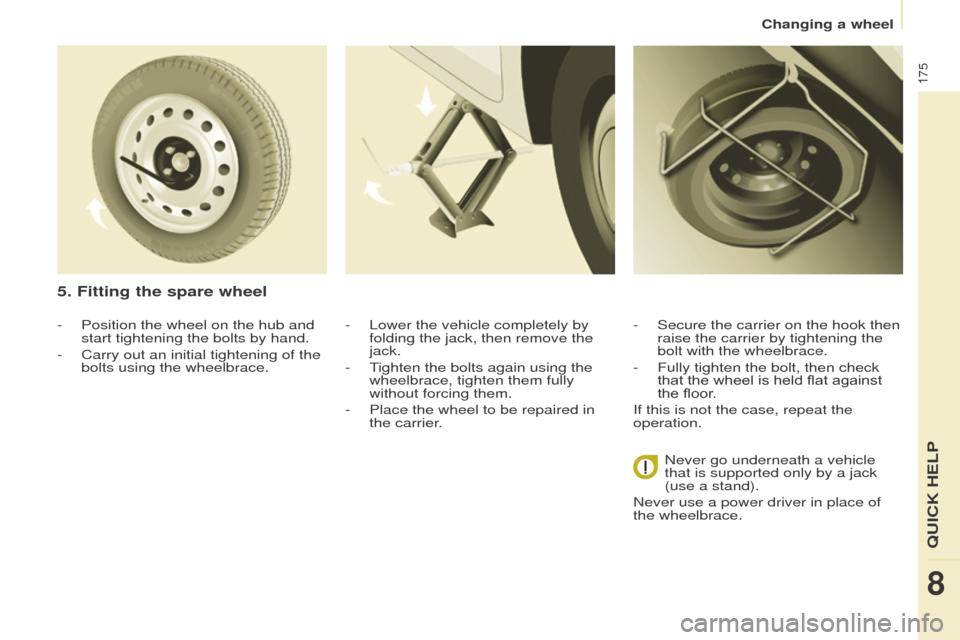
175
- Position the wheel on the hub and
start tightening the bolts by hand.
-
Carry out an initial tightening of the
bolts using the wheelbrace.
5. Fitting the spare wheel
- Lower the vehicle completely by
folding the jack, then remove the
jack.
-
T
ighten the bolts again using the
wheelbrace, tighten them fully
without forcing them.
-
Place the wheel to be repaired in
the carrier
. -
Secure the carrier on the hook then
raise the carrier by tightening the
bolt with the wheelbrace.
-
Fully tighten the bolt, then check
that the wheel is held flat against
the floor
.
If this is not the case, repeat the
operation.
Never go underneath a vehicle
that is supported only by a jack
(use a stand).
Never use a power driver in place of
the wheelbrace.
8
QuICK HeLP
Changing a wheel
Page 178 of 296
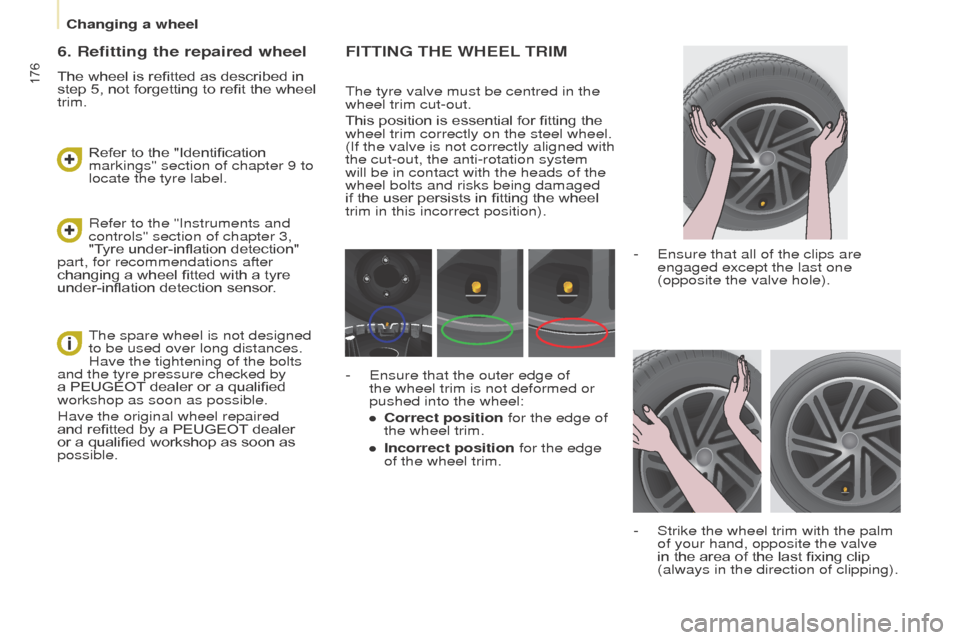
176
FIttINg tHe WHeeL tRIM
The tyre valve must be centred in the
wheel trim cut-out.
This position is essential for fitting the
wheel trim correctly on the steel wheel.
(If the valve is not correctly aligned with
the cut-out, the anti-rotation system
will be in contact with the heads of the
wheel bolts and risks being damaged
if the user persists in fitting the wheel
trim in this incorrect position).
-
e nsure that all of the clips are
engaged except the last one
(opposite the valve hole).
-
Strike the wheel trim with the palm
of your hand, opposite the valve
in the area of the last fixing clip
(always in the direction of clipping).
-
e nsure that the outer edge of
the wheel trim is not deformed or
pushed into the wheel:
●
Correct position
for the edge of
the wheel trim.
●
Incorrect position
for the edge
of the wheel trim.
6. Refitting the repaired wheel
The wheel is refitted as described in
step 5, not forgetting to refit the wheel
trim.
Refer to the "Instruments and
controls" section of chapter 3,
"Tyre under-inflation detection"
part, for recommendations after
changing a wheel fitted with a tyre
under-inflation detection sensor. Refer to the "Identification
markings" section of chapter 9 to
locate the tyre label.
The spare wheel is not designed
to be used over long distances.
Have the tightening of the bolts
and the tyre pressure checked by
a PEUGEOT dealer or a qualified
workshop as soon as possible.
Have the original wheel repaired
and refitted by a PEUGEOT dealer
or a qualified workshop as soon as
possible.
Changing a wheel
Page 179 of 296
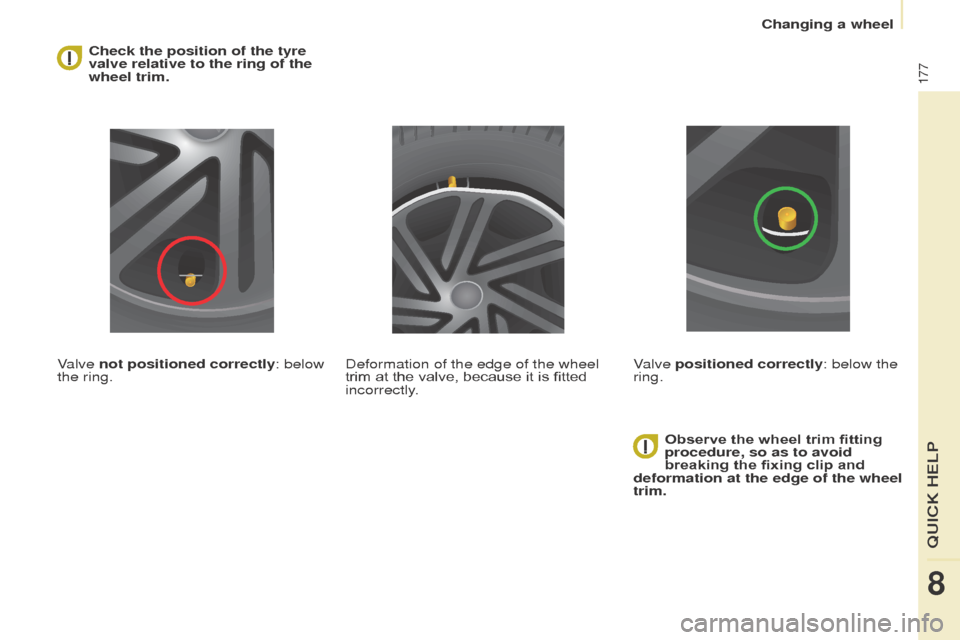
177
Check the position of the tyre
valve relative to the ring of the
wheel trim.
Valve not positioned correctly: below
the ring. Observe the wheel trim fitting
procedure, so as to avoid
breaking the fixing clip and
deformation at the edge of the wheel
trim.
Deformation of the edge of the wheel
trim at the valve, because it is fitted
incorrectly.
Valve positioned correctly: below the
ring.
8
QuICK HeLP
Changing a wheel
Page 184 of 296
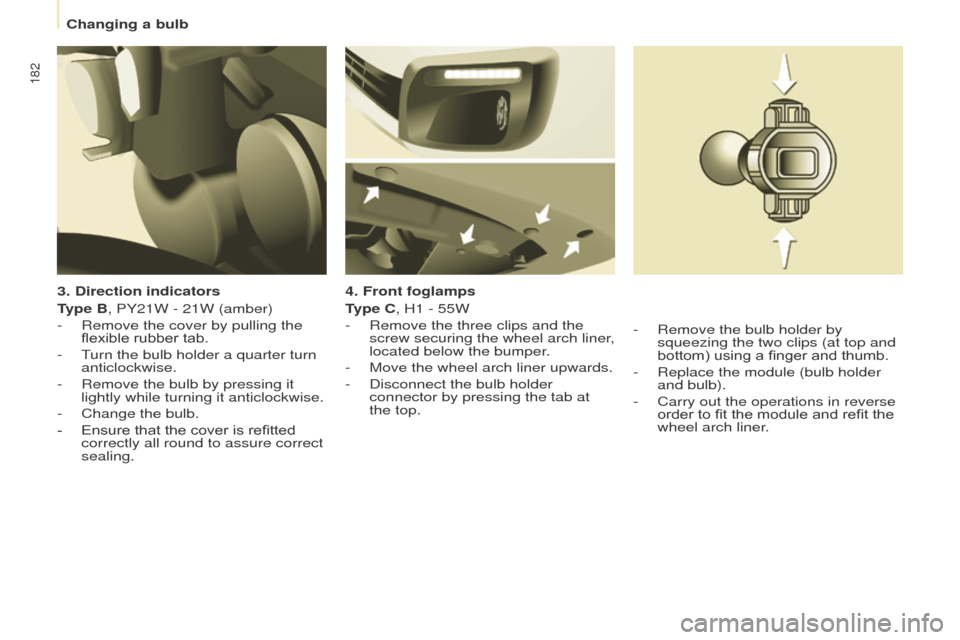
182
3. Direction indicators
type B
, PY21W - 21W (amber)
-
Remove the cover by pullin
g the
flexible rubber tab.
-
T
urn the bulb holder a quarter turn
anticlockwise.
-
Remove the bulb by pressing it
lightly while turning it anticlockwise.
-
Change the bulb.
-
Ensure that the cover is refitted
correctly all round to assure correct
sealing. 4.
Front foglamps
type C
, H1 - 55W
-
Remove the three clips and the
screw securing the wheel arch liner
,
located below the bumper.
-
Move the wheel arch liner upwards.
-
Disconnect the bulb holder
connector by pressing the tab at
the top.-
Remove the bulb holder by
squeezing the two clips (at top and
bottom) using a finger and thumb.
-
Replace the module (bulb holder
and bulb).
-
Carry out the operations in reverse
order to fit the module and refit the
wheel arch liner
.
Changing a bulb
Page 186 of 296
184
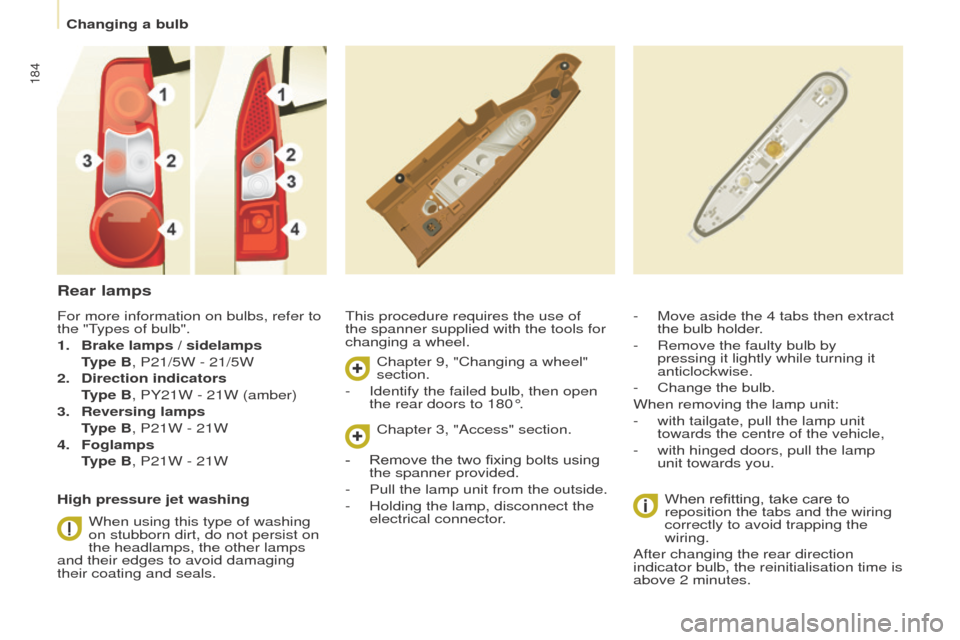
Rear lamps
This procedure requires the use of
the spanner supplied with the tools for
changing a wheel.When refitting, take care to
reposition the tabs and the wiring
correctly to avoid trapping the
wiring.
After changing the rear direction
indicator bulb, the reinitialisation time is
above 2 minutes. - Move aside the 4 tabs then extract
the bulb holder
.
-
Remove the faulty bulb by
pressing it lightly while turning it
anticlockwise.
-
Change the bulb.
When removing the lamp unit:
-
with tailgate, pull the lamp unit
towards the centre of the vehicle,
-
with hinged doors, pull the lamp
unit towards you.
For more information on bulbs, refer to
the "T
ypes of bulb".
1.
Brake lamps / sidelamps
type B
, P21/5W - 21/5W
2.
Direction indicators
type B
, PY21W - 21W (amber)
3.
Reversing lamps
type B
, P21W - 21W
4.
Foglamps
type B
, P21W - 21W
High pressure jet washing When using this type of washing
on stubborn dirt, do not persist on
the headlamps, the other lamps
and their edges to avoid damaging
their coating and seals. Chapter 9, "Changing a wheel"
section.
-
Identify the failed bulb, then open
the rear doors to 180°. Chapter 3, "Access" section.
-
Remove the two fixing bolts using
the spanner provided.
-
Pull the lamp unit from the outside.
-
Holding the lamp, disconnect the
electrical connector
.
Changing a bulb
Page 191 of 296
189
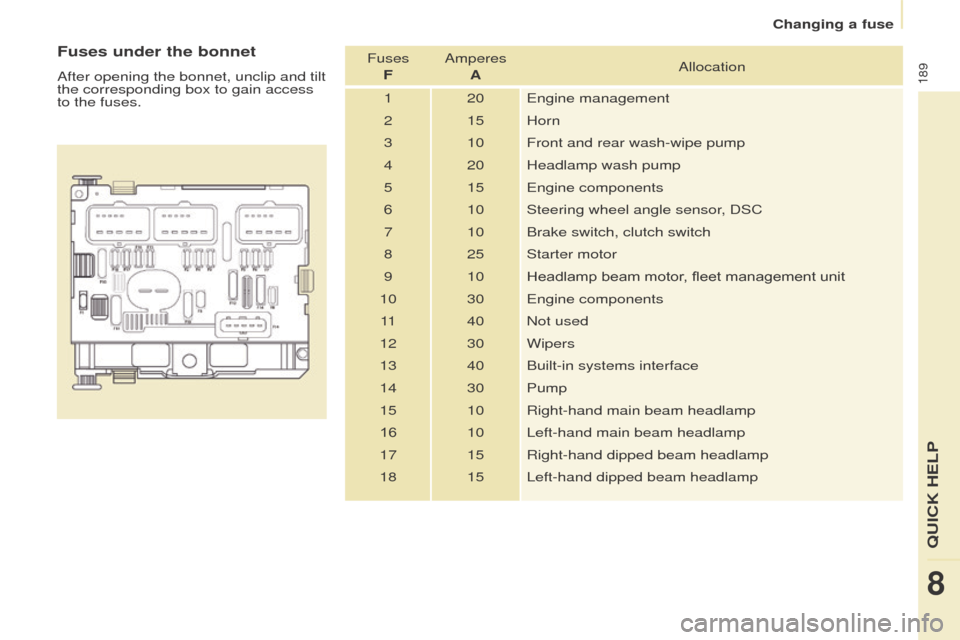
Fuses under the bonnet
After opening the bonnet, unclip and tilt
the corresponding box to gain access
to the fuses.Fuses
F Amperes
A Allocation
1 20
e
ngine management
2 15 Horn
3 10 Front and rear wash-wipe pump
4 20 Headlamp wash pump
5 15
e
ngine components
6 10 Steering wheel angle sensor, DSC
7 10 Brake switch, clutch switch
8 25 Starter motor
9 10 Headlamp beam motor, fleet management unit
10 30
e
ngine components
11 40 Not used
12 30 Wipers
13 40 Built-in systems interface
14 30 Pump
15 10 Right-hand main beam headlamp
16 10 Left-hand main beam headlamp
17 15 Right-hand dipped beam headlamp
18 15 Left-hand dipped beam headlamp
8
QuICK HeLP
Changing a fuse