instrument panel Peugeot Partner Tepee 2016 Owner's Guide
[x] Cancel search | Manufacturer: PEUGEOT, Model Year: 2016, Model line: Partner Tepee, Model: Peugeot Partner Tepee 2016Pages: 296, PDF Size: 10.76 MB
Page 116 of 296
11 4
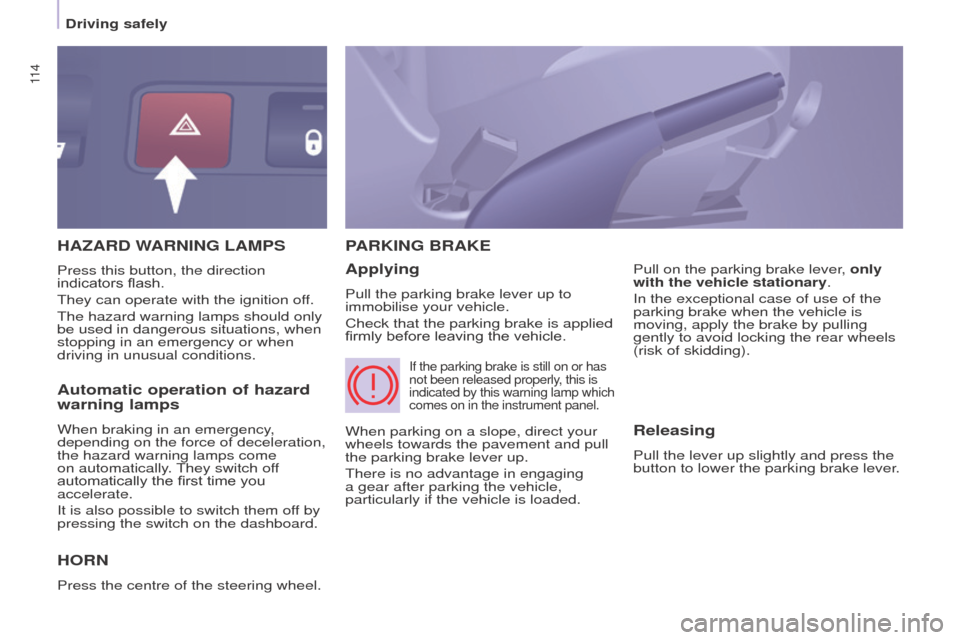
HAZARD WARNINg LAMPS
Ho
RN
Press the centre of the steering wheel.
PARKIN g BRAK e
Applying
Pull the parking brake lever up to
immobilise your vehicle.
Check that the parking brake is applied
firmly before leaving the vehicle. Pull on the parking brake lever, only
with the vehicle stationary.
In the exceptional case of use of the
parking brake when the vehicle is
moving, apply the brake by pulling
gently to avoid locking the rear wheels
(risk of skidding).
Press this button, the direction
indicators flash.
They can operate with the ignition off.
The hazard warning lamps should only
be used in dangerous situations, when
stopping in an emergency or when
driving in unusual conditions.
When parking on a slope, direct your
wheels towards the pavement and pull
the parking brake lever up.
There is no advantage in engaging
a gear after parking the vehicle,
particularly if the vehicle is loaded.
If the parking brake is still on or has
not been released properly, this is
indicated by this warning lamp which
comes on in the instrument panel.
Automatic operation of hazard
warning lamps
When braking in an emergency,
depending on the force of deceleration,
the hazard warning lamps come
on automatically. They switch off
automatically the first time you
accelerate.
It is also possible to switch them off by
pressing the switch on the dashboard.Releasing
Pull the lever up slightly and press the
button to lower the parking brake lever.
Driving safely
Page 133 of 296
131
Curtain airbags
This is a system which protects the
driver and passengers (with the
exception of the centre seat of row 2)
in the event of a serious side impact in
order to limit the risk of head injuries.
e
ach curtain airbag is incorporated in
the pillars and the upper part of the
passenger compartment.
Activation
It is triggered at the same time as the
corresponding lateral airbag in the
event of a serious side impact applied
to all or part of the side impact zone
B,
perpendicular to the longitudinal
centreline of the vehicle on a horizontal
plane and directed from the outside
towards the inside of the vehicle.
The curtain airbag inflates between the
front or rear occupant of the vehicle
and the windows.
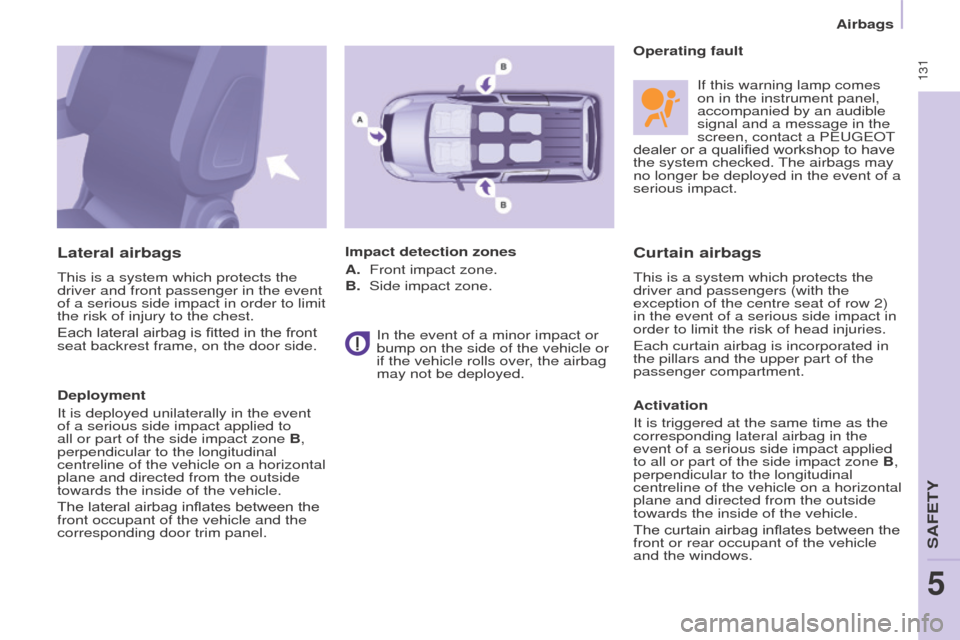
Lateral airbags
This is a system which protects the
driver and front passenger in the event
of a serious side impact in order to limit
the risk of injury to the chest.
Each lateral airbag is fitted in the front
seat backrest frame, on the door side.
Deployment
It is deployed unilaterally in the event
of a serious side impact applied to
all or part of the side impact zone
B,
perpendicular to the longitudinal
centreline of the vehicle on a horizontal
plane and directed from the outside
towards the inside of the vehicle.
The lateral airbag inflates between the
front occupant of the vehicle and the
corresponding door trim panel. Impact detection zones
A.
Front impact zone.
B. Side impact zone.
o
perating fault
If this warning lamp comes
on in the instrument panel,
accompanied by an audible
signal and a message in the
screen, contact a P eugeo T
dealer or a qualified workshop to have
the system checked. The airbags may
no longer be deployed in the event of a
serious impact.
In the event of a minor impact or
bump on the side of the vehicle or
if the vehicle rolls over, the airbag
may not be deployed.
5
SAFeTY
Airbags
Page 134 of 296
132
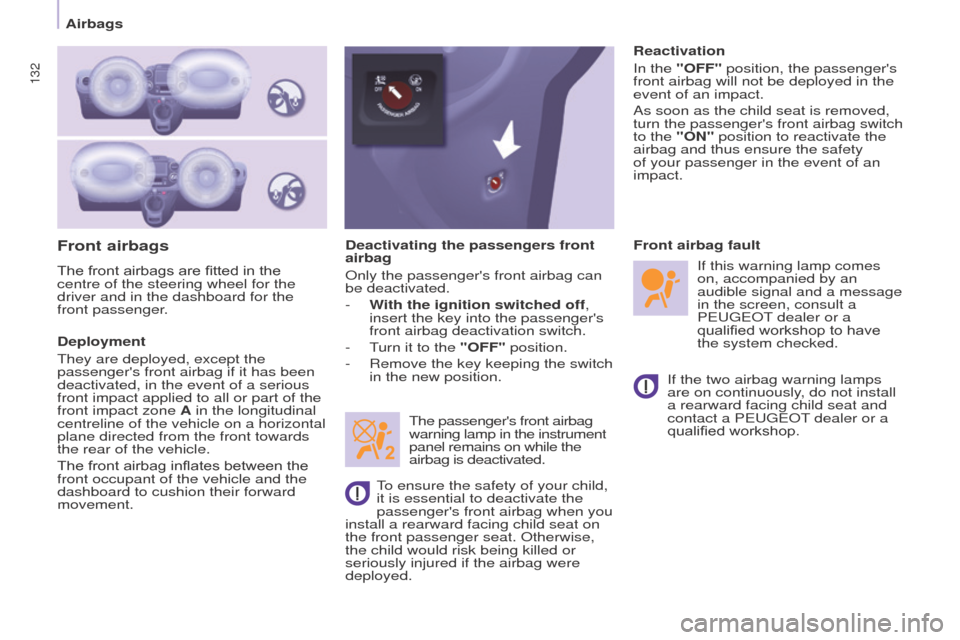
Front airbags
Deployment
They are deployed, except the
passenger's front airbag if it has been
deactivated, in the event of a serious
front impact applied to all or part of the
front impact zone A in the longitudinal
centreline of the vehicle on a horizontal
plane directed from the front towards
the rear of the vehicle.
The front airbag inflates between the
front occupant of the vehicle and the
dashboard to cushion their forward
movement.Deactivating the passengers front
airbag
o
nly the passenger's front airbag can
be deactivated.
-
W
ith the ignition switched off,
insert the key into the passenger's
front airbag deactivation switch.
- T urn it to the " o FF" position.
-
Remove the key keeping the switch
in the new position.
The passenger's front airbag
warning lamp in the instrument
panel remains on while the
airbag is deactivated. If the two airbag warning lamps
are on continuously, do not install
a rearward facing child seat and
contact a P
eugeo T dealer or a
qualified workshop.
Front airbag fault
To ensure the safety of your child,
it is essential to deactivate the
passenger's front airbag when you
install a rearward facing child seat on
the front passenger seat.
o therwise,
the child would risk being killed or
seriously injured if the airbag were
deployed. Reactivation
In the "
o FF" position, the passenger's
front airbag will not be deployed in the
event of an impact.
As soon as the child seat is removed,
turn the passenger's front airbag switch
to the " o N" position to reactivate the
airbag and thus ensure the safety
of your passenger in the event of an
impact.
If this warning lamp comes
on, accompanied by an
audible signal and a message
in the screen, consult a
P eugeo T dealer or a
qualified workshop to have
the system checked.
The front airbags are fitted in the
centre of the steering wheel for the
driver and in the dashboard for the
front passenger.
Airbags
Page 159 of 296
157
LeVeLSo il change
This must be carried out at
the intervals specified in the
manufacturer's servicing schedule. Ask
for advice from a Peugeo T dealer.
Remove the dipstick before filling.
Check the level after filling (never
exceed the max mark).
Refit the oil filler cap before closing the
bonnet.
Changing the brake fluid
The brake fluid must be changed at
the intervals stated, according to the
manufacturer's servicing schedule.
Use fluids recommended by the
manufacturer, which meet the D
o T4
standard.
The level must be between the MIN
and MAX marks on the reservoir.
If fluid has to be added frequently,
this indicates a fault which must be
checked by a P
eugeo T dealer or
a qualified workshop as soon as
possible.
Warning lamps
If you have to remove / refit
the engine style cover, handle it
with care to avoid damaging the
fixing clips.
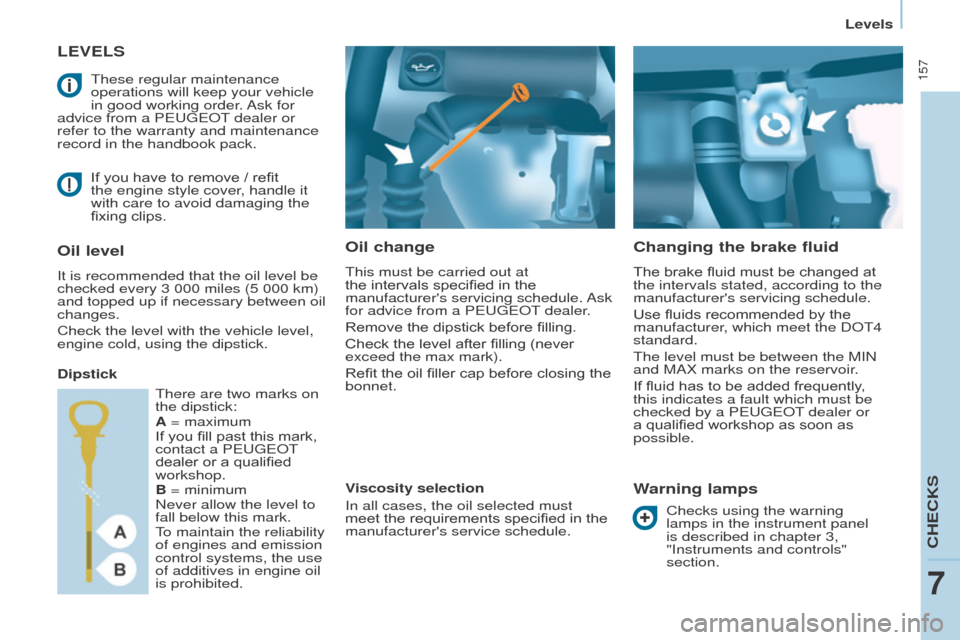
oil level
It is recommended that the oil level be
checked every 3 000 miles (5 000 km)
and topped up if necessary between oil
changes.
Check the level with the vehicle level,
engine cold, using the dipstick.
Dipstick
Viscosity selection
In all cases, the oil selected must
meet the requirements specified in the
manufacturer's service schedule.
These regular maintenance
operations will keep your vehicle
in good working order. Ask for
advice from a P eugeo T dealer or
refer to the warranty and maintenance
record in the handbook pack.
Checks using the warning
lamps in the instrument panel
is described in chapter 3,
"Instruments and controls"
section.
There are two marks on
the dipstick:
A = maximum
If you fill past this mark,
contact a P
eugeo T
dealer or a qualified
workshop.
B = minimum
Never allow the level to
fall below this mark.
To maintain the reliability
of engines and emission
control systems, the use
of additives in engine oil
is prohibited.
CHeCKS
7
Levels
Page 189 of 296

187
Dashboard fuses
Tilt the cover to gain access to the
fuses.Fuses
F Amperes
A Allocation
1 15 Rear wiper
2 - Not used
3 5 Airbag
4 10 Air conditioning, diagnostic socket, mirror control,
headlamp beam
5 30
e
lectric windows
6 30 Locks
7 5Rear courtesy lamp, front map reading lamp, roof
console
8 20 Audio equipment, screen, tyre under-inflation
detection, alarm and siren
9 30 Front and rear 12V socket
10 15 Central column 11 15 Low current ignition switch
12 15 Rain and sunshine sensor, airbag
13 5 Instrument panel
14 15 Parking sensors, digital air conditioning controls,
hands-free phone kit
15 30 Locks
16 - Not used
17 40 Rear screen/mirrors demist/defrost
8
QuICK HeLP
Changing a fuse