steering Peugeot Partner Tepee 2016 Owner's Guide
[x] Cancel search | Manufacturer: PEUGEOT, Model Year: 2016, Model line: Partner Tepee, Model: Peugeot Partner Tepee 2016Pages: 296, PDF Size: 10.76 MB
Page 71 of 296
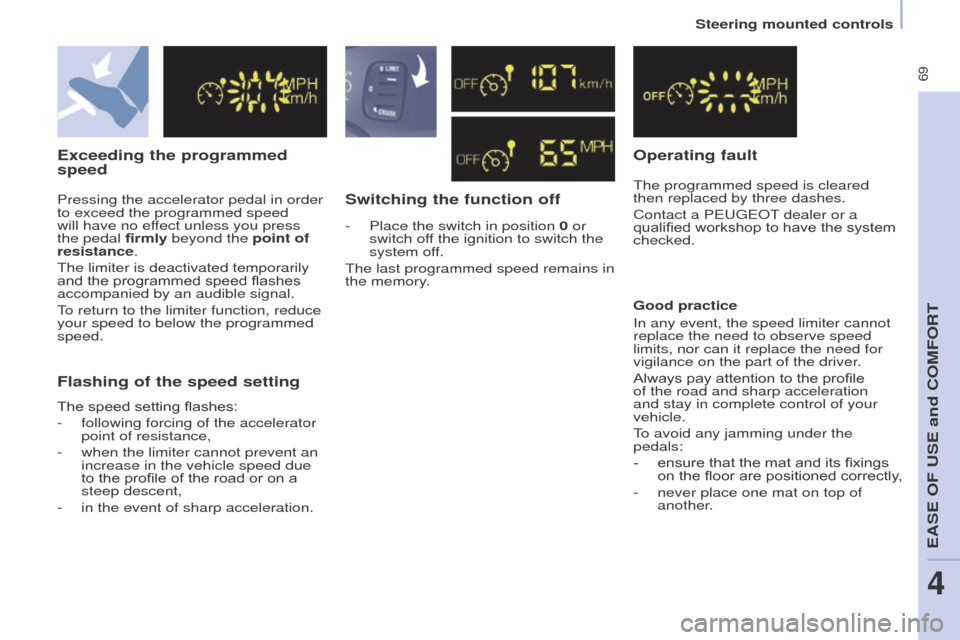
69
exceeding the programmed
speed
Switching the function offo perating fault
The programmed speed is cleared
then replaced by three dashes.
Contact a P
eugeo T dealer or a
qualified workshop to have the system
checked.
Flashing of the speed setting
good practice
In any event, the speed limiter cannot
replace the need to observe speed
limits, nor can it replace the need for
vigilance on the part of the driver
.
Always pay attention to the profile
of the road and sharp acceleration
and stay in complete control of your
vehicle.
To avoid any jamming under the
pedals:
-
ensure that the mat and its fixings
on the floor are positioned correctly
,
-
never place one mat on top of
another
.
Pressing the accelerator pedal in order
to exceed the programmed speed
will have no effect unless you press
the pedal firmly beyond the point of
resistance.
The limiter is deactivated temporarily
and the programmed speed flashes
accompanied by an audible signal.
To return to the limiter function, reduce
your speed to below the programmed
speed.
The speed setting flashes:
-
following forcing of the accelerator
point of resistance,
-
when the limiter cannot prevent an
increase in the vehicle speed due
to the profile of the road or on a
steep descent,
-
in the event of sharp acceleration. -
Place the switch in position
0 or
switch off the ignition to switch the
system off.
The last programmed speed remains in
the memory.
Steering mounted controls
eASe oF uSe and CoMFoRt
4
Page 96 of 296
94
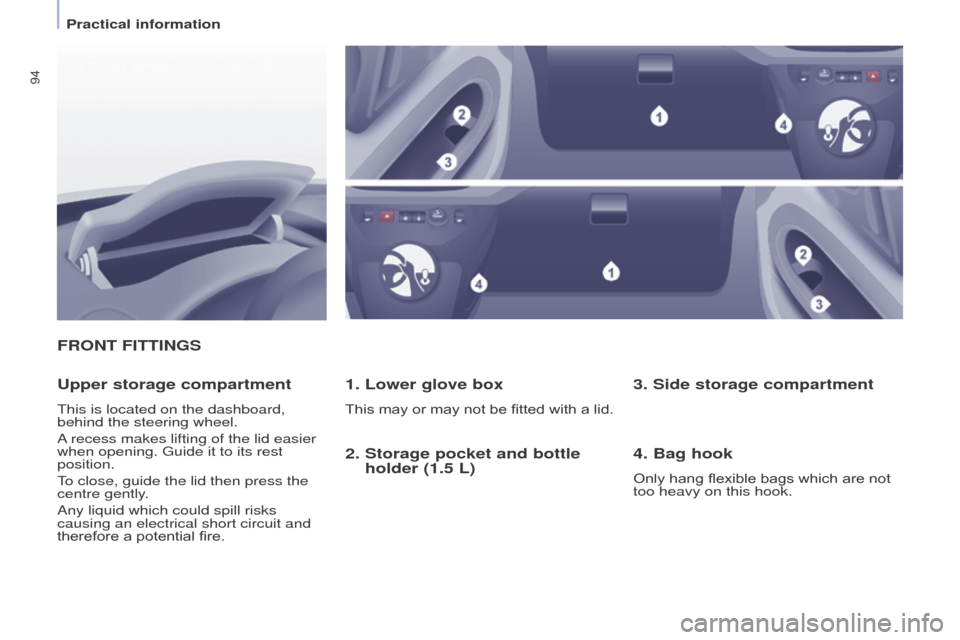
FRoNt FIttINgS
1. Lower glove box
This may or may not be fitted with a lid.
upper storage compartment
This is located on the dashboard,
behind the steering wheel.
A recess makes lifting of the lid easier
when opening. g uide it to its rest
position.
To close, guide the lid then press the
centre gently.
Any liquid which could spill risks
causing an electrical short circuit and
therefore a potential fire.
3. Side storage compartment
4. Bag hook
Only hang flexible bags which are not
too heavy on this hook.
2. Storage pocket and bottle
holder (1.5 L)
Practical information
Page 116 of 296
11 4
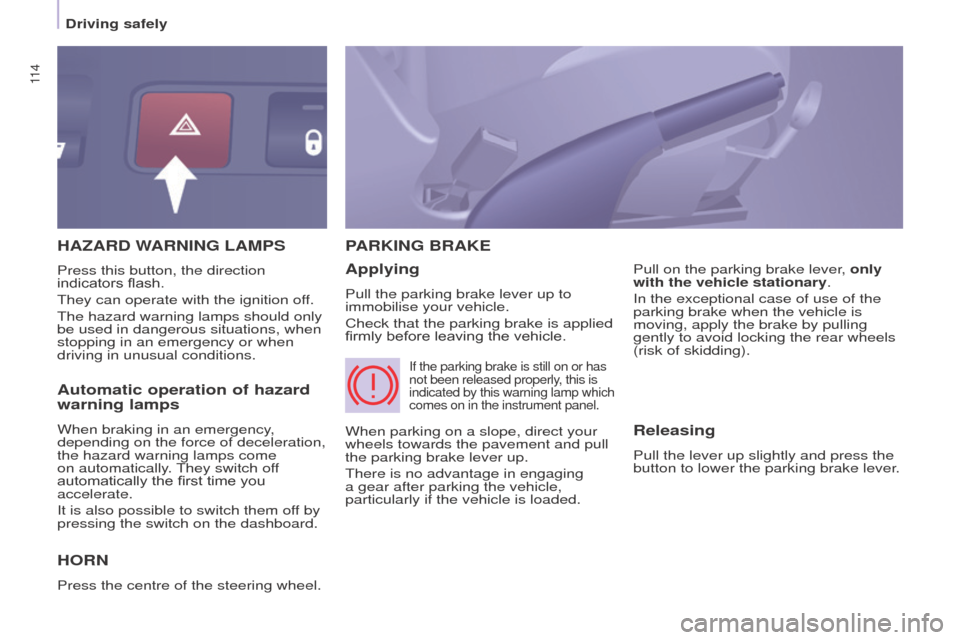
HAZARD WARNINg LAMPS
Ho
RN
Press the centre of the steering wheel.
PARKIN g BRAK e
Applying
Pull the parking brake lever up to
immobilise your vehicle.
Check that the parking brake is applied
firmly before leaving the vehicle. Pull on the parking brake lever, only
with the vehicle stationary.
In the exceptional case of use of the
parking brake when the vehicle is
moving, apply the brake by pulling
gently to avoid locking the rear wheels
(risk of skidding).
Press this button, the direction
indicators flash.
They can operate with the ignition off.
The hazard warning lamps should only
be used in dangerous situations, when
stopping in an emergency or when
driving in unusual conditions.
When parking on a slope, direct your
wheels towards the pavement and pull
the parking brake lever up.
There is no advantage in engaging
a gear after parking the vehicle,
particularly if the vehicle is loaded.
If the parking brake is still on or has
not been released properly, this is
indicated by this warning lamp which
comes on in the instrument panel.
Automatic operation of hazard
warning lamps
When braking in an emergency,
depending on the force of deceleration,
the hazard warning lamps come
on automatically. They switch off
automatically the first time you
accelerate.
It is also possible to switch them off by
pressing the switch on the dashboard.Releasing
Pull the lever up slightly and press the
button to lower the parking brake lever.
Driving safely
Page 125 of 296
123
operation
When your vehicle is too close to or
approaches the vehicle ahead too
quickly the system automatically
applies the brakes to avoid a collision.
You are then alerted by the display of a
message.
The brake lamps on your vehicle come
on to warn other road users.
The collision can be avoided
automatically if the difference in speed
between your vehicle and the vehicle
ahead does not exceed 9 mph
(15 km/h).
Above this threshold, the system will
do what is possible to avoid or reduce
the accident by lowering the speed of
impact.
The automatic braking may bring
the vehicle to a complete stop if the
situation requires it.
In this case, the vehicle is held
stationary temporarily (for about
1.5 seconds) to allow the driver to take
back control by pressing the brake
pedal.The triggering of the system may
cause the engine to stall, unless
the driver depresses the clutch
pedal quickly enough during automatic
braking.
During automatic braking, the
driver can always obtain a higher
rate of deceleration than that
controlled by the system, by pressing
firmly on the brake pedal.
After an impact, the system is
automatically put out of service: it
no longer operates.
You must go to a P
eugeo T dealer
or a qualified workshop to have the
system made operational again.
operating limits
The system only detects vehicles that
are stationary or moving in the same
direction as your vehicle.
It does not detect small vehicles
(bicycles, motorcycles),
pedestrians or animals, nor non-
reflective stationary objects.
The system is not triggered or is
interrupted if the driver:
-
accelerates strongly
-
or turns the steering wheel
suddenly (avoiding manoeuvre). In difficult weather conditions (very
heavy rain, snow
, fog, hail...),
braking distances increase, which
can reduce the ability of the system to
avoid a collision.
The driver must therefore remain
particularly vigilant.
Never leave accumulations of
snow or any object projecting
above the bonnet or in front of
the roof: this might fall into the field of
vision of the sensor and generate a
detection.
Driving safely
SAFeTY
5
Page 132 of 296
130
good practice
Sit in a normal upright position.
Wear a correctly adjusted seat belt.
Do not leave anything between the
occupants and the airbags (a child,
pet, object...). This could hinder the
operation of the airbags or injure the
occupants.
After an accident or if the vehicle has
been stolen or broken into, have the
airbag systems checked.
All work on the airbag system is strictly
forbidden unless it is carried out by
qualified personnel at a PEUGEOT
dealer or a qualified workshop.
e
ven if all of the precautions
mentioned are observed, a risk of
injury or of minor burns to the head,
chest or arms when an airbag is
deployed cannot be ruled out. In fact,
the bag inflates almost instantly (within
a few milliseconds) then deflates within
the same time discharging the hot gas
via openings provided for this purpose. Lateral airbagso
nly put recommended covers on
the seats. These will not hinder
inflation of the lateral airbags. Contact
a PEUGEOT dealer or a qualified
workshop.
Do not fix or attach anything to the seat
backs. This could cause injury to the
chest or arms when the lateral airbag
inflates.
Do not sit with the upper part of the
body any nearer to the door than
necessary.
Front airbags
Do not drive holding the steering wheel
by its spokes or resting your hands on
the centre part of the wheel.
Do not allow passengers to place
their feet on the dashboard, they risk
serious injury if the airbag is deployed.
Smoke as little as possible as
deployment of the airbags can cause
burns or the risk of injury from a
cigarette or pipe.
Never remove or pierce the steering
wheel or hit it violently.
Airbags only operate when the
ignition is switched on.
This equipment only operates once.
If a second impact occurs (during the
same or a subsequent accident), the
airbag will not operate.
The deployment of an airbag or airbags
is accompanied by a slight discharge
of smoke and a noise, due to the
activation of the pyrotechnic cartridge
incorporated in the system.
This smoke is not harmful, but
sensitive individuals may experience
some irritation.
The noise of the detonation may result
in a slight loss of hearing for a short
time.
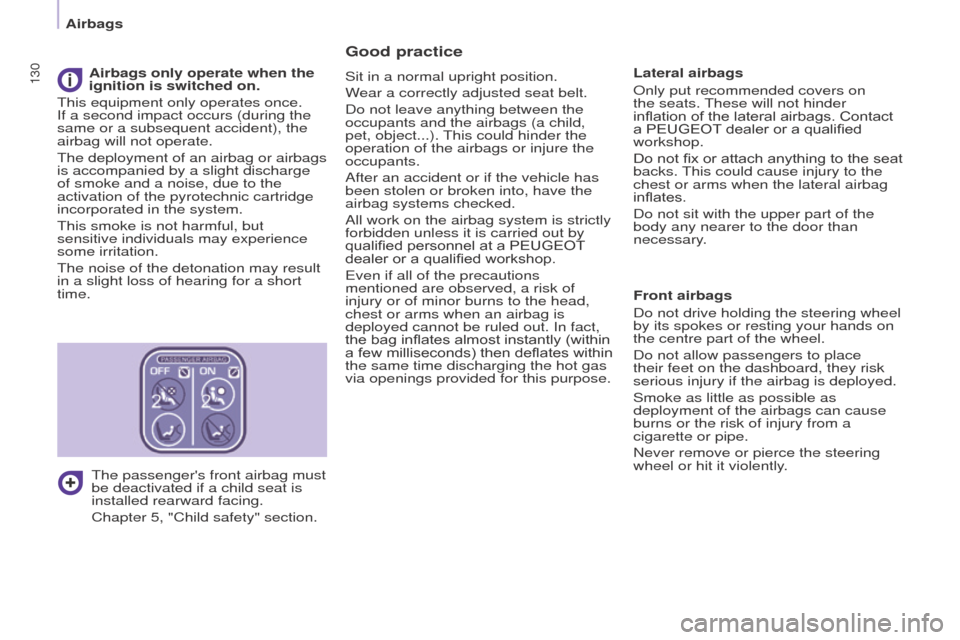
The passenger's front airbag must
be deactivated if a child seat is
installed rearward facing.
Chapter 5, "Child safety" section.
Airbags
Page 134 of 296
132
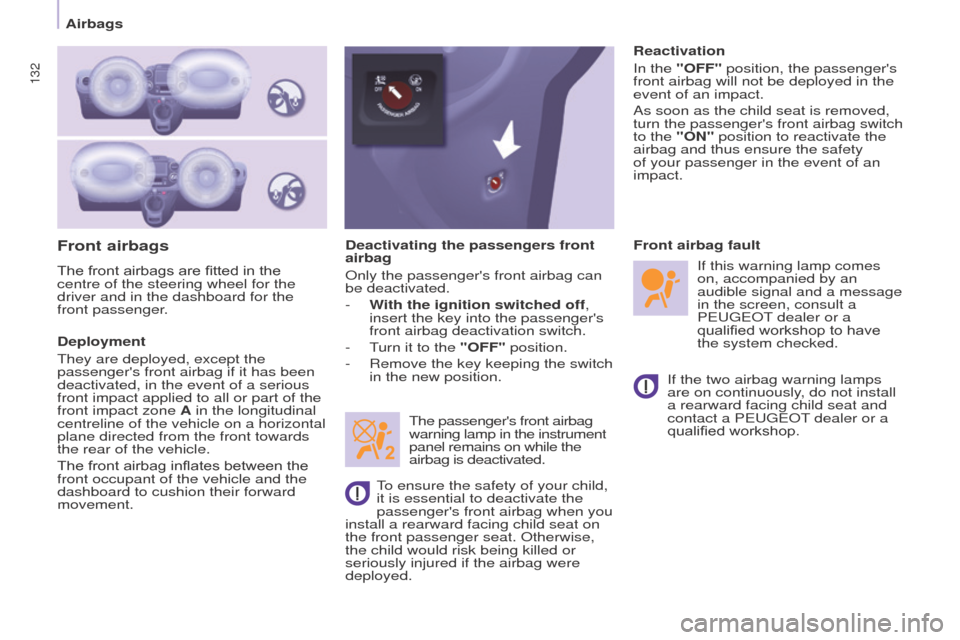
Front airbags
Deployment
They are deployed, except the
passenger's front airbag if it has been
deactivated, in the event of a serious
front impact applied to all or part of the
front impact zone A in the longitudinal
centreline of the vehicle on a horizontal
plane directed from the front towards
the rear of the vehicle.
The front airbag inflates between the
front occupant of the vehicle and the
dashboard to cushion their forward
movement.Deactivating the passengers front
airbag
o
nly the passenger's front airbag can
be deactivated.
-
W
ith the ignition switched off,
insert the key into the passenger's
front airbag deactivation switch.
- T urn it to the " o FF" position.
-
Remove the key keeping the switch
in the new position.
The passenger's front airbag
warning lamp in the instrument
panel remains on while the
airbag is deactivated. If the two airbag warning lamps
are on continuously, do not install
a rearward facing child seat and
contact a P
eugeo T dealer or a
qualified workshop.
Front airbag fault
To ensure the safety of your child,
it is essential to deactivate the
passenger's front airbag when you
install a rearward facing child seat on
the front passenger seat.
o therwise,
the child would risk being killed or
seriously injured if the airbag were
deployed. Reactivation
In the "
o FF" position, the passenger's
front airbag will not be deployed in the
event of an impact.
As soon as the child seat is removed,
turn the passenger's front airbag switch
to the " o N" position to reactivate the
airbag and thus ensure the safety
of your passenger in the event of an
impact.
If this warning lamp comes
on, accompanied by an
audible signal and a message
in the screen, consult a
P eugeo T dealer or a
qualified workshop to have
the system checked.
The front airbags are fitted in the
centre of the steering wheel for the
driver and in the dashboard for the
front passenger.
Airbags
Page 154 of 296
152
otHeR ACCeSSoRIeS
These accessories and parts, having
been tested and approved for reliability
and safety, are all adapted to your
vehicle. A wide range of recommended
accessories and genuine parts is
available.
A further range is also available,
structured around comfort, leisure and
maintenance:
Anti-theft alarm, window etching, first
aid kit, high visibility vest, front and
rear parking sensors, warning triangle,
security bolts for alloy wheels, ...
Seat covers compatible with airbags
for the front seats, bench seat, rubber
mats, carpet mats, snow chains, blinds,
tailgate bicycle carrier, ...
To prevent the mat from becoming
caught under the pedals:
-
ensure that the mat and its fixings
are positioned correctly
,
-
never fit one mat on top of another
.Audio equipment, hands-free kit,
speakers, CD changer, satellite
navigation system,
u
SB box, Video kit,
...
Regardless of the audio and telematic
equipment offered on the market, the
technical constraints associated with
the fitting of equipment of these product
groups mean that the special features
of the equipment and its compatibility
with the capacities of your vehicle's
standard equipment must be taken into
account. Please ask a P
eugeo T dealer
for more information before fitting such
equipment.
Maximum weights on bars
-
T
ransverse bars on longitudinal
bars: 75 Kg (these bars are not
compatible with the Zénith roof).
Installing radiocommunication
transmitters
You are advised to contact a
P
eugeo T dealer before installing
accessory radiocommunication
transmitters with external aerial on
your vehicle.
The P
eugeo T dealer network
will inform you of the specification
(frequency band, maximum output
power, aerial position, specific
conditions of installation) of the
transmitters which can be fitted, in
accordance with the Motor Vehicle
e
lectromagnetic Compatibility
Directive (2004/104/
e C).Front mud flaps, rear mud flaps,
15/17
inch alloy wheels, wheelarch
trim, leather steering wheel, ...
Screenwash, interior and exterior
cleaning and maintenance products,
spare bulbs, ...
The fitting of electrical equipment
or accessories which are not
recommended by P
eugeo T
may result in a failure of your vehicle's
electronic system. Please note this
specific warning. You are advised
to contact a dealer to be shown the
range of recommended equipment or
accessories.
Depending on the country in which
the vehicle is sold, it is compulsory
to have a high visibility vest, warning
triangle and spare bulbs available in
the vehicle.
equipment
Page 157 of 296
155
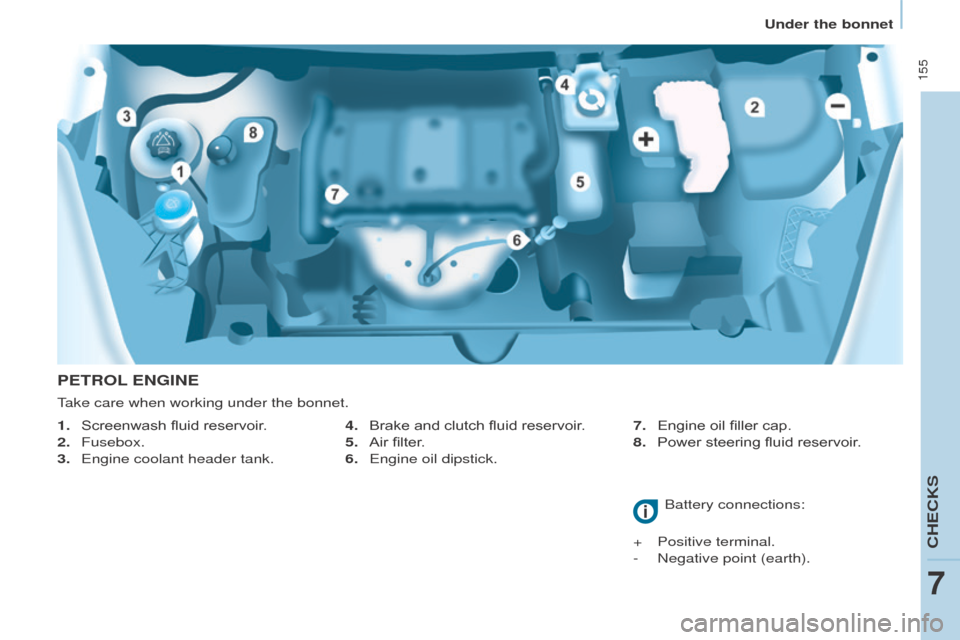
PetRoL eN g IN e
1. Screenwash fluid reservoir .
2.
Fusebox.
3.
e ngine coolant header tank.
Battery connections:
+
Positive terminal.
-
Negative point (earth).
T
ake care when working under the bonnet.
4. Brake and clutch fluid reservoir .
5.
Air filter
.
6.
e ngine oil dipstick.7.
Engine oil filler cap.
8.
Power steering fluid reservoir
.
CHeCKS
7
under the bonnet
Page 158 of 296
156
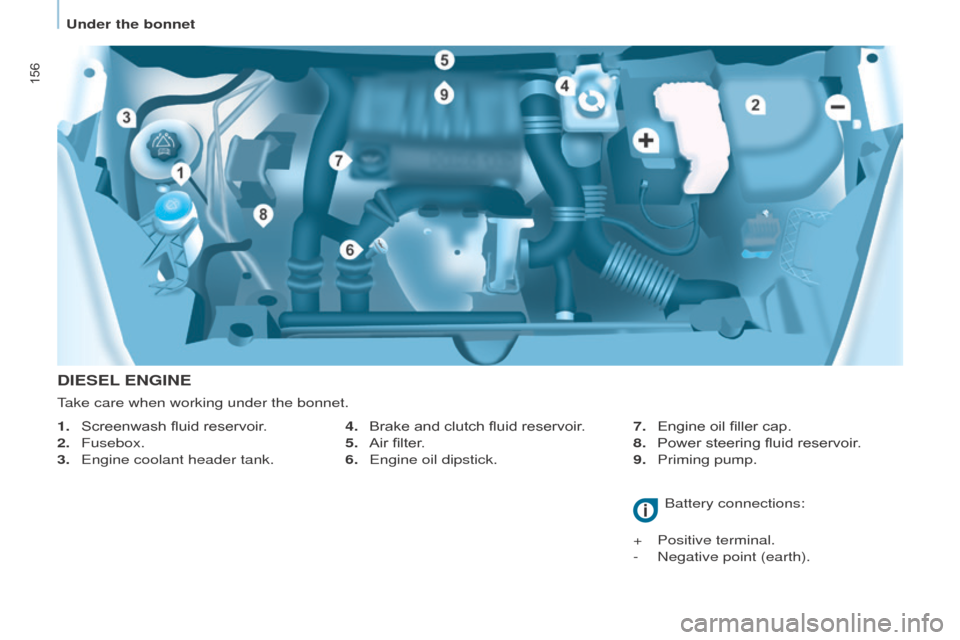
DIeSeL eN g IN e
4. Brake and clutch fluid reservoir .
5.
Air filter
.
6.
e ngine oil dipstick. 7.
Engine oil filler cap.
8.
Power steering fluid reservoir
.
9.
Priming pump.
1.
Screenwash fluid reservoir
.
2.
Fusebox.
3.
e
ngine coolant header tank.
Battery connections:
+
Positive terminal.
-
Negative point (earth).
T
ake care when working under the bonnet.
under the bonnet
Page 160 of 296
158
Cooling system
Only use the fluid recommended by the
manufacturer.
o
therwise, you risk seriously damaging
your engine.
When the engine is warm, the
temperature of the coolant is controlled
by the engine fan. As this fan can
operate with the ignition key removed
and because the cooling system is
pressurised, wait for at least one hour
after the engine has stopped before
carrying out any work.
Slacken the cap by 1/4 of a turn to
release the pressure to prevent any
risk of scalding. When the pressure
has dropped, remove the cap and top
up the level with coolant.
If fluid has to be added frequently,
this indicates a fault which must be
checked by a P
eugeo T dealer as
soon as possible.
Power steering fluid level
The vehicle must be parked on level
ground with the engine cold. u nscrew
the cap integrated with the gauge and
check the level which must be between
the MIN and MAX marks. In order to regenerate the filter, you
are advised to drive at a speed higher
than 40 mph (60 km/h) for at least five
minutes as soon as possible, when
traffic conditions permit (until the
message disappears and the service
warning lamp goes off).
During regeneration of the particle
emission filter, the noise of a relay
operating may be heard under the
dashboard.
If the message is still displayed and
if the service warning lamp remains
on, contact a P
eugeo T dealer or a
qualified workshop.
topping up
The level must be between the MIN
and MAX marks on the expansion
bottle. If more than 1 litre of fluid is
required to top up the level, have
the system checked by a P
eugeo
T
dealer or a qualified workshop.
Screenwash and headlamp
wash level
For best quality cleaning and for your
safety, we would advise that you use
products of the P
eugeo T range.
For optimum cleaning and to avoid
freezing, this fluid must not be topped
up or replaced with plain water.
Capacity of the screenwash reservoir:
approximately 3 litres.
If your vehicle is fitted with headlamp
washers, the capacity of the reservoir
is 6 litres.
Diesel additive level
(Diesel with particle
filter)
topping up
This additive must be topped up by
a PEUGEOT
dealer or a qualified
workshop without delay.
Waste products
Avoid prolonged contact of used oil
with the skin.
Brake fluid is harmful to health and
very corrosive.
Do not dispose of used oil, brake fluid
or coolant into drains or into the ground
but into the containers dedicated to this
use at a P
eugeo T dealer (France) or
an authorised waste disposal site.
The minimum level of this additive
is indicated by lighting of the service
warning lamp, accompanied by an
audible signal and a message in the
screen.
When this occurs with the engine
running it is due to the start of
saturation of the particle filter
(exceptionally prolonged urban type
driving conditions: low speed, long
traffic jams, ...).
Levels