change wheel Peugeot Partner Tepee 2016 Owner's Manual
[x] Cancel search | Manufacturer: PEUGEOT, Model Year: 2016, Model line: Partner Tepee, Model: Peugeot Partner Tepee 2016Pages: 296, PDF Size: 10.76 MB
Page 19 of 296
17
Motoring & the environment
Limit the causes of excess consumption
Spread loads throughout the vehicle; place the heaviest
items in the bottom of the boot, as close as possible to the
rear seats.
Limit the loads carried in the vehicle and reduce wind
resistance (roof bars, roof rack, bicycle carrier, trailer...).
u
se a roof box in preference.
Remove roof bars and roof racks after use.
At the end of winter, remove snow tyres and refit your
summer tyres.
observe the recommendations on maintenance
Check the tyre pressures regularly, when cold, referring to
the label in the door aperture, driver's side.
Carry out this check in particular:
-
before a long journey
,
-
at each change of season,
-
after a long period out of use.
Don't forget the spare wheel and the tyres on any trailer or
caravan.
Have your vehicle serviced regularly (engine oil, oil
filter
, air filter, passenger compartment filter...) and
observe the schedule of operations recommended in the
manufacturer's service schedule.
With a BlueHDi Diesel engine, if the SCR system is
faulty your vehicle becomes polluting; go to a P
eugeo T
dealer or a qualified workshop without delay to have the
emissions of nitrous oxides brought back to the legal level.
When refuelling, do not continue after the third cut-off of
the nozzle to avoid any overflow.
At the wheel of your new vehicle, it is only after the first
1 800 miles (3 000 kilometres) that you will see the fuel
consumption settle down to a consistent average.
2
eCo-DRIVINg
Page 45 of 296
Instruments and controls
43
uNDeR-INFLAtI o N D ete C t I o N WI t H R e INI t IALISAt I o N
System which automatically checks the
pressures of the tyres while driving.
The system monitors the pressures
in the four tyres, once the vehicle is
moving.
It compares the information given by
the four wheel speed sensors with
reference values, which must be
reinitialised every time the tyre
pressures are adjusted or a wheel
changed.
The system triggers an alert as soon
as it detects a drop in the inflation
pressure of one or more tyres.The under-inflation detection
system does not replace the
need for vigilance on the part of
the
driver.
This system does not avoid the need to
check the tyre pressures (including the
spare wheel) every month as well as
before a long journey.
Driving with under-inflated tyres
impairs road holding, extends braking
distances and causes premature
tyre wear, particularly under arduous
condition (high loading, high speed,
long journey).
Driving with under-inflated tyres
increases fuel consumption. The inflation pressures defined for
your vehicle can be found on the
tyre pressure label.
For more information on the
identification markings, refer to the
corresponding section.
Tyre pressures should be checked
when the tyres are "cold" (vehicle
stopped for 1 hour or after a journey of
less than 6 miles (10 km) at moderate
speeds).
o
therwise (when hot), add 0.3 bar to
the pressures shown on the label.
ReADY to go
3
Page 51 of 296

49
MANuAL geARB ox
5-speed
6-speed
To change gear easily, always depress
the clutch pedal fully.
To prevent the mat from becoming
caught under the pedal:
-
ensure that the mat is positioned
and secured correctly on the floor
,
-
never fit one mat on top of another
.
When driving, avoid leaving your hand
on the gear knob as the force exerted,
even if slight, may wear the internal
components of the gearbox over time.
Changing into 5th or 6th gear
To engage the gear correctly, move the
gear lever fully to the right.
engaging reverse gear
The lever should be moved slowly
to reduce noise.
To engage reverse gear, wait until the
vehicle has come to a complete stop.
SteeRINg WH ee L ADJ u S t M e N t
When the vehicle is stationary,
release the steering wheel adjustment
mechanism by pulling the lever.
Adjust the steering wheel for height
and reach, then lock the mechanism by
pushing the lever fully forward. In the 6-speed configuration, raise the
collar below the gear knob.
gearbox and steering wheel
ReADY To go
3
Page 52 of 296
50
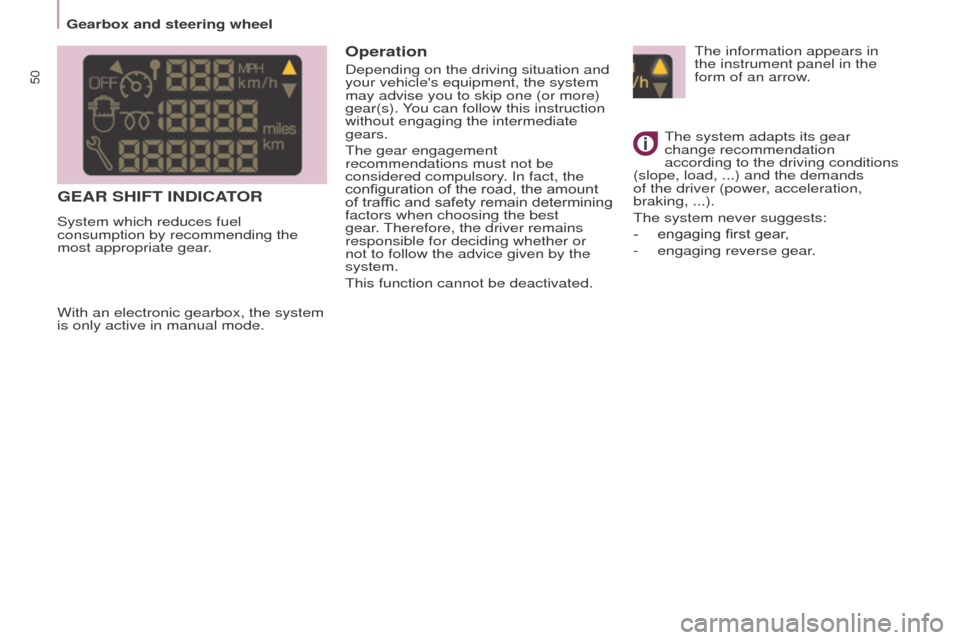
The information appears in
the instrument panel in the
form of an arrow.
The system adapts its gear
change recommendation
according to the driving conditions
(slope, load, ...) and the demands
of the driver (power, acceleration,
braking, ...).
The system never suggests:
-
engaging first gear
,
-
engaging reverse gear
.
With an electronic gearbox, the system
is only active in manual mode.
geAR SHIFt INDICAt o R
System which reduces fuel
consumption by recommending the
most appropriate gear.
operation
Depending on the driving situation and
your vehicle's equipment, the system
may advise you to skip one (or more)
gear(s). You can follow this instruction
without engaging the intermediate
gears.
The gear engagement
recommendations must not be
considered compulsory. In fact, the
configuration of the road, the amount
of traffic and safety remain determining
factors when choosing the best
gear. Therefore, the driver remains
responsible for deciding whether or
not to follow the advice given by the
system.
This function cannot be deactivated.
gearbox and steering wheel
Page 53 of 296
51
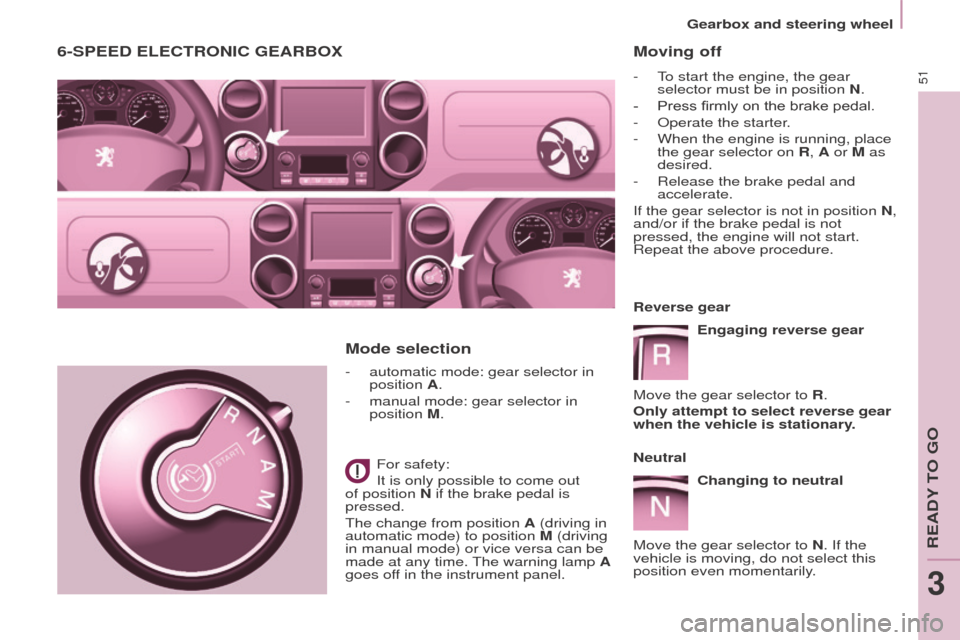
6-SPeeD eLeCtRoNIC geARBox
- automatic mode: gear selector in
position A.
-
manual mode: gear selector in
position
M.
For safety:
It is only possible to come out
of position N if the brake pedal is
pressed.
The change from position A (driving in
automatic mode) to position M (driving
in manual mode) or vice versa can be
made at any time. The warning lamp A
goes off in the instrument panel.
Mode selection Moving off
- To start the engine, the gear
selector must be in position N.
-
Press firmly on the brake pedal.
-
o perate the starter.
-
When the engine is running, place
the gear selector on
R, A or M as
desired.
-
Release the brake pedal and
accelerate.
If the gear selector is not in position
N,
and/or if the brake pedal is not
pressed, the engine will not start.
Repeat the above procedure.
Reverse gear
e
ngaging reverse gear
Move the gear selector to R.
o
nly attempt to select reverse gear
when the vehicle is stationary.
Neutral
Changing to neutral
Move the gear selector to N. If the
vehicle is moving, do not select this
position even momentarily.
gearbox and steering wheel
ReADY To go
3
Page 54 of 296
52
Acceleration
For optimum acceleration (e.g. to
overtake another vehicle), simply
press the pedal beyond the point of
resistance at the end of its travel, by
pressing down firmly.
Vehicle stationary, with the
engine running
In the event of a prolonged stop with
the engine running, the gearbox
changes automatically to neutral N.
Stopping the vehicle
Before stopping the engine, put the
gear selector in position N.
In all cases, it is essential to apply
the parking brake. Check that the
parking brake warning lamp is on in the
instrument panel.Before doing anything in the
engine compartment, check that
the gear selector is in neutral N.
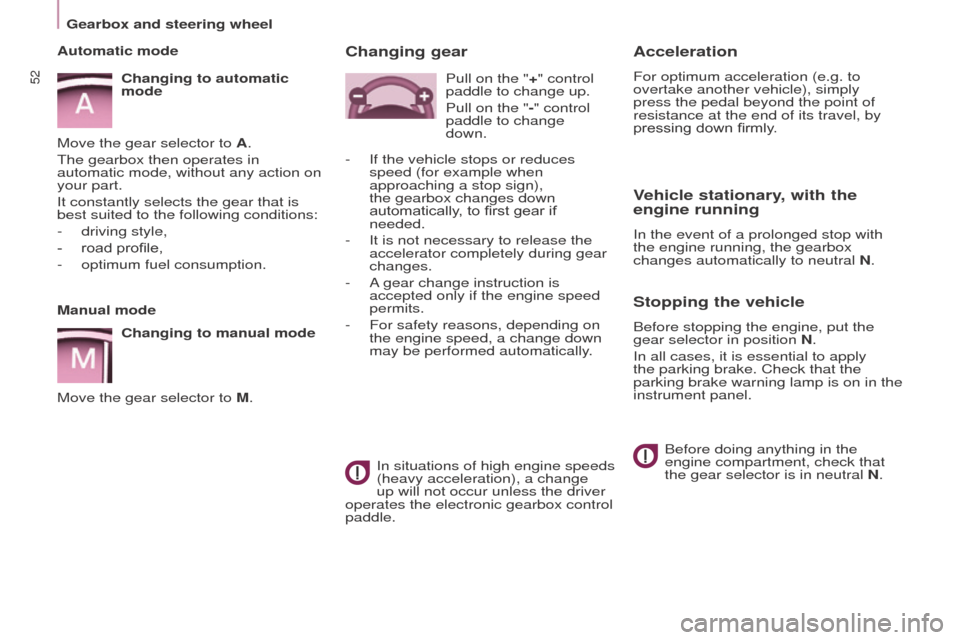
Changing gear
In situations of high engine speeds
(heavy acceleration), a change
up will not occur unless the driver
operates the electronic gearbox control
paddle. Pull on the "+" control
paddle to change up.
Pull on the "-" control
paddle to change
down.
-
If the vehicle stops or reduces
speed (for example when
approaching a stop sign),
the gearbox changes down
automatically
, to first gear if
needed.
-
It is not necessary to release the
accelerator completely during gear
changes.
-
A
gear change instruction is
accepted only if the engine speed
permits.
-
For safety reasons, depending on
the engine speed, a change down
may be performed automatically
.
Manual mode
Changing to manual mode
Move the gear selector to M. Automatic mode Changing to automatic
mode
Move the gear selector to A.
The gearbox then operates in
automatic mode, without any action on
your part.
It constantly selects the gear that is
best suited to the following conditions:
-
driving style,
-
road profile,
-
optimum fuel consumption.
gearbox and steering wheel
Page 154 of 296
152
otHeR ACCeSSoRIeS
These accessories and parts, having
been tested and approved for reliability
and safety, are all adapted to your
vehicle. A wide range of recommended
accessories and genuine parts is
available.
A further range is also available,
structured around comfort, leisure and
maintenance:
Anti-theft alarm, window etching, first
aid kit, high visibility vest, front and
rear parking sensors, warning triangle,
security bolts for alloy wheels, ...
Seat covers compatible with airbags
for the front seats, bench seat, rubber
mats, carpet mats, snow chains, blinds,
tailgate bicycle carrier, ...
To prevent the mat from becoming
caught under the pedals:
-
ensure that the mat and its fixings
are positioned correctly
,
-
never fit one mat on top of another
.Audio equipment, hands-free kit,
speakers, CD changer, satellite
navigation system,
u
SB box, Video kit,
...
Regardless of the audio and telematic
equipment offered on the market, the
technical constraints associated with
the fitting of equipment of these product
groups mean that the special features
of the equipment and its compatibility
with the capacities of your vehicle's
standard equipment must be taken into
account. Please ask a P
eugeo T dealer
for more information before fitting such
equipment.
Maximum weights on bars
-
T
ransverse bars on longitudinal
bars: 75 Kg (these bars are not
compatible with the Zénith roof).
Installing radiocommunication
transmitters
You are advised to contact a
P
eugeo T dealer before installing
accessory radiocommunication
transmitters with external aerial on
your vehicle.
The P
eugeo T dealer network
will inform you of the specification
(frequency band, maximum output
power, aerial position, specific
conditions of installation) of the
transmitters which can be fitted, in
accordance with the Motor Vehicle
e
lectromagnetic Compatibility
Directive (2004/104/
e C).Front mud flaps, rear mud flaps,
15/17
inch alloy wheels, wheelarch
trim, leather steering wheel, ...
Screenwash, interior and exterior
cleaning and maintenance products,
spare bulbs, ...
The fitting of electrical equipment
or accessories which are not
recommended by P
eugeo T
may result in a failure of your vehicle's
electronic system. Please note this
specific warning. You are advised
to contact a dealer to be shown the
range of recommended equipment or
accessories.
Depending on the country in which
the vehicle is sold, it is compulsory
to have a high visibility vest, warning
triangle and spare bulbs available in
the vehicle.
equipment
Page 174 of 296
172
1. Parking the vehicle
- The occupants must get out of the
vehicle and wait in a safe location.
-
If possible, park the vehicle on level,
stable and non-slippery ground.
-
Apply the parking brake, switch
of
f the ignition and engage first or
reverse gear. -
Place a chock under the wheel
diagonally opposite the one to be
changed.
CHANgINg A WH
ee L
2.
t
ools
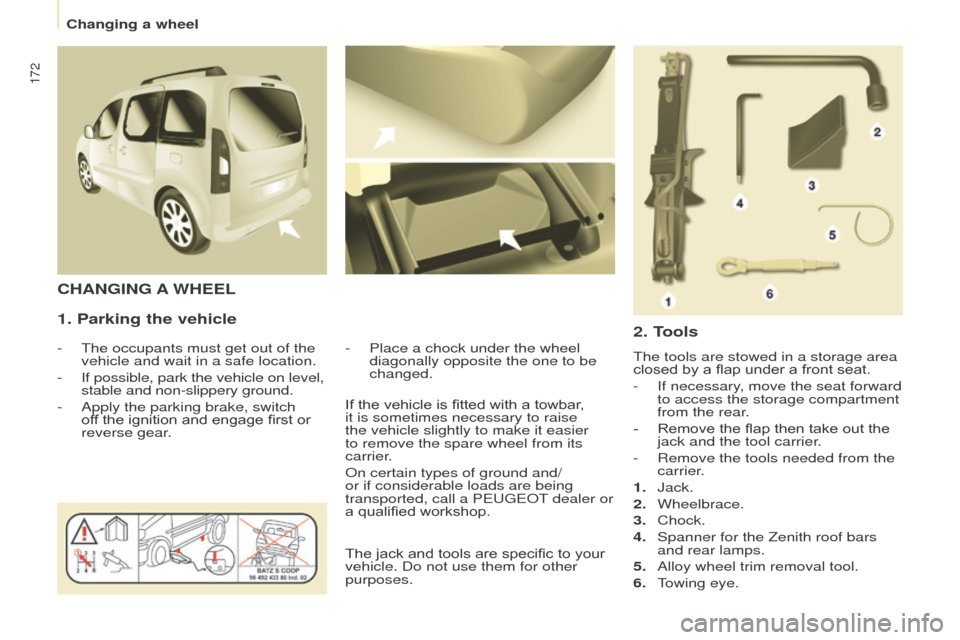
The tools are stowed in a storage area
closed by a flap under a front seat.
-
If necessary
, move the seat forward
to access the storage compartment
from the rear.
-
Remove the flap then take out the
jack and the tool carrier
.
-
Remove the tools needed from the
carrier
.
1.
Jack.
2.
Wheelbrace.
3.
Chock.
4.
Spanner for the Zenith roof bars
and rear lamps.
5.
Alloy wheel trim removal tool.
6.
T
owing eye.
If the vehicle is fitted with a towbar,
it is sometimes necessary to raise
the vehicle slightly to make it easier
to remove the spare wheel from its
carrier.
o
n certain types of ground and/
or if considerable loads are being
transported, call a P
eugeo
T dealer or
a qualified workshop.
The jack and tools are specific to your
vehicle. Do not use them for other
purposes.
Changing a wheel
Page 175 of 296
173
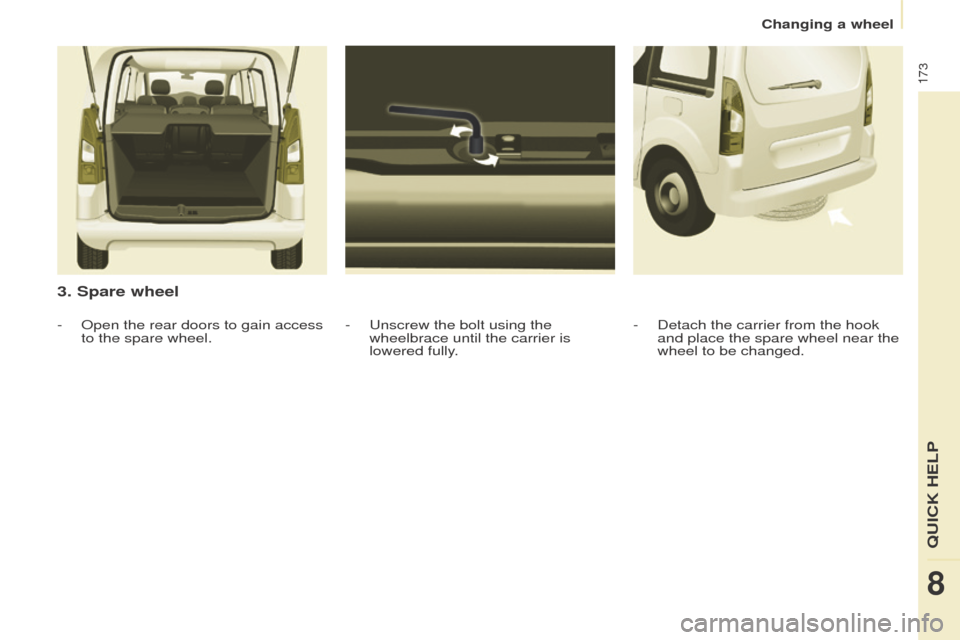
3. Spare wheel
- unscrew the bolt using the
wheelbrace until the carrier is
lowered fully
.
-
o
pen the rear doors to gain access
to the spare wheel. -
Detach the carrier from the hook
and place the spare wheel near the
wheel to be changed.
8
QuICK HeLP
Changing a wheel
Page 176 of 296
174
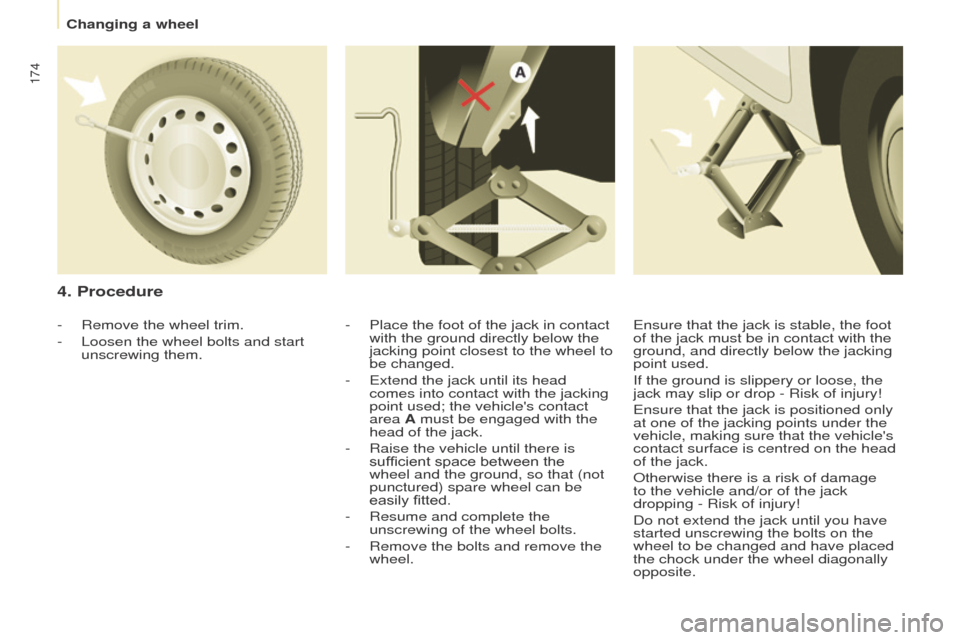
4. Procedure
- Place the foot of the jack in contact
with the ground directly below the
jacking point closest to the wheel to
be changed.
-
e xtend the jack until its head
comes into contact with the jacking
point used; the vehicle's contact
area A must be engaged with the
head of the jack.
-
Raise the vehicle until there is
sufficient space between the
wheel and the ground, so that (not
punctured) spare wheel can be
easily fitted.
-
Resume and complete the
unscrewing of the wheel bolts.
-
Remove the bolts and remove the
wheel.
-
Remove the wheel trim.
-
Loosen the wheel bolts and start
unscrewing them.
e nsure that the jack is stable, the foot
of the jack must be in contact with the
ground, and directly below the jacking
point used.
If the ground is slippery or loose, the
jack may slip or drop - Risk of injury!
e
nsure that the jack is positioned only
at one of the jacking points under the
vehicle, making sure that the vehicle's
contact surface is centred on the head
of the jack.
o
therwise there is a risk of damage
to the vehicle and/or of the jack
dropping
- Risk of injury!
Do not extend the jack until you have
started unscrewing the bolts on the
wheel to be changed and have placed
the chock under the wheel diagonally
opposite.
Changing a wheel