sensor Peugeot Partner Tepee 2016 Owner's Manual
[x] Cancel search | Manufacturer: PEUGEOT, Model Year: 2016, Model line: Partner Tepee, Model: Peugeot Partner Tepee 2016Pages: 296, PDF Size: 10.76 MB
Page 4 of 296
2
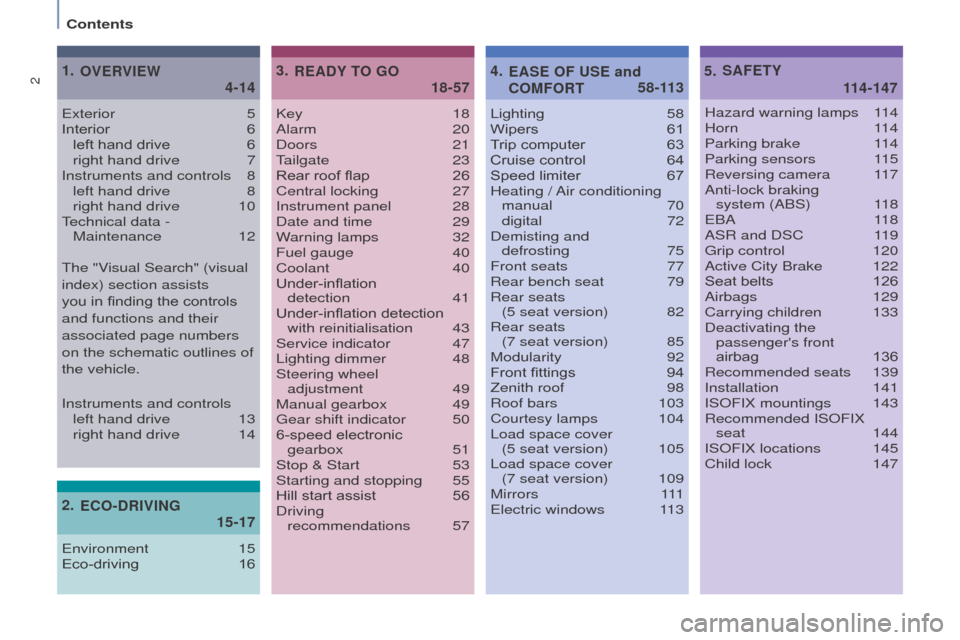
ContentsKey 18
Alarm
20
Doors
21
T
ailgate 23
Rear roof flap
26
Central locking
27
Instrument panel
28
Date and time
29
W
arning lamps
32
Fuel gauge
40
Coolant
40
Under-inflation detection
41
Under-inflation detection with reinitialisation
43
Service indicator
47
Lighting dimmer
48
Steering wheel
adjustment
49
Manual gearbox
49g
ear shift indicator
50
6-speed electronic
gearbox
51
Stop & Start
53
Starting and stopping
55
Hill start assist
56
Driving
recommendations
57Lighting
58
Wipers
61
T
rip computer
63
Cruise control
64
Speed limiter
67
Heating /
Air conditioning
manual
70
digital
72
Demisting and
defrosting
75
Front seats
77
Rear bench seat
79
Rear seats
(5 seat version)
82
Rear seats
(7 seat version)
85
Modularity
92
Front fittings
94
Zenith roof
98
Roof bars
103
Courtesy lamps
104
Load space cover
(5 seat version)
105
Load space cover
(7 seat version)
109
Mirrors
111
e
lectric windows
1
13
3.
18-57
R
e ADY to go5 .
1
14-147
SAF
et Y
exterior 5
Interior 6 left hand drive
6 right hand drive
7
Instruments and controls
8 left hand drive
8 right hand drive
10
T
echnical data - Maintenance
12
oVeRVIeW
1
.
4-14
Hazard warning lamps 1 14
Horn 114
Parking brake
1
14
Parking sensors
1
15
Reversing camera
1
17
Anti-lock braking system
(ABS)
1
18
e
BA
118
ASR and DSC
1
19
g
rip control
120
Active City Brake
122
Seat belts
126
Airbags
129
Carrying children
133
Deactivating the passenger's front
airbag
136
Recommended seats
139
Installation
141
IS
o FIX mountings
143
Recommended IS
o FIX
seat
144
IS
o FIX locations
145
Child lock
147
4.
58-113eAS e o F u S e and
C
o MF o R t
2
.
15-17
e
C
o
-DRIVIN
g
environment 15
Eco-driving 16
The "V
isual Search" (visual
index) section assists
you in finding the controls
and functions and their
associated page numbers
on the schematic outlines of
the vehicle.
Instruments and controls
left hand drive
13 right hand drive
14
Page 10 of 296
8
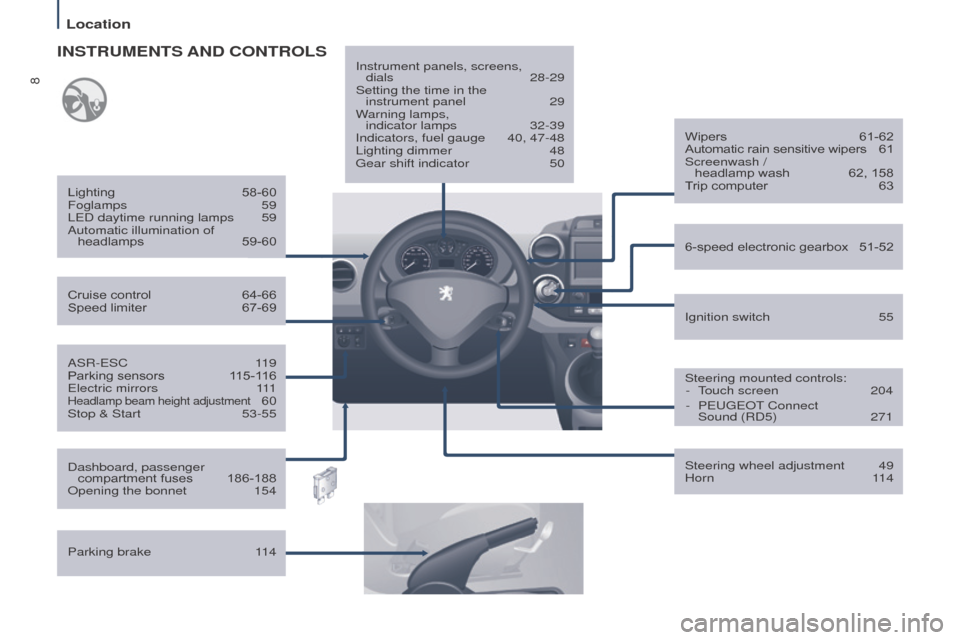
Location
ASR-eSC 119
Parking sensors 1 15-116
e
lectric mirrors
1
11
Headlamp beam height adjustment 60
Stop & Start
53-55
Cruise control
64-66
Speed limiter
67-69
Lighting
58-60
Foglamps
59
L
e
D daytime running lamps
59
Automatic illumination of headlamps
59-60
INStRuMeNtS AND
C o N t R o LS
Dashboard, passenger
compartment fuses 186-188o
pening the bonnet
154
Parking brake
1
14Instrument panels, screens,
dials 28-29
Setting the time in the instrument panel
29
W
arning lamps,
indicator lamps
32-39
Indicators, fuel gauge
40, 47-48
Lighting dimmer
48g
ear shift indicator
50
Wipers
61-62
Automatic rain sensitive wipers
6
1
Screenwash / headlamp wash
62, 158
T
rip computer
63
Steering wheel adjustment
49
Horn 114
Ignition switch
55
6-speed electronic gearbox
51-52
Steering mounted controls: -
T
ouch screen
204
-
Peugeo
T
Connect
Sound (RD5)
271
Page 13 of 296
11
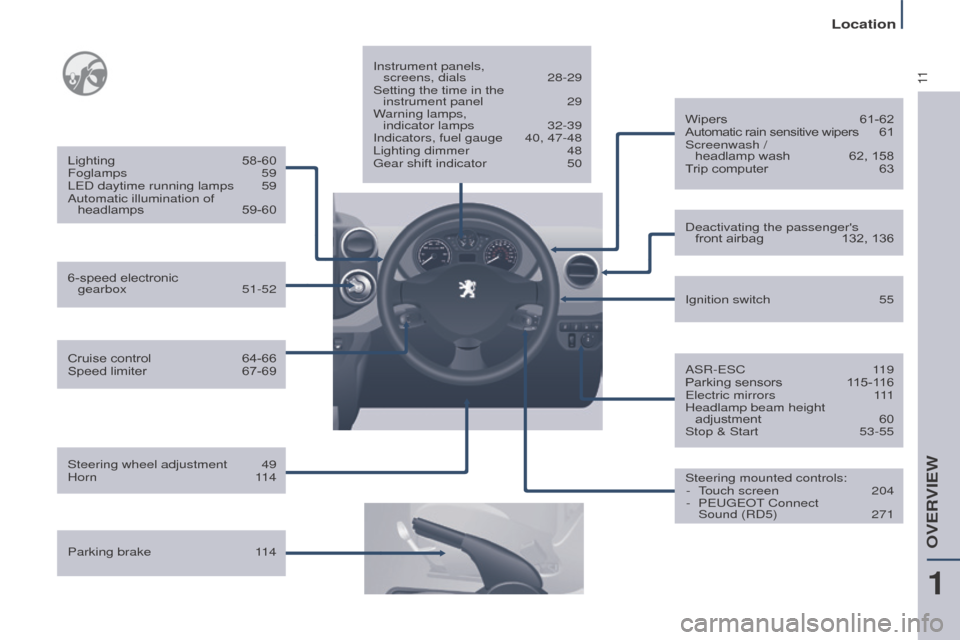
Location
Cruise control 64-66
Speed limiter 67-69
Lighting
58-60
Foglamps
59
L e D daytime running lamps
59
Automatic illumination of headlamps
59-60
Parking brake
1
14Instrument panels,
screens, dials
28-29
Setting the time in the
instrument panel
29
W
arning lamps,
indicator lamps
32-39
Indicators, fuel gauge
40, 47-48
Lighting dimmer
48g
ear shift indicator
50
Steering wheel adjustment
49
Horn
114 Ignition switch
55
Wipers
61-62
Automatic rain sensitive wipers
6
1
Screenwash / headlamp wash
62, 158
T
rip computer
63
Steering mounted controls: -
T
ouch screen
204
-
Peugeo
T
Connect
Sound (RD5)
271
Deactivating the passenger's
front airbag
132, 136
ASR-
e SC 1 19
Parking sensors
1
15-116
e
lectric mirrors
1
11
Headlamp beam height adjustment
60
Stop & Start
53-55
6-speed electronic
gearbox 51-52
1
oVeRVIeW
Page 15 of 296
13
Presentation
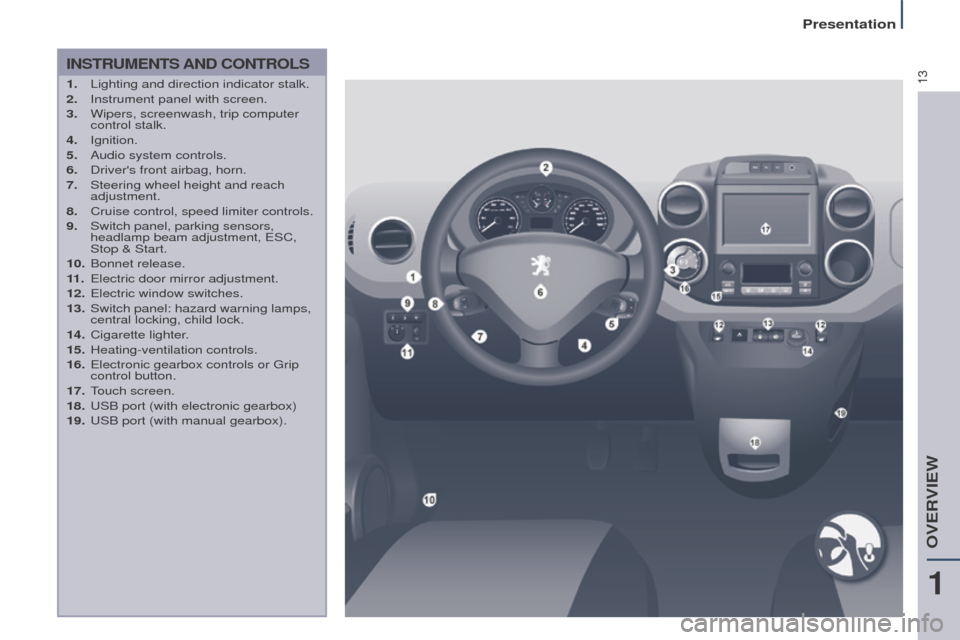
INStRuMeNtS AND Co N t R o LS
1. Lighting and direction indicator stalk.
2. Instrument panel with screen.
3.
Wipers, screenwash, trip computer
control stalk.
4.
Ignition.
5.
Audio system controls.
6.
Driver's front airbag, horn.
7.
Steering wheel height and reach
adjustment.
8.
Cruise control, speed limiter controls.
9.
Switch panel, parking sensors,
headlamp beam adjustment,
e SC,
Stop & Start.
10.
Bonnet release.
11
.
e lectric door mirror adjustment.
12.
e lectric window switches.
13.
Switch panel: hazard warning lamps,
central locking, child lock.
14.
Cigarette lighter
.
15.
Heating-ventilation controls.
16.
e lectronic gearbox controls or g rip
control button.
17.
T
ouch screen.
18.
u
SB port (with electronic gearbox)
19.
u
SB port (with manual gearbox).
1
oVeRVIeW
Page 16 of 296
14
Presentation
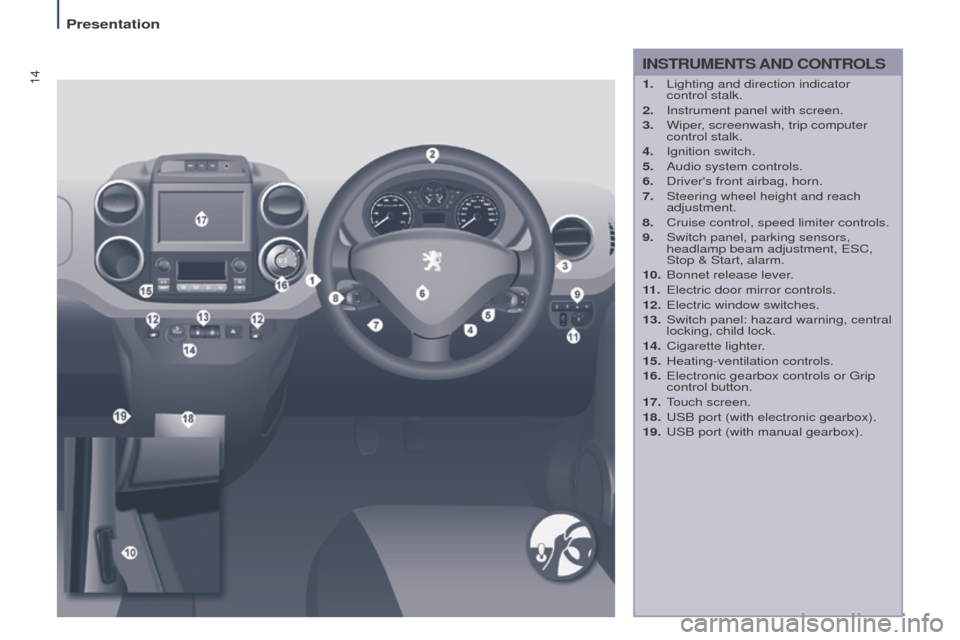
INStRuMeNtS AND Co N t R o LS
1. Lighting and direction indicator
control stalk.
2.
Instrument panel with screen.
3.
Wiper
, screenwash, trip computer
control stalk.
4.
Ignition switch.
5.
Audio system controls.
6.
Driver's front airbag, horn.
7.
Steering wheel height and reach
adjustment.
8.
Cruise control, speed limiter controls.
9.
Switch panel, parking sensors,
headlamp beam adjustment,
e SC,
Stop & Start, alarm.
10.
Bonnet release lever
.
11 .
e lectric door mirror controls.
12.
e lectric window switches.
13.
Switch panel: hazard warning, central
locking, child lock.
14.
Cigarette lighter
.
15.
Heating-ventilation controls.
16.
e lectronic gearbox controls or g rip
control button.
17.
T
ouch screen.
18.
u SB port (with electronic gearbox).
19.
u SB port (with manual gearbox).
Page 37 of 296
+
ABS
Instruments and controls
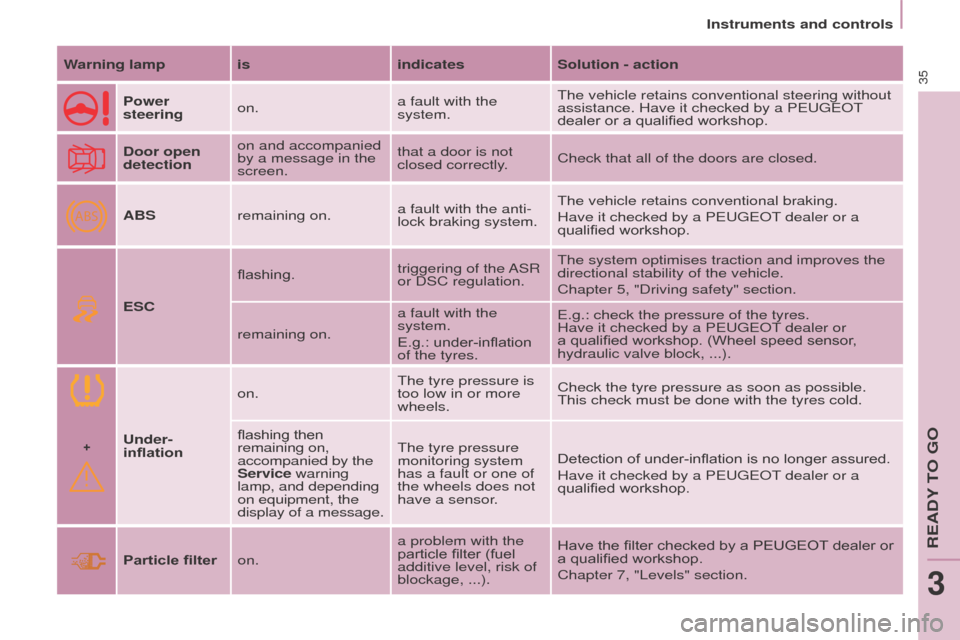
35Warning lamp isindicatesSolution - action
Power
steering on. a fault with the
system.The vehicle retains conventional steering without
assistance. Have it checked by a P
eugeo T
dealer or a qualified workshop.
Door open
detection on and accompanied
by a message in the
screen. that a door is not
closed correctly.
Check that all of the doors are closed.
ABS remaining on. a fault with the anti-
lock braking system.The vehicle retains conventional braking.
Have it checked by a P
eugeo T dealer or a
qualified workshop.
e
SC flashing.
triggering of the ASR
or DSC regulation.The system optimises traction and improves the
directional stability of the vehicle.
Chapter 5, "Driving safety" section.
remaining on. a fault with the
system.
E.g.: under-inflation
of the tyres.
e
.g.: check the pressure of the tyres.
Have it checked by a P
eugeo T dealer or
a qualified workshop. (Wheel speed sensor,
hydraulic valve block, ...).
u
nder-
inflation on.
The tyre pressure is
too low in or more
wheels.Check the tyre pressure as soon as possible.
This check must be done with the tyres cold.
flashing then
remaining on,
accompanied by the
Service warning
lamp, and depending
on equipment, the
display of a message. The tyre pressure
monitoring system
has a fault or one of
the wheels does not
have a sensor.
Detection of under-inflation is no longer assured.
Have it checked by a P
eugeo T dealer or a
qualified workshop.
Particle filter on. a problem with the
particle filter (fuel
additive level, risk of
blockage,
...).Have the filter checked by a PEUGEOT dealer or
a qualified workshop.
Chapter 7, "Levels" section.
ReADY to go
3
Page 43 of 296
Instruments and controls
41
eMISSIoNS CoNtRoLS
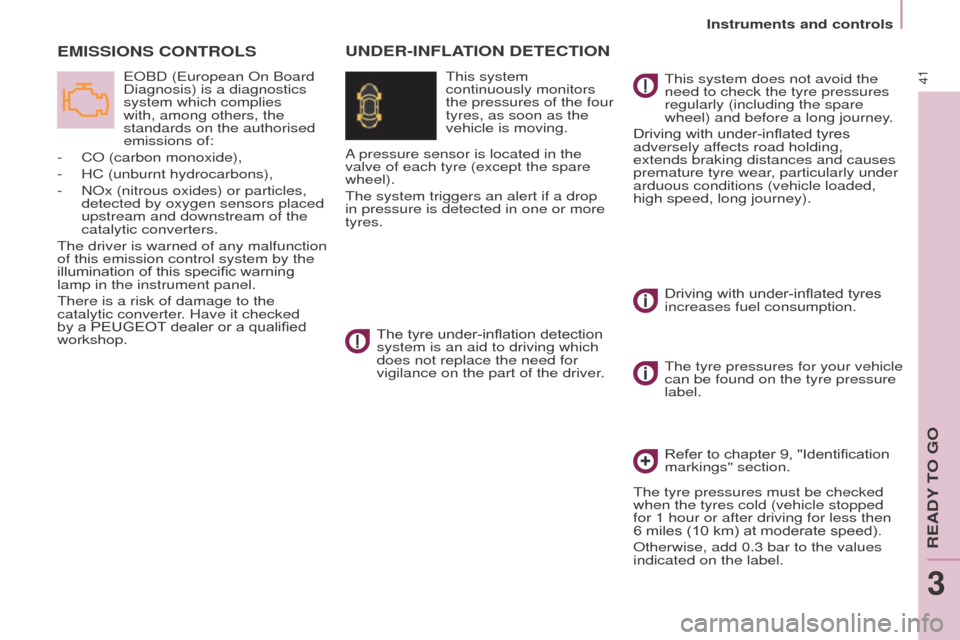
eoBD (european on Board
Diagnosis) is a diagnostics
system which complies
with, among others, the
standards on the authorised
emissions
of:
-
C
o
(carbon monoxide),
-
HC (unburnt hydrocarbons),
-
N
o
x (nitrous oxides) or particles,
detected by oxygen sensors placed
upstream and downstream of the
catalytic converters.
The driver is warned of any malfunction
of this emission control system by the
illumination of this specific warning
lamp in the instrument panel.
There is a risk of damage to the
catalytic converter. Have it checked
by a PEUGEOT dealer or a qualified
workshop.
uNDeR-INFLAt I o N D ete C t I o N
This system
continuously monitors
the pressures of the four
tyres, as soon as the
vehicle is moving.
A pressure sensor is located in the
valve of each tyre (except the spare
wheel).
The system triggers an alert if a drop
in pressure is detected in one or more
tyres.
The tyre under-inflation detection
system is an aid to driving which
does not replace the need for
vigilance on the part of the driver. This system does not avoid the
need to check the tyre pressures
regularly (including the spare
wheel) and before a long journey .
Driving with under-inflated tyres
adversely affects road holding,
extends braking distances and causes
premature tyre wear, particularly under
arduous conditions (vehicle loaded,
high speed, long journey).
Driving with under-inflated tyres
increases fuel consumption.
The tyre pressures for your vehicle
can be found on the tyre pressure
label.
Refer to chapter 9, "Identification
markings" section.
The tyre pressures must be checked
when the tyres cold (vehicle stopped
for 1 hour or after driving for less then
6 miles (10 km) at moderate speed).
o
therwise, add 0.3 bar to the values
indicated on the label.
ReADY to go
3
Page 44 of 296
Instruments and controls
42
The alert is maintained until
the tyre or tyres concerned is
reinflated, repaired or replaced.
The spare wheel (space-saver
type or a steel rim) does not have a
sensor.
operating faultu
nder-inflation alert
The loss of pressure detected
does not always lead to visible
deformation of the tyre. Do not rely
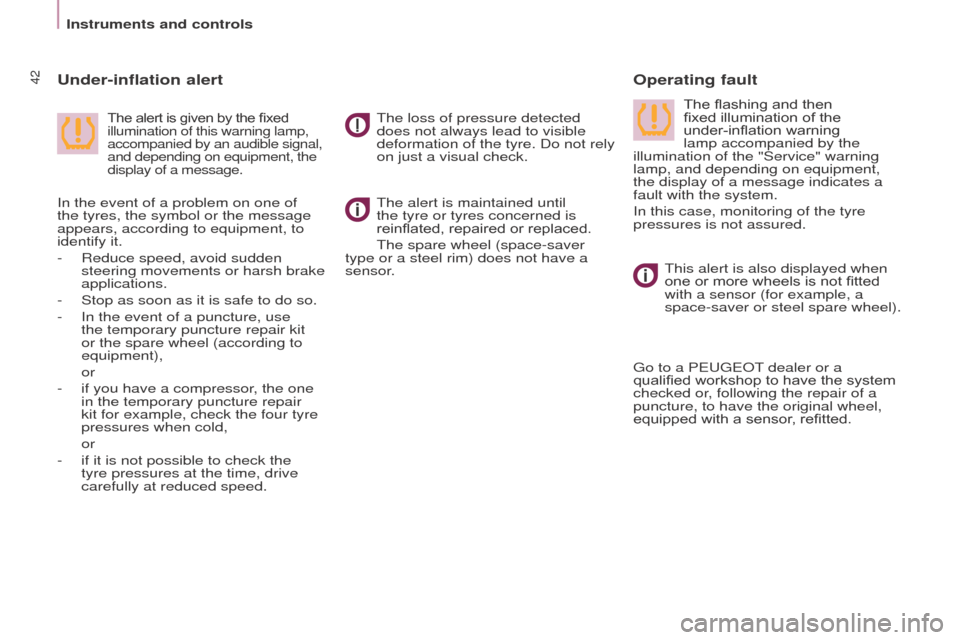
on just a visual check.The alert is given by the fixed
illumination of this warning lamp,
accompanied by an audible signal,
and depending on equipment, the
display of a message.The flashing and then
fixed illumination of the
under-inflation warning
lamp accompanied by the
illumination of the "Service" warning
lamp, and depending on equipment,
the display of a message indicates a
fault with the system.
In this case, monitoring of the tyre
pressures is not assured.
In the event of a problem on one of
the tyres, the symbol or the message
appears, according to equipment, to
identify it.
-
Reduce speed, avoid sudden
steering movements or harsh brake
applications.
-
Stop as soon as it is safe to do so.
-
In the event of a puncture, use
the temporary puncture repair kit
or the spare wheel (according to
equipment),
or
-
if you have a compressor
, the one
in the temporary puncture repair
kit for example, check the four tyre
pressures when cold,
or
-
if it is not possible to check the
tyre pressures at the time, drive
carefully at reduced speed.
This alert is also displayed when
one or more wheels is not fitted
with a sensor (for example, a
space-saver or steel spare wheel).
g
o to a P eugeo T dealer or a
qualified workshop
to have the system
checked or, following the repair of a
puncture, to have the original wheel,
equipped with a sensor, refitted.
Page 45 of 296
Instruments and controls
43
uNDeR-INFLAtI o N D ete C t I o N WI t H R e INI t IALISAt I o N
System which automatically checks the
pressures of the tyres while driving.
The system monitors the pressures
in the four tyres, once the vehicle is
moving.
It compares the information given by
the four wheel speed sensors with
reference values, which must be
reinitialised every time the tyre
pressures are adjusted or a wheel
changed.
The system triggers an alert as soon
as it detects a drop in the inflation
pressure of one or more tyres.The under-inflation detection
system does not replace the
need for vigilance on the part of
the
driver.
This system does not avoid the need to
check the tyre pressures (including the
spare wheel) every month as well as
before a long journey.
Driving with under-inflated tyres
impairs road holding, extends braking
distances and causes premature
tyre wear, particularly under arduous
condition (high loading, high speed,
long journey).
Driving with under-inflated tyres
increases fuel consumption. The inflation pressures defined for
your vehicle can be found on the
tyre pressure label.
For more information on the
identification markings, refer to the
corresponding section.
Tyre pressures should be checked
when the tyres are "cold" (vehicle
stopped for 1 hour or after a journey of
less than 6 miles (10 km) at moderate
speeds).
o
therwise (when hot), add 0.3 bar to
the pressures shown on the label.
ReADY to go
3
Page 61 of 296
59
LeD DAYtIMe RuNNINg LAMPS
Rear foglamps (amber,
2nd rotation of the ring
forwards).
Front foglamps (green,
1st
rotation of the ring
forwards). Rotate this ring forwards
to switch on and
rearwards to switch off.
Their state is confirmed by
the warning lamps in the
instrument panel. Do not forget to switch them off
when they are no longer needed.
o
peration of the automatic illumination
of headlamps switches off the rear
foglamps, but the front foglamps
remain on.
To switch off the front and
rear foglamps, turn the
ring rearwards twice in
succession.
Automatic illumination of headlamps
In foggy weather or in snow,
the sunshine sensor may detect
sufficient light. As a consequence,
the lighting will not come on
automatically.
If necessary, you must switch
on the dipped beam headlamps
manually.
Do not cover the sunshine sensor
located on the windscreen, behind
the mirror. It is used for the automatic
illumination of headlamps and for the
automatic rain sensitive wipers.
Activation
Turn the ring to the A
uto position. The
activation of this function is accompanied
by a message in the screen.
Deactivation
Turn the ring forwards or rearwards.
The deactivation of this function is
accompanied by a message in the screen.
The function is deactivated temporarily
when you use the manual lighting
control stalk. The sidelamps
and dipped beam
headlamps switch
on automatically if
the light is poor, or
during operation of the windscreen
wipers. They switch off as soon as the
light becomes bright enough or the
windscreen wipers stop.
This function is not compatible with the
daytime running lamps.
o
n starting the vehicle, in daylight the
L
e
D daytime running lamps come on
automatically.
If the sidelamps and headlamps are
switched on manually or automatically,
the daytime running lamps go off.
Programming
For countries where exterior lighting by
day is not a legal requirement, you can
activate or deactivate the function via
the configuration menu.
If the user does not operate any
equipment for 30 minutes, the
e
conomy mode engages to avoid
discharging the battery.
e
lectrical
functions are put on standby and the
battery warning lamp flashes.
Sidelamp operation is not affected by
e
conomy mode.
In clear weather or in rain, both day
and night, rear foglamps dazzle and
their use is prohibited.
Refer to chapter 8,
"Battery
section".
Front and rear foglamps
They operate with the sidelamps and
dipped beam headlamps.
Steering mounted controls
eASe oF uSe and CoMFoRT
4