check engine Peugeot Partner Tepee 2017 Owner's Guide
[x] Cancel search | Manufacturer: PEUGEOT, Model Year: 2017, Model line: Partner Tepee, Model: Peugeot Partner Tepee 2017Pages: 292, PDF Size: 10.49 MB
Page 160 of 292
158
Partner2VP_en_Chap07_Verification_ed02-2016Partner2VP_en_Chap07_Verification_ed02-2016
Cooling system
Only use the fluid recommended by the
manufacturer.
Otherwise, you risk seriously damaging
your engine.
When the engine is warm, the
temperature of the coolant is controlled
by the engine fan. As this fan can
operate with the ignition key removed
and because the cooling system is
pressurised, wait for at least one hour
after the engine has stopped before
carrying out any work.
Slacken the cap by 1/4 of a turn to
release the pressure to prevent any
risk of scalding. When the pressure
has dropped, remove the cap and top
up the level with coolant.
If fluid has to be added frequently,
this indicates a fault which must be
checked by a PEUGEOT dealer as
soon as possible.
Power steering fluid level
The vehicle must be parked on level
ground with the engine cold. Unscrew
the cap integrated with the gauge and
check the level which must be between
the MIN and MAX marks.In order to regenerate the filter, you
are advised to drive at a speed higher
than 40 mph (60 km/h) for at least five
minutes as soon as possible, when
traffic conditions permit (until the
message disappears and the service
warning lamp goes off).
During regeneration of the particle
emission filter, the noise of a relay
operating may be heard under the
dashboard.
If the message is still displayed and
if the service warning lamp remains
on, contact a PEUGEOT dealer or a
qualified workshop.
Topping up
The level must be between the MIN
and MAX marks on the expansion
bottle. If more than 1 litre of fluid is
required to top up the level, have
the system checked by a PEUGEOT
dealer or a qualified workshop.
Screenwash level
For best quality cleaning and for your
safety, we would advise that you use
products of the PEUGEOT range.
For optimum cleaning and to avoid
freezing, this fluid must not be topped
up or replaced with plain water.
Capacity of the screenwash reservoir:
approximately 3 litres.
Diesel additive level
(Diesel with particle
filter)
Topping up
This additive must be topped up by
a PEUGEOT dealer or a qualified
workshop without delay.
Waste products
Avoid prolonged contact of used oil
with the skin.
Brake fluid is harmful to health and
very corrosive.
Do not dispose of used oil, brake fluid
or coolant into drains or into the ground
but into the containers dedicated to this
use at a PEUGEOT dealer (France) or
an authorised waste disposal site.
The minimum level of this additive
is indicated by lighting of the service
warning lamp, accompanied by an
audible signal and a message in the
screen.
When this occurs with the engine
running it is due to the start of
saturation of the particle filter
(exceptionally prolonged urban type
driving conditions: low speed, long
traffic jams, ...).
Levels
Page 162 of 292
160
Partner2VP_en_Chap07_Verification_ed02-2016Partner2VP_en_Chap07_Verification_ed02-2016
Good practice
Bleeding water from the Diesel
filter
Manual gearbox
Have the level checked in accordance with
the manufacturer's servicing schedule.
In order to avoid damaging the
electrical units, we strongly
advise you not to use high
pressure washing to clean the engine
compartment.
After washing the vehicle dampness,
or in winter, ice may form on the brake
discs and pads: braking efficiency may
be reduced. Make some light brake
applications to dry and de-ice the
brakes.
If this warning lamp comes
on, bleed the filter. Otherwise
bleed regularly each time the
engine oil is changed.
HDi engines use advanced
technology. All work requires
special training, so should be
entrusted to a PEUGEOT dealer.
Depending on country of sale. To drain the water, unscrew the bleed
screw located on the filter.
Operate until all of the water no longer
flows in the transparent pipe, then
tighten the bleed screw. Only use products recommended by
PEUGEOT or products of equivalent
quality and specification.
In order to optimise the operation
of units as important as the braking
system, PEUGEOT selects and offers
specific products.
Checks
Page 163 of 292
161
Partner2VP_en_Chap07_Verification_ed02-2016Partner2VP_en_Chap07_Verification_ed02-2016
REFUELLING
Low fuel level
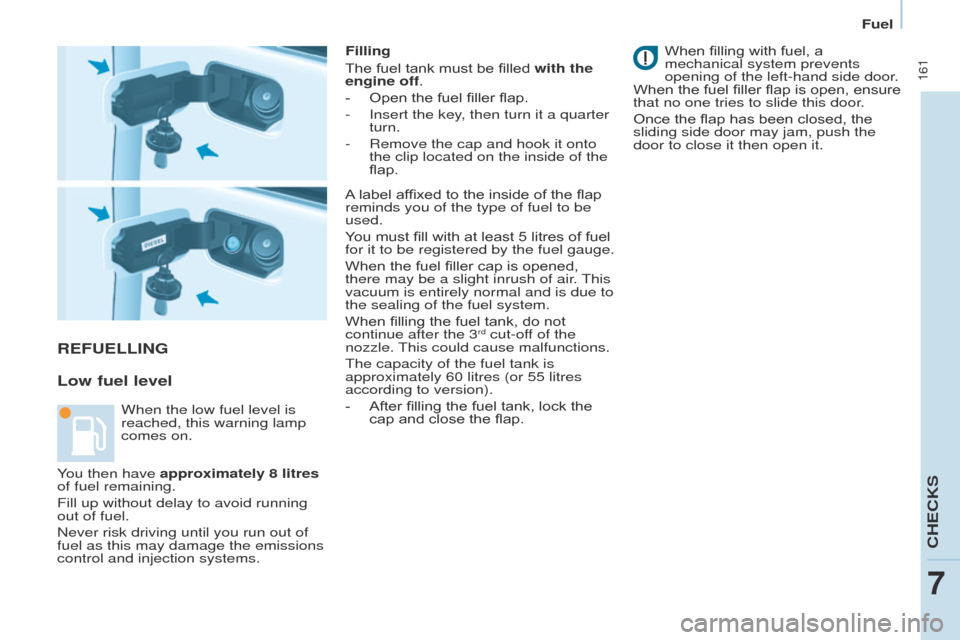
Filling
The fuel tank must be filled with the
engine off.
-
Open the fuel filler flap.
-
Insert the key
, then turn it a quarter
turn.
-
Remove the cap and hook it onto
the clip located on the inside of the
flap. When fillin
g with fuel, a
mechanical system prevents
opening of the left-hand side door.
When the fuel filler flap is open, ensure
that no one tries to slide this door.
Once the flap has been closed, the
sliding side door may jam, push the
door to close it then open it.
When the low fuel level is
reached, this warning lamp
comes on. A label affixed to the inside of the flap
reminds you of the type of fuel to be
used.
You must fill with at least 5 litres of fuel
for it to be registered by the fuel gauge.
When the fuel filler cap is opened,
there may be a slight inrush of air. This
vacuum is entirely normal and is due to
the sealing of the fuel system.
When filling the fuel tank, do not
continue after the 3
rd cut-off of the
nozzle. This could cause malfunctions.
The capacity of the fuel tank is
approximately 60 litres (or 55 litres
according to version).
-
After fillin
g the fuel tank, lock the
cap and close the flap.
You then have approximately 8 litres
of fuel remaining.
Fill up without delay to avoid running
out of fuel.
Never risk driving until you run out of
fuel as this may damage the emissions
control and injection systems.
CHECKS
7
Fuel
Page 165 of 292
163
Partner2VP_en_Chap07_Verification_ed02-2016Partner2VP_en_Chap07_Verification_ed02-2016
DIESEL PRIMING PUMP
If you run out of fuel, it is necessary to
prime the fuel circuit.
Other HDi engines
- Fill the fuel tank with at least
five
litres of Diesel.
-
Squeeze and release the manual
priming pump, under the bonnet,
under the protective cover
.
-
Operate the starter until the engine
starts.
BlueHDi engine
- Fill the fuel tank with at least five
litres of Diesel.
-
Switch on the ignition (without
starting the engine).
-
W
ait around 6 seconds and switch
off the ignition.
-
Repeat the operation 10 times.
-
Operate the starter to run the
engine.
FUEL CUT- OFF
In a serious collision, a mechanism
automatically prevents fuel from
reaching the engine.
The flashing of this warning
lamp is accompanied by a
message in the screen.
Check that there is no odour or
leakage of fuel outside the vehicle and
re-establish the fuel supply:
-
switch of
f the ignition
(STOP
position),
-
remove the key
,
-
put the key back in the ignition,
-
switch on the ignition and start.
CHECKS
7
AdBlue®
Page 168 of 292
166
Partner2VP_en_Chap07_Verification_ed02-2016Partner2VP_en_Chap07_Verification_ed02-2016
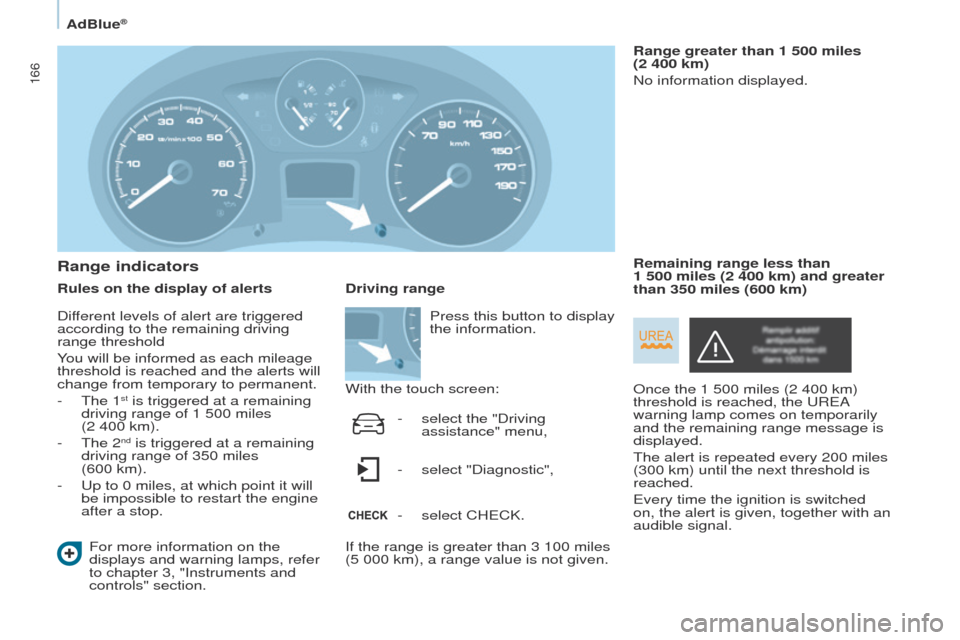
Range indicators
Rules on the display of alertsFor more information on the
displays and warning lamps, refer
to chapter 3, "Instruments and
controls" section. Range greater than 1 500 miles
(2 400 km)
No information displayed.
Once the 1 500 miles (2 400 km)
threshold is reached, the UREA
warning lamp comes on temporarily
and the remaining range message is
displayed.
The alert is repeated every 200 miles
(300 km) until the next threshold is
reached.
Every time the ignition is switched
on, the alert is given, together with an
audible signal. Remaining range less than
1
500 miles (2 400 km) and greater
than 350 miles (600 km)
Driving range
With the touch screen:
If the range is greater than 3 100 miles
(5 000 km), a range value is not given. Press this button to display
the information.
-
select the "Driving
assistance" menu,
-
select "Diagnostic",
-
select CHECK.
Dif
ferent levels of alert are triggered
according to the remaining driving
range threshold
You will be informed as each mileage
threshold is reached and the alerts will
change from temporary to permanent.
-
The 1st is triggered at a remaining
driving range of 1 500 miles
(2
400
km).
-
The 2nd is triggered at a remaining
driving range of 350 miles
(600
km).
-
Up to 0 miles, at which point it will
be impossible to restart the engine
after a stop.
AdBlue®
Page 169 of 292
167
Partner2VP_en_Chap07_Verification_ed02-2016Partner2VP_en_Chap07_Verification_ed02-2016
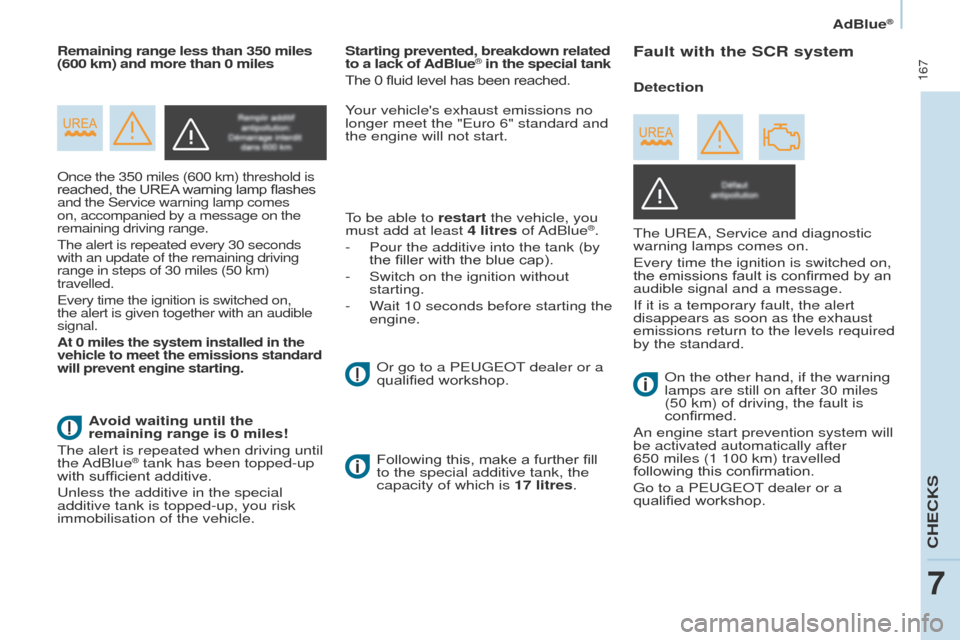
Once the 350 miles (600 km) threshold is
reached, the UREA warning lamp flashes
and the Service warning lamp comes
on, accompanied by a message on the
remaining driving range.
The alert is repeated every 30 seconds
with an update of the remaining driving
range in steps of 30 miles (50 km)
travelled.
Every time the ignition is switched on,
the alert is given together with an audible
signal.
At 0 miles the system installed in the
vehicle to meet the emissions standard
will prevent engine starting.
Your vehicle's exhaust emissions no
longer meet the "Euro 6" standard and
the engine will not start.
To be able to restart the vehicle, you
must add at least 4 litres of AdBlue
®.
-
Pour the additive into the tank (by
the filler with the blue cap).
-
Switch on the ignition without
starting.
-
W
ait 10 seconds before starting the
engine.
Remaining range less than 350
miles
(600 km) and more than 0 miles Starting prevented, breakdown related
to a lack of AdBlue
®
in the special tank
The 0 fluid level has been reached.
Avoid waiting until the
remaining range is 0 miles!
The alert is repeated when driving until
the AdBlue
® tank has been topped-up
with sufficient additive.
Unless the additive in the special
additive tank is topped-up, you risk
immobilisation of the vehicle. Following this, make a further fill
to the special additive tank, the
capacity of which is 17 litres.
Fault with the SCR system
The UREA, Service and diagnostic
warning lamps comes on.
Every time the ignition is switched on,
the emissions fault is confirmed by an
audible signal and a message.
If it is a temporary fault, the alert
disappears as soon as the exhaust
emissions return to the levels required
by the standard. Detection
On the other hand, if the warning
lamps are still on after 30 miles
(50 km) of driving, the fault is
confirmed.
An engine start prevention system will
be activated automatically after
650 miles (1 100 km) travelled
following this confirmation.
Go to a PEUGEOT dealer or a
qualified workshop.
Or go to a PEUGEOT dealer or a
qualified workshop.
CHECKS
7
AdBlue®
Page 170 of 292
168
Partner2VP_en_Chap07_Verification_ed02-2016Partner2VP_en_Chap07_Verification_ed02-2016
Fault confirmed
In addition to the previous signals,
the UREA warning lamp flashes and
the remaining range allowed will be
displayed in miles (kilometres).
The alert will be repeated every
30 seconds with an update of the
driving range in steps of 30 miles
(50 km).
Go to a PEUGEOT dealer or a
qualified workshop as soon as
possible.
You risk not being able to start the
engine.
Starting prevented, having
covered the 650 miles (1 100 km)
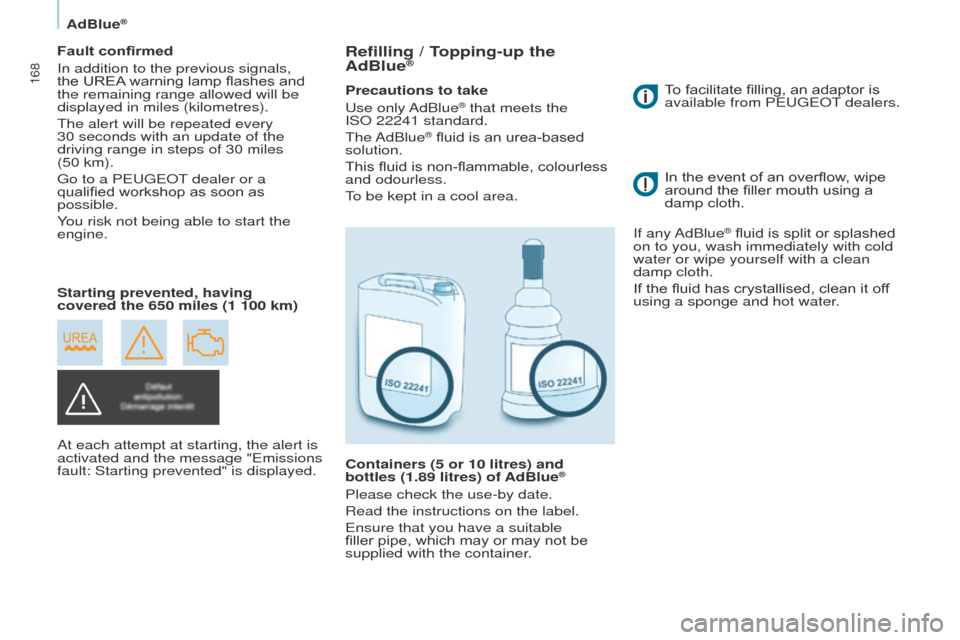
At each attempt at starting, the alert is
activated and the message "Emissions
fault: Starting prevented" is displayed.Refilling / Topping-up the
AdBlue®
Precautions to take
Use only AdBlue® that meets the
ISO
22241 standard.
The AdBlue
® fluid is an urea-based
solution.
This fluid is non-flammable, colourless
and odourless.
To be kept in a cool area.
Containers (5 or 10 litres) and
bottles (1.89 litres) of AdBlue
®
Please check the use-by date.
Read the instructions on the label.
Ensure that you have a suitable
filler pipe, which may or may not be
supplied with the container. In the event of an overflow, wipe
around the filler mouth using a
damp cloth.
If any AdBlue
® fluid is split or splashed
on to you, wash immediately with cold
water or wipe yourself with a clean
damp cloth.
If the fluid has crystallised, clean it off
using a sponge and hot water. To facilitate filling, an adaptor is
available from PEUGEOT dealers.
AdBlue®
Page 171 of 292
169
Partner2VP_en_Chap07_Verification_ed02-2016Partner2VP_en_Chap07_Verification_ed02-2016
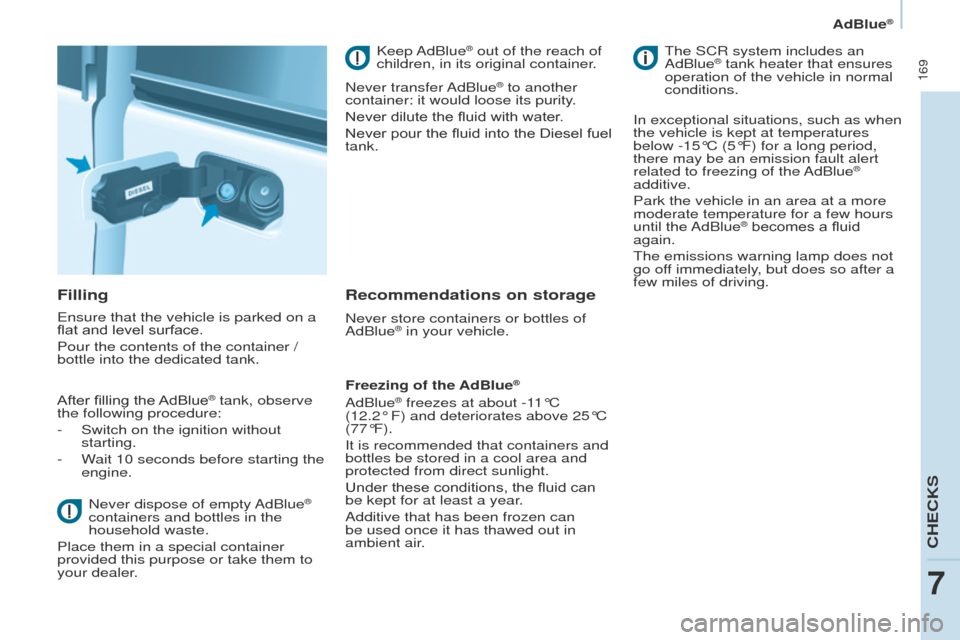
Filling
Ensure that the vehicle is parked on a
flat and level surface.
Pour the contents of the container /
bottle into the dedicated tank.
After filling the AdBlue
® tank, observe
the following procedure:
-
Switch on the ignition without
starting.
-
W
ait 10 seconds before starting the
engine.
Never dispose of empty AdBlue
®
containers and bottles in the
household waste.
Place them in a special container
provided this purpose or take them to
your dealer. Keep AdBlue
® out of the reach of
children, in its original container.
Never transfer AdBlue
® to another
container: it would loose its purity.
Never dilute the fluid with water.
Never pour the fluid into the Diesel fuel
tank.
Recommendations on storage
Never store containers or bottles of
AdBlue® in your vehicle.
Freezing of the AdBlue
®
AdBlue® freezes at about -11°C
(12.2°
F) and deteriorates above 25°C
(77°F).
It is recommended that containers and
bottles be stored in a cool area and
protected from direct sunlight.
Under these conditions, the fluid can
be kept for at least a year.
Additive that has been frozen can
be used once it has thawed out in
ambient
air. The SCR system includes an
AdBlue
® tank heater that ensures
operation of the vehicle in normal
conditions.
In exceptional situations, such as when
the vehicle is kept at temperatures
below -15°C (5°F) for a long period,
there may be an emission fault alert
related to freezing of the AdBlue
®
additive.
Park the vehicle in an area at a more
moderate temperature for a few hours
until the AdBlue
® becomes a fluid
again.
The emissions warning lamp does not
go off immediately, but does so after a
few miles of driving.
CHECKS
7
AdBlue®
Page 172 of 292
170
Partner2VP_en_Chap08_Aide-rapide_ed02-2016
BATTERY
Before disconnecting the battery, you
must wait for 2 minutes after switching
off the ignition.
Never disconnect a terminal when the
engine is running.
Never charge a battery without first
disconnecting the terminals.
After every reconnection of the battery,
switch on the ignition and wait 1 minute
before starting to allow the electronic
systems to be initialised. If problems
remain after doing this, please contact
a PEUGEOT dealer or a qualified
workshop.
After changing bulbs, wait
approximately 3 minutes before
reconnecting the battery.
It is advisable to disconnect the
battery if the vehicle is not to be
used for a period of more than
one
month.
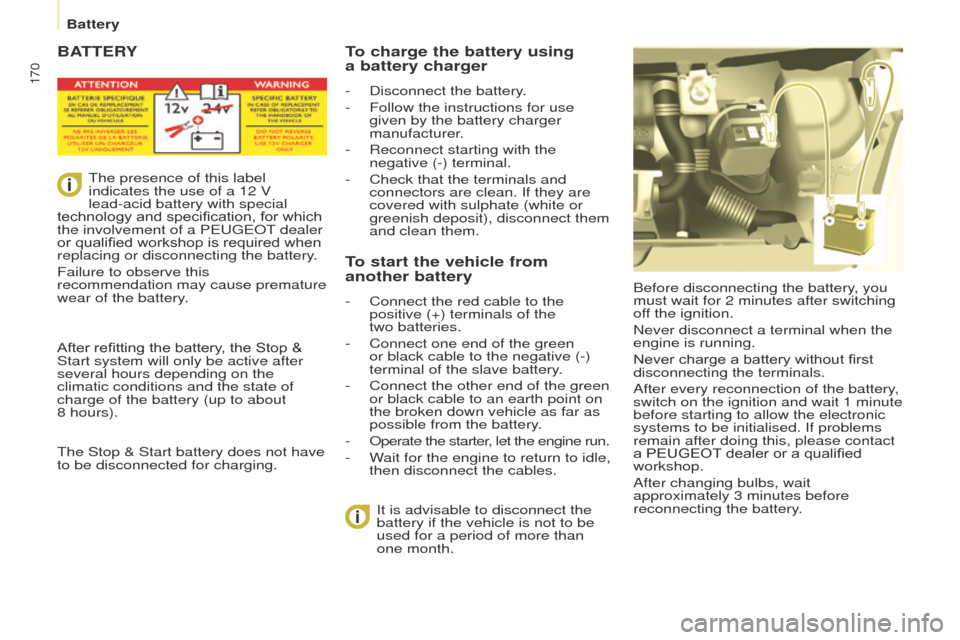
To charge the battery using
a battery charger
- Disconnect the battery .
-
Follow the instructions for use
given by the battery charger
manufacturer
.
-
Reconnect starting with the
negative (-) terminal.
-
Check that the terminals and
connectors are clean. If they are
covered with sulphate (white or
greenish deposit), disconnect them
and clean them.
To start the vehicle from
another battery
- Connect the red cable to the
positive (+) terminals of the
two batteries.
-
Connect one end of the green
or black cable to the negative (-)
terminal of the slave battery
.
-
Connect the other end of the green
or black cable to an earth point on
the broken down vehicle as far as
possible from the battery
.
-
Operate the starter
, let the engine run.
-
W
ait for the engine to return to idle,
then disconnect the cables.
The presence of this label
indicates the use of a 12 V
lead-acid battery with special
technology and specification, for which
the involvement of a PEUGEOT dealer
or qualified workshop is required when
replacing or disconnecting the battery.
Failure to observe this
recommendation may cause premature
wear of the battery.
After refitting the battery, the Stop
&
Start system will only be active after
several hours depending on the
climatic conditions and the state of
charge of the battery (up to about
8 hours).
The Stop & Start battery does not have
to be disconnected for charging.
Battery
Page 263 of 292
261
Partner2VP_en_Chap10a_SMEGplus_ed02-2016
QUESTIONANSWER SOLUTION
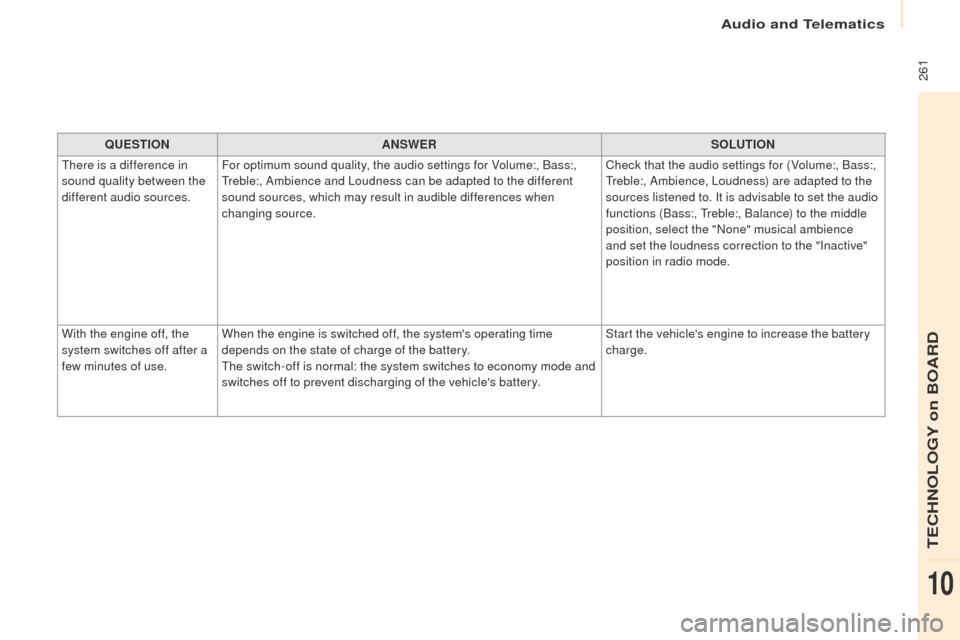
There is a difference in
sound quality between the
different audio sources. For optimum sound quality, the audio settings for Volume:, Bass:,
Treble:, Ambience and Loudness can be adapted to the different
sound sources, which may result in audible differences when
changing source. Check that the audio settings for (Volume:, Bass:,
Treble:, Ambience, Loudness) are adapted to the
sources listened to. It is advisable to set the audio
functions (Bass:, Treble:, Balance) to the middle
position, select the "None" musical ambience
and set the loudness correction to the "Inactive"
position in radio mode.
With the engine off, the
system switches off after a
few minutes of use. When the engine is switched off, the system's operating time
depends on the state of charge of the battery.
The switch-off is normal: the system switches to economy mode and
switches off to prevent discharging of the vehicle's battery. Start the vehicle's engine to increase the battery
charge.
Audio and Telematics
TECHNOLOGY on BOARD
10