lock PEUGEOT PARTNER TEPEE 2020 Owner's Guide
[x] Cancel search | Manufacturer: PEUGEOT, Model Year: 2020, Model line: PARTNER TEPEE, Model: PEUGEOT PARTNER TEPEE 2020Pages: 216, PDF Size: 8.46 MB
Page 81 of 216
79
Anti-lock braking system
(ABS/EBFD)
The ABS and EBFD (electronic brake force
distribution) systems improve the stability and
manoeuvrability of your vehicle when braking,
in particular on poor or slippery sur faces.
The ABS prevents the wheels from locking,
and the EBFD provides control of the braking
pressure wheel by wheel.
The anti-lock braking system comes into
operation automatically when there is a risk
of wheel lock. It does not reduce the braking
distance.
On very slippery sur faces (ice, oil, etc.), the
ABS may increase the braking distance. When
braking in an emergency, do not hesitate to
press the brake pedal firmly without releasing
the pressure, even on a slippery sur face; you
will then be able to continue to manoeuvre the
vehicle to avoid an obstacle.If this warning lamp comes on
accompanied by an audible signal
and a message in the screen, it
indicates a malfunction of the ABS
which could result in a loss of control
of the vehicle when braking.
If this warning lamp comes on
together with the brake and STOP
warning lamps, accompanied by an
audible signal and a message in the
screen, it indicates a malfunction of
the electronic brake force distribution,
which could result in a loss of control
of the vehicle when braking.
Stop as soon as it is safe to do so.
In both cases, contact a PEUGEOT dealer or a
qualified workshop.
Emergency braking
assistance (EBA)
In an emergency, this system enables you to
reach the optimum braking pressure more
quickly.
It is triggered in relation to the speed at which
the brake pedal is pressed.
This alters the resistance of the brake pedal
under your foot.To maintain operation of the emergency
braking assistance system, press very
firmly on the brake pedal, maintaining this
pressure.
Normal operation of the ABS may be felt
by slight vibration of the brake pedal.
When changing wheels (tyres and rims),
ensure that these are approved by
P E U G E O T.
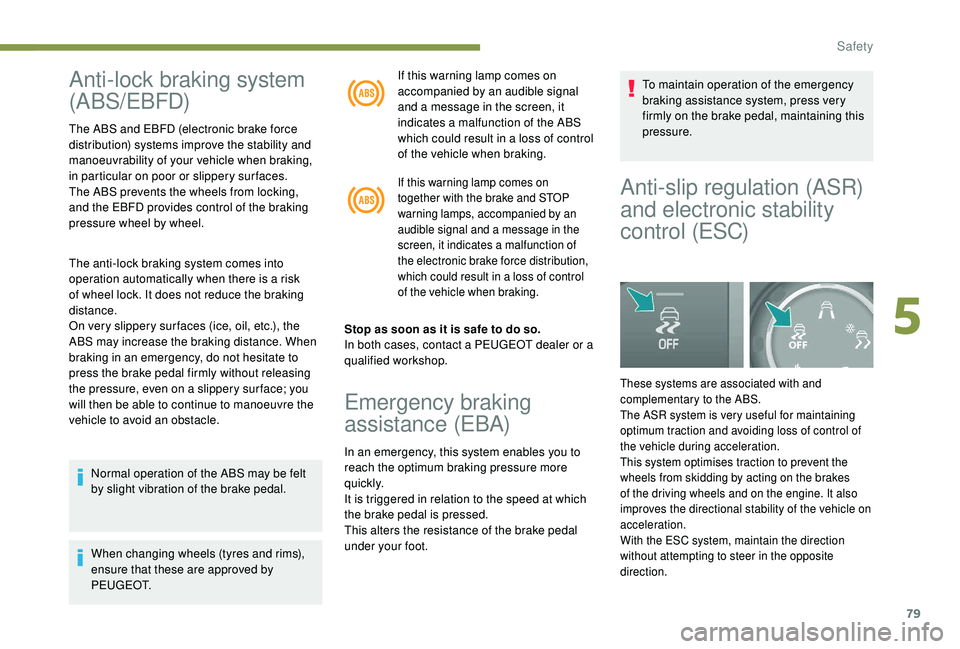
Anti-slip regulation (ASR)
and electronic stability
c ont rol (ESC)
These systems are associated with and
complementary to the ABS.
The ASR system is very useful for maintaining
optimum traction and avoiding loss of control of
the vehicle during acceleration.
This system optimises traction to prevent the
wheels from skidding by acting on the brakes
of the driving wheels and on the engine. It also
improves the directional stability of the vehicle on
acceleration.
With the ESC system, maintain the direction
without attempting to steer in the opposite
direction.
5
Safety
Page 86 of 216
84
Advice
The driver must ensure that passengers use
the seat belts correctly and that they are all
fastened before setting off.
Wherever you are seated in the vehicle,
always fasten your seat belt, even for short
journeys.
Do not interchange the seat belt buckles as
they will not fulfil their role fully.
The seat belts are fitted with an inertia reel
permitting automatic adjustment of the length
of the strap to your size. The seat belt is
stowed automatically when not in use.
Before and after use, ensure that the seat belt
is reeled in correctly.
The lower part of the strap must be positioned
as low as possible on the pelvis.
The upper part must be positioned in the
hollow of the shoulder.
The inertia reels have a device for automatic
locking in the event of a collision, sudden
braking or if the vehicle turns over. You can
release the device by pulling the strap firmly
and then releasing it so that it reels in slightly.In order to be effective, a seat belt must:
-
b e tightened as close to the body as
possible,
-
b
e pulled in front of you with a smooth
movement, checking that it does not twist,
-
b
e used to restrain only one person,
-
n
ot show any signs of cuts or fraying,
-
n
ot be converted or modified to avoid
affecting its performance.
In accordance with current safety regulations,
for all repairs on your vehicle's seat belts, go
to a qualified workshop with the skills and
equipment needed, which a PEUGEOT dealer
is able to provide.
Have your seat belts checked regularly by a
PEUGEOT dealer or a qualified workshop,
particularly if the straps show signs of
damage.
Clean the seat belt straps with soapy water or
a textile cleaning product, sold by PEUGEOT
dealers.
After folding or moving a seat or rear bench
seat, ensure that the seat belt is positioned
and reeled in correctly. Recommendations for children
Use a suitable child seat if the passenger is
less than 12
years old or shorter than one and
a half metres.
Never use the same seat belt to secure more
than one person.
Never allow a child to travel on your lap.
For more information on Child seats , refer to
the corresponding section.
In the event of an impact
Depending on the nature and seriousness
of the impact , the pyrotechnic device may
be deployed before and independently of the
airbags. Deployment of the pretensioners
is accompanied by a slight discharge of
harmless smoke and a noise, due to the
activation of the pyrotechnic cartridge
incorporated in the system.
In all cases, the airbag warning lamp comes
on.
Following an impact, have the seat belts
system checked and, if necessary, replaced,
by a PEUGEOT dealer or a qualified
workshop.
Safety
Page 103 of 216
101
Instructions for child seats
The incorrect installation of a child seat in a
vehicle compromises the child's protection in
the event of an accident.
Ensure that there is no seat belt or seat belt
buckle under the child seat, as this could
destabilise it.
Remember to fasten the seat belts or the
child seat harnesses keeping the slack
relative to the child's body to a minimum,
even for short journeys.
When installing a child seat using the seat
belt, ensure that the seat belt is tightened
correctly on the child seat and that it secures
the child seat firmly on the seat of your
vehicle. If your passenger seat is adjustable,
move it for wards if necessary.
At the rear, always leave sufficient space
between the front seat and:
-
a r
ear ward facing child seat,
-
t
he feet of a child seated in a for ward
facing child seat.
To do this, move the front seat for wards
and, if necessary, move its backrest into the
upright position. When a child seat is installed in row 3, place
the backrests of the outer seats and the
centre seat of row 2 in the table position, or
remove these row 2 seats so that the child
seat or the child's legs do not touch the row
2 seats.
For optimal installation of the "forward facing"
child seat, check that its backrest is as close
as possible to the backrest of the vehicle
seat, if possible in contact with it.
The head restraint must be removed before
installing a child seat with a backrest on a
passenger seat.
Ensure that the head restraint is stored or
attached securely to prevent it from being
thrown around the vehicle in the event of
sharp braking.
Refit the head restraint once the child seat
has been removed.
Installing a booster (height adjuster)
The chest part of the seat belt must be
positioned on the child's shoulder without
touching the neck.
Ensure that the lap part of the seat belt
passes correctly over the child's thighs.
PEUGEOT recommends using a booster seat
with a backrest, equipped with a belt guide at
shoulder level.
As a safety precaution, do not leave:
-
a c
hild or children alone and unattended in
a vehicle,
-
a c
hild or an animal in a vehicle which
is exposed to the sun, with the windows
closed,
-
t
he keys within reach of children inside the
vehicle.
To prevent accidental opening of the doors,
use the "Child lock" system.
Take care not to open the rear windows by
more than one third.
To protect young children from the rays of the
sun, fit side blinds on the rear windows.
Children in front
The legislation on carrying children on the
front passenger seat is specific to each
country. Refer to the legislation in force in
your country.
Deactivate the passenger’s front airbag when
a rear ward facing child seat is installed on
the front passenger seat. Otherwise, the child
may be seriously injured or killed if the airbag
is deployed.
5
Safety
Page 104 of 216
102
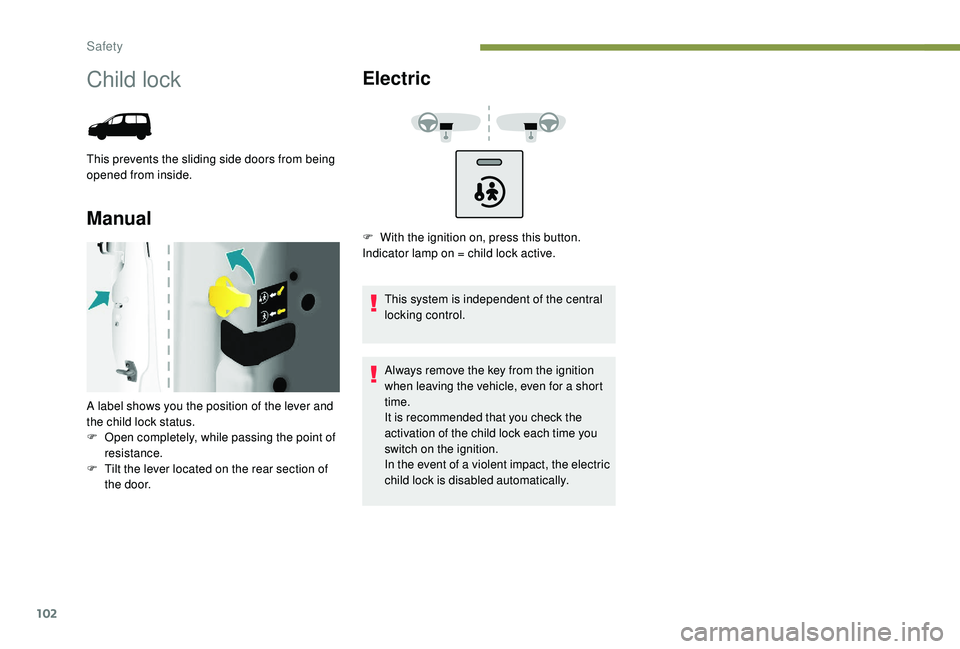
Child lock
This prevents the sliding side doors from being
opened from inside.
ManualElectric
This system is independent of the central
locking control.
Always remove the key from the ignition
when leaving the vehicle, even for a short
time.
It is recommended that you check the
activation of the child lock each time you
switch on the ignition.
In the event of a violent impact, the electric
child lock is disabled automatically.
A label shows you the position of the lever and
the child lock status.
F
O
pen completely, while passing the point of
resistance.
F
T
ilt the lever located on the rear section of
the door. F
W
ith the ignition on, press this button.
Indicator lamp on = child lock active.
Safety
Page 106 of 216
104
In some cases of particularly demanding use
(when towing the maximum load on a steep
gradient in high temperatures), the engine
power is automatically limited. In such a case,
the air conditioning is automatically switched
off to increase the available engine power.F
I
f this warning lamp and the
STOP warning lamp come on,
stop the vehicle and switch off
the engine as soon as possible.
New vehicle
Do not pull a trailer before having driven at
least 620
miles (1,000 kilometres).
Braking
Towing a trailer increases the braking distance.
To avoid overheating of the brakes, the use of
engine braking is recommended.
Ty r e s
F Check the tyre pressures of the towing vehicle and of the trailer, observing the
recommended pressures.
Lighting
F Check the electrical lighting and signalling on the trailer and the headlamp beam height
of your vehicle. For more information on adjusting
the Headlamp beam
, refer to the
corresponding section.
The rear parking sensors will be
deactivated automatically to avoid the
audible signal if a genuine PEUGEOT
towbar is used.
Starting and stopping
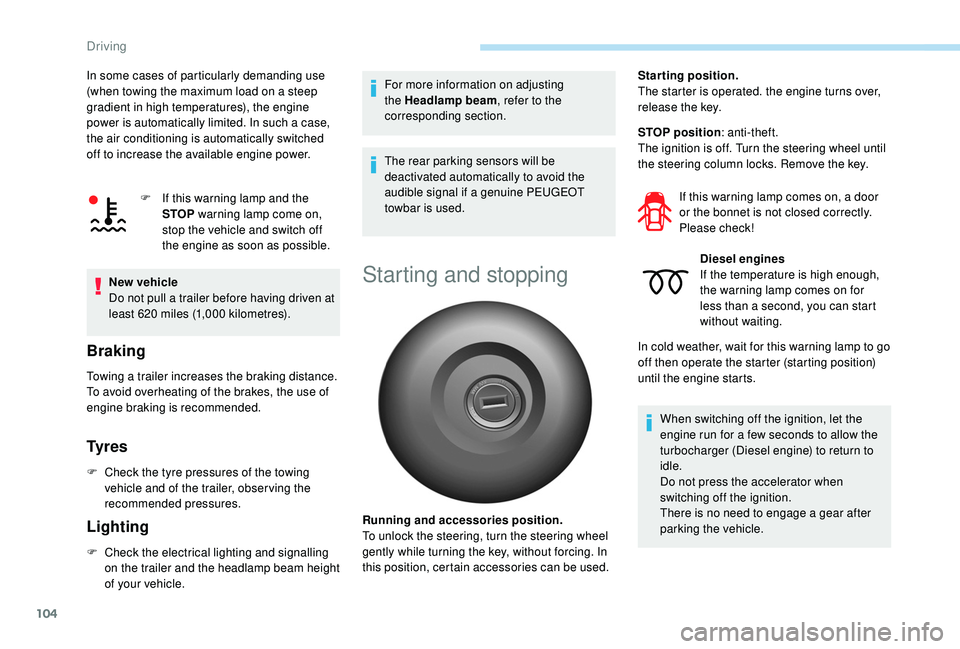
Running and accessories position.
To unlock the steering, turn the steering wheel
gently while turning the key, without forcing. In
this position, certain accessories can be used. Starting position.
The starter is operated. the engine turns over,
release the key.
STOP position
: anti-theft.
The ignition is off. Turn the steering wheel until
the steering column locks. Remove the key.
If this warning lamp comes on, a door
or the bonnet is not closed correctly.
Please check!Diesel engines
If the temperature is high enough,
the warning lamp comes on for
less than a second, you can start
without waiting.
In cold weather, wait for this warning lamp to go
off then operate the starter (starting position)
until the engine starts.
When switching off the ignition, let the
engine run for a few seconds to allow the
turbocharger (Diesel engine) to return to
idle.
Do not press the accelerator when
switching off the ignition.
There is no need to engage a gear after
parking the vehicle.
Driving
Page 107 of 216
105
Electronic engine
immobiliser
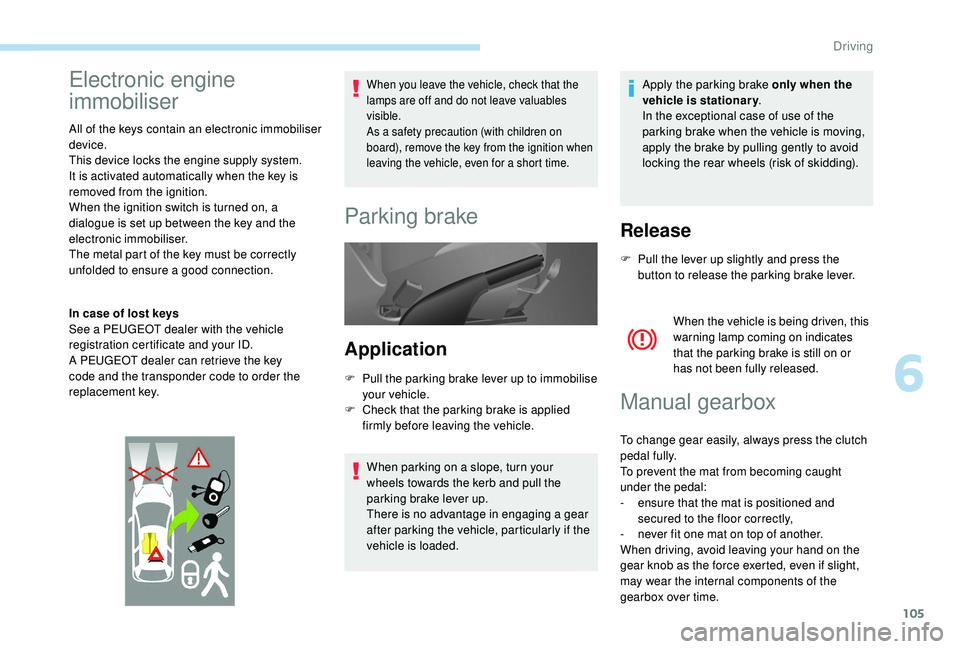
All of the keys contain an electronic immobiliser
device.
This device locks the engine supply system.
It is activated automatically when the key is
removed from the ignition.
When the ignition switch is turned on, a
dialogue is set up between the key and the
electronic immobiliser.
The metal part of the key must be correctly
unfolded to ensure a good connection.
In case of lost keys
See a PEUGEOT dealer with the vehicle
registration certificate and your ID.
A PEUGEOT dealer can retrieve the key
code and the transponder code to order the
replacement key.
When you leave the vehicle, check that the
lamps are off and do not leave valuables
visible.
As a safety precaution (with children on
board), remove the key from the ignition when
leaving the vehicle, even for a short time.
Parking brake
Application
F Pull the parking brake lever up to immobilise your vehicle.
F
C
heck that the parking brake is applied
firmly before leaving the vehicle.
When parking on a slope, turn your
wheels towards the kerb and pull the
parking brake lever up.
There is no advantage in engaging a gear
after parking the vehicle, particularly if the
vehicle is loaded. Apply the parking brake only when the
vehicle is stationary
.
In the exceptional case of use of the
parking brake when the vehicle is moving,
apply the brake by pulling gently to avoid
locking the rear wheels (risk of skidding).
Release
F Pull the lever up slightly and press the button to release the parking brake lever.
When the vehicle is being driven, this
warning lamp coming on indicates
that the parking brake is still on or
has not been fully released.
Manual gearbox
To change gear easily, always press the clutch
pedal fully.
To prevent the mat from becoming caught
under the pedal:
-
e
nsure that the mat is positioned and
secured to the floor correctly,
-
n
ever fit one mat on top of another.
When driving, avoid leaving your hand on the
gear knob as the force exerted, even if slight,
may wear the internal components of the
gearbox over time.
6
Driving
Page 128 of 216
126
Fuel
Low fuel level
When the low fuel level is reached
this warning lamp comes on.
When it first comes on, around 8
litres remain
in the tank, according to your driving style and
your engine.
You must refuel as soon as possible to avoid
running out.
Never continue to drive until you run out of fuel,
as this could damage the emission control and
injection systems.
Filling
The fuel tank must be filled with the engine
off. When filling the fuel tank, do not continue after
the 3
rd cut-off of the nozzle. This could cause
malfunctions.
The capacity of the tank is approximately
60
litres (53 litres for BlueHDi Diesel versions).
F
A
fter filling the fuel tank, lock the cap and
close the flap.
When refilling, a mechanical
system prevents opening of
the left side door. Ensure
that nobody attempts to slide
open this door while the fuel
flap is open.
After closing the flap, the
sliding side door can become
blocked. Push the door to
close it and then open it.
When refilling, ensure that
nobody attempts to open the
sliding side door while the
fuel filler flap is open.
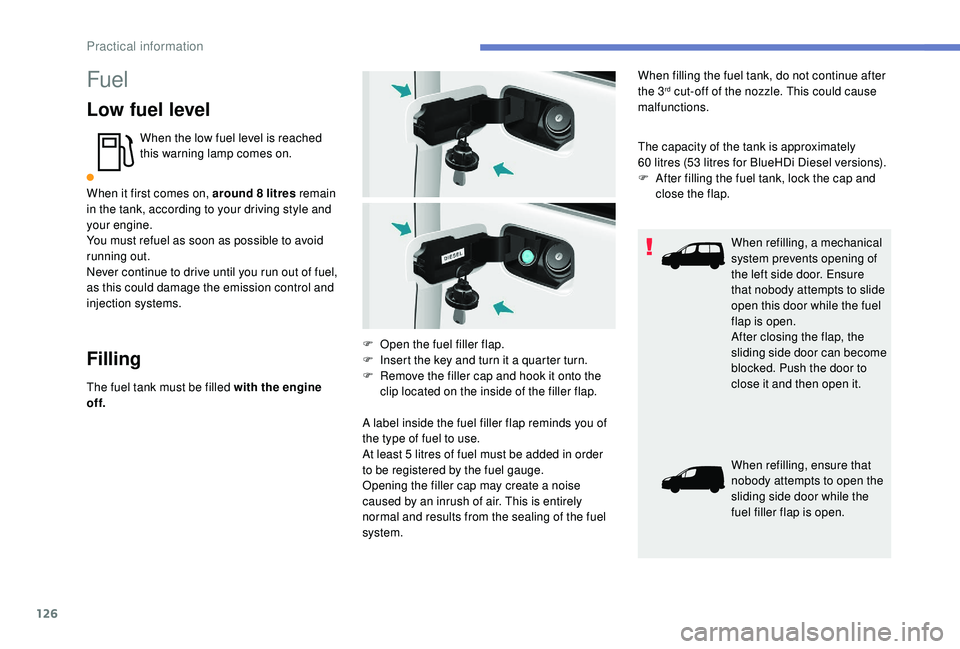
F
O
pen the fuel filler flap.
F
I
nsert the key and turn it a quarter turn.
F
R
emove the filler cap and hook it onto the
clip located on the inside of the filler flap.
A label inside the fuel filler flap reminds you of
the type of fuel to use.
At least 5
litres of fuel must be added in order
to be registered by the fuel gauge.
Opening the filler cap may create a noise
caused by an inrush of air. This is entirely
normal and results from the sealing of the fuel
system.
Practical information
Page 133 of 216
131
To return the wiper blades to their normal
position, switch on the ignition and operate the
wiper stalk again.
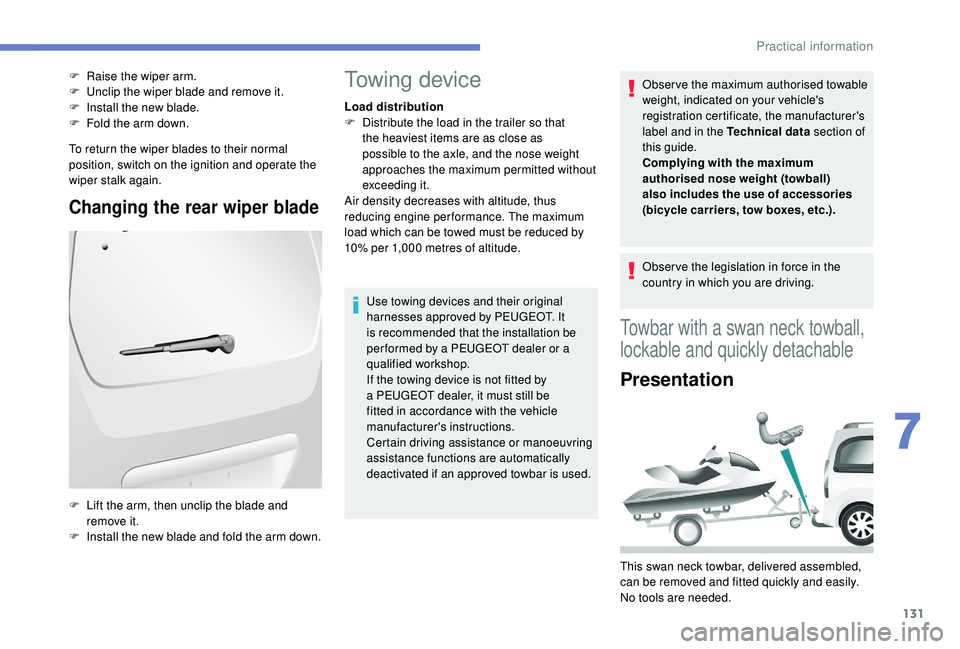
Changing the rear wiper blade
F Raise the wiper arm.
F U nclip the wiper blade and remove it.
F
I
nstall the new blade.
F
F
old the arm down.
F
L
ift the arm, then unclip the blade and
remove it.
F
I
nstall the new blade and fold the arm down.Towing device
Load distribution
F D istribute the load in the trailer so that
the heaviest items are as close as
possible to the axle, and the nose weight
approaches the maximum permitted without
exceeding
it.
Air density decreases with altitude, thus
reducing engine performance. The maximum
load which can be towed must be reduced by
10% per 1,000
metres of altitude.
Use towing devices and their original
harnesses approved by PEUGEOT. It
is recommended that the installation be
per formed by a PEUGEOT dealer or a
qualified workshop.
If the towing device is not fitted by
a PEUGEOT dealer, it must still be
fitted in accordance with the vehicle
manufacturer's instructions.
Certain driving assistance or manoeuvring
assistance functions are automatically
deactivated if an approved towbar is used. Obser ve the maximum authorised towable
weight, indicated on your vehicle's
registration certificate, the manufacturer's
label and in the Technical data
section of
this guide.
Complying with the maximum
authorised nose weight (towball)
also includes the use of accessories
(bicycle carriers, tow boxes, etc.).
Obser ve the legislation in force in the
country in which you are driving.
Towbar with a swan neck towball,
lockable and quickly detachable
Presentation
This swan neck towbar, delivered assembled,
can be removed and fitted quickly and easily.
No tools are needed.
7
Practical information
Page 134 of 216
132
Instructions for fitting and before
each use
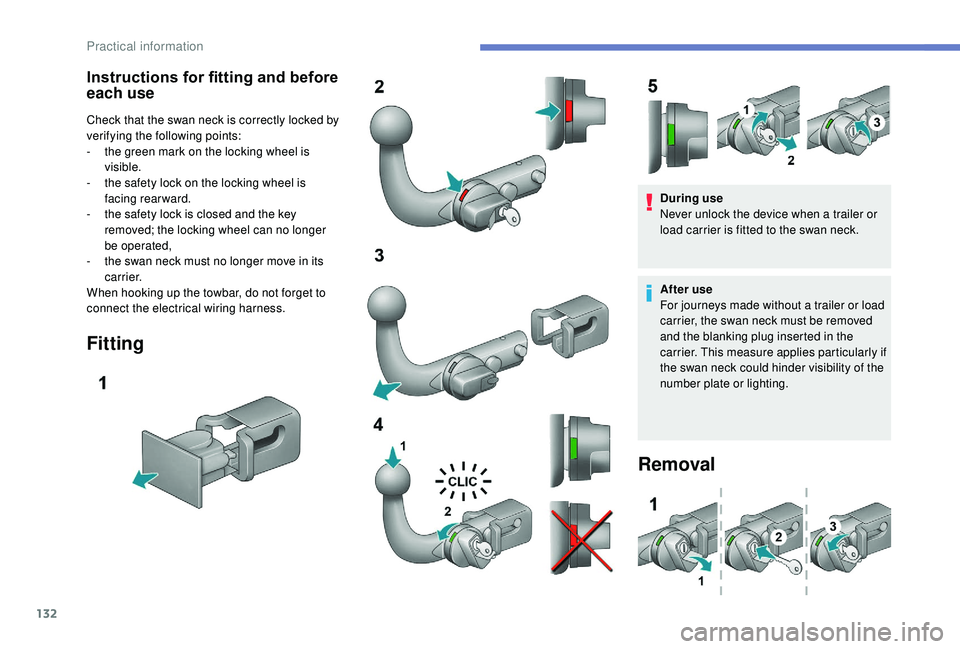
Check that the swan neck is correctly locked by
verifying the following points:
-
t
he green mark on the locking wheel is
visible.
-
t
he safety lock on the locking wheel is
facing rearward.
-
t
he safety lock is closed and the key
removed; the locking wheel can no longer
be operated,
-
t
he swan neck must no longer move in its
c a r r i e r.
When hooking up the towbar, do not forget to
connect the electrical wiring harness.
Fitting
During use
Never unlock the device when a trailer or
load carrier is fitted to the swan neck.
After use
For journeys made without a trailer or load
carrier, the swan neck must be removed
and the blanking plug inserted in the
carrier. This measure applies particularly if
the swan neck could hinder visibility of the
number plate or lighting.
Removal
Practical information
Page 137 of 216
135
taking into account the device specifics and
their compatibility with the capacities of the
standard equipment of your vehicle. Please
check this with a PEUGEOT dealer in advance.
The spare parts department publishes a
catalogue of accessories offering various
equipment and fittings, such as:
Load stops (all types).
Loading roller.
Towbar, towing harness: trailer towbar, which
must be installed by a PEUGEOT dealer.
Partition walls and dividing grilles, smooth
wood interior protection with non-slip floor.
Protective grilles.
Professional equipment
range
Bonnet
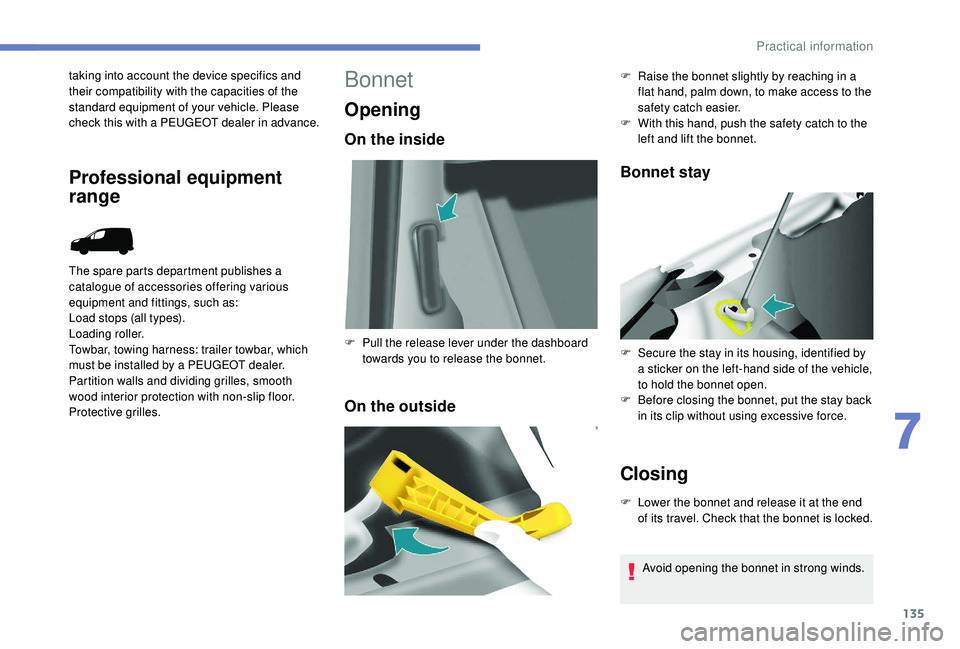
Opening
On the inside
On the outsideBonnet stay
Closing
F Lower the bonnet and release it at the end
of its travel. Check that the bonnet is locked.
F
P
ull the release lever under the dashboard
towards you to release the bonnet. F
R
aise the bonnet slightly by reaching in a
flat hand, palm down, to make access to the
safety catch easier.
F
W
ith this hand, push the safety catch to the
left and lift the bonnet.
F
S
ecure the stay in its housing, identified by
a sticker on the left-hand side of the vehicle,
to hold the bonnet open.
F
B
efore closing the bonnet, put the stay back
in its clip without using excessive force.
Avoid opening the bonnet in strong winds.
7
Practical information