power steering PEUGEOT PARTNER TEPEE 2020 Owners Manual
[x] Cancel search | Manufacturer: PEUGEOT, Model Year: 2020, Model line: PARTNER TEPEE, Model: PEUGEOT PARTNER TEPEE 2020Pages: 216, PDF Size: 8.46 MB
Page 11 of 216
9
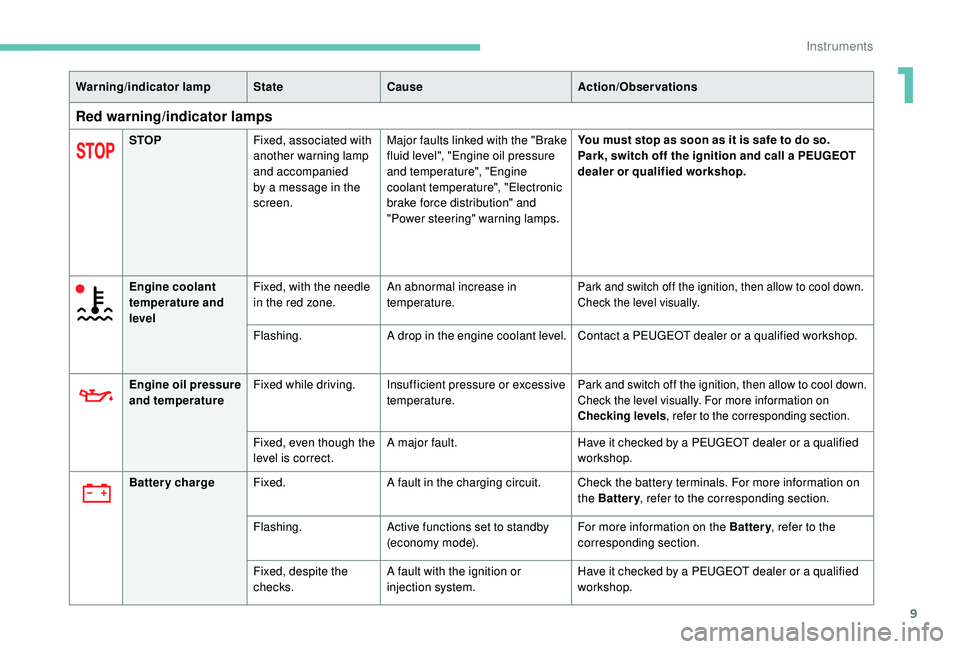
Warning/indicator lampStateCause Action/Observations
Red warning/indicator lamps
STOPFixed, associated with
another warning lamp
and accompanied
by a message in the
screen. Major faults linked with the "Brake
fluid level", "Engine oil pressure
and temperature", "Engine
coolant temperature", "Electronic
brake force distribution" and
"Power steering" warning lamps. You must stop as soon as it is safe to do so.
Park, switch off the ignition and call a PEUGEOT
dealer or qualified workshop.
Engine coolant
temperature and
level Fixed, with the needle
in the red zone.
An abnormal increase in
temperature.
Park and switch off the ignition, then allow to cool down.
Check the level visually.
Flashing.
A drop in the engine coolant level. Contact a PEUGEOT dealer or a qualified workshop.
Engine oil pressure
and temperature Fixed while driving. Insufficient pressure or excessive
temperature.
Park and switch off the ignition, then allow to cool down.
Check the level visually. For more information on
Checking levels, refer to the corresponding section.
Fixed, even though the
level is correct. A major fault.
Have it checked by a PEUGEOT dealer or a qualified
workshop.
Battery charge Fixed. A fault in the charging circuit. Check the battery terminals. For more information on
the Battery, refer to the corresponding section.
Flashing. Active functions set to standby
(economy mode). For more information on the Battery
, refer to the
corresponding section.
Fixed, despite the
checks. A fault with the ignition or
injection system. Have it checked by a PEUGEOT dealer or a qualified
workshop.
1
Instruments
Page 12 of 216
10
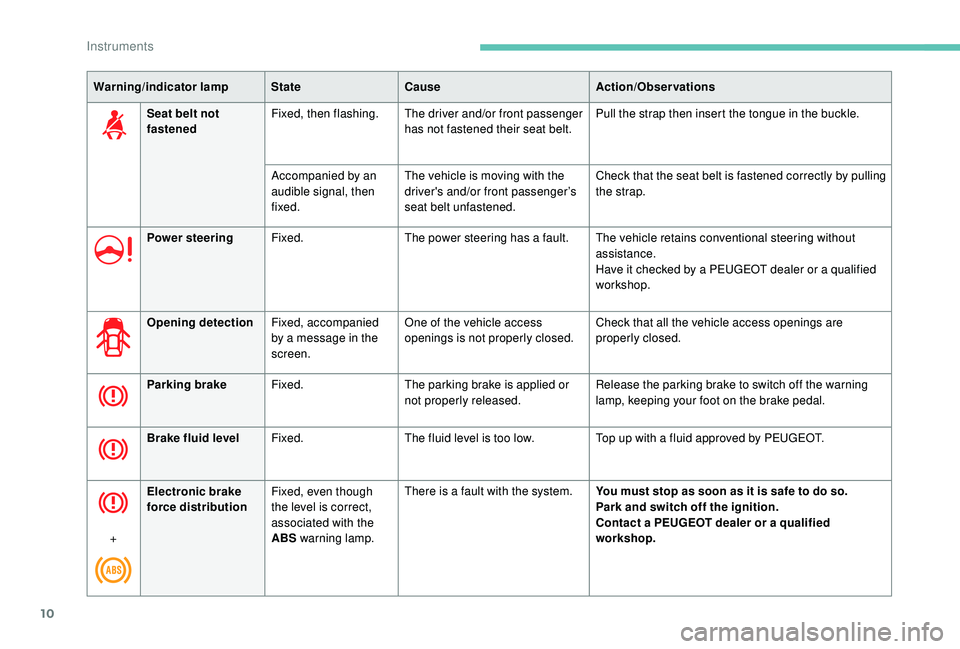
Warning/indicator lampStateCause Action/Observations
Seat belt not
fastened Fixed, then flashing.
The driver and/or front passenger
has not fastened their seat belt. Pull the strap then insert the tongue in the buckle.
Accompanied by an
audible signal, then
fixed. The vehicle is moving with the
driver's and/or front passenger’s
seat belt unfastened. Check that the seat belt is fastened correctly by pulling
the strap.
Power steering Fixed. The power steering has a fault. The vehicle retains conventional steering without
assistance.
Have it checked by a PEUGEOT dealer or a qualified
workshop.
Opening detection Fixed, accompanied
by a message in the
screen. One of the vehicle access
openings is not properly closed.
Check that all the vehicle access openings are
properly closed.
Parking brake Fixed. The parking brake is applied or
not properly released. Release the parking brake to switch off the warning
lamp, keeping your foot on the brake pedal.
Brake fluid level Fixed. The fluid level is too low. Top up with a fluid approved by PEUGEOT.
+ Electronic brake
force distribution
Fixed, even though
the level is correct,
associated with the
ABS
warning lamp. There is a fault with the system.
You must stop as soon as it is safe to do so.
Park and switch off the ignition.
Contact a PEUGEOT dealer or a qualified
workshop.
Instruments
Page 106 of 216
104
In some cases of particularly demanding use
(when towing the maximum load on a steep
gradient in high temperatures), the engine
power is automatically limited. In such a case,
the air conditioning is automatically switched
off to increase the available engine power.F
I
f this warning lamp and the
STOP warning lamp come on,
stop the vehicle and switch off
the engine as soon as possible.
New vehicle
Do not pull a trailer before having driven at
least 620
miles (1,000 kilometres).
Braking
Towing a trailer increases the braking distance.
To avoid overheating of the brakes, the use of
engine braking is recommended.
Ty r e s
F Check the tyre pressures of the towing vehicle and of the trailer, observing the
recommended pressures.
Lighting
F Check the electrical lighting and signalling on the trailer and the headlamp beam height
of your vehicle. For more information on adjusting
the Headlamp beam
, refer to the
corresponding section.
The rear parking sensors will be
deactivated automatically to avoid the
audible signal if a genuine PEUGEOT
towbar is used.
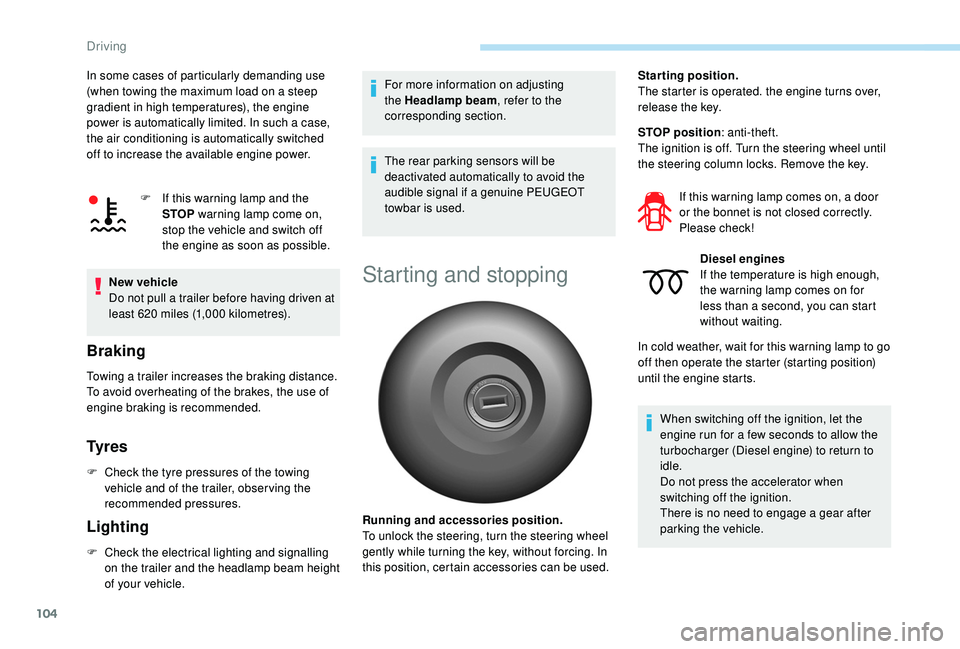
Starting and stopping
Running and accessories position.
To unlock the steering, turn the steering wheel
gently while turning the key, without forcing. In
this position, certain accessories can be used. Starting position.
The starter is operated. the engine turns over,
release the key.
STOP position
: anti-theft.
The ignition is off. Turn the steering wheel until
the steering column locks. Remove the key.
If this warning lamp comes on, a door
or the bonnet is not closed correctly.
Please check!Diesel engines
If the temperature is high enough,
the warning lamp comes on for
less than a second, you can start
without waiting.
In cold weather, wait for this warning lamp to go
off then operate the starter (starting position)
until the engine starts.
When switching off the ignition, let the
engine run for a few seconds to allow the
turbocharger (Diesel engine) to return to
idle.
Do not press the accelerator when
switching off the ignition.
There is no need to engage a gear after
parking the vehicle.
Driving
Page 111 of 216
109
With a 6 -speed electronic gearbox, for
your convenience when parking, the
STOP mode is not available for the few
seconds that follow disengagement of
reverse gear.
The Stop & Start system does not affect
the vehicle's functions, such as, for
example, braking, power steering, etc.
Never refuel with the engine in STOP
mode; you must switch off the ignition
using the key.
Special cases: STOP mode not
available
STOP mode is not triggered when:
- t he vehicle is on a steep slope (uphill or
downhill),
-
t
he driver's door is open,
-
t
he driver's seat belt is not fastened,
-
t
he vehicle has not exceeded 6 mph
(10
km/h) since the last engine start using
t h e key,
-
t
he engine is needed to maintain a
comfortable temperature in the passenger
compartment,
-
d
emisting is on, -
s
ome special conditions (battery charge,
engine temperature, braking assistance,
ambient temperature, etc.) are present
which require the engine to be running to
assure control of the system.
In this case, the " ECO" indicator
lamp flashes for a few seconds then
goes off.
This operation is perfectly normal.
Going into engine START mode
The " ECO" indicator lamp goes off
and the engine restarts:
-
w
ith a manual gearbox , when you fully
press the clutch pedal,
-
w
ith a 6-speed electronic gearbox
•
g
ear lever in position A or M , when you
release the brake pedal,
•
o
r gear lever in position N and the brake
pedal released, when you move the gear
selector to position A or M ,
•
o
r when you engage reverse gear. With a manual gearbox in STOP mode, if
a gear is engaged without fully pressing
the clutch pedal, a message is displayed
asking you to press the clutch pedal to
restart the engine.
Special cases: START mode
activated automatically
As a safety measure or to maintain comfort
levels in the vehicle, START mode is activated
automatically when:
-
y
ou open the driver's door,
-
y
ou unfasten the driver's seat belt,
-
t
he speed of the vehicle exceeds 16 mph
(25
km/h) with a manual gearbox or 7 mph
(11
km/h) with an electronic 6 -speed
gearbox,
-
s
ome special conditions (battery charge,
engine temperature, braking assistance,
ambient temperature, etc.) are present
which require the engine to be running to
assure control of the system or vehicle.
In this case, the " ECO" indicator
lamp flashes for a few seconds then
goes off.
This operation is perfectly normal.
6
Driving
Page 138 of 216
136
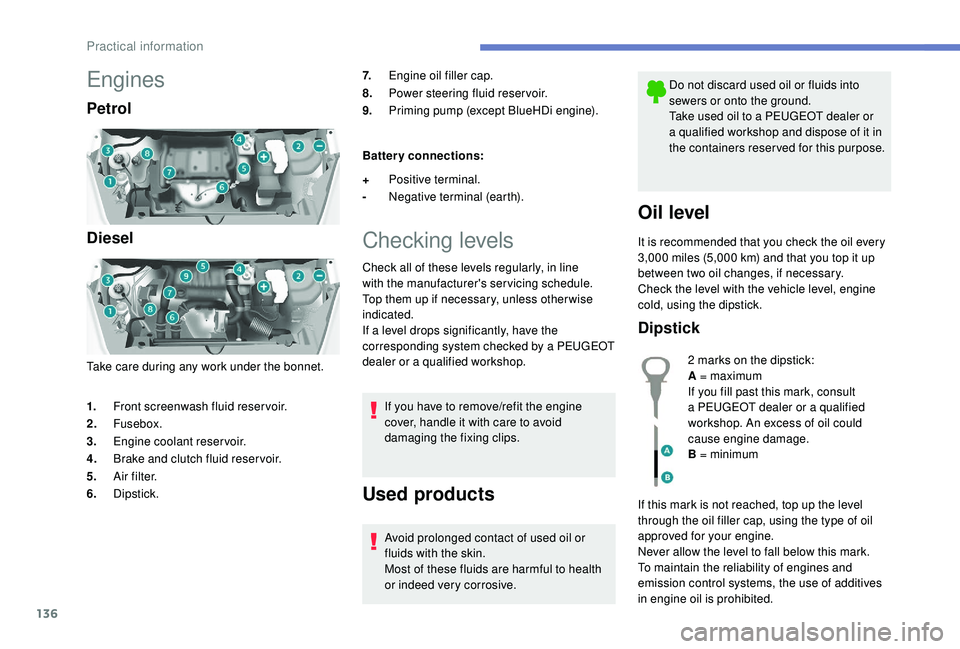
Engines
Petrol
Diesel
Take care during any work under the bonnet.7.
Engine oil filler cap.
8. Power steering fluid reservoir.
9. Priming pump (except BlueHDi engine).
Battery connections:
Checking levels
Check all of these levels regularly, in line
with the manufacturer's servicing schedule.
Top them up if necessary, unless other wise
indicated.
If a level drops significantly, have the
corresponding system checked by a PEUGEOT
dealer or a qualified workshop. If you have to remove/refit the engine
cover, handle it with care to avoid
damaging the fixing clips.
Used products
Avoid prolonged contact of used oil or
fluids with the skin.
Most of these fluids are harmful to health
or indeed very corrosive. Do not discard used oil or fluids into
sewers or onto the ground.
Take used oil to a PEUGEOT dealer or
a qualified workshop and dispose of it in
the containers reser ved for this purpose.
Oil level
It is recommended that you check the oil every
3,000
miles (5,000 km) and that you top it up
between two oil changes, if necessary.
Check the level with the vehicle level, engine
cold, using the dipstick.
Dipstick
1. Front screenwash fluid reser voir.
2. Fusebox.
3. Engine coolant reservoir.
4. Brake and clutch fluid reser voir.
5. A i r f i l t e r.
6. Dipstick. +
Positive terminal.
- Negative terminal (earth).
2 marks on the dipstick:
A = maximum
If you fill past this mark, consult
a PEUGEOT dealer or a qualified
workshop. An excess of oil could
cause engine damage.
B = minimum
If this mark is not reached, top up the level
through the oil filler cap, using the type of oil
approved for your engine.
Never allow the level to fall below this mark.
To maintain the reliability of engines and
emission control systems, the use of additives
in engine oil is prohibited.
Practical information
Page 139 of 216
137
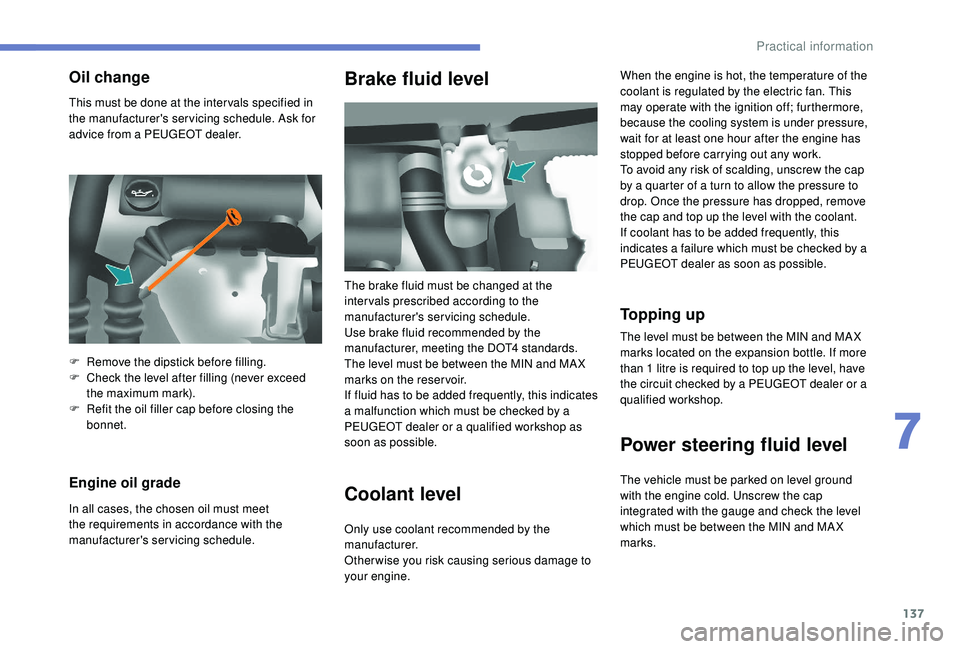
This must be done at the inter vals specified in
the manufacturer's servicing schedule. Ask for
advice from a PEUGEOT dealer.
Engine oil grade
In all cases, the chosen oil must meet
the requirements in accordance with the
manufacturer's servicing schedule.
Brake fluid level
Coolant levelWhen the engine is hot, the temperature of the
coolant is regulated by the electric fan. This
may operate with the ignition off; furthermore,
because the cooling system is under pressure,
wait for at least one hour after the engine has
stopped before carrying out any work.
To avoid any risk of scalding, unscrew the cap
by a quarter of a turn to allow the pressure to
drop. Once the pressure has dropped, remove
the cap and top up the level with the coolant.
If coolant has to be added frequently, this
indicates a failure which must be checked by a
PEUGEOT dealer as soon as possible.
To p p i n g u p
Oil change
The brake fluid must be changed at the
inter vals prescribed according to the
manufacturer's servicing schedule.
Use brake fluid recommended by the
manufacturer, meeting the DOT4 standards.
The level must be between the MIN and MA X
marks on the reservoir.
If fluid has to be added frequently, this indicates
a malfunction which must be checked by a
PEUGEOT dealer or a qualified workshop as
soon as possible.
Only use coolant recommended by the
manufacturer.
Otherwise you risk causing serious damage to
your engine.
F
R
emove the dipstick before filling.
F
C
heck the level after filling (never exceed
the maximum mark).
F
R
efit the oil filler cap before closing the
bonnet. The level must be between the MIN and MA X
marks located on the expansion bottle. If more
than 1
litre is required to top up the level, have
the circuit checked by a PEUGEOT dealer or a
qualified workshop.
Power steering fluid level
The vehicle must be parked on level ground
with the engine cold. Unscrew the cap
integrated with the gauge and check the level
which must be between the MIN and MA X
marks.
7
Practical information
Page 145 of 216
143
Temporary puncture
repair kit
The kit is located in a storage compartment
under the front seat.
Vehicles supplied with a temporary puncture
repair kit do not have a spare wheel or the
corresponding tools ( jack, wheelbrace, etc.).
The temporary puncture repair kit comprises a
compressor and a bottle of sealant.
Using the kit
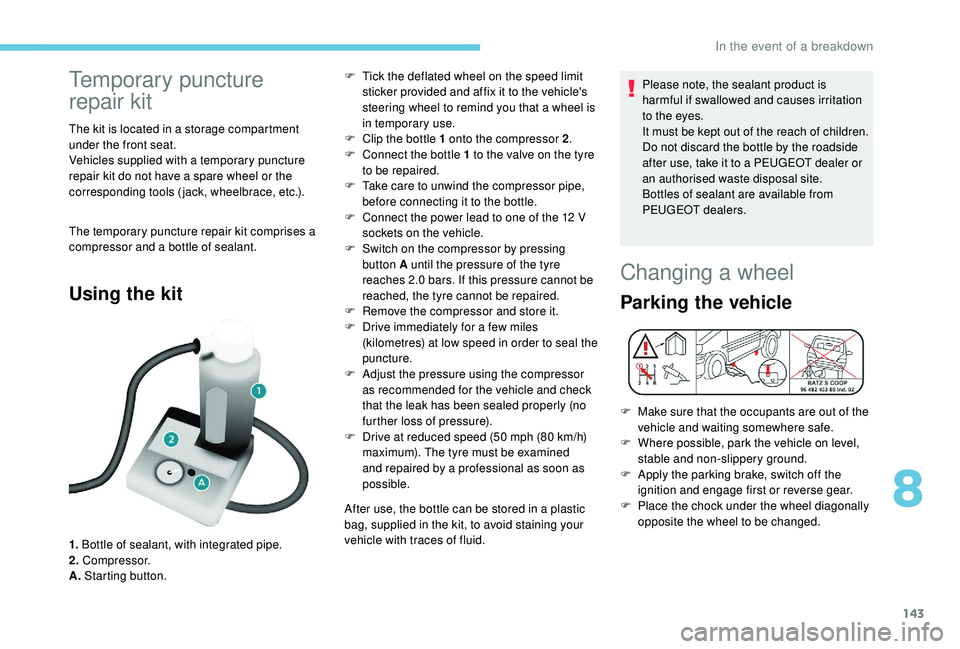
1. Bottle of sealant, with integrated pipe.
2. Compressor.
A. Starting button. F
T
ick the deflated wheel on the speed limit
sticker provided and affix it to the vehicle's
steering wheel to remind you that a wheel is
in temporary use.
F
C
lip the bottle 1 onto the compressor 2
.
F
C
onnect the bottle 1 to the valve on the tyre
to be repaired.
F
T
ake care to unwind the compressor pipe,
before connecting it to the bottle.
F
C
onnect the power lead to one of the 12 V
sockets on the vehicle.
F
S
witch on the compressor by pressing
button A until the pressure of the tyre
reaches 2.0 bars. If this pressure cannot be
reached, the tyre cannot be repaired.
F
R
emove the compressor and store it.
F
D
rive immediately for a few miles
(kilometres) at low speed in order to seal the
puncture.
F
A
djust the pressure using the compressor
as recommended for the vehicle and check
that the leak has been sealed properly (no
further loss of pressure).
F
D
rive at reduced speed (50 mph (80 km/h)
maximum). The tyre must be examined
and repaired by a professional as soon as
possible.
After use, the bottle can be stored in a plastic
bag, supplied in the kit, to avoid staining your
vehicle with traces of fluid. Please note, the sealant product is
harmful if swallowed and causes irritation
to the eyes.
It must be kept out of the reach of children.
Do not discard the bottle by the roadside
after use, take it to a PEUGEOT dealer or
an authorised waste disposal site.
Bottles of sealant are available from
PEUGEOT dealers.
Changing a wheel
Parking the vehicle
F Make sure that the occupants are out of the
vehicle and waiting somewhere safe.
F
W
here possible, park the vehicle on level,
stable and non-slippery ground.
F
A
pply the parking brake, switch off the
ignition and engage first or reverse gear.
F
P
lace the chock under the wheel diagonally
opposite the wheel to be changed.
8
In the event of a breakdown
Page 209 of 216
175
AAccessories ..................................... 76, 13 4 -13 5
Active City Brake ............................... .....120 -121
AdBlue
® ............................................ 13, 140 -141
Adjusting seat ................................................. 38
Adjusting the date
........................................... 24
Adjusting the time
..................................... 23 -24
Advanced Grip Control
................................... 80
Advice on driving
.................................. 103 -104
Airbags
...............................
.......................85, 90
Airbags, curtain
......................................... 87- 8 8
Airbags, front ...................................... 86, 88 , 91
Airbags, lateral
.......................................... 86, 88
Air conditioning, automatic
.............................69
Air conditioning, manual
................................. 69
A
nti-lock braking system (ABS) ......................79
Anti-pinch
........................................................ 36
A
nti-slip regulation (ASR)
............................... 12
Apple CarPlay connection
.............................. 13
Armrest
................
...................................... 38-39
Assistance call
...............................
............7 7-78
Audio streaming (Bluetooth)
.......................10, 6
BBattery ................................................... 13 8, 15 8
Battery, remote control ...................................27
Blanking screen (snow shield)
......................13 0
BlueHDi
........................................... 21, 140 , 160
Bluetooth (hands-free)
....................... 1
4 -16, 6-8
Bluetooth (telephone)
................................. 1
4 -16
Bonnet
........................................................... 13 5
Boot lid
...................................................... 29-30
Brake discs
............................................ 13 8, 140
Brakes
................................................... 13 8, 140
Bulbs (changing)
.................................... 14 9 -15 0
CCab, crew ............................... ...................50-52
Cable, audio ...................................................... 9
Cable, Jack
....................................................... 9
Cartridge, fragrance
....................................... 58
CD
..................................................................... 5
CD, MP3
........................................................ 5-6
Central locking
.......................................... 33
-34
Changing a bulb
..................................... 1
4 9 -15 0
Changing a wiper blade
......................... 13
0 -131
Changing the remote control battery
..............26
Checking the levels
....................................... 13 6
Checks
................................................... 13 6 -14 0
Checks, routine
...................................... 13 8 -14 0
Child lock
................................................. 36, 102
Child seats
..................... 84,
89-90, 94-95 , 101
Child seats, conventional
................................94
Connection, Bluetooth
............................... 1
4 -16
Connection, MirrorLink
...................................12
Control, electric windows
................................36
Control, emergency door
................................ 29
C
ontrol, heated seats
...................................... 39
Control stalk, lighting
..........................15, 71 , 73
Control stalk, wipers
.................................. 7
3 -74
Courtesy lamp, front
....................................... 55
Cover, load space
............................... 60, 62- 63
Cruise control
......................................... 117-12 0
DDAB (Digital Audio
Broadcasting) - Digital radio ....................... 8
-9
Date (setting)
................................................... 24
Daytime running lamps, LED
..........................72
Deactivating the passenger's front airbag
....................................... 86, 90 -91
Dimensions
..............................
......169, 171-173
Direction indicators
......................................... 15
Display screen, instrument panel
.................108
Doors, rear
................................................ 30-32
Doors, side ............................... .................28-29
Doors, side-hinged ................................... 3
0-32
Driving abroad ................................................. 73
EElectric windows ............................................. 35
Electronic brake force distribution (EBFD) .....79
Electronic stability control (ESC)
........12,
79-80
Emergency braking assistance (EBA)
............79
Emergency call
.......................................... 7 7-78
Emissions control system, SCR
.............14, 140
Engine
........................................................... 13 6
Engine, Diesel
............................................... 128
Engine, petrol
...............................
.................128
Engines
......................................................... 161
FFilling the fuel tank ................................12 6, 128
Filter, air ........................................................ 13 8
Filter, oil
................
.................................. 13 8 -13 9
Filter, passenger compartment
.....................13 8
Fittings, front
................................................... 55
Fittings, interior
......................................... 5
4-56
Fittings, rear
.................................................... 60
Flap, fuel filler
................................................ 126
Fluid, brake
................................................... 13 6
Fluid, engine coolant
..................................... 13 6
Fluid, power steering
.................................... 13
6
Foglamps, front
............................................... 73
Fragrance diffuser ..................................... 57- 5 9
Frequency (radio)
........................................... 7- 8
Fuel ................................................................ 128
.
Alphabetical index