oil PONTIAC BONNEVILLE 1993 Owner's Manual
[x] Cancel search | Manufacturer: PONTIAC, Model Year: 1993, Model line: BONNEVILLE, Model: PONTIAC BONNEVILLE 1993Pages: 322, PDF Size: 16.31 MB
Page 234 of 322
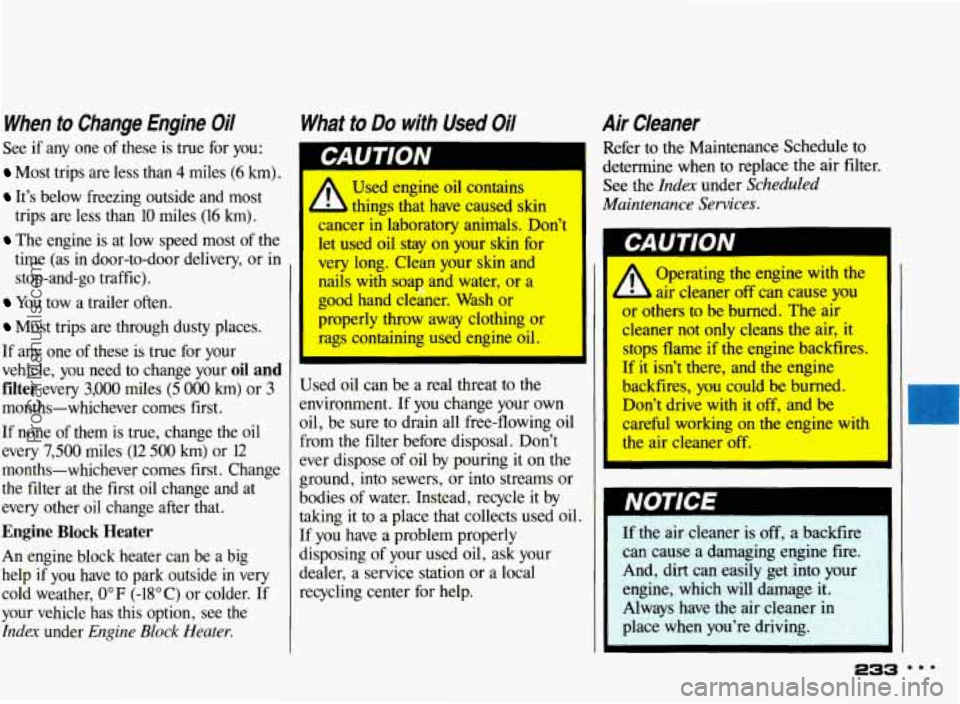
When to Change Engine Oil
See if any one of these is true for you:
Most trips are less than 4 miles (6 km).
It’s below freezing outside and most
trips are less than
10 miles (16 km).
The engine is at low speed most of the
time (as
in door-to-door delivery, or in
stop-and-go traffic).
You tow a trailer often.
Most trips are through dusty places.
If any one of these is true for your
vehicle, you need to change your oil
and
filter every 3,000 miles (5 000 km) or 3
months-whichever comes first.
If none of them is true, change the oil
every
7,500 miles (12 500 km) or 12
months-whichever comes first. Change
the filter at the first oil change and at
every other oil change after that.
Engine Block Heater
An engine block heater can be a big
help if you have to park outside
in very
cold weather,
0°F (-18OC) or colder. If
your vehicle has this option, see the
Index under Engine Block Heater.
What to Do with Used Oil Air Cleaner
things that have caused skin
1 cancer in laboratory animals. Don’t
let used
oil stay on your skin fbr
very long. Clean your skin and
nails with soaQ and water, or a
good hand cleaner. Wash or
properly throw away clothing or
rags containing used engine oil. Refer
to the Maintenance Schedule to
determine when to replace the air filter.
See the
Index under Scheduled
Maintenance Services.
Used oil can be a real threat to the I
environment. If you change your own
oil, be sure
to drain all free-flowing oil
from the filter before disposal. Don’t
ever dispose of oil by pouring it on the
ground,
into sewers, or into streams or
bodies
of water. Instead, recycle it by
taking it to a place that collects used oil.
If you have a problem properly
disposing
of your used oil, ask your
dealer, a service station or a local
recycling center for help.
1%
CAUTION
Operating the engine with the
air cleaner
off can cause you
uz others to be burned. The air
cleaner not
only cleans the air, it
stops flame if the engine backfires.
If it isn’t there, and the engine
backfires, you could be burned.
I Don’t drive with it off, and be
I careful working on the engine with
I the air cleaner off. I
If the air cleaner is off, a backfire
can cause a damaging engine fire.
And, dirt can easily get into your
engine, which will damage it.
Always have
the air cleaner in
place when you’re driving.
...
ProCarManuals.com
Page 237 of 322
Service & Appearance Care
Automatic Transax/e Fluid
When to Check and Change:
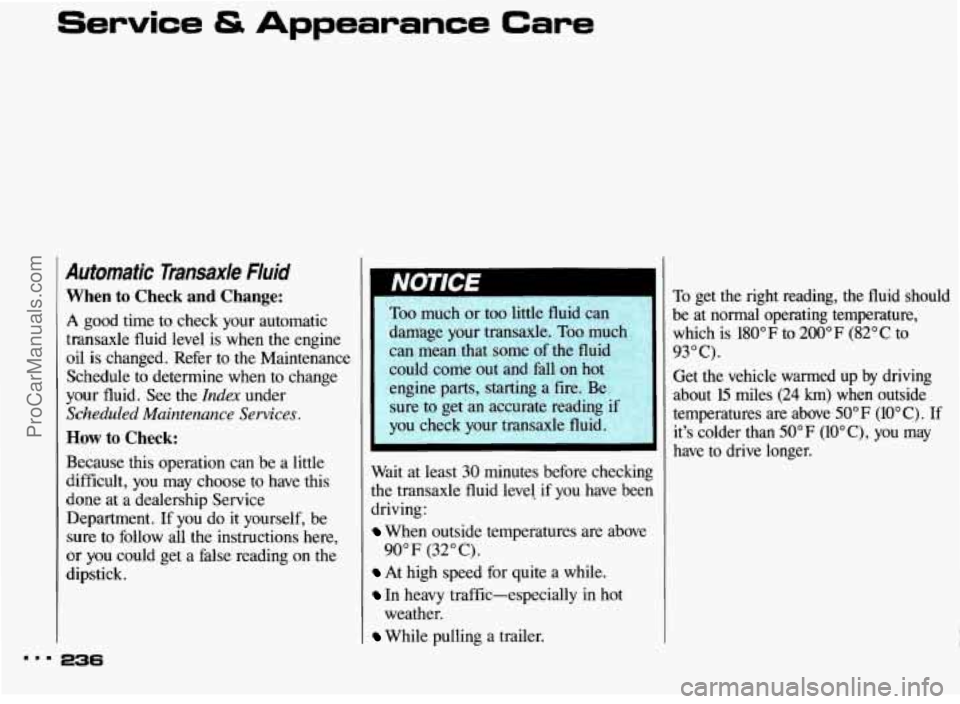
A good time to check your automatic
transaxle fluid level is when the engine
oil is changed. Refer to the Maintenance
Schedule to determine when to change
your fluid. See the
Index under
Scheduled Maintenance Services.
How to Check:
Because this operation can be a little
difficult, you may choose to have this
done at a dealership Service
Department. If
you do it yourself, be
sure to follow all the instructions here,
or you could get a false reading on the
dipstick.
Too much or too little fluid can
damage your transaxle.
Too much
can mean that some of the fluid
could come
out and fall on hot
engine parts, starting
a fire. Be
sure to get an accurate reading if
you check your transaxle fluid.
Wait at least
30 minutes before checking
the transaxle fluid level if
you have been
driving:
When outside temperatures are above
At high speed for quite a while.
In heavy traffic-especially in hot
While pulling a trailer.
90" F (32" C).
weather.
To get the right reading, the fluid should
be at normal operating temperature,
which is
180°F to 200°F (82°C to
93" C).
Get the vehicle warmed up by driving
about
15 miles (24 km) when outside
temperatures are above
50" F (10" C). If
it's colder than
50°F (lO°C), you may
have
to drive longer.
ProCarManuals.com
Page 239 of 322
Service & Appearance Care
Automatic Transaxle Fluid (CONTJ
How to Add Fluid:
Refer to the Maintenance Schedule to
determine what kind
of transaxle fluid to
use. See the
Index under Fluids &
Lubricants.
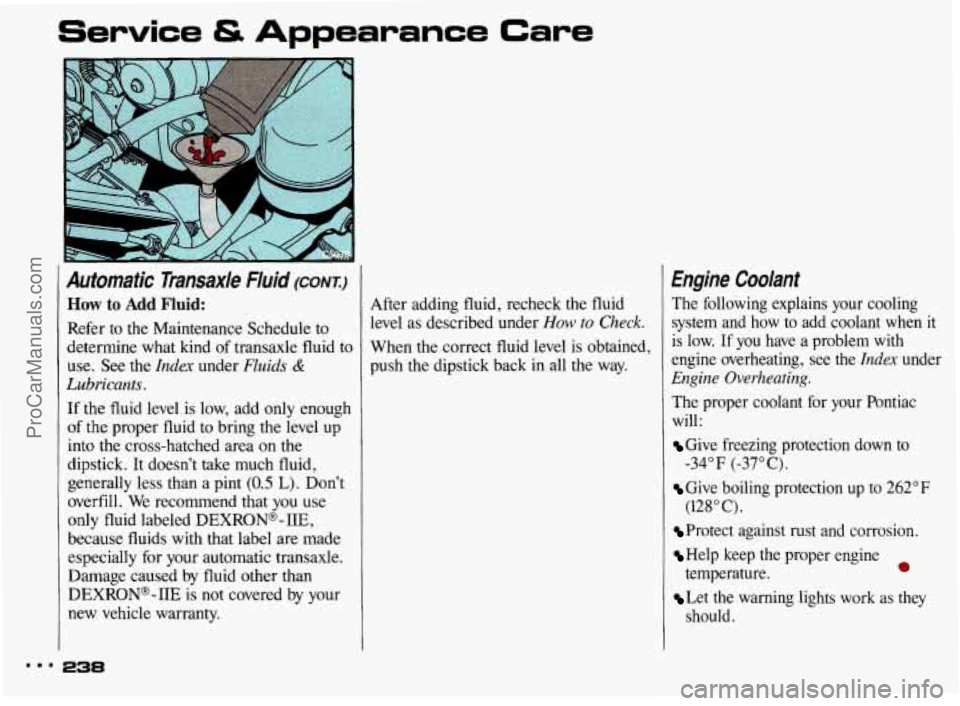
If the fluid level is low, add only enough
of the proper fluid to bring
the level up
into the cross-hatched area on the
dipstick. It doesn't take much fluid,
generally less than a pint
(0.5 L). Don't
overfill. We recommend that you use
only fluid labeled DEXRON@-IIE,
because fluids with that label are made
especially for your automatic transaxle.
Damage caused by fluid other than
DEXRON@-IIE is not covered by your
new vehicle warranty. After adding
fluid, recheck the fluid
level as described under
How to Check.
When the correct fluid level is obtained,
push the dipstick back
in all the way.
Engine Coolant
The following explains your cooling
system and how to add coolant when
it
is low. If you have a problem with
engine overheating, see the Index under
Engine Overheating.
The proper coolant for your Pontiac
will:
Give freezing protection down to
Give boiling protection up to 262°F
Protect against rust and corrosion.
-34°F (-37°C).
(128" C).
Help keep the proper engine
temperature.
a
Let the warning lights work as they
should.
I.. 238
ProCarManuals.com
Page 240 of 322
What to Use:
Use a mixture of one-half clean water
‘preferably distilled) and one-half
intifreeze that meets
“GM Specification
1825-M,” which won’t damage
aluminum parts. You can also use a
recycled coolant conforming to
GM
Specification 1825-M with a complete
2oolant flush and refill. If you use this
mixture, you don’t need to add anything
:1 se .
Adding only plain water to
your cooling system can be
wgerous. Plain water, or some
other liquid like alcohol, can boil
:fore the proper coolant mix will.
Your vehicle’s coolant warning
system is set for the proper coolant
mix. With plain water or the -
wrong mix, your engine couId get
too hot but you wouldn’t get the
overheat warning. Your engine
could catch fire and you or others
could be burned. Use a S0/50 mix
of clean water and a proper
antifreeze.
If you use an improper coolant
mix, your engine could overheat
and be badly damaged. The repair
cost wouldn’t be covered by your
warranty.
Too much water in the
mix can freeze and crack the
engine, radiator, heater core
other parts.
ProCarManuals.com
Page 245 of 322
Service & Appearance Care
I
Brake Master Cylinder (CONI:)
your linings are worn, then you’ll have
too much fluid when you get new brake
linings.
You should add (or remove)
brake fluid, as necessary, only when
work is done on the brake hydraulic
system.
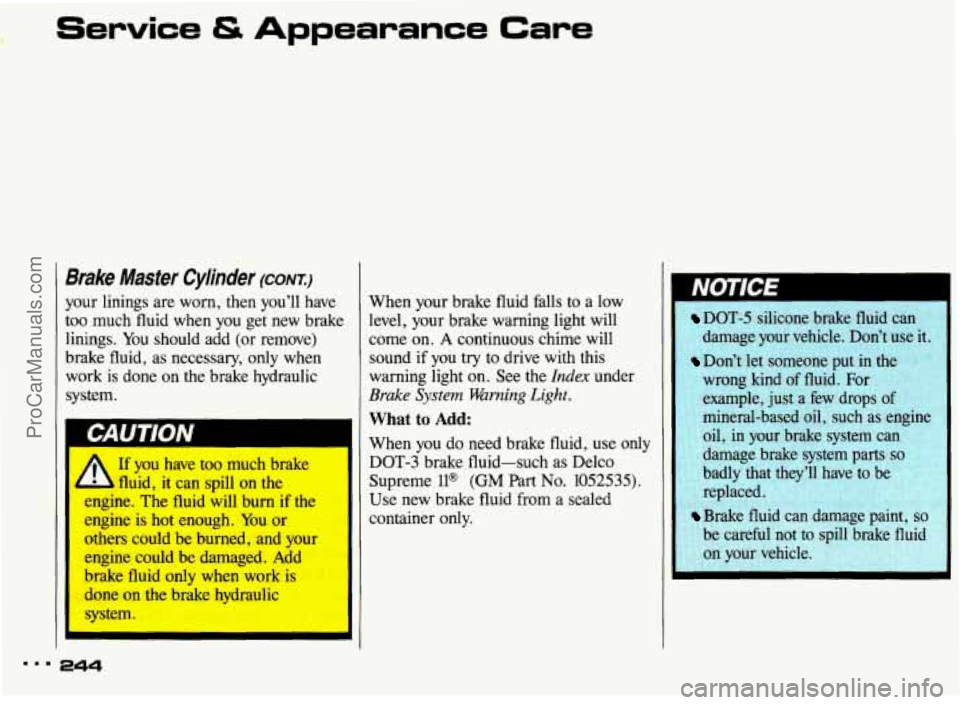
, If you have too much brake
hid,
it can spill on the
engine. The fluid will burn if the
engine is hot enough.
You or
others could be burned, and your
engine could be damaged. Add
brake fluid only when work is
done on the brake hydraulic
system.
244
When your brake fluid falls to a low
level, your brake warning light will
come on. A continuous chime will
sound if
you try to drive with this
warning light on. See the
Index under
Brake System Warning Light.
What to Add:
When you do need brake fluid, use only
DOT-3 brake fluid-such as Delco
Supreme
ll@ (GM Part No. 1052535).
Use new brake fluid from a sealed
container only.
DOT-5 silicone brake fluid can
damage your vehicle. Don’t use
it.
Don’t let someone put in the
wrong kind
of fluid. For
example, just a few drops of
mineral-based oil, such as engine
oil, in your brake system can
damage brake system parts
so
badly that they’ll have to be replaced.
Brake fluid can damage paint, so
be careful not to spill brake fluid
on your vehicle.
ProCarManuals.com
Page 260 of 322
Using Solvent-Type Cleaner on
Fabric
First, see if you have to use solvent-type
cleaner at all. Some spots and stains will
clean off better with just water and mild
soap.
If you need to use it, then:
Gently scrape excess soil from the
trim material with a clean, dull knife
or scraper. Use very little cleaner,
light pressure and clean cloths (preferably cheesecloth). Cleaning
should start at the outside of the stain,
“feathering” toward the center. Keep
changing to a clean section of the
cloth.
When you clean a stain from fabric,
immediately dry the area with an air
hose, hair dryer, or heat lamp to help
prevent a cleaning ring. (See the
previous
NOTICE.)
Special Cleaning Problems
Greasy or Oily Stains:
Like grease, oil, butter, margarine, shoe
polish, coffee with cream, chewing
gum, cosmetic creams, vegetable oils,
wax crayon, tar and asphalt.
Carefully scrape off excess stain.
Then follow the solvent-type
Shoe polish, wax crayon, tar and
instructions
above.
asphalt will stain if
left on a vehicle
seat fabric. They should be removed
as soon as possible. Be careful,
because the cleaner will dissolve them
and may cause them
to bleed.
Non-Greasy Stains:
Like catsup, coffee (black), egg, fruit,
fruit juice, milk, soft drinks, wine,
vomit, urine and blood.
0 Carefully scrape off excess stain, then
sponge the soiled area with cool water.
If a stain remains, follow the foam-
type instructions above.
If an odor lingers after cleaning vomit
or urine, treat
the area with a water/
baking soda solution:
1 teaspoon
(5 ml) of baking soda to 1 cup
(250 ml) of lukewarm water.
Finally, if needed, clean lightly with
solvent-type cleaner.
Combination Stains:
Like candy, ice cream, mayonnaise,
chili sauce and unknown stains.
Carefully scrape off excess stain, then
clean with cool water and allow to
dry.
If a stain remains, clean it with
solvent-type cleaner.
259
ProCarManuals.com
Page 264 of 322
Sheet Metal Damage
If your vehicle is damaged and requires
sheet metal repair or replacement, make
sure the body repair shop applies anti-
corrosion material to the parts repaired
or replaced to restore corrosion
protection.
Foreign Material
Calcium chloride and other salts, ice
melting agents, road oil and tar, tree sap,
bird droppings, chemicals from
industrial chimneys, and other foreign
matter can damage your vehicle’s finish
if they remain
on painted surfaces. Use
cleaners that are marked safe for painted
surfaces for these stains.
Finish Damage
Any stone chips, fractures or deep
scratches in the finish should be
repaired right away. Bare metal will
corrode quickly and may develop into a
major repair expense.
Minor chips and scratches can be
repaired with touch-up materials
available from your dealer or other
service outlets. Larger areas
of finish
damage can be corrected in
your
dealer’s body and paint shop.
ProCarManuals.com
Page 268 of 322
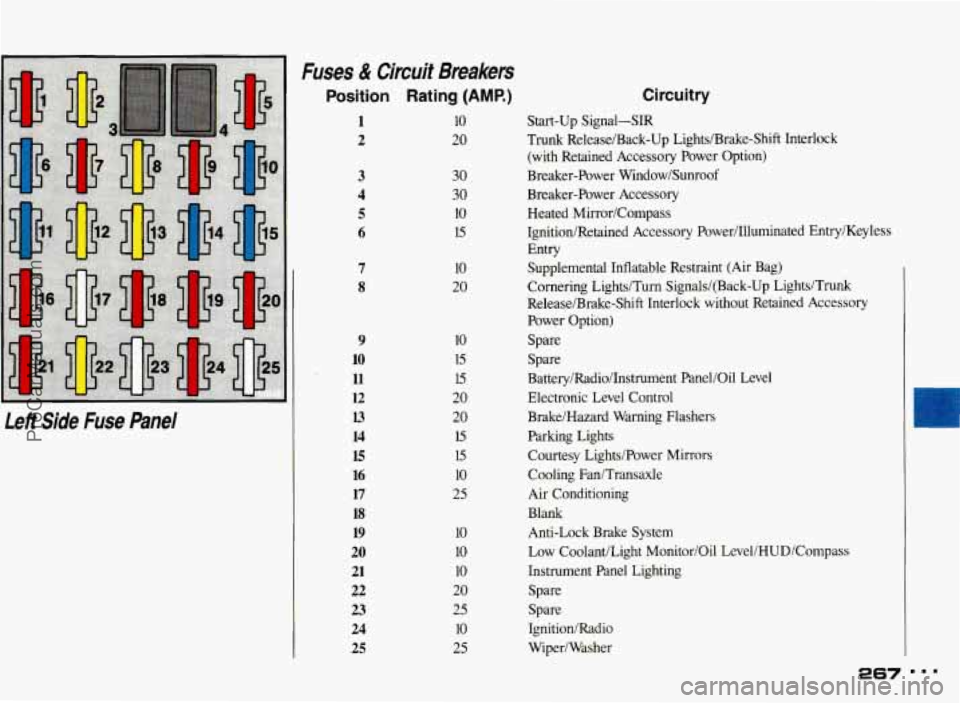
Left Side Fuse Panel Fuses
& Circuit Breakers
Position Rating (AMP.)
7
8
9
10
ll
12
13
14
15
16
17 18
19
20 21
22
23 24
25
10
20
30
30
10
15
10
20
10
15
15
20
20
15
15
10
25
10
10
10
20
25
10
25
Circuitry
Start-up Signal-SIR
Trunk Release/Back-Up Lights/Brake-Shift Interlock (with Retained Accessory Power Option)
Breaker-Power Window/Sunroof
Breaker-Power Accessory Heated Mirror/Compass
IgnitiodRetained Accessory Power/Illuminated EntryKeyless
Entry
Supplemental Inflatable Restraint (Air Bag)
Cornering Lights/Turn Signals/(Back-Up Lights/Trunk
Release/Brake-Shift Interlock without Retained Accessory Power Option)
Spare
Spare
Battery/Radio/Instrument Panel/Oil Level
Electronic Level Control
Brake/Hazard Warning Flashers Parking Lights Courtesy Lights/Power Mirrors
CooIing Fan/Transaxle
Air Conditioning
Blank Anti-Lock Brake System Low Coolant/Light Monitor/Oil Level/HUD/Compass
Instrument Panel Lighting Spare
Spare
IgnitiodRadio
WipedWasher
267
ProCarManuals.com
Page 271 of 322
Service & Appearance Care
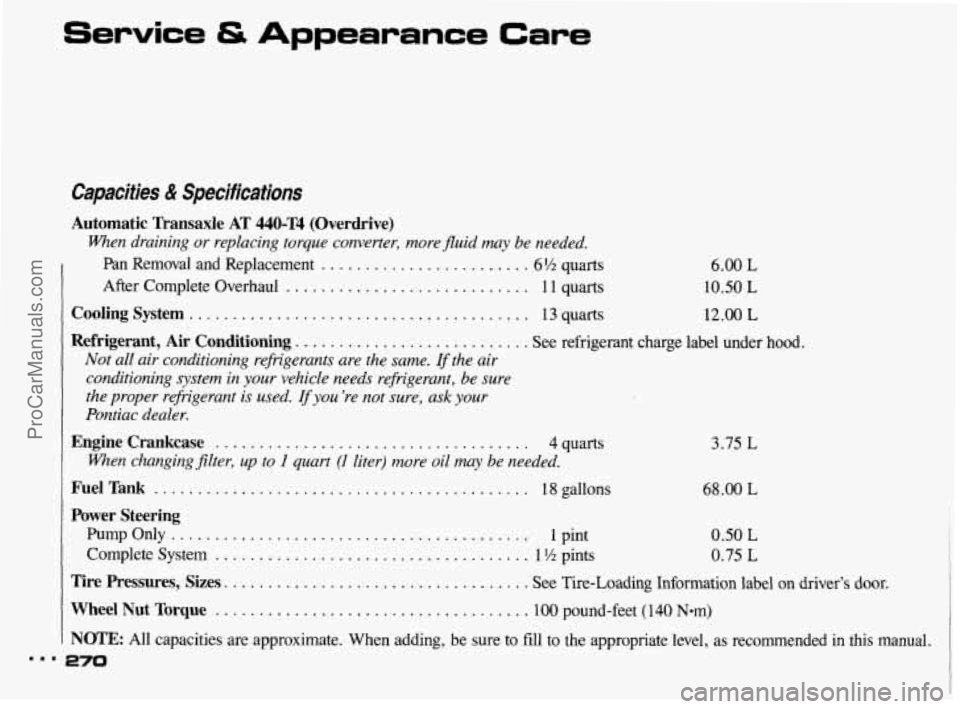
Capacities & Specifications
Automatic Transaxle AT 440-T4 (Overdrive)
When draining or replacing torque converter, more fluid may be needed.
Pan Removal and Replacement ........................ 6% quarts
After Complete Overhaul
............................ 1 1 quarts
I Cooling System ....................................... 13 quarts
6.00 L
10.50 L
12.00 L
Refrigerant, Air Conditioning ........................... See refrigerant charge label under hood.
Not all air conditioning refrzgerants are the same. If the air
conditioning system in your vehicle needs refiigerant, be sure
the proper refngerant is used.
If you 're not sure, ask your
Pontiac dealer.
Engine Crankcase .................................... 4 quarts
Fuel Tank ........................................... 18 gallons
When changing filter, up to I quart (I liter) more oil may be needed.
3.75 L
68.00 L
Power Steering
Pump Only ......................................... 1 pint 0.50 L
Complete System .................................... 1 !h pints 0.75 L
Tire Pressures, Sizes. .................................. See Tire-Loading Information label on driver's door.
Wheel Nut Torque ..................................... 100 pound-feet (140 Nom)
NOTE: All capacities are approximate. When adding, be sure to fill to the appropriate level, as recommended in this manual.
270 I..
ProCarManuals.com
Page 272 of 322
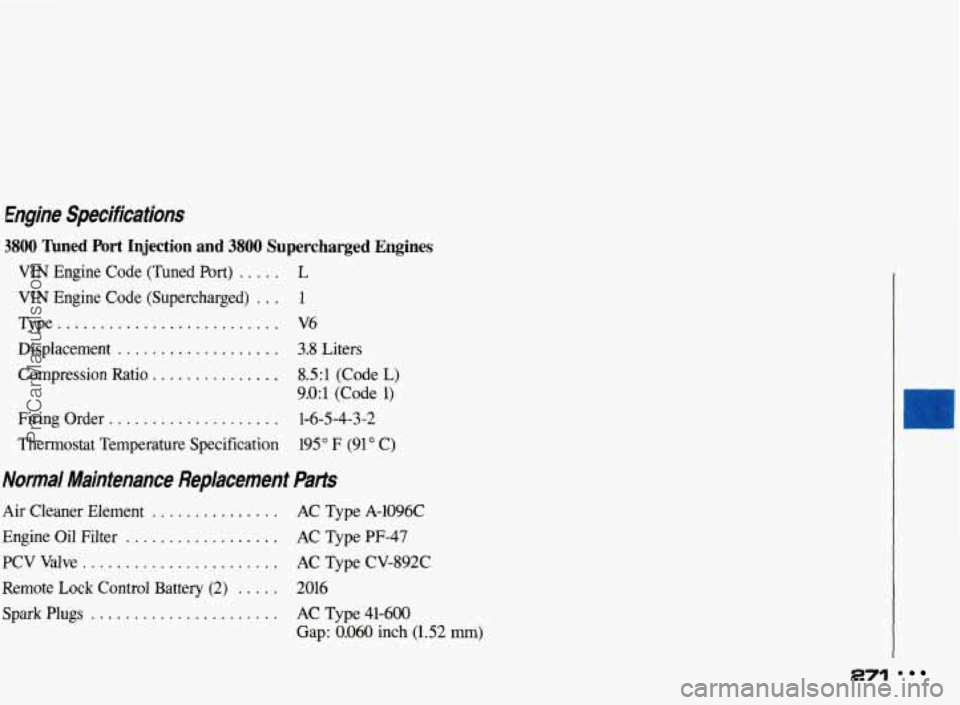
Engine Specifications
3800 fined Port Injection and 3800 Supercharged Engines
VIN Engine Code (Tuned Port) ..... L
VIN Engine Code (Supercharged) ... 1
Type .......................... V6
Displacement
................... 3.8 Liters
Compression Ratio
............... 8S:l (Code L)
9.0:l (Code 1)
Firing Order .................... 1-6-5-4-3-2
Thermostat Temperature Specification 195"
F (91 O C)
Normal Maintenance Replacement PaHs
Air Cleaner Element ............... AC Type A-1096C
Engine Oil Filter
.................. AC Type PF-47
PCV
Valve ....................... AC Type CV-892C
Remote
Lock Control Battery (2) ..... 2016
Spark Plugs ...................... AC Type 41-600
Gap: 0.060 inch (1.52
mm)
n
271
ProCarManuals.com