towing PONTIAC BONNEVILLE 1993 Owners Manual
[x] Cancel search | Manufacturer: PONTIAC, Model Year: 1993, Model line: BONNEVILLE, Model: PONTIAC BONNEVILLE 1993Pages: 322, PDF Size: 16.31 MB
Page 63 of 322
5 & Controls
Park
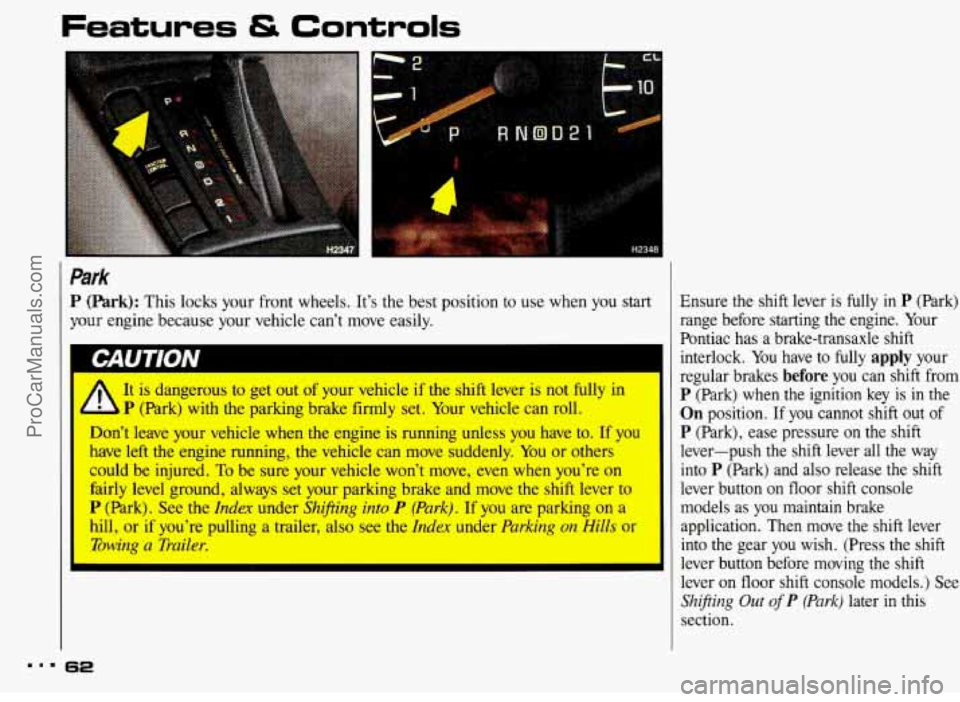
P (Park): This locks your front wheels. It’s the best position to use when you start
your engine because your vehicle can’t move easily.
1 It is dangerous to get out of your vehicle if the shift lever is not my in
Don’t leave your vehicle when the engine is running unless you have to. If you
have left the engine running, the vehicle can move suddenly. You or others
could be injured. To be sure your vehicIe won’t move, even when you’re on
fkirly level ground, always set your parking brake and move the shift lever to
P (Fark). See the Inda under Shiping into P (Park). If you are parking on a
hill, or if you’re pulling a trailer, also see the Inda under Parking on HilZs or
Towing a llailer.
- P (park) with the parking brake firmly set. Your vehicle can roll.
Ensure the shift lever is fully in P (Park)
range before starting the engine. Your
Pontiac has a brake-transaxle shift
interlock. You have to fully
apply your
regular brakes
before you can shift from
P (Park) when the ignition key is in the
On position. If you cannot shift out of
P (Park), ease pressure on the shift
lever-push the shift lever all the way into
P (Park) and also release the shift
lever button
on floor shift console
models as you maintain brake
application. Then move the shift lever
into the gear you wish. (Press the shift
lever button before moving the shift
lever on floor shift console models.) See
Shifting Out of P (Park} later in this
section.
I.. 62
ProCarManuals.com
Page 66 of 322
If your vehicle seems to start up
rather slowly, or if it seems not to
shift gears
as you go faster,
something may be wrong with a
transaxle system sensor. If you
drive very far that way, your
vehicle can be damaged.
So, if this
happens, have your vehicle
serviced right away. Until
then,
you can use 2 (Second Gear) when
vou are driving less than
35 mDh
i56 km/h) anza (0
higher speeds.
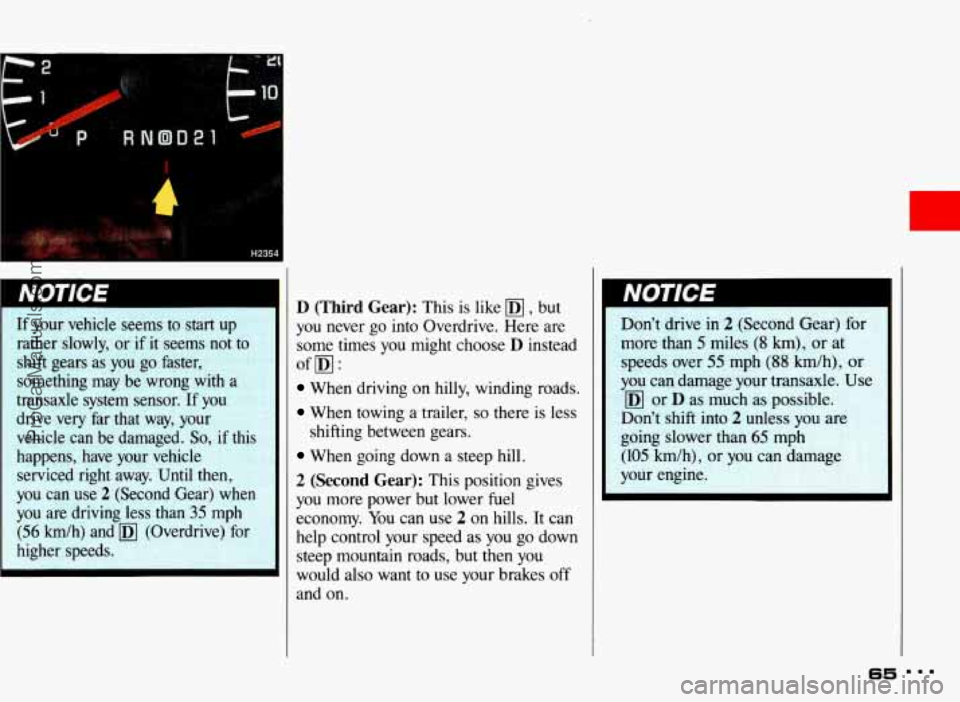
D (Third Gear): This is like , but
you never go into Overdrive. Here are
some times you might choose
D instead
When driving on hilly, winding roads.
When towing a trailer, so there is less
When going down a steep hill.
2 (Second Gear): This position gives
you more power but lower fuel
economy.
You can use 2 on hills. It can
help control your speed as you go down
steep mountain roads, but then you
would also want to use your brakes
off
and on.
ofm:
shifting between gears.
r
Don't drive in 2 (Second Gear) for I
more than 5 miles (8 km), or at
speeds over
55 mph (88 km/h), or
you
can damage your transaxle. Use
or
D as much as possible.
Don't shift into
2 unless you are
going slower than
65 mph
(105 km/h), or you can damage
your engine.
65 mmm
ProCarManuals.com
Page 68 of 322
L-
Parking Brake
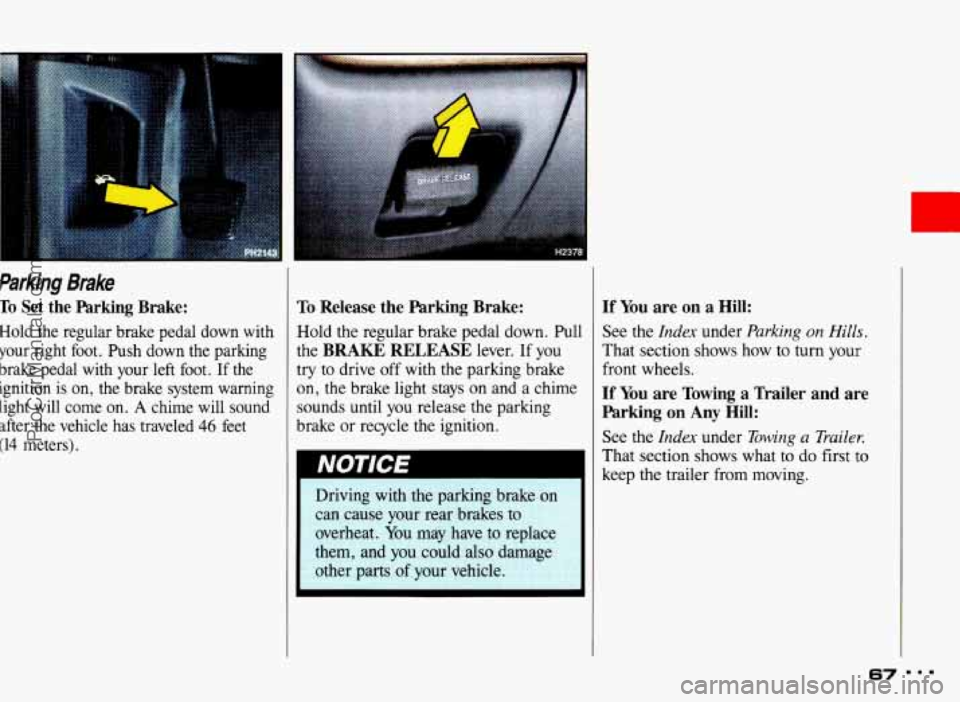
To Set the Parking Brake:
Hold the regular brake pedal down with
your right foot. Push down the parking
brake pedal with
your left foot. If the
ignition
is on, the brake system warning
light will come on.
A chime will sound
after the vehicle has traveled
46 feet
(14 meters),
To Release the Parking Brake:
Hold the regular brake pedal down. Pull
the
BRAKE RELEASE lever. If you
try to drive off with the parking brake
on, the brake light stays on and a chime
sounds until you release the parking
brake or recycle the ignition.
If You are on a Hill:
See the Index under Parking on Hitls.
That section shows how to turn your
front wheels.
If You are Towing a Trailer and are
Parking on
Any Hill:
See the Index under Towing a Trailer.
That section shows what to do first to
keep the trailer from moving.
67
c
...
ProCarManuals.com
Page 69 of 322
Features & Controls
1 Shifting Znto P (Park)
It can be dangerous to get out
~ b of your vehicle if the shift
lever is not fully
in P (Park) with
the parking brake firmly set. Your
vehicle can roll.
If you have left the
engine running, the vehicle can
move suddenly. You or others
could be injured.
To be sure your
vehicle won’t move, when you’re
on fairly level ground, use the
steps that follow. If you are parking
on a hill, or if you’re pulling a
trailer, also see the
Index under
rking on Hills or Towing a
rrailer.
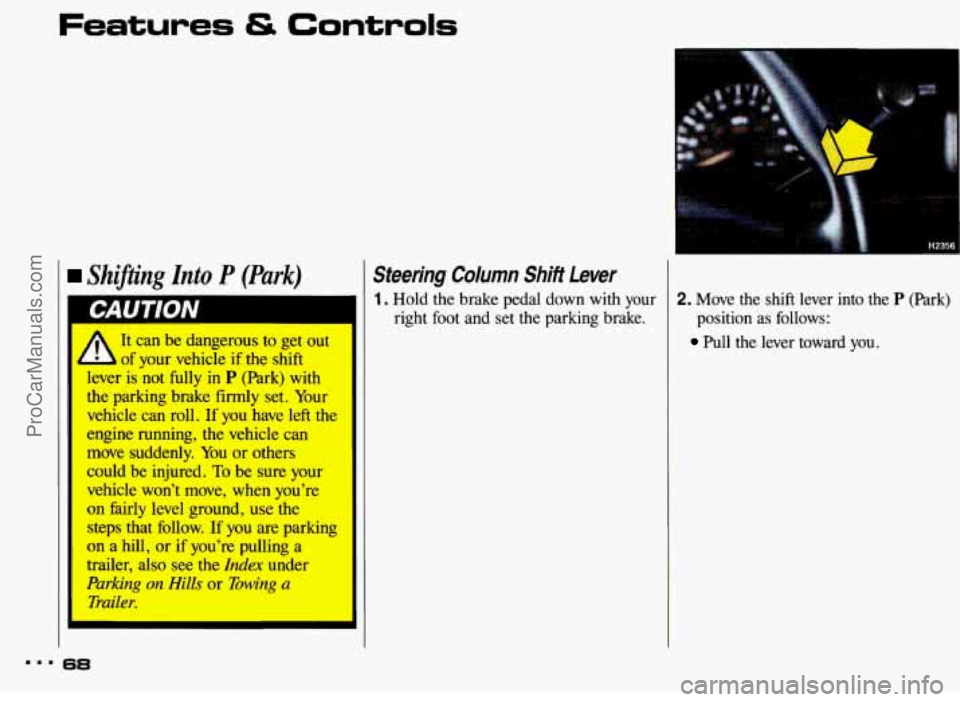
Steering Column Shift Lever
1. Hold the brake pedal down with your
right foot and set the parking brake. 2. Move the shift lever into the P (Park)
position as follows:
Pull the lever toward you.
68
ProCarManuals.com
Page 73 of 322
Features & Controls
Running Your Engine While You’re Parked
It’s better not to park with the engine running. But if you ever have to, here are
I some things to know.
II Idling the engine with the air system control OFF could allow dangerous
xhaust
into your vehicle (see the earlier CAUTION under Engine Exhaust). ‘
so, idling in a closed-in place can let deadly carbon monoxide (CO) into
your vehicle even
if the fan switch is at the highest setting. One place this can
happen is a garage. Exhaust-with CO-can come
in easily. Never park in a
garage
with the engine running.
Another closed-in place can be a blizzard. (See
the Index under Bliaard.)
It can be dangerous to get out of your vehicle if the shift lever is not fully in
P (Park) with the parking brake firmly set. Your vehicle can roll. Don’t leave
your vehicle when the engine is running unless you have to. If you’ve
left the
engine running, the vehicle can move suddenly. You or others could be
injured.
To be sure your vehicle won’t move, even when you’re on fairly level\
ground, always set your parking brake and move
the shift lever to P (Park).
If you are parking on a hill, or if you’re pulling a trailer, also see the Zndex
under Parking on Hills or Towing a Truik
rn.1 72
Horn
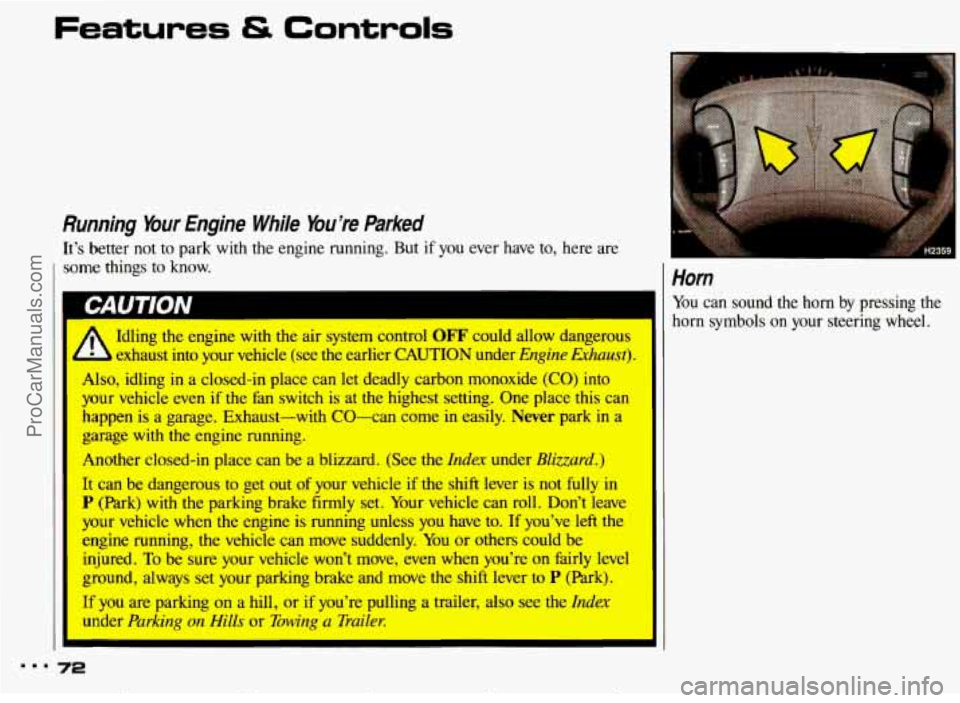
You can sound the horn by pressing the
horn
symbols on your steering wheel,
ProCarManuals.com
Page 75 of 322
Features & Controls
Turn Signal and Lane Change
Indicator
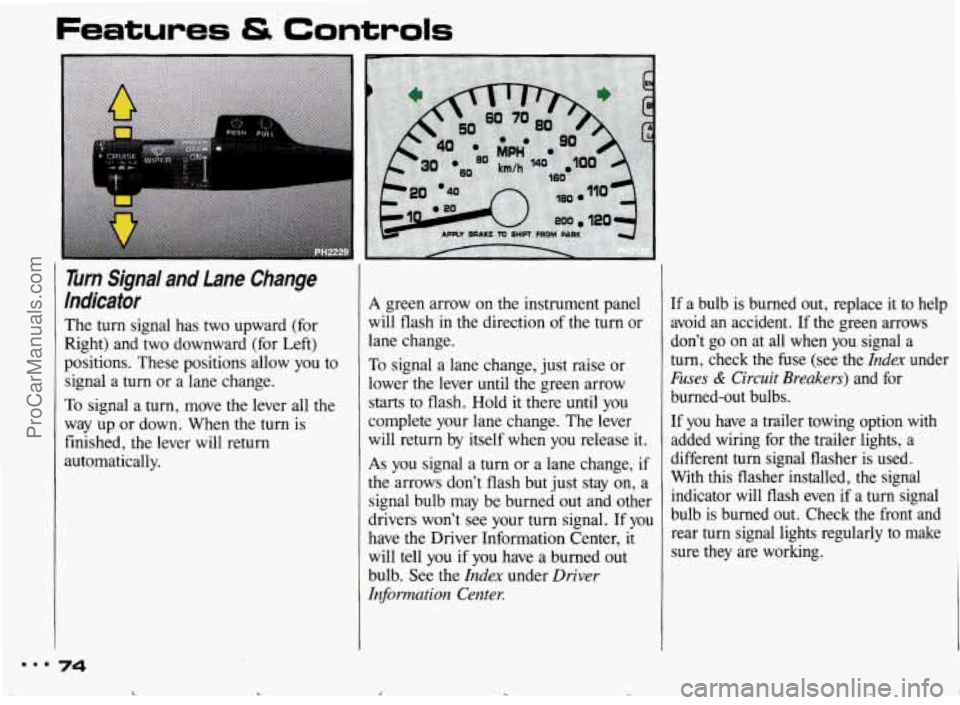
The turn signal has two upward (for
Right) and two downward (for Left)
positions. These positions allow you to
signal a turn or a lane change.
To signal a turn, move the lever all the
way up or down. When the turn is
finished, the lever will return
automatically.
A green arrow on the instrument panel
will flash in the direction of the turn or
lane change.
To signal a lane change, just raise or
lower the lever until the green arrow
starts to flash. Hold it there until you
complete your lane change. The lever
will return by itself when you release
it.
As you signal a turn or a lane change, if
the arrows don’t flash but just stay
on, a
signal bulb may be burned out and other
drivers won’t see your turn signal.
If you
have the Driver Information Center, it
will tell you if you have a burned out
bulb. See the
Index under Driver
Information
Center.
If a bulb is burned out, replace it to help
avoid an accident.
If the green arrows
don’t go on at all when you signal a
turn, check the fuse (see the
Index under
Fuses & Circuit Breakers) and for
burned-out bulbs.
If you have a trailer towing option with
added wiring for the trailer lights, a
different
turn signal flasher is used.
With this flasher installed, the signal
indicator will flash even if a
turn signal
bulb is burned out. Check the front and
rear turn signal lights regularly to make
sure they are working.
... 74
.. c L ProCarManuals.com
Page 106 of 322
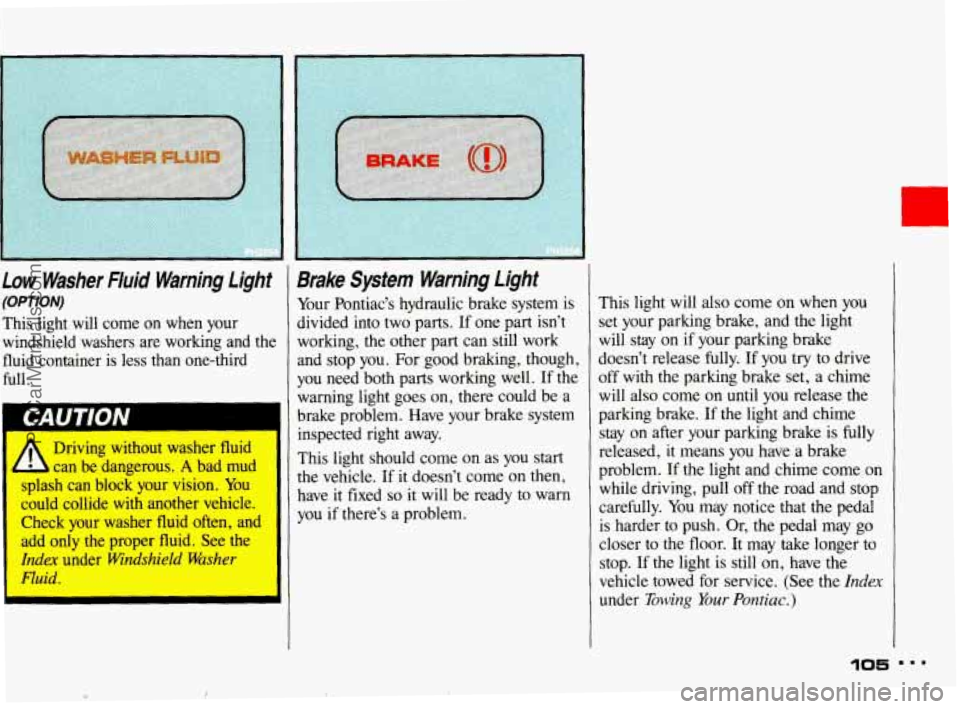
Low Washer Fluid Warning Light
(OPTION)
This light will come on when your
windshield washers are working and the
fluid container
is less than one-third
full.
Driving without washer
fluid
- :an be dangerous. A bad mud
splash
can block your vision. You
could collide with another vehicle.
Check
your washer fluid often, and
add
only the proper fluid. See the
Idex under Windshiel$ Washer
Fluid.
I
I
Brake System Warning Light
Your Pontiac’s hydraulic brake system is
divided into two parts.
If one part isn’t
working, the other part can still work
and stop you. For good braking, though,
you need both parts working well. If the
warning light goes
on, there could be a
brake problem. Have your brake system
inspected right away.
This light should come on as you start
the vehicle.
If it doesn’t come on then,
have it fixed
so it will be ready to warn
you if there’s a problem. This
light will also come
on when you
set your parking brake, and the light
will stay on if your parking brake
doesn’t release fully.
If you try to drive
off with the parking brake set, a chime
will also come on until you release the
parking brake. If the light and chime
stay
on after your parking brake is fully
released, it means you have a brake
problem.
If the light and chime come on
while driving, pull off the road and stop
carefully.
You may notice that the pedal
is harder to push. Or, the pedal may go
closer to the floor. It may take longer to
stop. If the light
is still on, have the
vehicle towed for service. (See the
Index
under Towing Your Pontiac.)
105
J ProCarManuals.com
Page 146 of 322
Here you'll find information about
driving on different kinds of roads
and in varying weather conditions
.
We've also included many other
useful tips on driving
.
Your Driving and the Road
......................................................
................................................
.................................................
Road Signs 146
Defensive Driving
150
Drunken Driving 151
Control of a Vehicle
Braking 154
Anti-Lock Brakes
155
Steering Tips 160
Passing ....................................................... 163
DrivingatNight .................................................. 165
Driving in the Rain
168
CityDriving ..................................................... 171
Freeway Driving 172
HillandMountainRoads
........................................... 176
ParkingonHills .................................................. 177
Winter Driving 179
TowingaTrailer
.................................................. 183
.....................................................
...............................................
...................................................
Steering in Emergencies .......................................... 161
...............................................
Driving in Fog, Mist and Haze ...................................... 170
Driving a Long Distance
........................................... 174
..................................................
...................................................
ProCarManuals.com
Page 184 of 322
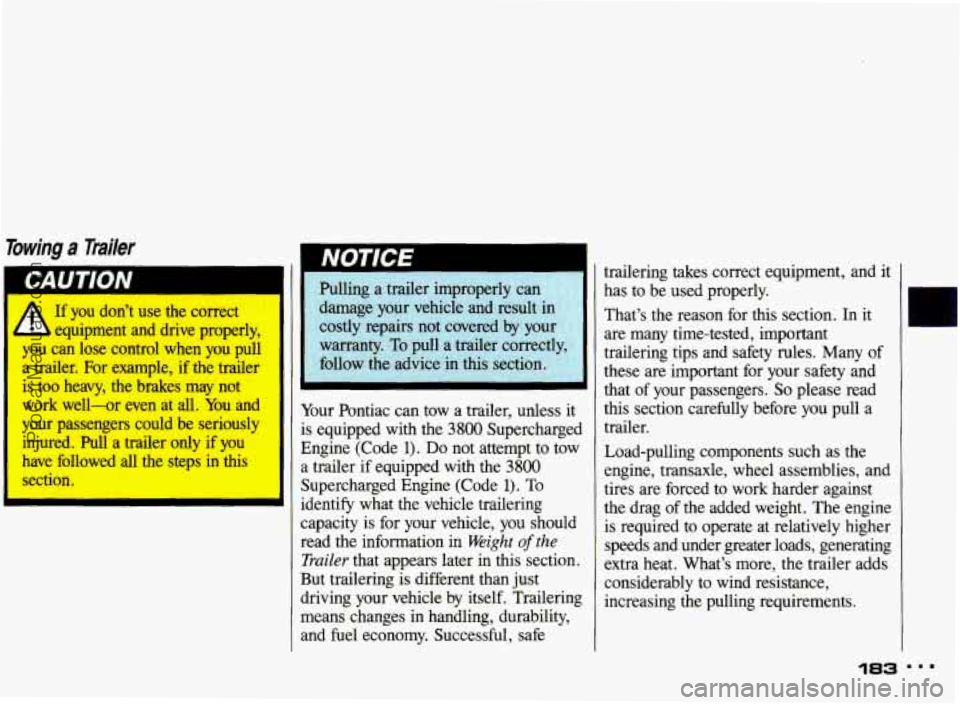
Towing a Tmiler
I
If you don't use the correct
equipment and drive properly,
you can lose control when you pull
a trailer. For example, if the trailer
is too heavy, the brakes may not
work well-or even at all. You and
your passengers could be seriously injured. Pull a trailer only if you
have followed all the steps in this
section.
NOTICE
I I; Pulling a trailer improperly can : __
damage your vehicle and result in' ;'
costly repairs not covered by your
follow the advice in this section.
Your Pontiac can tow a trailer, unless it
is equipped with the
3800 Supercharged
Engine (Code
1). Do not attempt to tow
a trailer
if equipped with the 3800
Supercharged Engine (Code 1). To
identify what the vehicle trailering
capacity is for your vehicle,
you should
read the information in
Weight of the
Trailer that appears later in this section.
But trailering is different than just
driving your vehicle by itself. Trailering
means changes in handling, durability,
and fuel economy. Successful, safe trailering
takes correct equipment, and it
has to be used properly.
That's the reason for this section.
In it
are many time-tested, important
trailering tips and safety rules. Many
of
these are important for your safety and
that of your passengers.
So please read
this section carefully before you pull a
trailer.
Load-pulling components such as the
engine, transaxle, wheel assemblies, and
tires are forced to work harder against
the drag of the added weight. The engine
is required to operate at relatively higher
speeds and under greater loads, generating
extra heat. What's more, the trailer adds
considerably to wind resistance,
increasing the pulling requirements.
ProCarManuals.com
Page 185 of 322
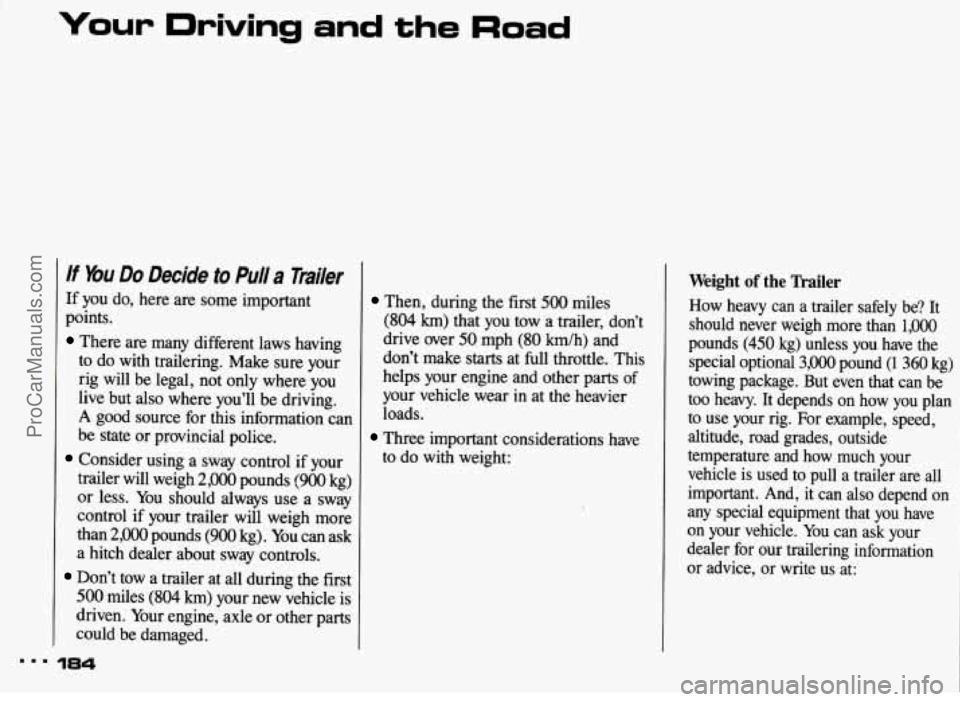
Your Driving and the Road
If bu Do Decide to Pulla Trailer
If you do, here are some important
points.
There are many different laws having
to do with trailering. Make sure your
rig will be legal, not only where you
live but also where you’ll be driving.
A good source for this information can
be
state or provincial police.
trailer will weigh
2,000 pounds (900 kg)
or less. You should always use a sway
control if your trailer will weigh more
than
2,000 pounds (900 kg). You can ask
a hitch dealer about sway controls.
Don’t tow a trailer at all during the first
500 miles (804 km) your new vehicle is
driven. Your engine, axle or other parts
could be damaged.
Consider using a sway control if your
Then, during the first 500 miles
(804 km) that you tow a trailer, don’t
drive over
50 mph (80 km/h) and
don’t make
starts at full throttle. This
helps your engine and other parts of
your vehicle wear in at the heavier
loads.
Three important considerations have
to do with weight:
Weight of the Trailer
How heavy can a trailer safely be? It
should never weigh more than
1,000
pounds (450 kg) unless you have the
special optional
3,000 pound (1 360 kg)
towing package. But even that can
be
too heavy. It depends on how you plan
to use your rig. For example, speed,
altitude, road grades, outside
temperature and how much your
vehicle is
used to pull a trailer are all
important. And, it can also depend on
any special equipment that you have
on your vehicle. You can ask your
dealer for our trailering information
or advice, or write us at:
mmm 184
ProCarManuals.com