engine PONTIAC BONNEVILLE 1994 Manual PDF
[x] Cancel search | Manufacturer: PONTIAC, Model Year: 1994, Model line: BONNEVILLE, Model: PONTIAC BONNEVILLE 1994Pages: 290, PDF Size: 14.75 MB
Page 219 of 290
Service & Appearance Care
Brake Master Cylinder
(CONK)
work at all. So, it isn’t a good idea to “top
off’ your brake fluid. Adding brake fluid.
won’t correct a leak. If you add fluid
when your linings are worn, then you’ll
have too much fluid when you get new
brake linings.
You should add (or remove)
brake fluid, as necessary, only when work
is done on the brake hydraulic system.
When your brake fluid falls to a low level,
your brake warning light will come on. A
chime will sound
if you try to drive with
this warning light on. See “Brake System
Warning Light” in the Index.
. . .218
What to Add
When you do need brake fluid, use only
DOT-3 brake fluid
-- such as Delco
Supreme 11
@ (GM Part No. 1052535).
Use new brake fluid from a sealed
container only, and always clean the brake
fluid reservoir cap before removing
it.
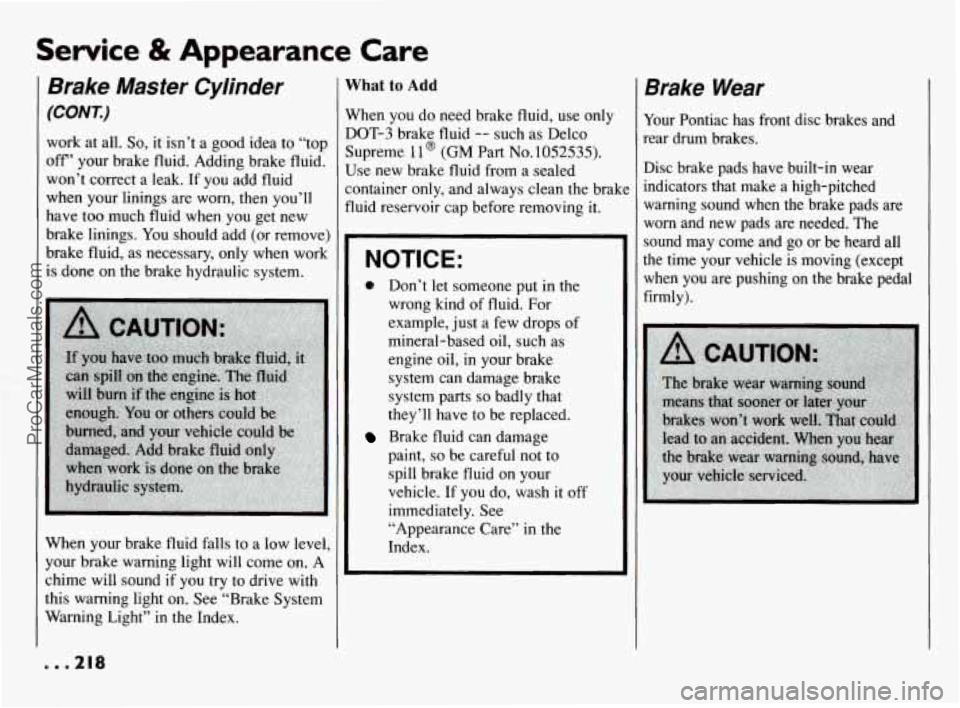
NOTICE:
e Don’t let someone put in the
wrong kind of fluid. For
example, just a few drops of
mineral-based oil, such as
engine oil, in your brake
system can damage brake
system parts
so badly that
they’ll have to be replaced.
Brake fluid can damage
paint,
so be careful not to
spill brake fluid on your
vehicle. If you do, wash it
off
immediately. See
“Appearance Care”
in the
Index.
Brake Wear
Your Pontiac has front disc brakes and
rear drum brakes.
Disc brake pads have built-in wear
indicators that make a high-pitched
warning sound when the brake pads are
worn and new pads are needed. The
sound may come and
go or be heard all
the time your vehicle is moving (except when you are pushing on the brake pedal
firmly).
ProCarManuals.com
Page 238 of 290
I
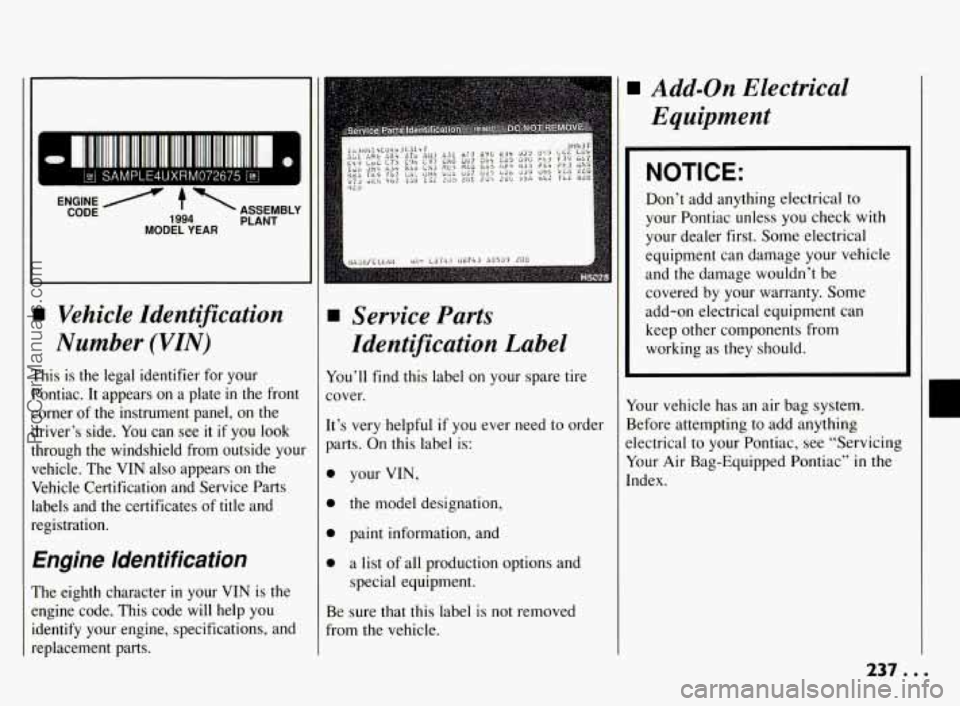
A ’ ASSEMBLY
CODE
MODEL
YEAR 1994 PLANT
Vehicle Identification
Number (VZN)
This is the legal identifier for your
Pontiac. It appears
on a plate in the front
corner of the instrument panel, on the
driver’s side.
You can see it if you look
through the windshield from outside your
vehicle. The VIN also appears on the
Vehicle Certification and Service Parts
labels and the certificates of title and
registration.
Engine Identification
The eighth character in your VIN is the
engine code. This code will help
you
identify your engine, specifications, and
replacement parts.
Service Parts
Identification Label
You’ll find this label on your spare tire
cover.
It’s very helpful if
you ever need to order
parts. On this label is:
0 your VIN,
0 the model designation,
0 paint information, and
0 a list of all production options and
special equipment.
Be sure that this label
is not removed
from the vehicle.
Add-on Electrical
Equipment
NOTICE:
Don’t add anything electrical to
your Pontiac unless
you check with
your dealer first. Some electrical
equipment can damage your vehicle
and the damage wouldn’t be
covered by your warranty. Some
add-on electrical equipment can
keep other components from
working as they should.
Your vehicle has an air bag system.
Before attempting to add anything
electrical to your Pontiac, see “Servicing
Your Air Bag-Equipped Pontiac” in the
Index.
c
237.. .
ProCarManuals.com
Page 241 of 290
Service & Appearance Care
Right Side Fuse Panel
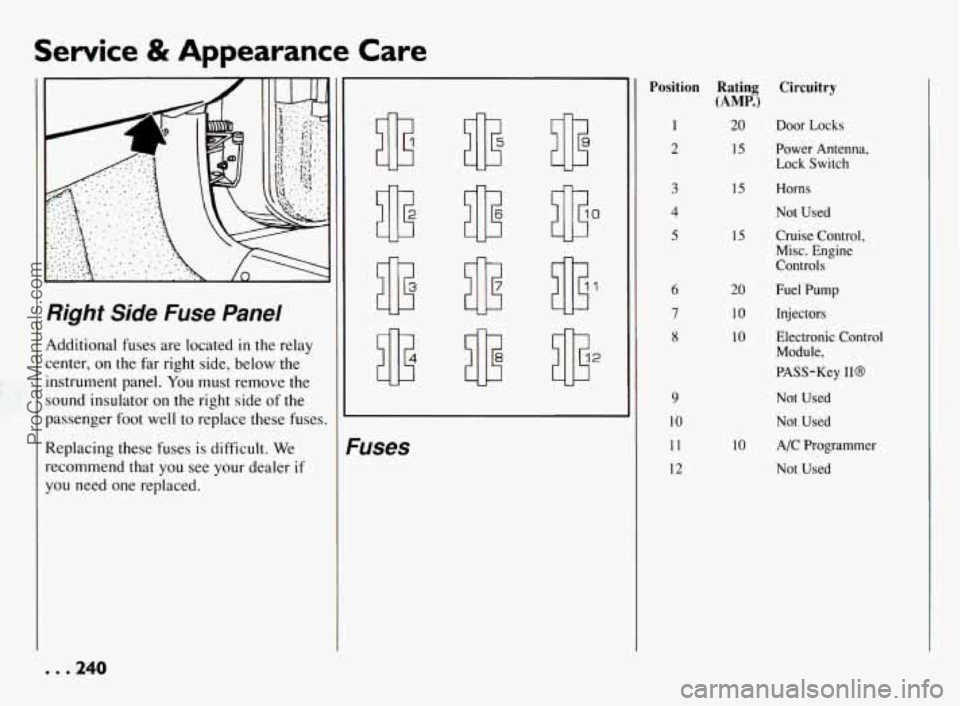
Additional fuses are located in the relay
center,
on the far right side, below the
instrument panel.
You must remove the
sound insulator on the right side of the
passenger foot
well to replace these fuses
Replacing these fuses is difficult.
We
recommend that you see your dealer if
you need one replaced.
IL ).
t
U
:uses
Position
1
2
3
4
5
9
10
11
12
Rating Circuitry
(AMP.)
20
15
15
15
20
10
10
10
Door Locks
Power Antenna,
Lock Switch
Horns
Not Used
Cruise Control, Mix. Engine
Controls
Fuel Pump
Injectors Electronic Control
Module,
PASS-Key
110
Not Used
Not Used
A/C Programmer
Not Used
. . .240
ProCarManuals.com
Page 243 of 290
Service & Appearance Care
Capacities and Specifications
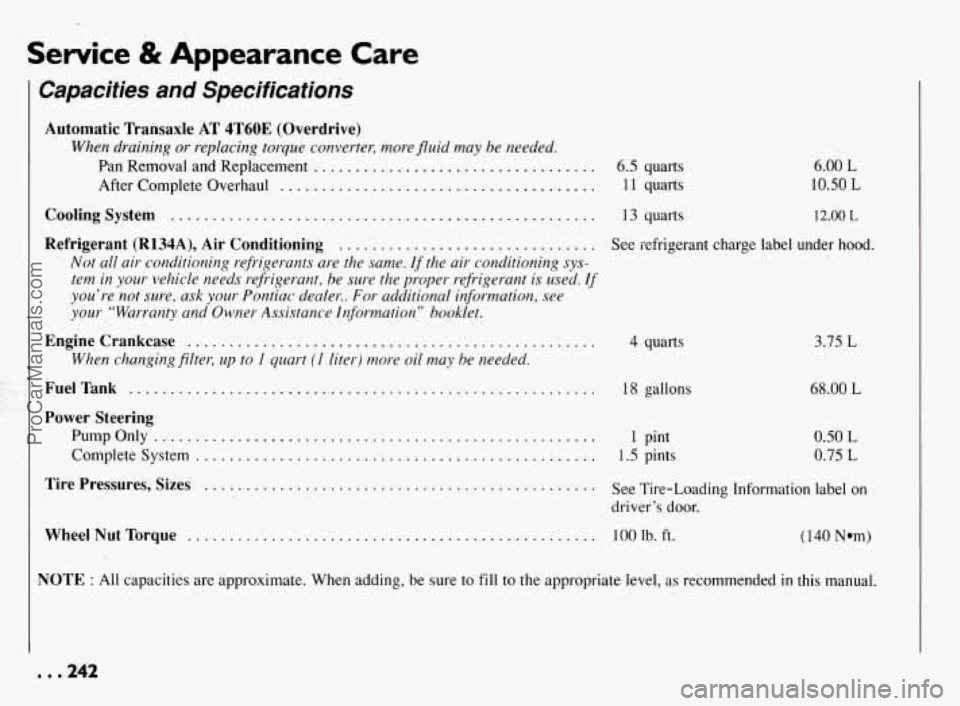
Automatic Transaxle AT 4T60E (Overdrive)
When draining or replacing torque converter, more fluid may be needed.
Pan Removal and Replacement .................................. 6.5 quarts
After Complete Overhaul
...................................... 11 quarts
Cooling System ................................................... 13 quarts 6.00
L
10.50 L
12.00 L
Refrigerant (R134A), Air
Conditioning ............................... See refrigerant charge label under hood.
Not all air conditioning refiigerants are the same. If the air conditioning sys-
tem in your vehicle needs refrigerant, be sure the proper
refrigerant is used. If
you’re not sure, ask your Pontiac dealer.. For additional information, see
your “Warranty and Owner Assistunce Information” booklet.
Enginecrankcase ................................................. 4 quarts
When chunging filter, up to 1 quart (I liter) more oil may be needed.
FuelTank ........................................................ 18 gallons
Power Steering
PumpOnly ..................................................... 1 pint
Complete System
................................................ 1.5 pints
3.75 L
68.00 L
0.50
L
0.75 L
Tire Pressures, Sizes ............................................... See Tire-Loading Information label on
driver’s door.
Wheel Nut Torque ................................................. 100 Ib. ft. ( 140 Nom)
NOTE : All capacities are approximate. When adding, be sure to fill to the appropriate level, as recommended in this manual.
.. .242
ProCarManuals.com
Page 244 of 290
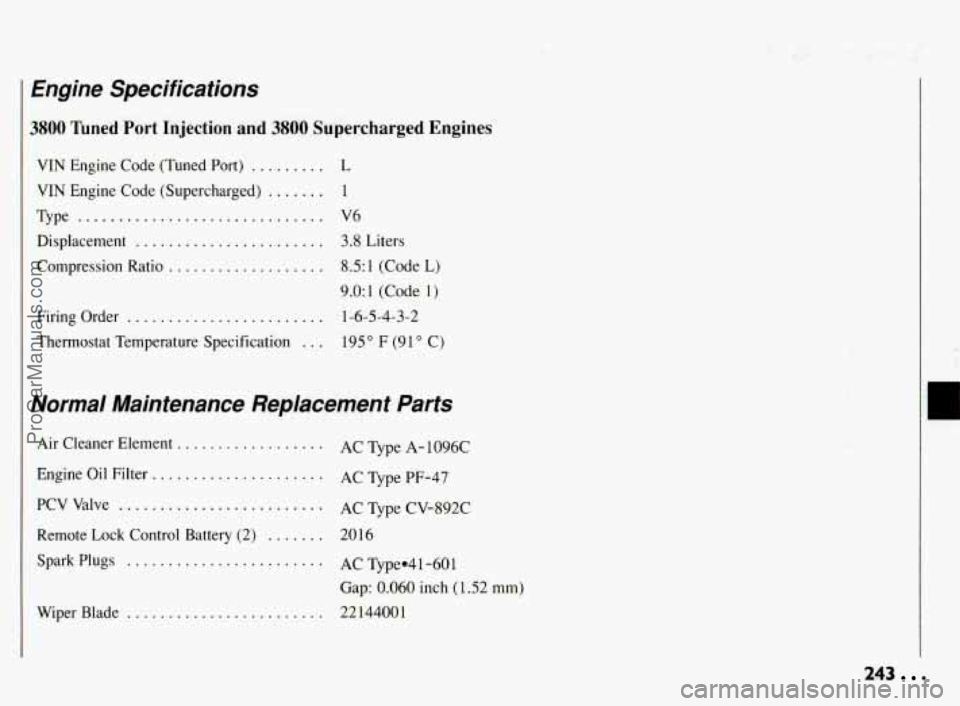
Engine Specifications
3800 Tuned Port Injection and 3800 Supercharged Engines
VIN Engine Code (Tuned Port) . . . . . . . . . L
VIN Engine Code (Supercharged)
. . . . . . . 1
Type
.............................. V6
Displacement
. . . . . . . . . . . . . . . . . . . . . . . 3.8 Liters
Compression Ratio
. . . . . . . . . . . . . . . . . . . 851 (Code L)
9.0:l (Code 1)
Firing Order . . . . . . . . . . . . . . . . . . . . . . . . 1-6-5-4-3-2
Thermostat Temperature Specification
. . . 195" F (91 O C)
Normal Maintenance Replacement Parts
Air Cleaner Element . . . . . . . . . . . . . . . . . . AC Type A- 1096C
Engine
Oil Filter . . . . . . . . . . . . . . . . . . . . . AC Type PF-47
PCV Valve
. . . . . . . . . . . . . . . . . . . . . . . . . AC Type CV-892C
Remote Lock Control Battery (2)
. . . . . . . 2016
Spark Plugs
. . . . . . . . . . . . . . . . . . . . . . . . AC Type04 1 -60 1
Gap: 0.060 inch (1.52 mm)
Wiper Blade ........................ 22144001
243 .
ProCarManuals.com
Page 248 of 290
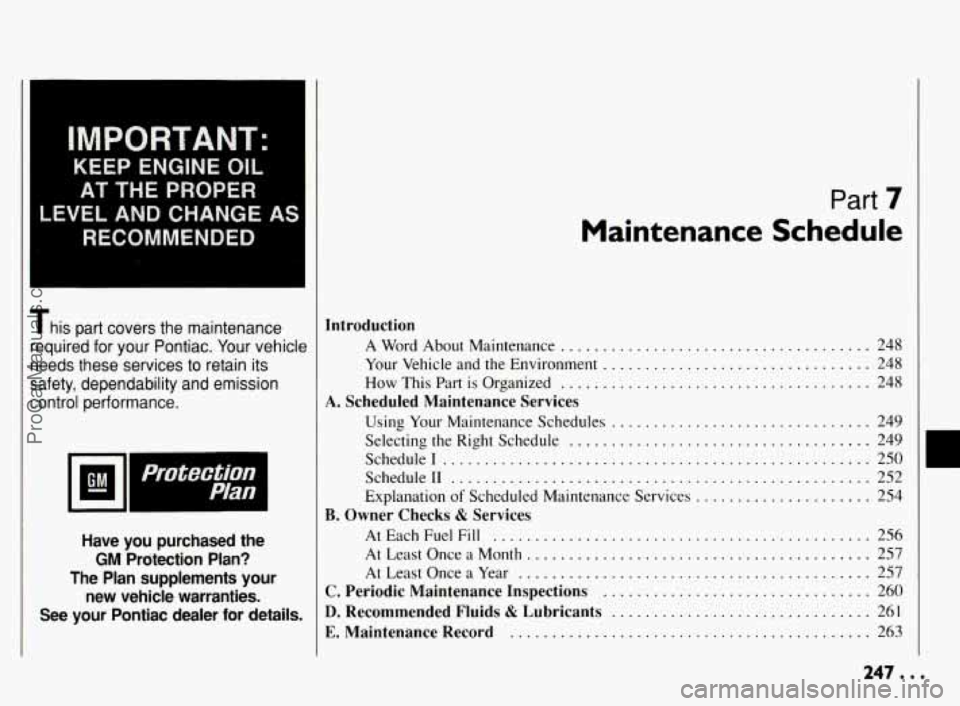
IMPORTANT:
KEEP ENGINE OIL
AT THE PROPER
LEVEL
AND CHANGE AS
RECOMMENDED
This part covers the maintenance
required for your Pontiac
. Your vehicle
needs these services to retain its
safety. dependability and emission
control performance
.
Have you purchased the
GM Protection Plan?
The Plan supplements your
new vehicle warranties
.
See your Pontiac dealer for details .
Part 7
Maintenance Schedule
Introduction
A Word About Maintenance ..................................... 248
Your Vehicle and the Environment
................................ 248
How This Part is Organized ..................................... 248
A . Scheduled Maintenance Services
Using Your Maintenance Schedules ............................... 249
Selecting the Right Schedule
.................................... 249
Schedule1
............................................... 250
Schedule11
......................................... . . 252
Explanation
of Scheduled Maintenance Services ..................... 254
AtEachFuelFill
............................................. 256
At Least Once a Month ......................................... 257
AtLeastOnceaYear
.......................................... 257
C . Periodic Maintenance Inspections ................................ 260
D . Recommended Fluids & Lubricants ............................... 261
E . Maintenance Record ........................................... 263
B . Owner Checks & Services
ProCarManuals.com
Page 250 of 290
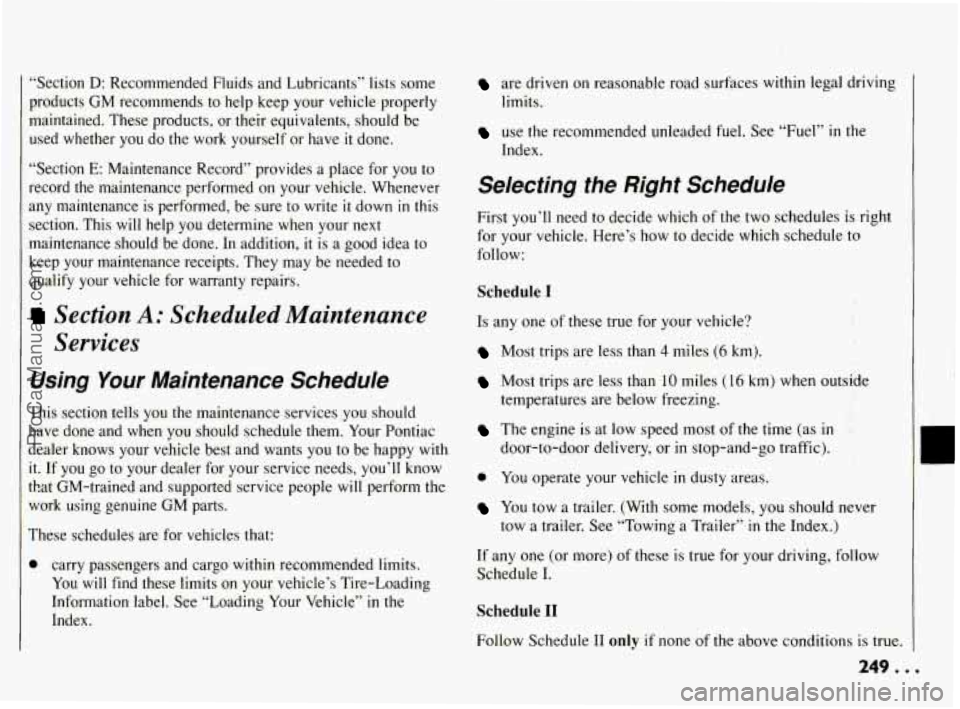
“Section D: Recommended Fluids and Lubricants” lists some
products GM recommends to help keep your vehicle properly
maintained. These products, or their equivalents, should be
used whether you do the work yourself or have
it done.
“Section
E: Maintenance Record” provides a place for you to
record the maintenance performed on your vehicle. Whenever
any maintenance is performed, be sure to write it down in this
section. This
will help you determine when your next
maintenance should be done. In addition, it is a good idea to
keep your maintenance receipts. They may be needed to
qualify your vehicle for warranty repairs.
Section A: Scheduled Maintenance
Using Your Maintenance Schedule
Services
This section tells you the maintenance services you should
have done and
when you should schedule them. Your Pontiac
dealer knows your vehicle best and wants you to be happy with
it. If you go to your dealer for your service needs, you’ll know
that GM-trained and supported service people
will perform the
work using genuine
GM parts.
These schedules are for vehicles that:
@ carry passengers and cargo within recommended limits.
You
will find these limits on your vehicle’s Tire-Loading
Information label. See “Loading Your Vehicle” in the
Index.
are driven on reasonable road surfaces within legal driving
limits.
use the recommended unleaded fuel. See “Fuel” in the
Index.
Selecting the Right Schedule
First you’ll need to decide which of the two schedules is right
for your vehicle. Here’s how to decide which schedule to
follow:
Schedule I
Is any one of these true for your vehicle?
Most trips are less than 4 miles (6 km).
Most trips are less than 10 miles (16 km) when outside
temperatures are below freezing.
The engine is at low speed most of the time (as in
door-to-door delivery, or
in stop-and-go traffic).
”.
0 You operate your vehicle in dusty areas.
You tow a trailer. (With some models, you should never
,.’
tow a trailer. See “Towing a Trailer” in the Index.)
If any one (or more) of these is true for your driving, follow
Schedule I.
Schedule 11
Follow Schedule I1 only if none of the above conditions is true.
ProCarManuals.com
Page 251 of 290
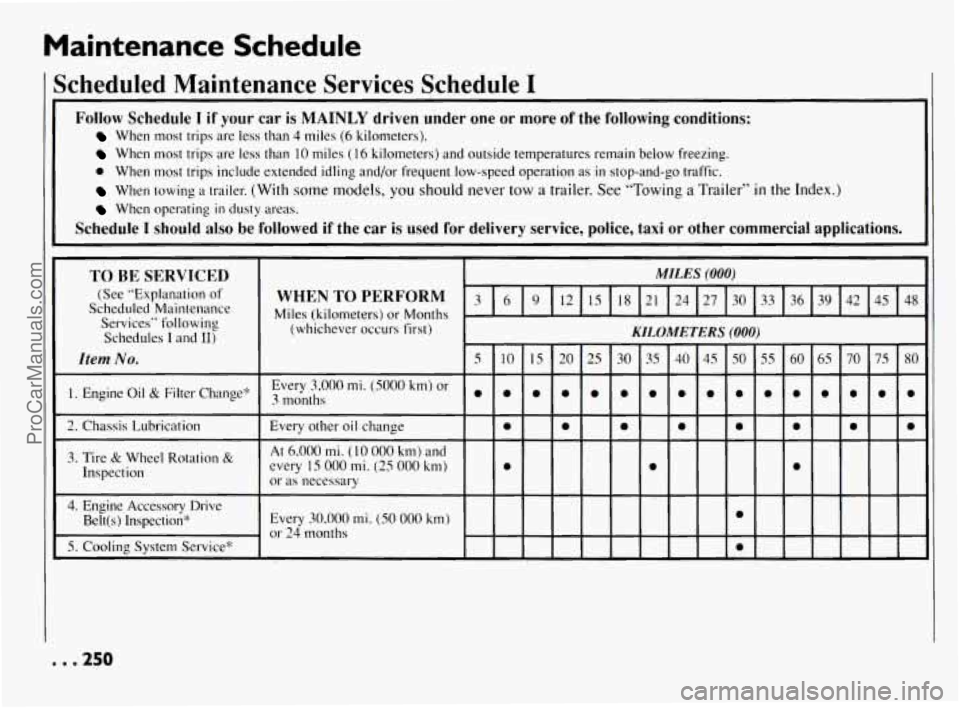
Maintenance Schedule
Scheduled Maintenance Services Schedule I
Follow Schedule I if your car is MAINLY driven under one or more of the following conditions:
When most trips are less than 4 miles (6 kilometers).
When most trips are less than 10 miles (16 kilometers) and outside temperatures remain below freezing.
0 When most trips include extended idling and/or frequent low-speed operation as in stop-and-go traffic.
When towing a trailer. (With some models, you should never tow a trailer. See “Towing a Trailer” in the Index.)
When operating in dusty areas.
Schedule I should also be followed if the car is used for delivery service, police, taxi or other commercial applications.
TO BE SERVICED
(See “Explanation of
Scheduled Maintenance Services” following
Schedules
I and 11)
Item No.
1. Engine Oil & Filter Change”
2. Chassis Lubrication
3. Tire & Wheel Rotation &
Inspection
4. Engine Accessory Drive
Belt(s) Inspection*
5. Cooling System Service* 1
I MILES (000)
(whichever occurs first) I
Every 3,000 mi. (5000 km) or
3 months I I I
Every other oil change I 0
At 6,000 mi. ( 10 000 km) and
every 15
000 mi. (25 000 km) 0
or as necessary
Every
30.000 mi. (50 000 km)
or 24 months
. . .250
ProCarManuals.com
Page 253 of 290
Maintenance Schedule
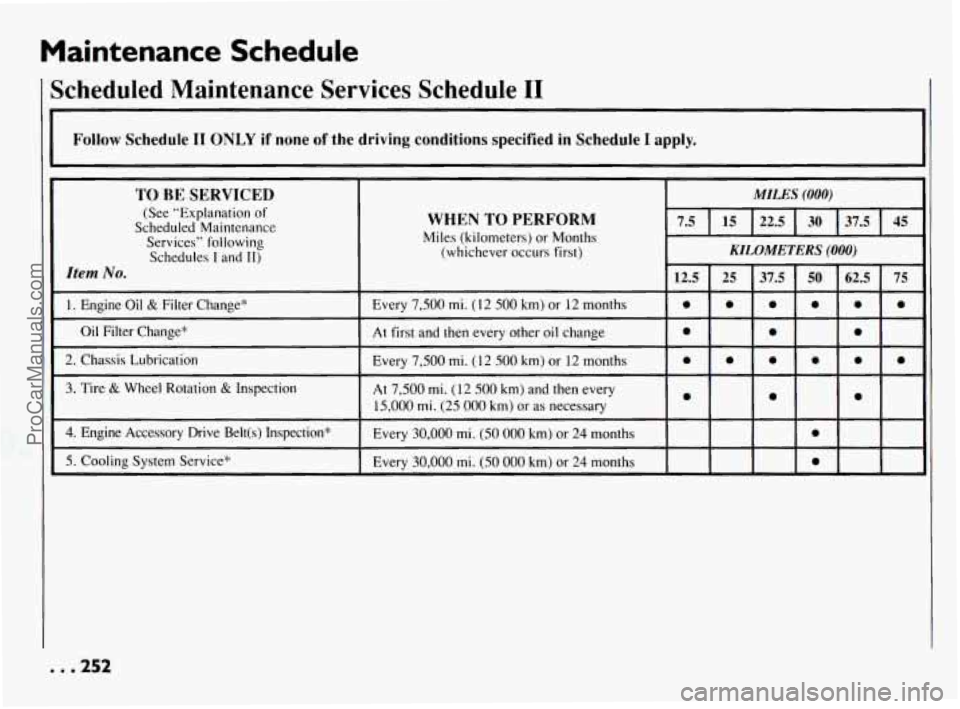
I Scheduled Maintenance Services Schedule I1
II I
Follow Schedule I1 ONLY if none of the driving conditions specified in Schedule I apply.
TO BE SERVICED
(See “Explanation of
Scheduled Maintenance
Services” following Schedules
I and 11)
Item No.
WHEN TO PERFORM
Miles (kilometers) or Months
(whichever occurs first)
-
1. Engine Oil & Filter Change*
At
7,500 mi. (12 500 km) and then every 3. Tire & Wheel Rotation & Inspection Every
7,500 mi. (12 500 km)
or 12 months 2. Chassis Lubrication
At first and then every other oil change
Oil Filter Change” Every
7,500 mi. (12 500 km) or 12 months
15,000 mi. (25 000 km) or as
necessary
4. Engine Accessory Drive Belt(s) Inspection*
Every
30,000 mi. (50 000 km) or 24 months 5. Cooling System Service* Every
30,000 mi. (50 000 km) or 24 months
MILES (000)
KILOMETERS (000)
ProCarManuals.com
Page 255 of 290
Maintenance Schedule
Explanation of Scheduled Maintenance
Services
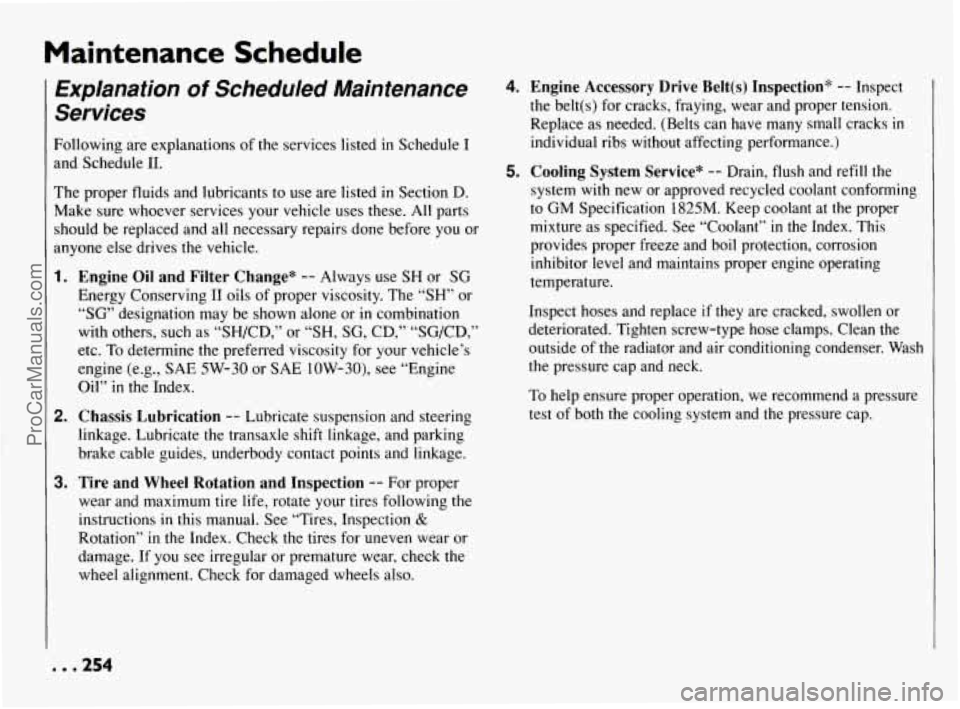
Following are explanations of the services listed in Schedule I
and Schedule
11.
The proper fluids and lubricants to use are listed in Section D.
Make sure whoever services your vehicle uses these. All parts
should be replaced and all necessary repairs done before you or
anyone else drives the vehicle.
1. Engine Oil and Filter Change* -- Always use SH or SG
Energy Conserving I1 oils
of proper viscosity. The “SH” or
“SG” designation may be shown alone or in combination
with others, such as “SH/CD,” or “SH, SG, CD,” “SG/CD,”
etc. To determine the preferred viscosity for your vehicle’s
engine (e.g., SAE 5W-30 or SAE
10W-30), see “Engine
Oil”
in the Index.
2. Chassis Lubrication -- Lubricate suspension and steering
linkage. Lubricate the transaxle shift linkage, and parking
brake cable guides, underbody contact points and linkage.
3. Tire and Wheel Rotation and Inspection -- For proper
wear and maximum tire
life, rotate your tires following the
instructions in this manual. See “Tires, Inspection &
Rotation” in the Index. Check the tires for uneven wear or
damage. If
you see irregular or premature wear, check the
wheel alignment. Check for damaged wheels also.
4. Engine Accessory Drive Belt(s) Inspection* -- Inspect
the belt(s) for cracks, fraying, wear and proper tension.
Replace as needed. (Belts can have many small cracks
in
individual ribs without affecting performance.)
5. Cooling System Service* -- Drain, flush and refill the
system with new or approved recycled coolant conforming
to GM Specification 1825M. Keep coolant at the proper
mixture as specified. See “Coolant”
in the Index. This
provides proper freeze and boil protection, corrosion inhibitor level and maintains proper engine operating
temperature.
Inspect hoses and replace
if they are cracked, swollen or
deteriorated. Tighten screw-type hose clamps. Clean the
outside of the radiator and air conditioning condenser. Wash
the pressure cap and neck.
To help ensure proper operation, we recommend a pressure
test of both the cooling system and the pressure cap.
ProCarManuals.com