seats PONTIAC BONNEVILLE 1997 Owners Manual
[x] Cancel search | Manufacturer: PONTIAC, Model Year: 1997, Model line: BONNEVILLE, Model: PONTIAC BONNEVILLE 1997Pages: 405, PDF Size: 18.83 MB
Page 2 of 405
7 The 1997 Pontiac Bonneville Owner’s Manual
1-1
2- 1
3-1
4- 1
5-1
6-1
Seats and Restraint Systems
This section tells you how to use your seats and safety belts properly. It also explains the “SRS’’ system.
Features and Controls
This section explains how to start and operate your Pontiac.
Comfort Controls and Audio Systems
This section tells you how to adjust the ventilation and comfort controls and how to operate your audio system.
Your Driving and the Road
Here you’ll find helpful information and tips about the road and how to drive under different conditions.
Problems on the Road
This section tells what to do if you have a problem while driving, such as a flat tire or overheated engine, etc.
Service and Appearance Care
Here the manual tells you how to keep your Pontiac running properly and looking good.
7-1 Maintenance Schedule
This section tells you when to perform vehicle maintenance and what fluids and lubricants to use.
8- 1
9-1
Customer Assistance Information
This section tells you how to contact Pontiac for assistance and how to get service and owner publications.
It also gives you information on “Reporting Safety Defects” on page
8-8.
Index
Here’s an alphabetical listing of almost every subject in this manual. You can use it to quickly find
something you want to read.
i
ProCarManuals.com
Page 8 of 405
v Section 1 Seats and Restraint Systems
Here you’ll find information about the seats in your Pontiac and how to use your safety belts properly. You can also
learn about some things you should
not do with air bags and safety belts.
1-2
1-5
1-9
1-10 1-10
1-17
1-18
1-18
1-24 Seats and Seat Controls
Safety Belts: They’re
for Everyone
Here Are Questions Many People Ask About
Safety Belts
-- and the Answers
How to Wear Safety Belts Properly
Driver Position
Safety Belt Use During Pregnancy
Right Front Passenger Position
Supplemental Restraint System (SRS)
Center Passenger Position 1-25
1-29
1-3 1
1-33
1-41
1-44
1-44
1-44
Rear Seat Passengers
Rear Safety Belt Comfort Guides
for
Children and Small Adults Children
Child Restraints
Larger Children Safety Belt Extender
Checking Your Restraint Systems
Replacing Restraint System Parts After
a Crash
ProCarManuals.com
Page 9 of 405
Seats and Seat Controls
This section tells you about the seats -- how to adjust
them
-- and also about reclining seatbacks and
head restraints.
Manual Front Seat
CAUTION:
-
You can lose control of the vehicle if you try to
adjust
a manual driver’s seat while the vehicle is
moving. The sudden movement could startle and
confuse you, or make you push
a pedal when you
don’t want to. Adjust the driver’s seat only when
the vehicle is not moving.
Pull up on the control bar under the front
of the seat to
unlock it. Slide the seat to where you want
it. Then
release the bar and try to move the seat with your body,
to make sure the seat is locked into place.
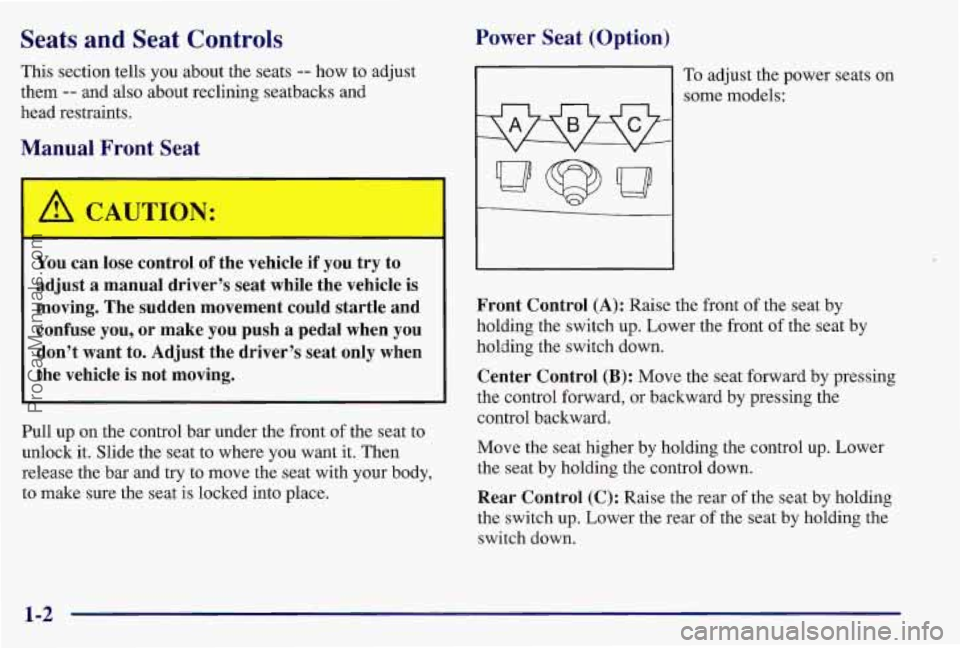
Power Seat (Option)
To adjust the power seats on
some models:
Front Control
(A): Raise the front of the seat by
holding the switch
up. Lower the front of the seat by
holding the switch down.
Center Control
(B): Move the seat forward by pressing
the control forward, or backward by pressing the
control backward.
Move the seat higher by holding the control up. Lower
the seat by holding the control down.
Rear Control (C): Raise the rear
of the seat by holding
the switch up. Lower the rear of the seat by holding the
switch down.
1-2
ProCarManuals.com
Page 12 of 405
Safety Belts: They’re for Everyone
This part of the manual tells you how to use safety belts
properly.
It also tells you some things you should not do
with safety belts.
And it explains the Supplemental Restraint System
(SRS), or air bag system.
A CAUTION:
r
Don’t let anyone ride where he or she can’t wear
a safety belt properly. If you are in a crash and
you’re not wearing
a safety belt, your injuries
can be much worse,
You can hit things inside the
vehicle or be ejected from it.
You can be seriously
injured or killed. In the same crash, you might
not be if you are buckled up, Always fasten your
safety belt, and check that your passengers’ belts
are fastened properly too.
‘ A CAUTION:
It is extremely dangerous to ride in a cargo area,
inside or outside of
a vehicle. In a collision,
people riding in these areas are more likely to be
seriously injured or killed.
Do not allow people to
ride in any area of your vehicle that
is not
equipped with seats and safety belts. Be sure
everyone in your vehicle
is in a seat and using a
safety belt properly.
1-5
ProCarManuals.com
Page 17 of 405
&: If I’m a good driver, and I never drive far from
A: You may be an excellent driver, but if you’re in an
home, why should I wear safety belts?
accident -- even one that isn’t your fault -- you and
your passengers can be hurt. Being a good driver
doesn’t protect you from things beyond your
control, such as bad drivers.
Most accidents occur within
25 miles (40 km) of
home. And the greatest number of serious injuries
and deaths occur at speeds of less than
40 mph (65
km/h).
Safety belts are for everyone.
How to Wear Safety Belts Properly
Adults
This part is only for people of adult size.
Be aware that there are special things to know about safety
belts
and children. And there are different rules for smaller
children and babies. If a child will be riding in
your
Pontiac, see the part of this manual called “Children.”
Follow those rules for everyone’s protection.
First, you’ll want to know which restraint systems your
vehicle has.
We’ll start with the driver position.
Driver Position
This part describes the driver’s restraint system.
Lap-Shoulder Belt
The driver has a lap-shoulder belt. Here’s how to wear
it properly.
1. Close and lock the door.
2. Adjust the seat (to see how, see “Seats” in the Index)
so you can sit up straight.
1-10
ProCarManuals.com
Page 31 of 405
CAUTION:
For up to 10 minutes after the ignition key is
turned off and the battery
is disconnected, an air
bag can still inflate during improper service.
You
can be injured if you are close to an air bag when
it inflates. Avoid wires wrapped with yellow tape
or yellow connectors. They are probably part of
the
air bag system. Be sure to follow proper
service procedures, and make sure the person
performing work for you is qualified to do
so.
The air bag system does not need regular maintenance.
Center Passenger Position
Lap Belt
If your vehicle has front and rear bench seats, someone
can sit
in the center positions.
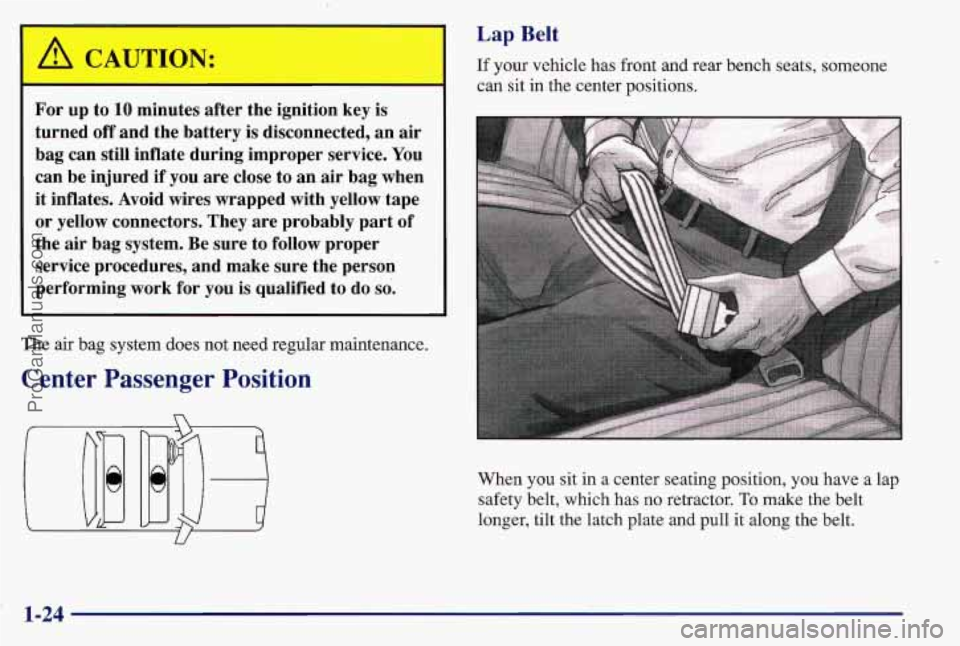
When you sit in a center seating position,
you have a lap
safety belt, which has no retractor.
To make the belt
longer, tilt the latch plate and pull
it along the belt.
1-24
ProCarManuals.com
Page 46 of 405
Securing a Child Restraint in the Right
Front Seat Position
n
Your vehicle has a right front passenger air bag. Never
put a rear-facing child restraint in this seat. Here’s why:
U
A child in a rear-facing child restraint can be
seriously injured if the right front passenger’s air
bag inflates. This is because the back
of a
rear-facing child restraint would be very close
to
the inflating air bag. Always secure a rear-facing
child restraint in the rear seat.
You’ll be using the lap-shoulder belt. See the earlier part
about the top strap if the child restraint has one.
1. Because your vehicle has a right front passenger air
bag, always move the seat as far back as it will
go
before securing a forward-facing child restraint. (See
“Seats” in the Index.)
2. ht the restraint on the seat. Follow the instructions
for the child restraint.
3. Secure the child in the child restraint as the
instructions say.
4. Pick up the latch plate, and run the lap and shoulder
portions
of the vehicle’s safety belt through or
around the restraint.
The child restraint instructions
will show you how.
If the shoulder belt goes in front of the child’s face or
neck, put it behind the child restraint.
1-39
ProCarManuals.com
Page 77 of 405
4. Before starting the engine, be sure to unplug and
store the cord as it was before to keep it away
from moving engine parts.
If you don’t, it could
be damaged.
How long should you keep the coolant heater plugged
in? The answer depends on the outside temperature, the
kind of oil you have, and some other things. Instead of
trying to list everything here, we ask that you contact
your Pontiac dealer in the area where you’ll be parking
your vehicle. The dealer can give you the best advice for
that particular
area.
Automatic Transaxle Operation
Your automatic transaxle may have a shift lever
located on the console between the seats or
on the
steering column.
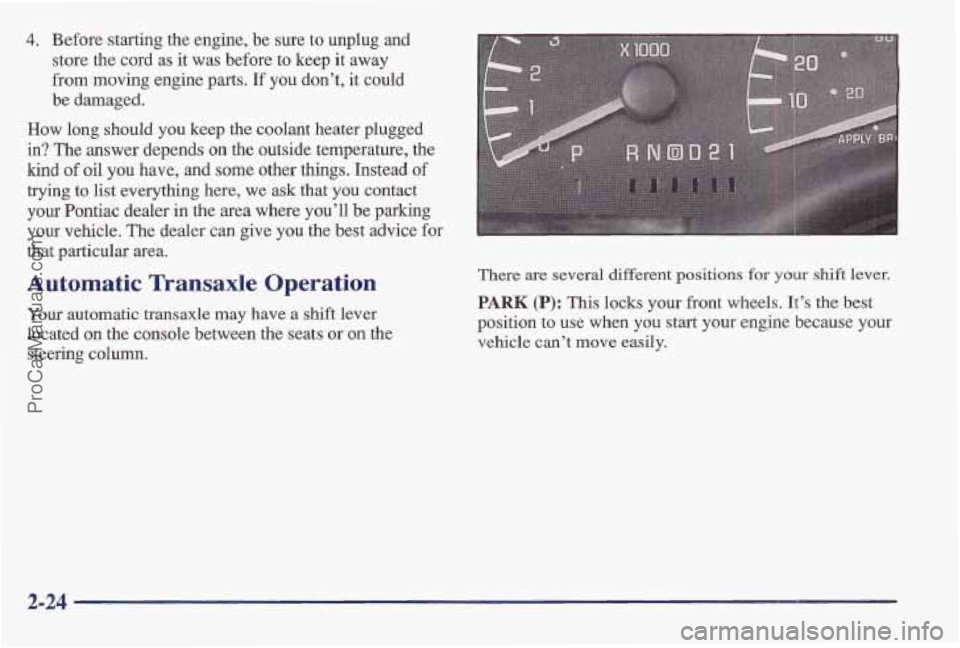
There are several different positions for your shift lever.
PARK (P): This locks your front wheels. It’s the best
position
to use when you start your engine because your
vehicle can’t move easily.
2-24
ProCarManuals.com
Page 149 of 405
Ventilation Tips
0
0
0
0
Keep the hood and front air inlet free of ice, snow or
any other obstruction such as leaves. The heater and
defroster will work better, reducing the chance
of
fogging your windows.
When you enter a vehicle with the standard system
in
cold weather, select HEATER to supply air through
the floor outlets. Then turn the fan
on high for a few
moments before driving away. This will blow moist
air from the intake outlets toward the floor, not the
windshield. It reduces
the chance #of fogging your
windows. If you have the electronic system, the
AUTO
setting will do this for you. Manual operation
of the electronic system
in the HEAT mode will also
supply air though the floor outlets.
Keep the air path under the front 'seats clear of objects.
This helps air to circulate throughout your vehicle.
When the engine idles for a long time, the exterior
temperature sensor may cause the system
to blow air
that is. too cool. Once the vehicle is moving again the
system will try to maintain the set temperature inside
your vehicle.
When you start your vehicle
and the EXT TEMP
display flashes (electronic system only) for some time,
the system may need repair. See your Pontiac dealer.
Defogging and Defrosting
On cool, humid days, use DEFOG to keep the
windshield
and side windows clear. Use DEFROST to
remove fog or ice from the windshield quickly in
extremely humid or cold conditions.
If you have the standard system, use
DEFOG and adjust
the
fan speed to your comfort level. Use DEFROST
with the temperature toward'the red area and the fan
control toward high.
If you have the electronic system, press the
DEFOG
button and adjust the fan speed by pressing the fan
button up or down to your comfort level. Adjust
fan
speed by pressing the fan up or down mow. If you
select DEFROST from AUTO, the system will control
the fan speed. Adjust the temperature to your comfort
level by pressing the
TEMP up or down arrow.
3-8
ProCarManuals.com
Page 205 of 405
Towing a Trailer
Things you put inside your vehicle can strike and
injure people in a sudden stop or turn,
or in
a crash.
0 Put things in the trunk of your vehicle. In a
trunk, put them as far forward as you can.
Try to spread the weight evenly.
inside the vehicle
so that some of them are
above the tops of the seats.
Don’t leave an unsecured child restraint in
your vehicle.
When you carry something inside the
vehicle, secure it whenever you can.
Don’t leave a seat folded down unless you
need to.
Never stack heavier things, like suitcases,
Electronic LeveI Control (Option)
This feature keeps the rear of your vehicle level as the
load changes.
It is automatic -- you do not need to
adjust anything.
I A CAUTION:
- I
If you don’t use the correct equipment and drive
properly, you can lose control when you pull a
trailer.
For example, if the trailer is too heavy, the
brakes may not work well
-9 or even at all. You
and your passengers could be seriously injured.
Pull a trailer only if you have followed all the
steps in this section.
Ask your Pontiac dealer for
advice
and information about towing a trailer
with your vehicle.
NOTICE:
~~ ~~ ~~
Pulling a trailer improperly can damage your
vehicle and result in costly repairs not covered
by
your warranty. To pull a trailer correctly, follow
the advice in this part, and see your Bontiac
dealer
for important information about towing a
trailer with your vehicle.
4-32
ProCarManuals.com