trailer PONTIAC BONNEVILLE 1997 Owners Manual
[x] Cancel search | Manufacturer: PONTIAC, Model Year: 1997, Model line: BONNEVILLE, Model: PONTIAC BONNEVILLE 1997Pages: 405, PDF Size: 18.83 MB
Page 72 of 405
See your Pontiac dealer or a locksmith who can service
the PASS-Key
I1 to have a new key made.
If you’re ever driving and the SECURITY light comes
on and remains on, you will
be able to restart your
engine
if you turn it off. Your PASS-Key I1 system,
however,
is not working properly and must be serviced
by your Pontiac dealer. Your vehicle is not protected by
the PASS-Key
I1 system.
If you lose or damage a PASS-Key I1 ignition key,
see your Pontiac dealer or a locksmith
who can service
PASS-Key
I1 to have a new key made. In an emergency,
call the Pontiac Roadside Assistance Center
at
l-SOO-ROADSI~, or 1-800-762-3743.
New Vehicle CCBreak-In”
NOTICE:
Your modern Pontiac doesn’t need an elaborate
“break-in.” But it will perform better in the long
run if you follow these guidelines:
Don’t drive at any one speed -- fast or
slow
-- for the first 500 miles (805 km).
Don’t make full-throttle starts.
200 miles (322 km) or so. During this time
your new brake linings aren’t yet broken
in. Hard stops with new linings can mean
premature wear and earlier replacement.
Follow
this breaking-in guideline every
time you get new brake linings.
See “Towing
a Trailer” in the Index for
more information.
Avoid making hard stops for the first
Don’t tow a trailer during break-in.
2-19
ProCarManuals.com
Page 78 of 405
r
It is dangerous to get out of your vehicle if the
shift lever is not fully in
PARK (P) with the
parking brake firmly set. Your vehicle can
roll.
Don’t leave your vehicle when the engine is
running unless you have to. If you have left the
engine running, the vehicle can move suddenly.
You or others could be injured. To be sure your
vehicle won’t move, even when you’re on fairly
level ground, always
set your parking brake and
move the shift lever
to PARK (P).
See “Shifting Into PARK (P)” in the Index. If
you’re pulling a trailer, see “Towing a Trailer” in
the Index. Ensure
the shift lever is fully in PARK
(P) range before
starting the engine. Your Pontiac has a brake-transaxle
shift interlock. You have to fully
apply your regular
brakes
before you can shift from PARK (P) when the
ignition key is in an on position. If you cannot shift out
of PARK (P), ease pressure on the shift lever
-- push the
shift lever all the way into
PARK (P) and also release
the shift lever button
on floor shift console models as
you maintain brake application. Then move the shift lever into the gear you wish. (Press the shift lever button
before moving the shift lever on floor shift console
models.) See “Shifting Out of PARK
(P)” later in
this section.
REVERSE (R): Use this gear to back up.
I NOTICE:
Shifting to REVERSE (R) while your vehicle is
moving forward could damage your transaxle.
Shift to
REVERSE (R) only after your vehicle
is stopped.
To rock your vehicle back and forth to get out’of snow,
ice or sand without damaging your transaxle, see
“Stuck: In
Sand, Mud, Ice or Snow” in the Index.
2-25
- ProCarManuals.com
Page 80 of 405
Here are some times you might choose DRIVE (D)
instead of AUTOMATIC OVERDRIVE (@):
0 When driving on hilly, winding roads.
0 When towing a trailer, so there is less shifting
between gears.
When going down a steep hill.
SECOND (2): This position gives you more power but
lower fuel economy. You
can use SECOND (2) on hills.
It can help control your speed as you go down steep
mountain roads, but then you would also want to use
your brakes
off and on.
NOTICE:
Don’t drive in SECOND (2) for more than 5 miles
(8 km), or at speeds over 55 mph (88 km/h),
or you can damage your transaxle. Use
AUTOMATIC OVERDRIVE (@) or DRIVE (D)
as much as possible.
Don’t shift into SECOND
(2) unless you are going
s‘lower than 65 mph (105 km/h), or you can
damage
your engine.
FIRST (1): This position gives you even more power
(but lower fuel economy) than
SECOND (2). You can
use it
on very steep hills, or in deep snow or mud. If
the selector lever is put in FIRST (I ), the transaxle
won’t shift into first gear until the vehicle is going
slowly enough.
I NOTICE:
If your front wheels can’t rotate, don’t try to
drive. This might happen if you were stuck in
very deep sand or mud or were up against
a solid
object.
You could damage your transaxle.
Also, if you stop when going uphill, don’t hold
your vehicle there with only the accelerator
pedal. This could overheat
and damage the
transaxle. Use
your brakes or shift into PARK (P)
to hold your vehicle in position on a hill.
ProCarManuals.com
Page 82 of 405

Parking Brake
Your Pontiac has a PUSH
TO RELEASE parking
brake.
To set the parking
brake, hold the regular
brake pedal down with your
right foot. Push down the
parking brake pedal with
your left foot. If the ignition
is on, the brake system
warning light will come
on and a single chime
will be heard.
If you start to drive away with the parking brake set, a
chime will sound after the vehicle has traveled
approximately
40 feet (12 m).
If you try to drive away with the parking brake on, the
brake light stays on and a chime sounds until you release
the parking brake.
NOTICE:
Driving with the parking brake on can cause
your rear brakes to overheat.
You may have to
replace them, and you could also damage other
parts
of your vehicle.
If you are towing a trailer and are parking on any hill,
see “Towing a Trailer” in the Index. That section
shows
what to do first to keep the trailer from moving.
To release the parking brake, use the PUSH TO
RELEASE parking brake pedal. Hold the regular brake
pedal down with your right foot and push the parking
brake pedal with your left foot. This will unlock the
pedal.
When you lift your left foot, the parking brake
pedal will follow it to the release position.
2-29
ProCarManuals.com
Page 83 of 405
Shifting Into PARK (P)
I-
It can be dangerous to get out of your vehicle if
the shift lever is not fully in PARK (P) with the
parking brake firmly set. Your vehicle can roll.
If you have left the engine running, the vehicle
can move suddenly. You
or others could be
injured.
To be sure your vehicle won’t move, even
when you’re
on fairly level ground, use the steps
that follow.
If you’re pulling a trailer, see
“Tomwing
a Trailer” in the Index.
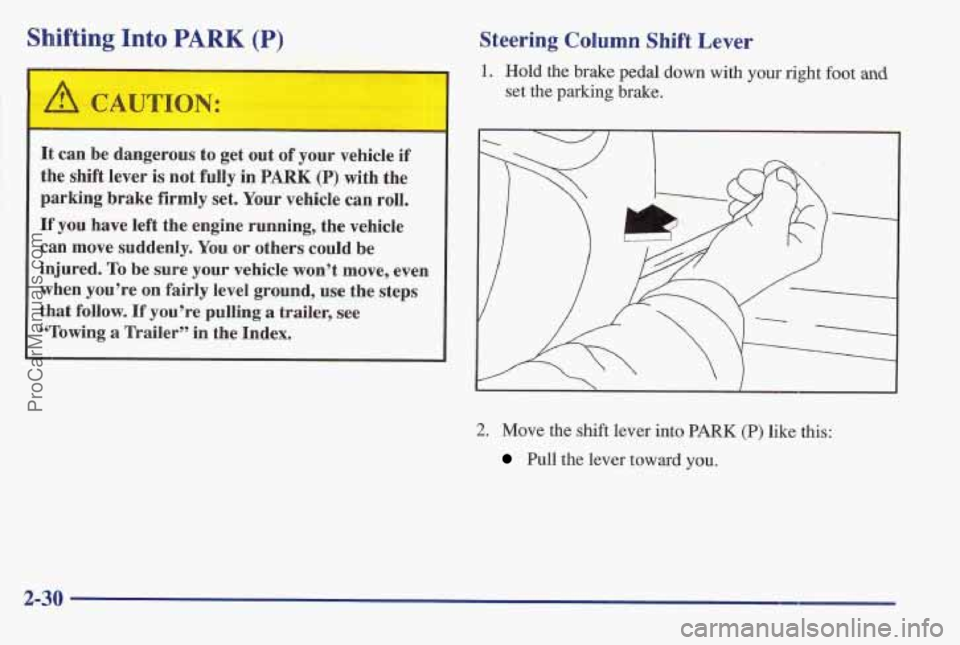
Steering Column Shift Lever
1. Hold the brake pedal down with your right foot and
set the parking brake.
2. Move the shift lever into PARK (P) like this:
Pull the lever toward you.
2-30
ProCarManuals.com
Page 88 of 405
It can be dangerous to get out of your vehicle if
the shift lever is not fully in
PARK (P) with the
parking brake firmly set. Your vehicle can roll.
Don’t leave your vehicle when the engine is
running unless you have to. If you’ve left the
engine running, the vehicle can move suddenly.
You or others could be injured. To be sure your
vehicle won’t move, even when you’re on fairly
level ground, always set your parking brake and
1 move the shift lever to PARK (P).
Follow the proper steps to be sure your vehicle won’t
move. See “Shifting Into
PARK (P)” in the Index.
If you are parking on a hill and if you’re pulling a
trailer, also
see “Towing a Trailer” in the Index.
Windows
Power Windows
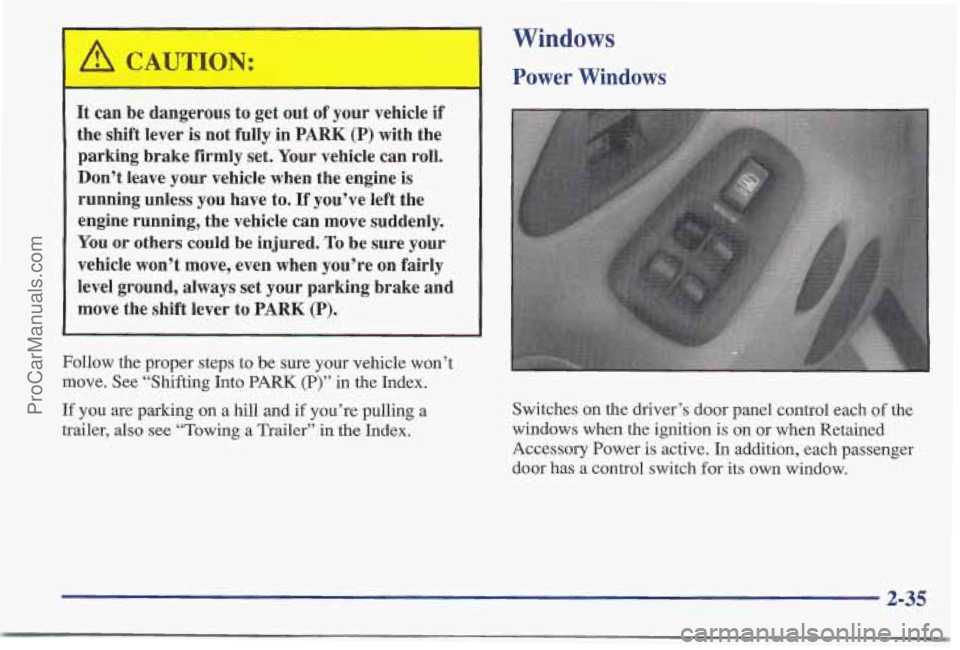
Switches on the driver’s door panel control each of the
windows when the ignition is on or when Retained
Accessory Power is active. In addition, each passenger
door has a control switch far its
own window.
2-35
ProCarManuals.com
Page 125 of 405

If the Light Is Flashing
The following may prevent more serious damage to
your vehicle:
Reducing vehicle speed.
0 Avoiding hard accelerations.
Avoiding steep uphill grades.
If you are towing a trailer, reduce the amount of
cargo being hauled as soon as it is possibmle.
If the light stops flashing and remains on steady, see “If
the Light
Is On Steady” following.
If the light continues to flash, when it is safe to do
so,
stop the vehicle. Find a safe place to park your vehicle.
Turn the key
off, wait at least 10 seconds and restart the
engine. If
the light remains on steady, see “If the Light
Is On Steady” following.
If the light is still flashing,
follow the previous steps, and drive the vehicle to your
dealer or qualified service center for service.
If the Light Is On Steady
You may be able to correct the emission system
malfunction
by considering the following:
Did you recently put fuel into your vehicle?
If so, reinstall the fuel cap, making sure to fully install
the cap. The diagnostic system can determine if the fuel cap
has been left
off or improperly installed. A loose or
missing fuel cap will allow fuel to evaporate into the
atmosphere.
A few driving trips with the cap properly
installed should turn the light off.
Did you just drive through
a deep puddle of water?
If
so, your electrical system may be wet. The condition
will usually be corrected when the electrical system
dries out,
A few driving trips should turn the light off.
Have
you recently changed brands of fuel?
If
so, be sure to fuel your vehicle with quality fuel (see
“Fuel”
in the Index). Poor fuel quality will cause your
engine not to run as efficiently as designed. You may
notice this as stalling after start-up, stalling when you put
the vehicle into gear, misfiring, hesitation on acceleration
or stumbling on acceleration. (These conditions may
go
away once the engine is warmed up.) This will be
detected
by the system and cause the light to hrn on.
If you experience one or more
of these conditions,
change
the fuel brand you use. It will require at least
one full tank of the proper fuel to turn the light off.
If none of the above steps have made the light turn on,
have your dealer or qualified service center check the
vehicle. Your dealer has the proper test equipment and
diagnostic tools to fix any mechanical or electrical
problems that may have developed.
2-72
ProCarManuals.com
Page 174 of 405

Section 4 Your Driving and the Road
Here you’ll find information about driving on different kinds of roads and in varying weather conditions. We’ve also
included many other useful tips on driving.
4-2 Defensive Driving 4-18
Driving in Rain and on Wet Roads
4-3 Drunken Driving 4-2
1 City
Driving
4-6 Control
of a Vehicle
4-6 Braking 4-22
Freeway Driving
4-23 Before Leaving on a Long Trip
4-
10 Steering 4-24
Highway Hypnosis
4-13 Off-Road Recovery
4-30
Loading Your Vehicle 4-15 Loss of Control
4-26 Winter Driving
4-13 Passing 4-24
Hill and Mountain Roads
4- 16 Driving at Night 4-32
Towing a Trailer
4-1
ProCarManuals.com
Page 205 of 405
Towing a Trailer
Things you put inside your vehicle can strike and
injure people in a sudden stop or turn,
or in
a crash.
0 Put things in the trunk of your vehicle. In a
trunk, put them as far forward as you can.
Try to spread the weight evenly.
inside the vehicle
so that some of them are
above the tops of the seats.
Don’t leave an unsecured child restraint in
your vehicle.
When you carry something inside the
vehicle, secure it whenever you can.
Don’t leave a seat folded down unless you
need to.
Never stack heavier things, like suitcases,
Electronic LeveI Control (Option)
This feature keeps the rear of your vehicle level as the
load changes.
It is automatic -- you do not need to
adjust anything.
I A CAUTION:
- I
If you don’t use the correct equipment and drive
properly, you can lose control when you pull a
trailer.
For example, if the trailer is too heavy, the
brakes may not work well
-9 or even at all. You
and your passengers could be seriously injured.
Pull a trailer only if you have followed all the
steps in this section.
Ask your Pontiac dealer for
advice
and information about towing a trailer
with your vehicle.
NOTICE:
~~ ~~ ~~
Pulling a trailer improperly can damage your
vehicle and result in costly repairs not covered
by
your warranty. To pull a trailer correctly, follow
the advice in this part, and see your Bontiac
dealer
for important information about towing a
trailer with your vehicle.
4-32
ProCarManuals.com
Page 206 of 405

Your vehicle can tow a trailer if it is equipped with the
proper trailer towing equipment. To identify what the
vehicle trailering capacity
is for your vehicle, you
should read the information
in “Weight of the Trailer’‘
that appears later in this section. But trailering is
different than just driving your vehicle by itself.
Trailering means changes in handling, durability and
fuel economy. Successful, safe trailering takes correct
equipment, and
it has to be used properly.
That’s the reason for this part.
In it are many
time-tested, important trailering tips and safety rules.
Many of these
are important for your safety and that of
your passengers. So please read this section carefully
before you pull
a trailer.
Load-pulling components such as the engine, transaxle,
wheel assemblies and tires
are forced to work harder
against the drag of the added weight. The engine is
required
to operate at relatively higher speeds and under
greater loads, generating extra heat. What’s more, the
trailer adds considerably to wind resistance, increasing
the pulling requirements.
If You Do Decide To Pull A Trailer
If you do, here are some important points:
0
0
0
0
0
There are many different laws, including speed limit
restrictions, having to do with trailering. Make sure
your rig will be legal,
not only where you live but
also where you’ll be driving.
A good source for this
information can be state or provincial police.
Consider using a sway control. You
can ask a hitch
dealer about sway controls.
Don’t tow a trailer at all during the first
1,000 miles
(1 600 krn) your new vehicle is driven. Your engine,
axle or other parts could be damaged.
Then, during the first
500 miles (800 km) that you
tow a trailer, don’t drive over
50 mph (80 lun/h) and
don’t make starts at full throttle. This helps your
engine and other parts of your vehicle wear in at the
heavier loads.
Obey speed limit restrictions when towing a trailer.
Don’t drive faster than the maximum posted speed
for trailers (or no more than
55 mph (90 km/h)) to
save wear on your vehicle’s parts.
ProCarManuals.com