fuel pressure PONTIAC BONNEVILLE 1998 Owners Manual
[x] Cancel search | Manufacturer: PONTIAC, Model Year: 1998, Model line: BONNEVILLE, Model: PONTIAC BONNEVILLE 1998Pages: 395, PDF Size: 17.6 MB
Page 6 of 395
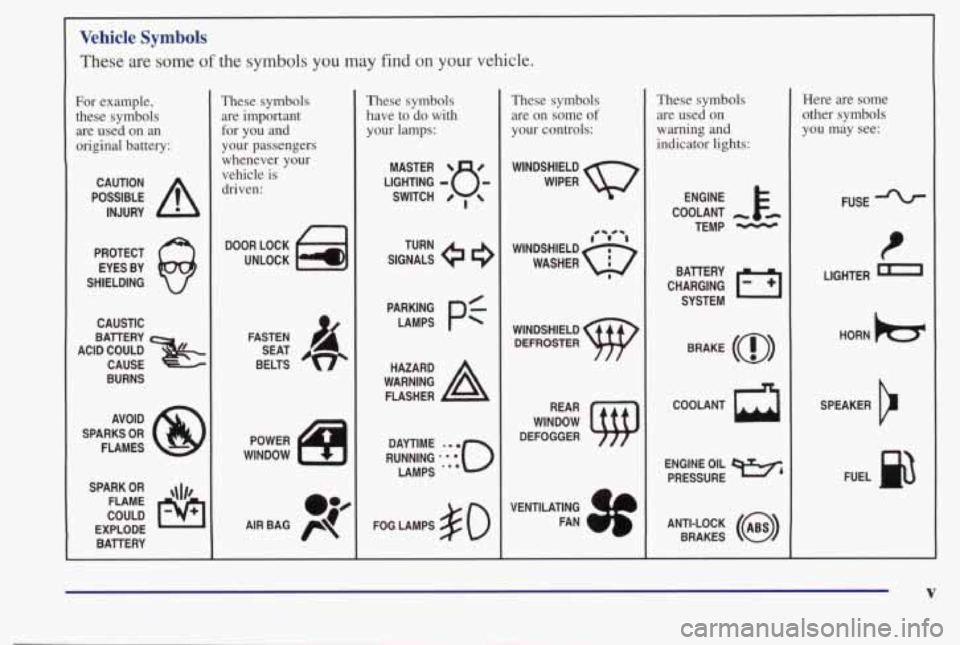
Vehicle Symbols
These are some of the symbols you may find on your vehicle.
For example,
these symbols are used on an
original battery:
POSSIBLE A
CAUTION
INJURY
PROTECT EYES BY
SHIELDING
Q
CAUSTIC
ACID COULD BAllERY
CAUSE -~~-. .
BURNS
AVOID
SPARKS
OR
FLAMES
SPARK
OR ,\I/,
COULD FLAME
EXPLODE BAllERY
I
These symbols are important
for you and
your passengers
whenever your
vehicle is
driven:
DOOR LOCK
UNLOCK
n
POWER
WINDOW
oJ4
AIR BAG p
These symbols
have to do with your lamps:
SIGNALS e3
TURN
FOG LAMPS
# 0
These symbols are on some
of
your controls:
WINDSHIELD
WIPER
WINDSHIELD
DEFROSTER
DEFOGGER
VENTILATING FAN
( rc?: A
These symbols are used on
warning
and
indicator lights:
COOLANT -
TEMP -
CHARGING I-1
BAllERY
SYSTEM
BRAKE
(a)
R
Here are some
other symbols
you may see:
FUSE
LIGHTER
n
HORN )b.
ENGINE OIL e,
PRESSURE
V
SPEAKER
b
FUEL
Page 129 of 395
Check Oil Level Warning Light
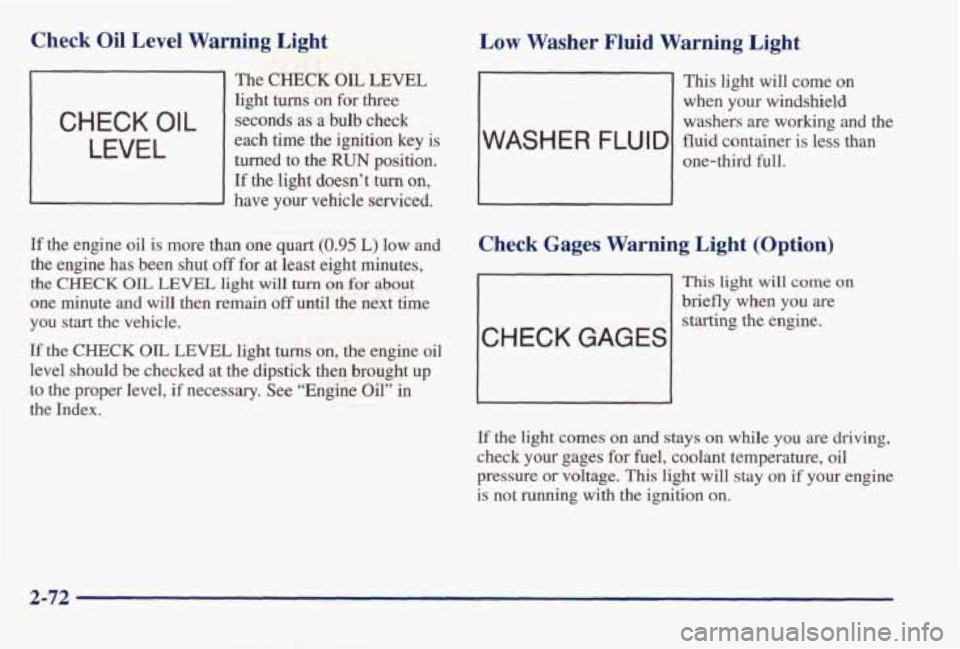
The CHECK OIL LEVEL
light turns on for three
each time the ignition key is turned to the
RUN position.
If the light doesn’t turn on,
- have your vehicle serviced.
C H EC K 0 I L seconds as a bulb check
LEVEL
If the engine oil is more than one quart (0.95 L) low and
the engine has been shut off for at least eight minutes,
the CHECK OIL LEVEL light will turn on for about
one minute and will then remain off until the next time
you start the vehicle.
If the CHECK OIL LEVEL light turns on, the engine oil
level should be checked at the dipstick then brought up
to the proper level, if necessary. See “Engine Oil” in
the Index.
Low Washer Fluid Warning Light
- This light will come on
when your windshield
washers are working
and the
one-third full.
WASH E R FLU I D fluid container is less than
Check Gages Warning Light (Option)
CHECK GAGES
This light will come on
briefly when you are
starting
the engine.
If
the light comes on and stays on while you are driving,
check your gages for fuel, coolant temperature, oil
pressure
or voltage. This light will stay on if your engine
is not running with the ignition
on.
2-72
Page 131 of 395
Boost Gage (Option) Head-Up Display (Option)
fXjST
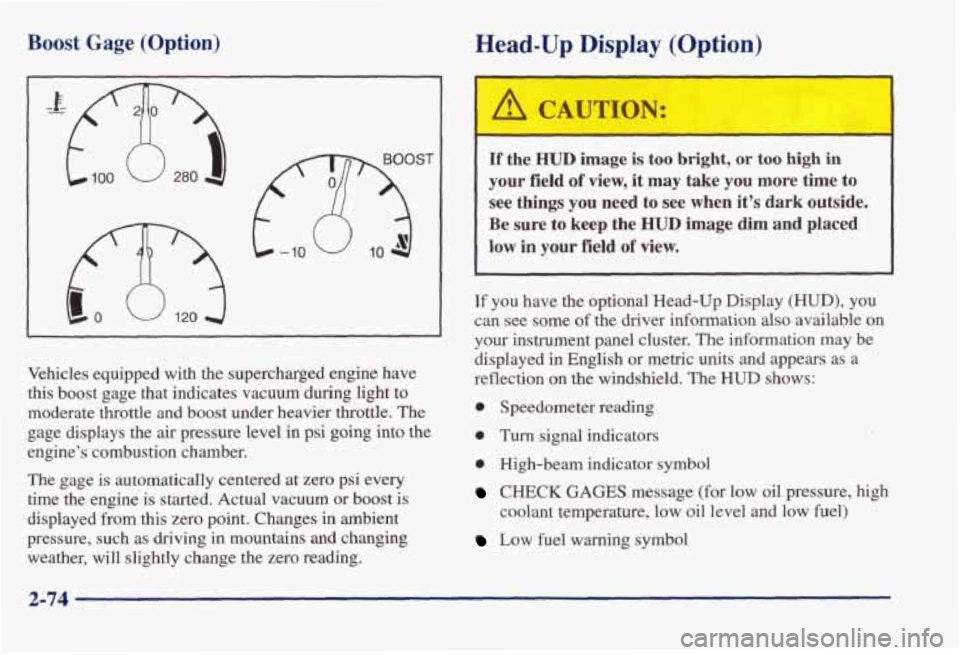
Vehicles equipped with the supercharged engine have
this boost gage that indicates vacuum during light
to
moderate throttle and boost under heavier throttle. The
gage displays the air pressure level in psi going into the
engine’s combustion chamber.
The gage is automatically centered at zero psi every
time the engine is started. Actual vacuum or boost
is
displayed from this zero point. Changes in ambient
pressure, such as driving in mountains
and changing
weather, will slightly change the zero reading.
If the HUD image is too bright, or too high in
your field of view, it may take you more time to
see things you need to see when it’s dark outside.
Be sure to keep the HUD image dim and placed
low in your field of view.
If you have the optional Head-Up Display (HUD), you
can see some
of the driver information also available on
your instrument panel cluster. The information
may be
displayed in English or metric units and appears as a
reflection on the windshield. The
HUD shows:
0 Speedometer reading
0 Turn signal indicators
0 High-beam indicator symbol
CHECK GAGES message (for low oil pressure, high
coolant temperature, low oil level and low fuel)
Low fuel warning symbol
2-74
Page 135 of 395
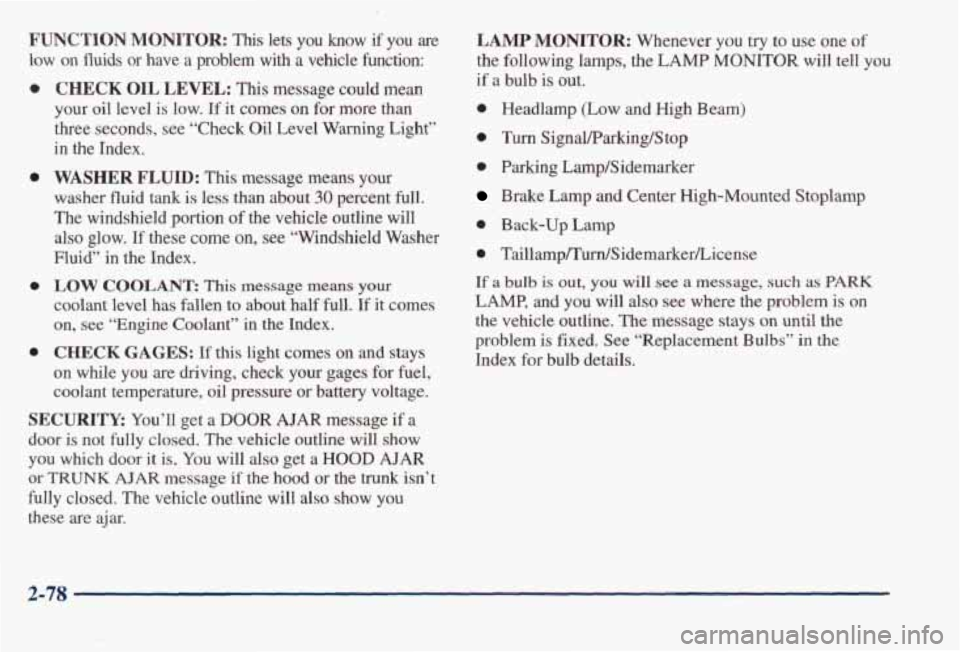
FUNCTION MONITOR: This lets you know if you are
low on fluids or have a problem with a vehicle function:
0
0
0
0
CHECK OIL LEVEL: This message could mean
your oil level
is low. If it comes on for more than
three seconds, see “Check Oil
Level Warning Light”
in the Index.
WASHER FLUID: This message means your
washer fluid
tank is less than about 30 percent full.
The windshield portion
of the vehicle outline will
also glow,
If these come on, see “Windshield Washer
Fluid” in the Index.
LOW COOLANT: This message means your
coolant level has fallen to about half full. If it comes
on,
see “Engine Coolant” in the Index.
CHECK GAGES: If this light comes on and stays
on while you are driving, check your gages for fuel,
coolant temperature, oil pressure or battery voltage.
SECURITY: You’ll get a DOOR AJAR message if a
door is not fully closed. The vehicle outline will show
you which door
it is. You will also get a HOOD AJAR
or TRUNK AJAR message if the hood or the trunk isn’t
fully closed. The vehicle outline will
also show you
these are ajar.
LAMP MONITOR: Whenever you try to use one of
the following lamps, the LAMP MONITOR will tell you
if a bulb is out.
0 Headlamp (Low and High Beam)
0 Turn Signal/Parking/Stop
0 Parking Lamp/Sidemarker
Brake Lamp and Center High-Mounted Stoplamp
0 Back-up Lamp
0 Taillamp~rn/Sidemarker/License
If a bulb is out, you will see a message, such as PARK
LAMP, and you will also see where the problem is on
the vehicle outline.
The message stays on until the
problem
is fixed. See “Replacement Bulbs” in the
Index for bulb details.
2-78
Page 195 of 395
The exit speed is usually posted.
Reduce
your speed according to your speedometer, not
to your sense
of motion. After driving for any distance
at higher speeds, you may tend to
think you are going
slower
than you actually are.
Before Leaving on a Long Trip
Make sure you’re ready. Try to be well rested. If you
must
start when you’re not fresh -- such as after a day’s
work
-- don’t plan to make too many miles that first part
of the journey. Wear comfortable clothing and shoes you
can
easily drive in.
Is your vehicle ready for a long trip? If you keep it
serviced and maintained, it’s ready to
go. If it needs
service, have it
done before starting out. Of course,
you’ll fiid experienced and able service experts
in
Pontiac dealerships all across North America. They’ll be
ready and willing to help
if you need it. Here are some things
you can check before a trip:
e
0
0
0
0
Windshield Washer Fluid: Is
the reservoir full? Are
all windows clean inside and outside?
Wper Blades: Are they in good shape?
Fuel, Engine Oil, Other Fluids: Have you checked
all levels?
Lumps: Are they all working? Are the lenses clean?
Zlres: They are vitally important to a safe,
trouble-free trip.
Is the tread good enough for
long-distance driving? Are the
tires all inflated to the
recommended pressure?
Weather Forecasts: What’s the weather outlook
along your route? Should you delay your trip a short
time
to avoid a major storm system?
Maps: Do you have up-to-date maps?
4-22
Page 202 of 395
Run your engine only as long as you must. This saves fuel. When you run the engine, make it go a little faster
than just idle. That is, push the accelerator slightly. This
uses less fuel for .the heat that you get and it keeps the
battery charged. You will need
a well-charged battery to
restart the vehicle, and possibly for signaling later on
with your headlamps. Let the heater run for a while.
Then, shut the engine
off and close the window almost
all the way to preserve the heat. Start the engine again and repeat this only when you feel really uncomfortable
from the cold. But do
it as little as possible. Preserve the
fuel as long as you can. To help keep warm, you can get
out
of the vehicle and do some fairly vigorous exercises
every half hour
or so until help comes.
Loading Your Vehicle
;"
7
TIRE-LOADING INFORMATION
OCCUPANTS
VEHICLE CAP. WT.
FRT. CTR.
RR. TOTAL LBS. KG
MAX. LOADING & GVWR SAME AS VEHICLE
CAPACITY WEIGHT
XXX COLD TIRE
TIRE SIZE SPEED PRESSURE
RTG PSVKPa
FRT.
RR.
SPA.
IF TIRES ARE HOT, ADD 4PS1/28KPa
SEE OWNER'S MANUAL FOR ADDITIONAL
, INFORMATION
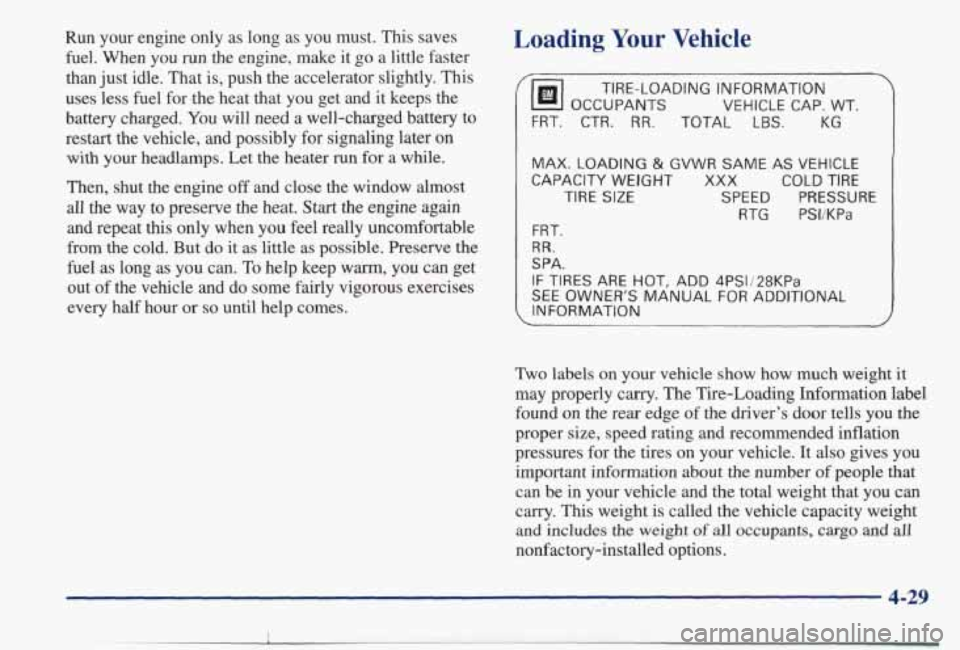
Two labels on your vehicle show how much weight it
may properly carry. The Tire-Loading Information label
found on
the rear edge of the driver's door tells you the
proper size, speed rating and recommended inflation
pressures for the tires on your vehicle. It also gives you
important information about the number
of people that
can be in your vehicle and the total weight that you can
carry. This weight is called the vehicle capacity weight
and includes the weight of all occupants, cargo and all
nonfactory-installed options.
4-29
Page 252 of 395

Section 6 Service and Appearance Care
Here you will find information about the care of your vehicle.\
This section begins with service and fuel information,
and then it
shows how to check important fluid and lubricant levels. There is also technical information about your
vehicle, and a part devoted to its appearance care.
6-2
6-3
6-5
6-6
6-9
6-9
6-13
6- 17
6-20
6-23
6-26
6-26
6-27
6-28
6-32
6-32
6-40
Service
Fuel
Fuels in Foreign Countries
Filling Your
Tank
Filling a Portable Fuel Container
Checking Things Under the Hood
Engine
Oil
Air Cleaner
Automatic Transaxle Fluid
Engine Coolant
Radiator Pressure Cap
Power Steering Fluid
Windshield Washer Fluid Brakes
Battery
Bulb Replacement Windshield Wiper Blade Replacement
6-4 1
6-49
6-49
6-5
1
6-52
6-54
6-54
6-56
6-57
6-58
6-64
6-65
6-65 6-66
6-66
6-66
Tires
Appearance Care
Cleaning the Inside of Your Vehicle
Care
of Safety Belts
Cleaning the Outside of Your Vehicle
Cleaning Aluminum or Chrome Wheels
(If Equipped)
Sheet Metal Damage
Appearance Care Materials Chart
Vehicle Identification Number
(VIN)
Electrical System
Replacement Bulbs
Capacities and Specifications
Air Conditioning Refrigerants
Engine Specifications
Normal Maintenance Replacement
Parts
Vehicle Dimensions
6-1
Page 264 of 395
Supercharged Engine (If Equipped)
Your vehicle may have a 3800 Supercharged engine.
The supercharger is a device designed to pump more air
into the engine than it would normally use.
This air,
mixed with fuel, creates increased engine power. Since
the supercharger is a pump and is driven from an engine
accessory drive belt, increased pressure is available at
all driving conditions.
The Powertrain Control Module (PCM), works with a vacuum control to regulate the increased pressure
required during specific driving conditions. When this
increased pressure or boost is not desired, such
as during
idling and light throttle cruising, the excess
air that the
supercharger is pumping is routed through
a bypass.
All of these controls, working together, provide high
performance character and fuel efficiency in the
3800 V6 Supercharged engine.
Engine Oil
CHECK OIL
LEVEL
If the CHECK OIL LEVEL
light on the instrument panel
comes
on, it means you need
to check your engine oil level
right away.
For more
information,
see “Check Oil
Level Light” in the Index. You
should check your engine oil level regularly;
this is
an added reminder.
It’s
a good idea to check your engine oil every time you
get fuel.
In order to get an accurate reading, the oil must
be warm and the vehicle must be on level ground.
Turn
off the engine and give the oil a few minutes to
drain back into the oil pan. If you don’t, the oil dipstic\
k
might not show
the actual level.
6-13
Page 293 of 395
NOTICE:
Don’t let anyone tell you that underinflation or
overinflation is
all right. It’s not. If your tires
don’t have enough air (underinflation),
you can
get the following:
0 Too much flexing
0 Too much heat
Tire overloading
Bad wear
Bad handling
0 Bad fuel economy.
If your tires have too much air (overinflation),
you can get the following:
Unusual wear
Bad handling
0 Rough ride
0 Needless damage from road hazards. When
to Check
Check your tires once a month or more.
Don’t forget your compact spare tire. It should
be at
60 psi (420 Wa).
How to Check
Use a good quality pocket-type gage to check tire
pressure.
You can’t tell if your tires are properly inflated
simply by looking at them. Radial tires may look
properly inflated even when they’re underinflated.
Be sure to put the valve caps back on the valve
stems.
They help prevent leaks by keeping out dirt
and moisture.
6-42
Page 316 of 395

Capacities and Specifications
The following approximate capacities are given in English and m\
etric conversions. Please refer to “Recommended
Fluids and Lubricants” in the Index for more information.
Automatic Transaxle (Overdrive)
Pan Removal and Replacement ........... 6 quarts (6.1 L)
Complete Overhaul .................. 11 quarts (10.4 L)
Cooling System ........................ 13 quarts (12.3 L)
When draining or replacing torque converter; more fluid may be needed.
Cooling System ................ ........ 13 quarts (12.3 L)
Engine Crankcase ................... 4.5 quarts (4.3L)
Fuel Tank ............................ 18 gallons (68 L)
Tire Pressures .... >.. . See Ere-Loading Information label on the driver’s dool:
Wheel Nut Torque ......... . 100 lb-ft 140 N-m
R-134a Air Conditioning .... . See refrigerant charge label under the hood.
Oil
change with filter change
.......
.......
.......
All capacities are approximate. When adding, be sure to fill to the appropriate level, as recommended in this manual.
Air Conditioning Refrigerants
Not all air conditioning refrigerants are the same. If the air conditioning system in your vehicle needs refrigerant, be
sure the proper refrigerant is used. If you’re not sure,
ask your dealer.
6-65