engine PONTIAC BONNEVILLE 2003 Owners Manual
[x] Cancel search | Manufacturer: PONTIAC, Model Year: 2003, Model line: BONNEVILLE, Model: PONTIAC BONNEVILLE 2003Pages: 418, PDF Size: 20.24 MB
Page 301 of 418
Brakes
Brake Fluid
I 1
your brake system fixed, since a leak means that
sooner or later your brakes won’t work well, or won’t
work at all.
So, it isn’t a good idea to “top off your brake fluid.
Adding brake fluid won’t correct a leak.
If you add fluid
when your linings are worn, then you’ll have too
much fluid when you get new brake linings. You should
add (or remove) brake fluid, as necessary, only when
work
is done on the brake hydraulic system
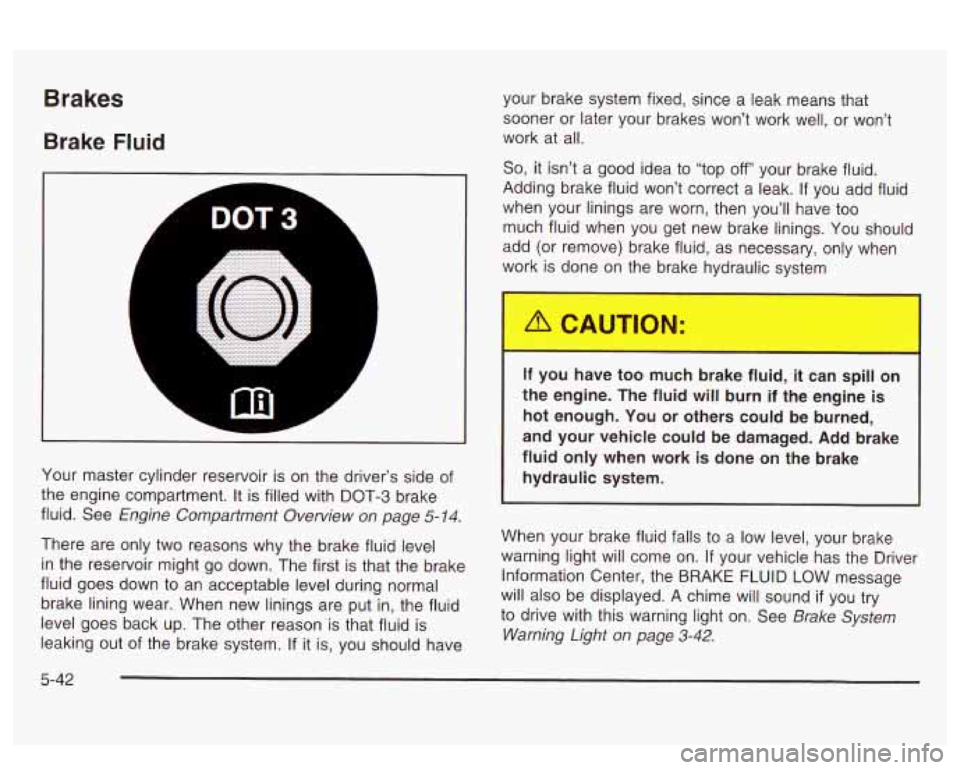
Your master cylinder reservoir is on the driver’s side of
the engine compartment. It is filled with DOT-3 brake
fluid. See
Engine Compartment Overview on page 5-14.
There are only two reasons why the brake fluid level
in the reservoir might go down. The first is that the brake
fluid goes down to an acceptable level during normal
brake lining wear. When new linings are put in, the fluid
level goes back up. The other reason is that fluid is
leaking out of the brake system.
If it is, you should have
If you have too much brake fluid, it can spill on
the engine. The fluid will burn if the engine
is
hot enough. You or others could be burned,
and your vehicle could be damaged. Add brake
fluid only when work
is done on the brake
hydraulic system.
When your brake fluid falls to a low level, your brake
warning light will come on. If your vehicle has the Driver
Information Center, the BRAKE FLUID LOW message
will also be displayed. A chime will sound
if you try
to drive with this warning light on. See
Brake System
Warning Light on page
3-42.
5-42
Page 302 of 418
What to Add
When you do need brake fluid, use only DOT-3 brake
fluid. Refer to
Part D: Recommended Fluids and
Lubricants on page
6-24. Use new brake fluid from a
sealed container only.
Always clean the brake fluid reservoir cap and the area
around the cap before removing it. This will help
ke-- dirt from entering the reservoir.
I
With the wrong kind of fluid in your brake
system, your brakes may not work well, or
they may not even work at all. This could
cause a crash. Always use the proper
brake fluid.
* If you spill brake fluid on your vehicle’s painted
surfaces, the paint finish can be damaged. Be
careful not to spill brake fluid on your vehicle.
If you do, wash
it off immediately. See
“Appearance Care” in the Index.
Brake wear
Your vehicle has four-wheel disc brakes.
Disc brake pads have built-in wear indicators that make
a high-pitched warning sound when the brake pads
are worn and new pads are needed. The sound
may come and go or be heard all the time your vehicle
is moving (except when you are pushing on the
brake pedal firmly).
Notice:
Using the wrong fluid can badly damage brake
system parts. For example, just a few drops of mineral-based oil, such as engine oil,
in your
brake system can damage brake system
parts
so badly that they’ll have to be replaced.
Don’t let someone put in the wrong kind of fluid. The brake
wear warning sound --jeans that
soon your brakes won’t work well. That could
lead
KO an accident. wnen you near ine brake
wear warning sound, have your vehicle
serviced.
5-43
Page 306 of 418
Notice: Ignoring these steps could result in costly
damage to your vehicle that wouldn’t be covered
by your warranty.
Trying to start your vehicle by pushing or pulling
it
won’t work, and it could damage your vehicle.
1. Check the other vehicle. It must have a 12-volt
battery with a negative ground system.
Notice:
If the other system isn’t a 12-volt system
with a negative ground, both vehicles can be damaged.
2. Get the vehicles close enough so the jumper cables
can reach, but be sure the vehicles aren’t touching
each other.
If they are, it could cause a ground
connection you don’t want. You wouldn’t be able to
start your vehicle, and the bad grounding could
damage the electrical systems.
To avoid the possibility of the vehicles rolling, set
the parking brake firmly on both vehicles involved in
the jump start procedure. Put an automatic
transaxle in PARK (P) or a manual transmission in
NEUTRAL (N) before setting the parking brake. Notice:
If you
leave your radio on, it could be badly
damaged. The repairs wouldn’t be covered by
your warranty.
3. Turn off the ignition on both vehicles. Unplug
unnecessary accessories plugged into the cigarette
lighter or in the accessory power outlet. Turn
off
the radio and all lamps that aren’t needed. This will
avoid sparks and help save both batteries. And it
could save your radio!
4. Open the hood on the other vehicle and locate the
positive
(+) and the negative (-) terminal locations
on that vehicle.
Open the hood on your vehicle and find the remote
positive
(+) terminal located in the engine
compartment
on the passenger side of the vehicle.
See
Engine Compartment Overview on page 5-14
for more information on location.
5-47
Page 307 of 418
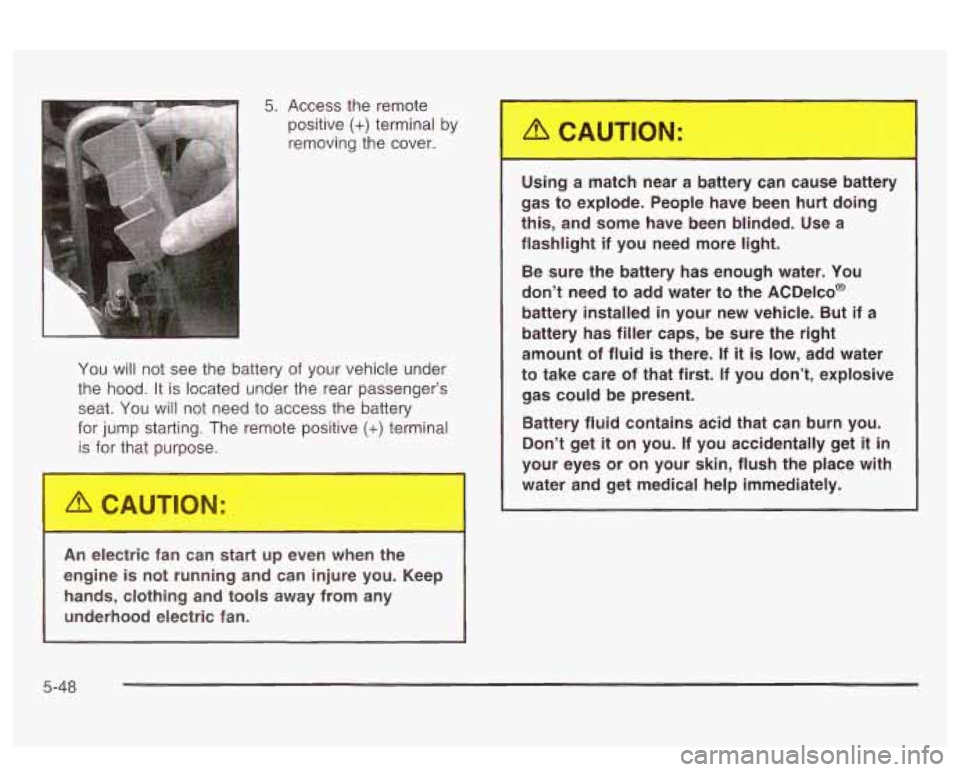
You will not see the battery of your vehicle under
the hood.
It is located under the rear passenger’s
seat. You will not need to access the battery
for jump starting. The remote positive
(+) terminal
is for that purpose.
An electric fan can start
up even when the
engine is not running and can injure you. Keep
hands, clothing and tools away from any
underhood electric fan. Using a match
near a battery can cause battery
gas to explode. People have been hurt doing
this, and some have been blinded. Use a
flashlight if you need more light.
Be sure the battery has enough water. You
don’t need to add water to the ACDelco@
battery installed in your new vehicle. But if a
battery has filler caps, be sure the right
amount of fluid
is there. If it is low, add water
to take care
of that first. If you don’t, explosive
gas could be present.
Battery fluid contains acid that can burn you.
Don’t get
it on you. If you accidentally get it in
your eyes or on your skin, flush the place with
water and get medical help immediately.
5-48
Page 308 of 418
r
Fans or other moving engine parts can injure
you badly. Keep your hands away from moving parts once the engine
is running.
6. Check that the jumper cables don’t have loose or
missing insulation. If they do, you could get a
shock. The vehicles could be damaged too.
Before you connect the cables, here are some
basic things you should know. Positive
(+) will go to
positive
(+) or to a remote positive (+) terminal if
the vehicle has one. Negative (-) will go to a heavy,
unpainted metal engine part or to a remote
negative
(-) terminal if the vehicle has one.
Don’t connect positive
(+) to negative (-) or you’ll
get a short that would damage the batterv and
maybe other parts too. And don’t connect the
negative
(-) cable to the negative (-) terminal on
the dead battery because this can cause sparks.
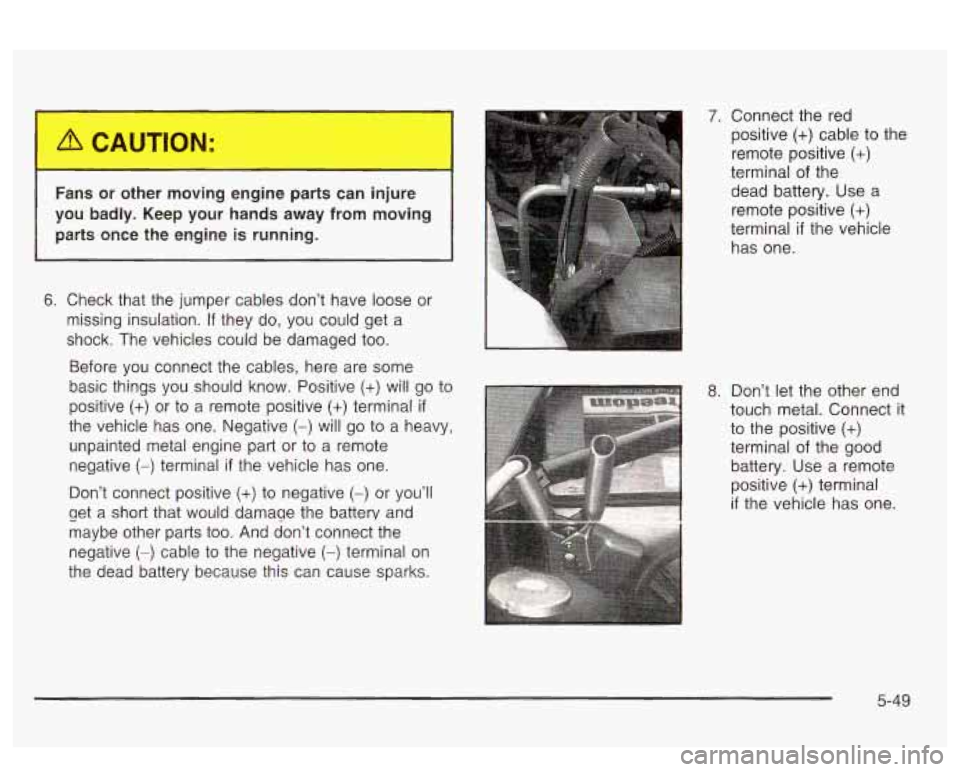
7. Connect the red
positive
(+) cable to the
remote positive
(+)
terminal of the
dead battery. Use a
remote positive
(+)
terminal if the vehicle
has one.
8. Don’t !et the other end
touch metal. Connect it
to the positive
(+)
terminal of the good
battery. Use a remote
positive (+) terminal
if the vehicle has one.
5-49
Page 309 of 418
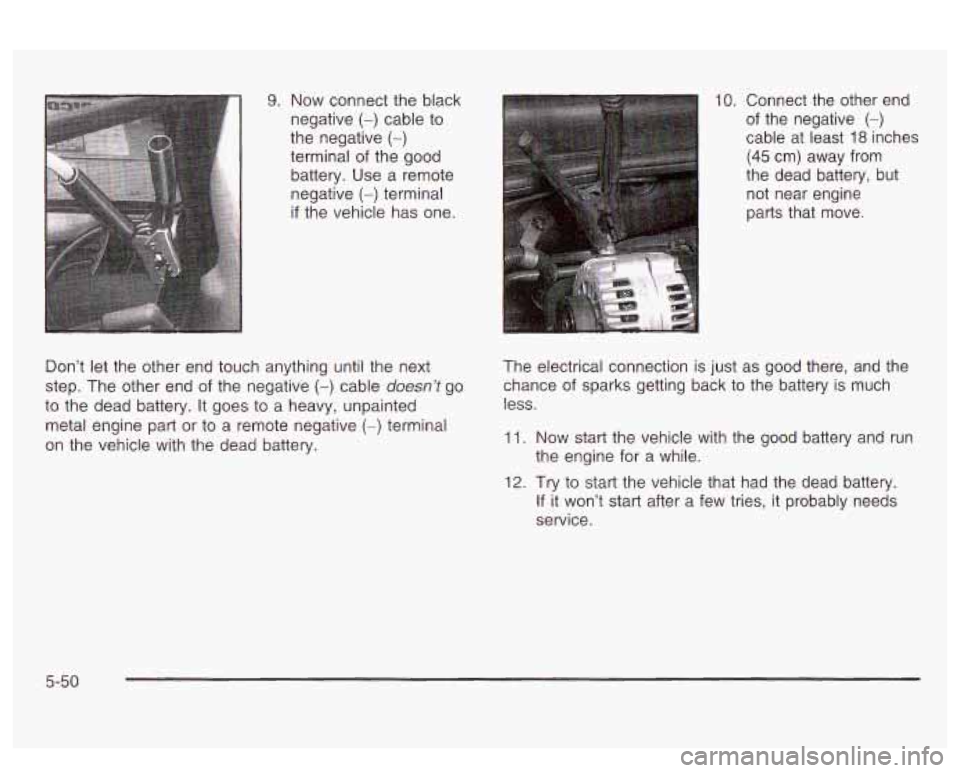
9. Now connect the black
negative
(-) cable to
the negative (-)
terminal of the good
battery. Use a remote
negative
(-) terminal
if the vehicle has one.
Don’t
let the other end touch anything until the next
step. The other end of the negative
(-) cable doesn’t go
to the dead battery. It goes to a heavy, unpainted
metal engine part or
to a remote negative (-) terminal
on the vehicle with the dead battery.
10. Connect the other end
of the negative
(-)
cable at least 18 inches
(45 cm) away from
the dead battery, but not near engine
parts that move.
The electrical connection is just as good there, and the
chance of sparks getting back
to the battery is much
less.
11.
12.
Now start the vehicle with the good battery and run
the engine for a while.
Try to start the vehicle that had the dead battery.
If it Won’t start after a few tries, it probably needs
service.
5-50
Page 310 of 418
Notice: Damage to your vehicle may result from
electrical shorting
if jumper cables are removed
incorrectly. To prevent electrical shorting, take care
that the cables don’t touch each other or any
other metal. The repairs wouldn’t be covered by
your warranty.
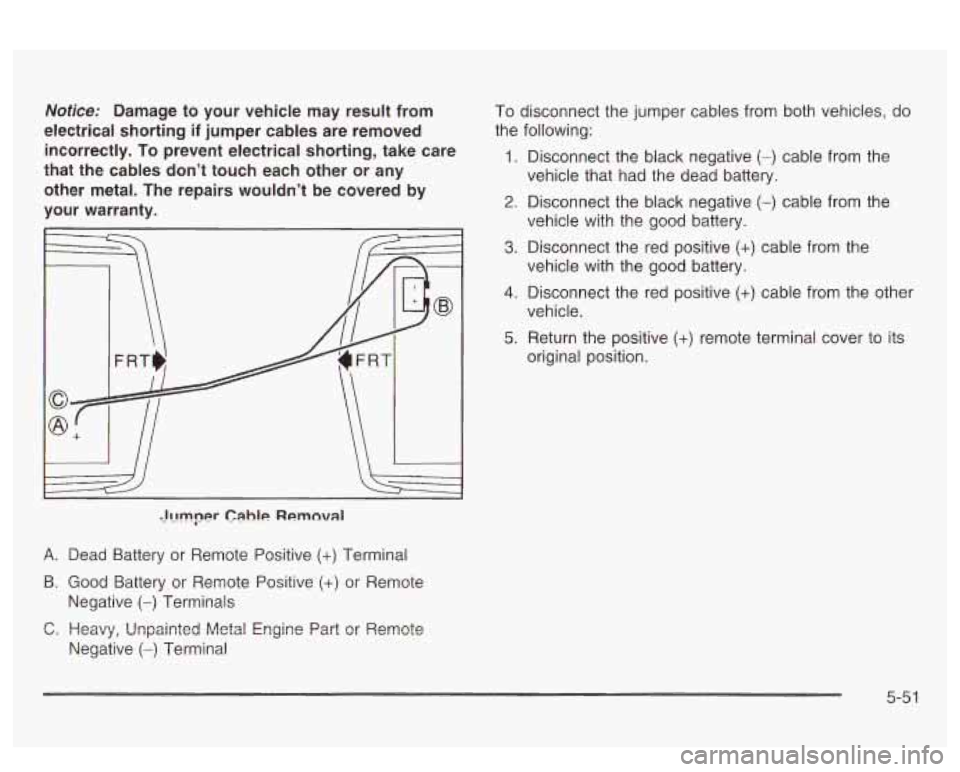
A. Dead Battery or Remote Positive (+) Terminal
B. Good Battery or Remote Positive
(+) or Remote
Negative
(-) Terminals
Negative
(-) Terminal
c. Hexby, Unpainted Meta! Engine Part e!- !?em&?
To disconnect the jumper cables from both vehicles, do
the following:
1. Disconnect the black negative (-) cable from the
2. Disconnect the black negative (-) cable from the
3. Disconnect the red positive (+) cable from the
4. Disconnect the red positive (+) cable from the other
5. Return the positive (+) remote terminal cover to its
vehicle that had the dead
battery.
vehicle with the good battery.
vehicle with the good battery.
vehicle.
original position.
5-5 1
Page 332 of 418
Changing a Flat Tire
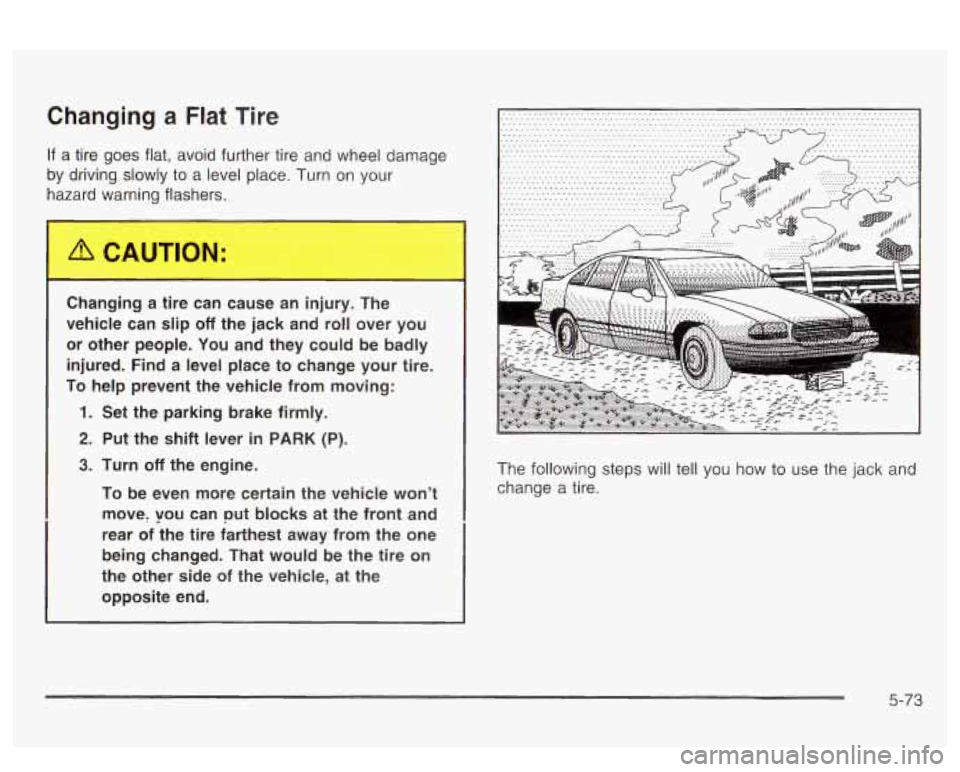
If a tire goes flat, avoid further tire and wheel damage
by driving slowly to a level place. Turn
on your
hazar
' varning flasl s.
Changing L he can cause an y. ... 2
vehicle can slip off the jack and roll over you
or other people. You and they could be badly
injured. Find a level place to change your tire.
To help prevent the vehicle from moving:
1. Set the parking brake firmly.
2. Put the shift lever in PARK (P).
3. Turn off the engine.
To be even more certain the vehicle won't
move: you can put blocks at the front and
rear
of the tire farthest away from the one
being changed. That would be the tire on
the other
side of the vehicle, at the
opposite end.
-
The following steps will tell you how to use the jack and
change a tire.
5-73
Page 349 of 418
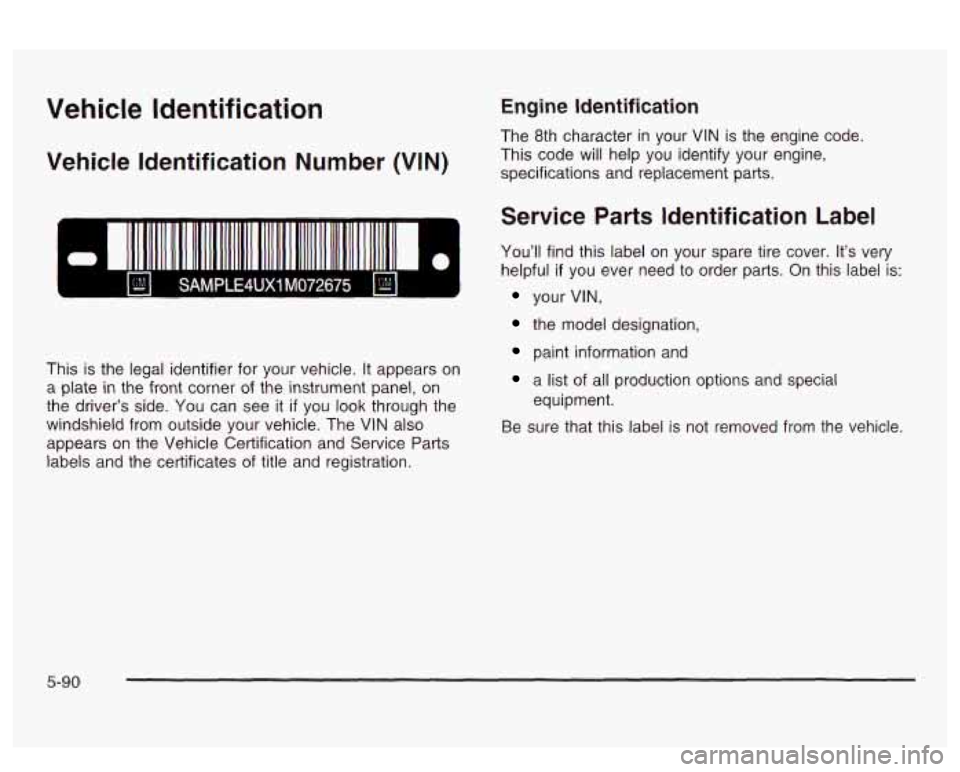
Vehicle Identification
Vehicle Identification Number (VIN)
SAMPLE4UXl M072675 1
This is the legal identifier for your vehicle. It appears on
a plate in the front corner of the instrument panel, on
the driver’s side. You can see it
if you look through the
windshield from outside your vehicle. The VIN also
appears on the Vehicle Certification
and Service Parts
labels and the certificates of title and registration.
Engine Identification
The 8th character in your VIN is the engine code.
This code will help you identify your engine,
specifications and replacement parts.
Service Parts Identification Label
You’ll find this label on your spare tire cover. It’s very
helpful if you ever need to order parts. On this label is:
your VIN,
the model designation,
paint information and
a list of all production options and special
equipment.
Be sure that this label
is not removed from the vehicle.
5-90
Page 351 of 418
Fuses and Circuit Breakers
The wiring circuits in your vehicle are protected from
short circuits by a combination of fuses and circuit
breakers. This greatly reduces the chance of damage
caused by electrical problems.
Look at the silver-colored band inside the fuse.
If the
band is broken or melted, replace the fuse. Be sure you
replace a bad fuse with a new one of the identical
size and rating.
The MaxiFuses are located in
two fuse blocks, one in
the engine compartment and the other under the
rear seat. If a MaxiFuse should blow, have your vehicle
serviced by your dealer immediately.
Removing Fuses
You will find a fuse puller attached in both of the fuse
blocks. Snap the wide end of the fuse puller on
to
the fuse, at the side indentations holding the puller and
pull the fuse
out.
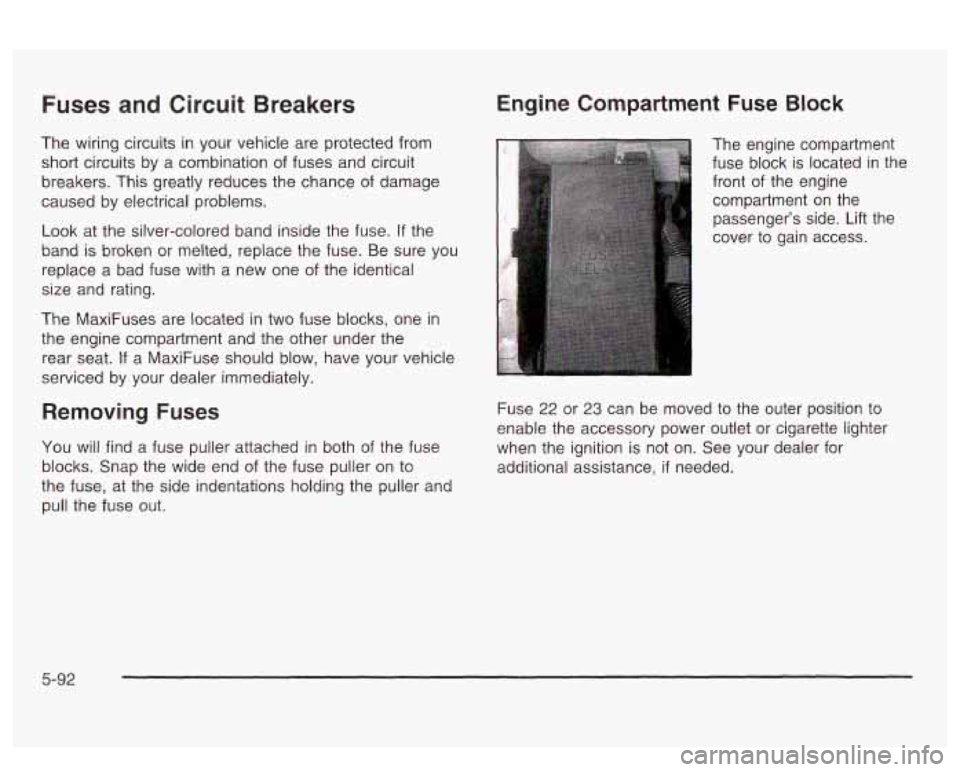
Engine Compartment Fuse Block
The engine compartment
fuse block is located in the
front
of the engine
compartment on the
passenger’s side. Lift the
cover
to gain access.
Fuse
22 or 23 can be moved to the outer position to
enable the accessory power outlet or cigarette lighter
when the ignition is not on. See your dealer for
additional assistance,
if needed.
5-92