seats PONTIAC BONNEVILLE 2003 User Guide
[x] Cancel search | Manufacturer: PONTIAC, Model Year: 2003, Model line: BONNEVILLE, Model: PONTIAC BONNEVILLE 2003Pages: 418, PDF Size: 20.24 MB
Page 51 of 418

Securing a Child Restraint in the
Right Front Seat Position
Your vehicle has a right front passenger air bag.
Never put a rear facing child restraint in this seat.
t e’s why:
A child in a rear-facing child restraint can be
seriously injured or killed if the right front passenger’s air bag inflates. This is because
the back
of the rear-facing child restraint
would be very close to the inflating air bag. Always secure
a rear-facing child restraint in a
rear seat.
Although a rear seat is a safer place, you can secure a
forward-facing child restraint in the right front seat.
You’ll be using the lap-shoulder belt. See
Top Strap on
page 1-37 if the child restraint has one. Be sure to
follow the instructions that came with the child restraint.
Secure the child
in the child restraint when and as
the instructions say.
1. Because your vehicle has a right front passenger
air bag, always move the seat as far back as it will
go before securing a forward-facing child restraint.
See
Power Seats on page 1-2.
2. Put the restraint on the seat.
3. Pick up the latch plate, and run the lap and shoulder
portions of the vehicle’s safety belt through or
around the restraint. The child restraint instructions
will show you how.
1-44
Page 93 of 418
To Use the Engine Coolant Heater
1. Turn off the engine.
2. Open the hood and unwrap the electrical cord.
The engine coolant heater cord is located on the
passenger’s side of the vehicle, above the
headlamp assembly.
3. Plug it into a normal, grounded 1 IO-volt AC outlet.
Plu ing the cord into an
L Jrounded outlet
could cause an electrical shock.
Also, the
wrong kind of extension cord could overheat
and cause a fire. You could
be seriously
injured. Plug the cord into a properly grounded
three-prong 110-volt
AC outlet. If the cord
won’t reach, use a heavy-duty three-prong
extension cord rated for at least 15 amps.
4. Before starting the engine, be sure to unplug and
store the cord
as it was before to keep it away
from moving engine parts.
If you don’t, it could be
damaged. How long should
you keep the coolant heater plugged
in? The answer depends
on the outside temperature, the
kind of oil you have, and some other things. Instead
of trying to list everything here, we ask that you contact
your dealer in the area where you’ll be parking your
vehicle. The dealer can give you the best advice for that
particular area.
Automatic Transaxle Operation
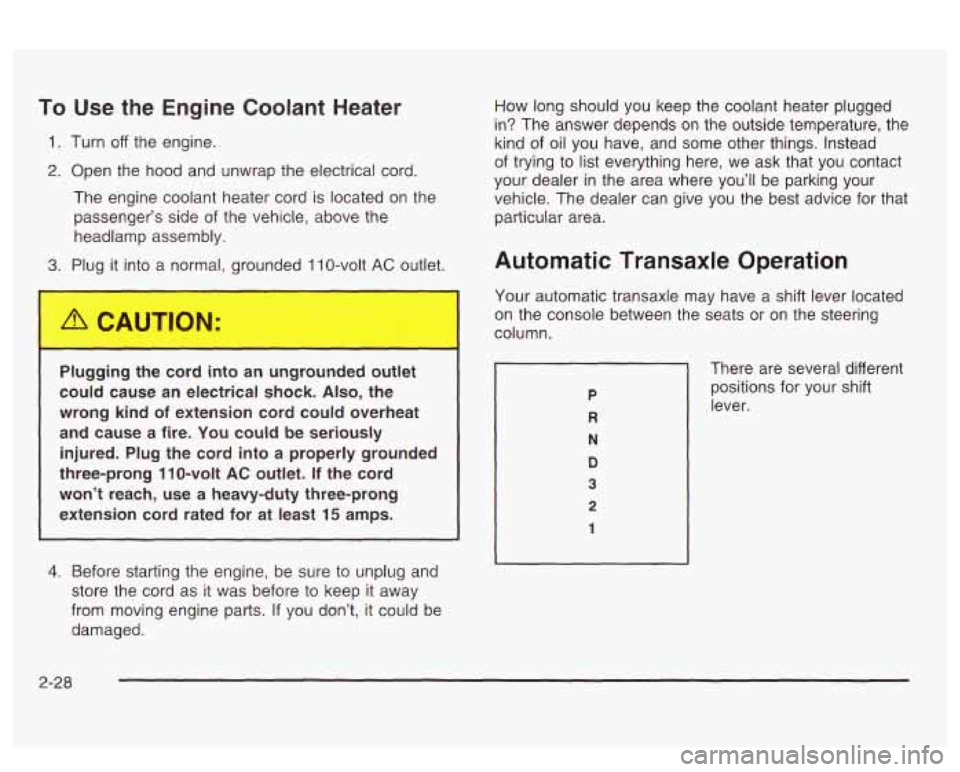
Your automatic transaxle may have a shift lever located
on the console between the seats or on the steering
column.
There are several different
positions for your shift
lever.
2-28
Page 135 of 418
Inadvertent Power Battery Saver
This feature is designed to protect your vehicle’s battery
against drainage from the interior lamps, trunk lamp,
glove box lamp or cigarette lighters. When the ignition is
turned
off, the power to these features will automatically
turn
off after 10 minutes. Power will be restored for
an additional
10 minutes if any door is opened, the trunk
is opened or the courtesy lamps are turned on. To
restore power back to the cigarette lighters the ignition
must be turned back to
ON.
Battery Load Management
The battery load management feature is designed to
monitor the vehicle’s electrical load and determine when
the battery is in a heavy discharge condition. During
times of high electrical loading, the engine may idle at
higher revolutions per minute (rpm) than normal to
make sure the battery charges. High electrical loads
may occur when several
of the following are on:
headlamps, high beams, fog lamps, rear window
defogger, fan on high speed, heated seats and engine
cooling fans.
If your vehicle’s battery remains in a heavy discharge
condition for a long period of time, the fan, rear
defogger, heated seats and heated mirrors will be
disabled and the DIC will display BATTERY SAVER
ACTIVE. This can happen either under long periods of
idling or low speed driving with high electrical loading,
or in the event of a charging system fault.
Monitor the battery voltage when in the BATTERY
SAVER ACTIVE mode.
If the voltmeter remains in the shaded area (below
11 volts) when driving then have the charging
system serviced immediately.
If the voltage increases above 12 volts then the
battery needs to be recharged.
Try driving on
the highway with as few electrical accessories on
as possible.
3-20
Page 147 of 418
Outlet Adjustment
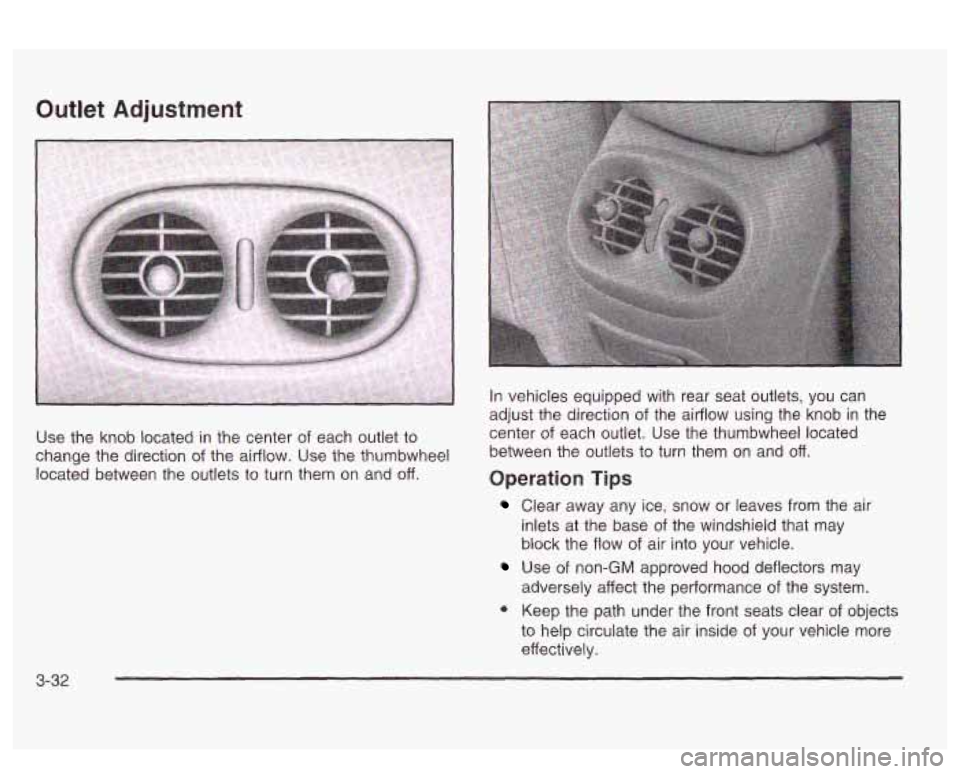
Use the knob located in the center of each outlet to
change the direction
of the airflow. Use the thumbwheel
located between the outlets to turn them on and
off.
In vehicles equipped with rear seat outlets, you can
adjust the direction of the airflow using the knob in the
center of each outlet. Use the thumbwheel located
between the outlets to turn them on and
off.
Operation Tips
Clear away any ice, snow or leaves from the air
inlets at the base of the windshield that may
block the flow of air into your vehicle.
Use of non-GM approved hood deflectors may
adversely affect
the performance of the system.
Keep the path under the front seats clear
of objects
to help circulate the air inside
of your vehicle more
effectively.
3-32
Page 177 of 418
DIC Vehicle Personalization
The DIC can be used to program the following
personalization features available with your vehicle:
Automatic Door Locks
Window Lock Out
Security Feedback
Delayed Locking
Perimeter Lighting
Memory Seats
Outside Curb View Assist Mirror
Driver ID
The DIC is used to program the personal choices of two
drivers. The drivers are recognized as DRIVER
#1
and DRIVER #2. You will let the DIC know which driver
you are by using your remote keyless entry transmitter
or by pressing the appropriate memory seat control
button located on the driver’s door or by choosing the
driver with the
DIC. Each remote keyless entry
transmitter was preprogrammed to belong to DRIVER
#I
or DRIVER #2. Each transmitter may be programmed
differently for each driver. When you
press the button with the unlock symbol on
your transmitter, the DIC will automatically change driver
numbers and the vehicle will recall the personalization
settings that were last made to correspond to your
transmitter, including your radio and comfort control
settings. See
Climate Controls Personalization on
page
3-33.
If you unlock the vehicle using your door key instead of
your transmitter, the DIC will not change drivers and
will recall the information from the last transmitter use or
the last driver change using the memory seat controls.
If this happens and you were not the last driver of
the vehicle, simply press your correct driver number on
the memory seat controls or press the button with
the unlock symbol
on your transmitter or select the
personalization programming mode and choose
the correct driver number.
Use the following steps for personalization programming
instructions.
1. Turn the ignition on and keep the transaxle in
2. Press the MODE button to reach personalization
3. Press the SELECT button to enter personalization
PARK (P).
programming display. programming mode.
3-62
Page 182 of 418

Memory Seats
If your vehicle has this feature, the memory seat and
mirror positions will be recalled for the identified
driver when the remote keyless entry transmitter is used
to enter the vehicle.
You can program this feature to be active by choosing
ON when the SEAT RECALL choice appears, or
inactive by choosing
OFF when the SEAT RECALL
choice appears on the DIC. Make your choices
by pressing the RESET button and store them to
memory by pressing the SELECT button.
You can also program this feature
to recall your
memory seat position or the exit seat position.
Memory Position: Choose ON when the SEAT
RECALL choice appears and then choose
MEMORY when the RECALL POSITION choice
appears.
Ex!! PesW?!?: Chwse ON when the SEAT
RECALL choice appears and then choose
EXIT
when the RECALL POSITION choice appears.
The seat will move when you enter the vehicle after
unlocking it with a remote keyless entry transmitter.
This will allow for easy entry.
For more information on this feature, see
Memory Seat
and Mirrors on page 2-48.
Outside Curb View Assist Mirror
If your vehicle has this feature, the outside curb view
assist mirror, which tips the passenger mirror while the
vehicle is in REVERSE
(R), can be made active or
inactive through the DIC. When TILT MIRROR
-OFF/ON
appears on the display, use the RESET button to
toggle the arrow between
OFF and ON. When you have
made your choice, press the SELECT button to record
your selection. For more information on this feature, see
Outside Curb View Assist Mirror on page 2-39.
Driver ID
This feature displays the DRIVER ID, as identified by
the
DIC. If this feature is ON, the DRIVER ID will
be displayed every time the ignition
is turned on. If the
DRIVER ID
is OFF, the DRIVER ID can be displayed
by pressing either a button on the remote keyless entry
transmitter or a memory seat button.
3-67
Page 252 of 418
And, if you do have a heavy load, you should spread it
out. Don’t carry more than 176 Ibs. (80 kg) in
your trunk.
Do not load your vehicle any heavier than the
GVWR, or either the maximum front or rear
GAWR. If you do, parts on your vehicle can
break, and
it can change the way your vehicle
handles. These could cause you to lose
control and crash.
Also, overloading can
shorten the life of your vehicle.
Nofice: Your warranty does not cover parts or
components that fail because of overloading.
If you put things inside your vehicle - like suitcases,
tools, packaqes, or anything else
- they will go as fast
as the vehicle goes.
If you have to stop or turn
quickly, or
if there is a crash, they’ll keep going. Things you
put inside your vehicle can strike
and injure people
in a sudden stop or turn, or
in a crash.
Put things in the trunk of your vehicle. In a
trunk, put them as far forward as you can.
Try to spread the weight evenly.
Never stack heavier things, like suitcases,
inside the vehicle
so that some of them
are above the tops of the seats.
0 Don’t leave an unsecured child restraint in
your vehicle.
When you carry something inside the
vehicle, secure
it whenever you can.
4-35
Page 358 of 418

Circuit
Breakers
56
57
Relays
58
59
Fuses
60
61 62
63
Usage
Power Seats
Power Windows
Usage
Cigarette Lighter
Rear Defog
Usage
Not Used Rear Defog
Not Used
Audio Amplifier
Fuses
64
65
66
67
68 69 70
71
72
73
74
75
Usage
Electronic Level Control
Compressor/Exhaust
Cigarette Lighter
Not Used
Spare Not Used
Not Used
Spare
Spare
Spare Spare Spare Fuse Puller
5-99
Page 405 of 418
Front Reading Lamps ...................................... 3-19
Front Storage Area
......................................... 2-46
Fuel
............................................................... 5-5
Additives ...................................................... 5-6
California Fuel
.............................................. 5-6
Filling a Portable Fuel Container
.................... 5-1 1
Filling Your Tank
........................................... 5-8
Fuels in Foreign Countries
.............................. 5-7
Gage ......................................................... 3-53
Gasoline Octane
........................................... 5-5
Gasoline Specifications .................................. 5-6
System Inspection
....................................... 6-22
Fuel Door Lock
.............................................. 5-10
Fuses Fuses and Circuit Breakers
........................... 5-92
Windshield Wiper
......................................... 5-91
G
Gage Boost
......................................................... 3-54
Check Gages Warning Light
.......................... 3-51
Engine Coolant Temperature
......................... 3-45
Fuel
.......................................................... 3-53
Oil Pressure
............................................... 3-49
Speedometer
.............................................. 3-38
Tachometer
................................................. 3-39
Voltmeter Gage
........................................... 3-41
Garage
Door Opener ....................................... 2-42 Gasoline
Octane
........................................................ 5-5
Specifications ............................................... 5-6
Gate Operator and Canadian Programming
........ 2-44
Glass Surfaces
............................................... 5-84
Glove
Box ..................................................... 2-46
GM Mobility Program for Persons with
Disabilities
................................................ 7-4
Hazard Warning Flashers ................................... 3-5
Head Restraints
............................................... 1-6
Headlamp Aiming
....................................................... 5-52
Headlamp High/Low-Beam Changer .................... 3-8
Headlamp Horizontal Aiming
............................. 5-54
Headlamp Vertical Aiming
................................. 5-54
Headlamp Wiring
............................................ 5-91
Headlamps
.................................................... 5-56
Bulb Replacement
....................................... 5-56
Front Turn Signal and Parking Lamps
............. 5-57
Halogen Bulbs ............................................ 5-56
Headlamps On Reminder
................................... 3-8
Head-Up Display (HUD)
................................... 3-21
Heated Seats
................................................... 1-4
Highway Hypnosis
........................................... 4-23
Hill and Mountain Roads
.................................. 4-24
Hitches
.......................................................... 4-38
6
Page 408 of 418

M
.... 4-11
... 5-101
Magnetic Speed Variable Assist
Steering
....
Maintenance. Normal Replacement Parts ....
Maintenance Schedule
At Each Fuel Fill
......................................... 6-18
At Least Once a Month
................................ 6-18
At Least Once a Year
.................................. 6-1 9
At Least Twice a Year
.................................. 6-19
Brake System Inspection
.............................. 6-23
Engine Cooling System Inspection
................. 6-23
Exhaust System Inspection
........................... 6-22
Fuel System Inspection
................................ 6-22
How This Section is Organized
....................... 6-3
Introduction
.................................................. 6-2
Long Trip/Highway Scheduled Maintenance
..... 6-1 3
Maintenance Requirements
............................. 6-2
Part
A - Scheduled Maintenance Services ......... 6-4
Part B
- Owner Checks and Services ............. 6-18
Part C
- Periodic Maintenance Inspections ...... 6-22
Part D
- Recommended Fluids and Lubricants .... 6-24
Part E
- Maintenance Record ........................ 6-26 Cnlnrrtinn thn Dinkt
CchndltIn .......................... 6-5 “-I””III my L . I” I ..y. IL -”I lWUUlW
Short Trip/City Scheduled Maintenance ............. 6-6
Boot and Seal Inspection
.......................... 6-22
Throttle System Inspection
............................ 6-23
Steering, Suspension
and Front Drive Axle
Using Your
................................................... 6-4 Maintenance
Schedule (cont.)
Your Vehicle and the Environment
................... 6-2
Maintenance When Trailer Towing
..................... 4-42
Making Turns
................................................. 4-40
Malfunction Indicator Light
................................ 3-46
Manual Lumbar Controls
.................................... 1-3
Manual Qperation
........................................... 3-29
Manual Seats
................................................... 1-2
Matching Transmitter(s) to Your Vehicle
............... 2-8
Memory Mirrors
.............................................. 2-48
Memory Seat
................................................. 2-48
Memory Seats
................................................ 3-67
Message DIC Warnings and Messages
........................ 3-60
Mexico, Central America and Caribbean
Islands/Csuntries (Except Puerto Rico
and U.S. Virgin Islands)
...................... .... 7-4
Mirror Operation
................................ ...... 2-38
Mirrors Automatic Dimming Rearview
........................ 2-38
Manual Rearview Mirror
................................ 2-38
Memory
..................................................... 2-48
Outside Convex Mirror
................................. 2-39
Outside Curb View Assist Mirror
.................... 2-39
Outside Heated Mirrors
................................ 2-39
Outside Power Mirrors
.................................. 2-38
Monitor, Systems
............................................ 3-55
9