instrument panel PONTIAC BONNEVILLE 2003 Service Manual
[x] Cancel search | Manufacturer: PONTIAC, Model Year: 2003, Model line: BONNEVILLE, Model: PONTIAC BONNEVILLE 2003Pages: 418, PDF Size: 20.24 MB
Page 257 of 418
Following Distance
Stay at least twice as far behind the vehicle ahead as
you would when driving your vehicle without a trailer.
This can help you avoid situations that require
heavy braking and sudden turns.
Passing
You’ll need more passing distance up ahead when
you’re towing a trailer. And, because you’re a good deal
longer, you’ll need to go much farther beyond the
passed vehicle before you can return to your lane.
Backing Up
Hold the bottom of the steering wheel with one hand.
Then, to move the trailer to the left, just move that hand
to the left. To move the trailer to the right, move your
hand to the right. Always back up slowly and,
if possible,
have someone guide you.
Making Turns
Notice: Making very sharp turns while trailering
could cause the trailer to come in contact with the
vehicle. Your vehicle could be damaged. Avoid
making very sharp turns while trailering.
When you’re turning with a trailer, make wider turns
than normal.
Do this so your trailer won’t strike
soft shoulders, curbs, road signs, trees or other objects.
Avoid jerky or sudden maneuvers. Signal well
in
advance.
Turn Signals When Towing a Trailer
When you tow a trailer, your vehicle may need a
different turn signal flasher and/or extra wiring. Check
with your dealer. All of the electrical circuits required for
your trailer lighting system can be accessed at the
left rear lamp connector. This connector is located under
the carpet on the driver’s side in the rear corner of
your trunk compartment. The arrows on your instrument
panel will flash whenever you signal a turn or lane
change. Properly hooked up, the trailer lamps will also
flash, telling other drivers you’re about to turn,
change lanes or stop.
When towing a trailer, the arrows on your instrument
panel will flash for turns even
if the bulbs on the trailer
are burned out. Thus, you may think drivers behind
you are seeing your signal when they are not. It’s
important to check occasionally to be sure the trailer
bulbs are still working.
Your vehicle has bulb warning lights. When you plug a
trailer lighting system into your vehicle’s lighting
system, its bulb warning lights may not let you know
if
one of your lamps goes out. So, when you have a trailer
lighting system plugged in, be sure to check your
vehicle and trailer lamps from time to time to be sure
they’re all working. Once you disconnect the trailer
lamps, the bulb warning lights again can tell you
if one
of your vehicle lamps is out.
4-40
Page 264 of 418
Fuel
The 8th digit of your vehicle identification number (VIN)
shows the code letter or number that identifies your
engine. You will find the VIN at the top left of the
instrument panel. See
Vehicle ldentification Number
(VIN) on page
5-90.
Gasoline Octane
If your vehicle has the 3800 V6 engine (VIN Code K),
use regular unleaded gasoline with a posted octane
of 87 or higher. If the octane is less than 87, you
may get a heavy knocking noise when you drive.
If this occurs, use a gasoline rated at 87 octane or
higer as
soon as possible. Otherwise, you might
damage your engine.
A little pinging noise when you
accelerate or drive uphill is considered normal. This does not
indicate a problem exists or that a
higher-octane fuel is necessary.
If you are using
87 octane or higher-octane fuel and you hear heavy
knocking, your engine needs service.
If your vehicle has the 3800 Supercharged V6 engine
(VIN Code
I), use only premium unleaded gasoline with
a posted octane of
91 or higher. In an emergency,
you may be able to use a lower octane
- as low
as 87
- if heavy knocking does not occur. Refill
your tank with premium fuel as soon as possible.
Otherwise, you might damage your engine.
If you are
using
91 octane or higher-octane fuel and you hear
heavy knocking, your engine needs service.
5-5
Page 288 of 418
1 -J can __ burned if you spill coolant -.I hot
engine parts. Coolant contains ethylene glycol,
and
it will burn if the engine parts are hot
enough. Don’t spill coolant on a hot engine.
~~ ~ ~~
Occasionally check the coolant level in the radiator.
For information on how to add coolant to the radiator,
see
Cooling System on page 5-32.
Radiator Pressure Cap
Notice: Your radiator cap is a pressure-type cap
and must be tightly installed to prevent coolant
loss
and possible engine damage from overheating.
Be sure the arrows on the cap line up with the
overflow tube on the radiator filler
neck.
See Engine Compartment Overview on page 5-14 for
more information on location.
Engine Overheating
You will find a coolant temperature gage or a DIC
warning message about a hot engine on your vehicle’s
instrument panel. See
Engine Coolant Temperature
Gage on page 3-45
and DIC Warnings and Messages
on page
3-60.
5-29
Page 343 of 418

Vinyl
Use warm water and a clean cloth.
Rub with a clean, damp cloth to remove dirt. You
may have to do this more than once.
Things like tar, asphalt and shoe polish will stain if
you don’t get them off quickly. Use a clean cloth
and vinyl/leather cleaner. See your dealer for
this product.
Leather
Use a soft cloth with lukewarm water and a mild soap or
saddle soap and wipe dry with a
soft cloth. Then, let
the leather dry naturally.
Do not use heat to dry.
For stubborn stains, use a leather cleaner. See your
dealer for this product.
Never use oils, varnishes, solvent-based or abrasive
cleaners, furniture polish or shoe polish on leather.
Interior Plastic Components
Use only a mild soap and water solution on a soft cloth
or sponge. Commercial cleaners may affect the
surface finish.
Glass Surfaces
Glass should be cleaned often. GM Glass Cleaner or a
liquid household glass cleaner will remove normal
tobacco smoke and dust films on interior glass. See
GM
Vehicle Care/Appearance Materials on page 5-88.
Notice: Don’t use abrasive cleaners on glass,
because they may cause scratches. Avoid placing
decals on the inside rear window, since they
may have to be scraped
off later. If abrasive cleaners
are used on the inside
of the rear window, an
electric defogger element may be damaged. Any
temporary license should not be attached across the
defogger grid.
Soiled or stained leather should be cleaned
immediately.
If dirt is allowed to work into the finish,
it can harm the leather.
Top of the Instrument Panel
Use only mild soap and water to clean the top surfaces
of the instrument panel. Sprays containing silicones
or waxes may cause annoying reflections
in the
windshield and even make it difficult to see through the
windshield under certain conditions.
5-84
Page 349 of 418
Vehicle Identification
Vehicle Identification Number (VIN)
SAMPLE4UXl M072675 1
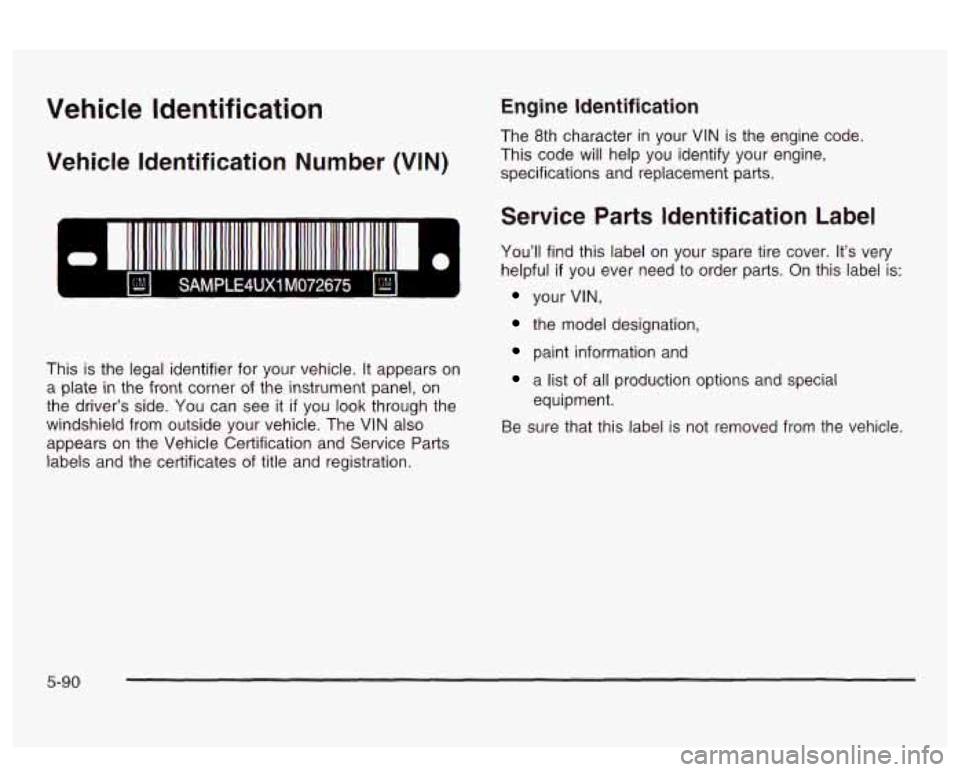
This is the legal identifier for your vehicle. It appears on
a plate in the front corner of the instrument panel, on
the driver’s side. You can see it
if you look through the
windshield from outside your vehicle. The VIN also
appears on the Vehicle Certification
and Service Parts
labels and the certificates of title and registration.
Engine Identification
The 8th character in your VIN is the engine code.
This code will help you identify your engine,
specifications and replacement parts.
Service Parts Identification Label
You’ll find this label on your spare tire cover. It’s very
helpful if you ever need to order parts. On this label is:
your VIN,
the model designation,
paint information and
a list of all production options and special
equipment.
Be sure that this label
is not removed from the vehicle.
5-90
Page 356 of 418
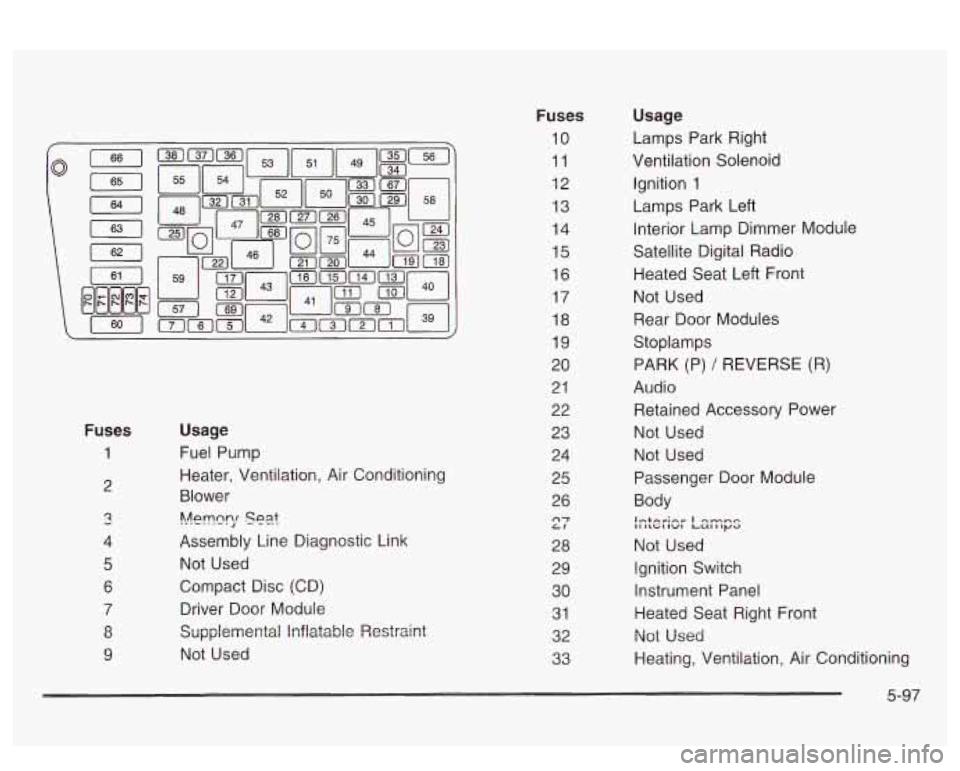
Fuses
1
2
Usage
Fuel Pump
Heater, Ventilation, Air Conditioning
Blower
Assembly Line Diagnostic Link
Not Used
Compact Disc (CD) Driver Door Module
Not Used
hllemCl!-y SP?!
Ssn- uppltz, r\.nr I IGfifCll -I In II lflaLaute I t hl Bestrairrt Fuses
10
11
12
13
14
15
16
17
18
19
20
21
22
23 24
25
26
07 LI
28
29
30
31
32
33
Usage
Lamps Park Right
Ventilation Solenoid
Ignition 1
Lamps Park Left Interior Lamp Dimmer Module
Satellite Digital Radio
Heated Seat Left Front
Not Used Rear Door Modules
Stoplamps PARK (P)
/ REVERSE (R)
Audio Retained Accessory Power
Not Used
Not Used Passenger Door Module
Body
Not Used
Ignition Switch
Instrument Panel
Heated Seat Right Front
iiof: Used
Heating, Ventilation, Air Conditioning
ln+nu;-u I nmnr. I1 ILGI IVI LUI I lvcl
5-97
Page 391 of 418

Customer Assistance information
Customer Satisfaction Procedure
Your satisfaction and goodwill are important to
your dealer and to Pontiac. Normally, any concerns with
the sales transaction or the operation of your vehicle
will be resolved by your dealer’s sales or service
departments. Sometimes, however, despite the best
intentions of all concerned, misunderstandings can
occur.
If your concern has not been resolved to your
satisfaction, the following steps should be taken:
STEP ONE: Discuss your concern with a member of
dealership management. Normally, concerns can
be quickly resolved at that level.
If the matter has
already been reviewed with the sales, service or parts
manager, contact the owner of the dealership or
the general manager.
STEP TWO: If after contacting a member of dealership
management, it appears your concern cannot be
resolved by the dealership without further help, contact
the Pontiac Customer Assistance Center by calling
1-800-762-2737. In Canada, contact GM of Canada
Customer Communication Centre in Oshawa by calling
1-800-263-3777 (English) or 1-800-263-7854 (French). We encourage you
to call the toll-free number in order
to give your inquiry prompt attention. Please have
the following information available to give the Customer
Assistance Representative:
Vehicle Identification Number (This is available from
the vehicle registration or title, or the plate at the
top left of the instrument panel and visible through
the windshield.)
Dealership name and location
Vehicle delivery date and present mileage
When contacting Pontiac, please remember that your
concern will likely be resolved at a dealer’s facility.
That is why we suggest you follow Step One first
if you
have a concern.
STEP THREE: Both General Motors and your dealer
are committed to making sure you are completely
satisfied with your new vehicle. However,
if you continue
to remain unsatisfied after following the procedure
outlined in Steps One and Two, you should file with the
GM/BBB Auto Line Program to enforce any additional
rights you may have. Canadian owners refer to
your Warranty and Owner Assistance Information
booklet for information on the Canadian Motor Vehicle
Arbitration Plan (CAMVAP).
7-2
Page 406 of 418
HomeLink@ Transmitter. Programming ................ 2-43
HomeLink@ Transmitter
.................................... 2-42
Hood Checking Things Under
................................ 5-12
Release
..................................................... 5-1 3
Horn
............................................................... 3-6
How to Add Coolant to the Coolant
How to Add Coolant to the Radiator
.................. 5-36
How to Add Fluid
............................................ 5-26
How to Check
................................................ 5-24
How
to Check and Add Oil ............................... 5-22
How to Check Power Steering Fluid
.................. 5-40
How to Use This Manual
...................................... ii
How to Wear Safety Belts Properly ................... 1-12
Hydroplaning
.................................................. 4-1 9
Recovery Tank ............................................ 5-34 Infants
and Young Children. Restraints
............... 1-29
Inflation
.. Tire Pressure .................................. 5-62
Inspection Brake System
............................................. 6-23
Exhaust System
.......................................... 6-22
Fuel System
............................................... 6-22
Part C
- Periodic Maintenance ....................... 6-22
Steering, Suspension and Front Drive Axle
Boot and Seal
......................................... 6-22
Throttle System
........................................... 6-23
Cluster
....................................................... 3-35
Overview
..................................................... 3-4
Instrument Panel Brightness
............................. 3-16
Interior Lamps
................................................ 3-16
Interior Plastic Components
........................... 5-84
Engine Cooling
System
................................ 6-23
Instrument Panel
If No Steam Is Coming From Your Engine .......... 5-31 J
If Steam 1s Coming From Your Engine ............... 5-30 Jump Starting ............................ If the Light Is Flashing ..................................... 3-47 ... 5-46
.
If the Light Is On Steady ................................. 3-48
If You Are Stuck in Sand, Mud, Ice or Snow ....... 4-30
If You Do Decide To Pull A Trailer ..................... 4-37
If You’re Caught in a Blizzard ........................... 4-28 Key Lock Cylinders Service .......................... 6-19
Ignition Positions
............................................. 2-25 Key Fkminder Warning .................................... 2-26
Ignition Transaxle Lock Check
.......................... 6-21 Keyless Entry System ....................................... 2-5
K
Inadvertent Power Battery Saver .................... 3-20 Keys ............................................................... 2-3
7
Page 413 of 418
Tilt Wheel ................. ............ 3-6
Ti re
Pressure Light
................ .................. 3-46
Tire inflation Check
......................................... 6-18
Ti res ................................... .......... 5.62. 5-87
Buying New Tires
....... ...................... 5-67
Chains
....................................................... 5-71
Changing a Flat Tire
.................................... 5-73
Check Tire Pressure System
......................... 5-64
Compact Spare Tire
..................................... 5-81
If a Tire Goes Flat ....................................... 5-72
Inflation
-- Tire Pressure ............................... 5-62
Inspection and Rotation
................................ 5-65
Uniform Tire Quality Grading
......................... 5-68
Wheel Alignment and Tire Balance
................. 5-69
Wheel Replacement
..................................... 5-69
When It
Is Time for New Tires ...................... 5-67
To Use the Engine Coolant Heater
.................... 2-28
Top
of the Instrument Panel ............................. 5-84
Top Strap
...................................................... 1-37
Top Strap Anchor Location
............................... 1-38
Torque Lock
................................................... 2-34
Total Weight on Your Vehicle’s Tires
.................. 4-38
Towing
Recreational Vehicle
..................................... 4-32
Towing a Trailer
.......................................... 4-36
Your Vehicle
............................................... 4-32
Control System (TCS)
.................................... 4-9
Control System Warning Light
....................... 3-43
Traction Traction
(cont.)
Low Active Light
...................................... 3-44
Trailer Brakes
................................................. 4-39
Trailer Wiring Harness
..................................... 4-39
Transaxle
Fluid. Automatic
........................................... 5-23
Transaxle Operation. Automatic
......................... 2-28
Transmission. Transaxle. Transfer Case Unit
Repair Manual
.............................................. 7-9
Transportation Options
...................................... 7-7
Trip Odometer
................................................ 3-38
Trunk
........................................................ 2-16
Trunk Ajar Light
.............................. .... 3-52
Trunk Lock Release
.................................... 2-16
Trunk Security Override
............................... 2-17
Turn and Lane-Change Signals
.......................... 3-7
Turn Signal/Multifunction Lever
........................... 3-7
Turn Signals When Towing a Trailer
.................. 4-40
Twilight Sentinel@
............................................ 3-15
U
Underbody Flushing Service ............................. 6-21
Understanding Radio Reception
........................ 3-99
Uniform Tire Quality Grading
............................ 5-68
United States
................................................... 7-3
Used Replacement Wheels
.............................. 5-70
Using Cleaner on Fabric .................................. 5-83
Using HomeLink@ ........................................... 2-45
14