tow PONTIAC BONNEVILLE 2003 Service Manual
[x] Cancel search | Manufacturer: PONTIAC, Model Year: 2003, Model line: BONNEVILLE, Model: PONTIAC BONNEVILLE 2003Pages: 418, PDF Size: 20.24 MB
Page 337 of 418

Never use oil or grease on studs or nuts. If
you do, the nuts might come loose. Your wheel
could fall
off, causing a serious accident.
8. Place the compact spare tire on the wheel-mounting
surface.
9. Then reinstall the
wheel nuts with the
rounded end
of
the nuts toward the
wheel.
10. Lower the vehicle by turning the wheel wrench
counterclockwise. Lower the jack completely.
Make sure each wheel bolt is centered in each wheel
hole while tightening the nuts. Tighten each nut by hand
until the wheel
is held against
the hub.
5-78
Page 342 of 418

Here are some cleaning tips:
*
Always read the instructions on the cleaner label.
Clean up stains as soon as you can
- before
they set.
Carefully scrape off any excess stain.
Use a clean cloth or sponge, and change to a clean
area often.
A soft brush may be used if stains are
stubborn.
If a ring forms on fabric after spot cleaning, clean
the entire area immediately or it will set.
Using Cleaner on Fabric
1. Vacuum and brush the area to remove any
2. Always clean a whole trim panel or section. Mask
surrounding trim along stitch or welt lines.
3. Follow the directions on the container label.
loose dirt.
5. As
soon as you’ve cleaned the section, use a
6. Wipe cleaned area with a clean, water-dampened
7. Wipe with a clean cloth and let dry.
sponge to remove any excess
cleaner.
towel or cloth.
Special Fabric Cleaning Problems
Stains caused by such things as catsup, coffee (black),
egg, fruit, fruit juice, milk, soft drinks, vomit, urine
and blood can be removed as follows:
1. Carefully scrape off excess stain, then sponge the
soiled area with cool water.
2. If a stain remains, follow the cleaner instructions
3. If an odor lingers after cleaning vomit or urine, treat
described earlier.
the area with
a watedbaking soda solution:
1 teaspoon (5 ml) of baking soda to 1 cup (250 ml)
of lukewarm water.
4. Let dry.
Stains caused by candy, ice cream, mayonnaise, chili
sauce and unknown stains can be removed as follows:
1. Carefully scrape off excess stain.
2. Clean with cool water and allow to dry completely.
3. If a stain remains, follow the cleaner instructions
aescribea eariier.
5-83
Page 344 of 418

Care of Safety Belts
Keep belts clean and dry.
Do not bleach or dye safety belts. If you do, it
may severely weaken them. In a crash, they
might not be able
to provide adequate
protection. Clean safety belts only with mild
soap and lukewarm water.
Weatherstrips
Silicone grease on weatherstrips will make them last
longer, seal better, and not stick or squeak. Apply
silicone grease with a clean cloth at least every six
months. During very cold, damp weather more frequent
appiicaiiorl may ue required. See Fari E. %cur/////e/f&d
Fluids and Lubricants on page 6-24.
Cleaning the Outside of Your
Vehicle
The paint finish on your vehicle provides beauty, depth
of color, gloss retention and durability.
Washing Your Vehicle
The best way to preserve your vehicle’s finish is to keep
it clean by washing it often with lukewarm or cold
water.
Don’t wash your vehicle in the direct rays
of the sun.
Use a car washing soap. Don’t use
strong soaps
or chemical detergents. Be sure to rinse the vehicle
well, removing all soap residue completely. You can get
GM-approved cleaning products from your dealer.
See
GM Vehicle Care/Appearance Materials on
page 5-88. Don’t use cleaning agents that are petroleum
based, or that contain acid or abrasives. All cleaning
agents should be flushed promptly and not allowed
to dry on the surface, or they could stain. Dry the finish
with a soft, clean chamois or an all-cotton towel to
avoid surface scratches and water spotting.
High pressure car washes may cause water to enter
your vehicle.
wearwg tmtmur L~III~WL~IIS~S
Use only lukewarm or cold water, a soft cloth and a car
washing soap to clean exterior lamps and lenses.
Follow instructions under “Washing Your Vehicle.”
nm - 5.- _. F-A---~--- I ______ 11 _____
5-85
Page 345 of 418

Finish Care
Occasional waxing or mild polishing of your vehicle by
hand may be necessary to remove residue from the
paint finish. You can get GM-approved cleaning products
from your dealer. See
GM Vehicle Care/Appearance
Materials on page
5-88.
If your vehicle has a “basecoatklearcoat” paint finish.
The clearcoat gives more depth and gloss to the colored
basecoat. Always use waxes and polishes that are
non-abrasive and made for a basecoatklearcoat paint
finish.
Notice: Machine compounding or aggressive
polishing
on a basecoatklearcoat paint finish may
dull the finish or leave swirl marks.
Foreign materials such as calcium chloride and other
salts, ice melting agents, road oil and tar, tree sap, bird
droppings, chemicals from industrial chimneys, etc.,
can damage your vehicle’s finish
if they remain
on painted surfaces. Wash the vehicle as soon as
possible. If necessary, use non-abrasive cleaners that
are marked safe for painted surfaces to remove
foreign matter.
Exterior painted surfaces are subject to aging, weather
and chemical fallout that can take their
toll over a
period of years. You can help to keep the paint finish
looking new by keeping your vehicle garaged or covered
whenever possible.
Windshield and Wiper Blades
If the windshield is not clear after using the windshield
washer, or
if the wiper blade chatters when running,
wax, sap or other material may be on the blade or
windshield.
Clean the outside
of the windshield with a full-strength
glass cleaning liquid. The windshield is clean
if beads do
not form when you rinse it with water.
Grime from the windshield will stick to the wiper blades
and affect their performance. Clean the blade by
wiping vigorously with a cloth soaked in full-strength
windshield washer solvent. Then rinse the blade
with water.
Check the wiper blades and clean them as necessary;
replace blades that look worn.
Aluminum or Chrome-Plated Wheels
Your vehicle may be equipped with either aluminum or
chrome-plated wheels.
Keep your wheels clean using a soft clean cloth with
mild soap and water. Rinse with clean water. After
rinsing thoroughly, dry with a soft clean towel. A wax
may then be applied.
The surface of these wheels is similar
to the painted
surface of your vehicle. Don’t use strong soaps,
chemicals, abrasive polishes, abrasive cleaners,
5-86
Page 354 of 418

Removing the Rear Seat Cushion
Notice: The battery and main fuse blocks are
located under the rear seat cushion. The battery’s
ground terminal and some relay wires are exposed.
To help avoid damage to the battery and wires,
be careful when removing or reinstalling the seat
cushion.
Do not remove covers from covered parts.
Do not store anything under the seat, as objects
could touch exposed wires and cause a short.
To remove the rear seat cushion, do the following:
1. Pull up on the front of the cushion to release the
2. Pull the cushion up and out toward the front of the
front
hooks,
vehicle.
To reinstall the rear seat cushion, do the following:
A safety belt tha sn’t properly roL.---. _hrough
the seat cushion or
is twisted won’t prowide
the protection needed in a crash. If the safety
belt hasn’t been routed through the seat
cushion at all,
it won’t be there to work for the
next passenger. The person sitting in that
position could be badly injured. After reinstalling the seat cushion, always check to
be sure that the safety belts are properly
routed and are not twisted.
5-95
Page 366 of 418

Selecting the Right Schedule
First you’ll need to decide which of the two schedules is
right for your vehicle. Here’s how to decide which
schedule to follow:
Follow the Short Trip/City Scheduled Maintenance
if any
one of these conditions is true for your vehicle:
0 Most trips are less than 5 miles (8 km). This is
particularly important when outside temperatures
are below freezing.
0 Most trips include extensive idling (such as frequent
0 You frequently tow a trailer or use a carrier on top
driving in
stop-and-go traffic).
of your vehicle.
0 If the vehicle is used for delivery service, police,
One of the reasons you should follow this schedule if
you operate your vehicle under any of these conditions
is that these conditions cause engine oil to break
down sooner.
taxi or other commercial application.
Short TriplCity Intervals
Every 3,000 Miles (5 000 km): Engine Oil and Filter
Change (or
3 months, whichever occurs first).
Every 6,000 Miles (IO 000 km): Tire Rotation.
Every 15,000 Miles (25 000 km): Engine Air Cleaner
Filter Inspection,
if driving in dusty conditions.
Every 30,000 Miles (50 000 km): Engine Air Cleaner
Filter Replacement. Supercharger Oil Check
(or every
36 months, whichever occurs first)
(3800 Code 1 V6 engine only).
Every 50,000 Miles (83 000 km): Automatic Transaxle
Service (severe conditions only).
Every 100,000 Miles (166 000 km): Spark Plug Wire
Inspection. Spark Plug Replacement. Automatic
Transaxle Service (normal conditions).
Every 150 000 Miles (240 000 km): Cooling System
Service [nr every 60 months, whichever nccIJrs
first). Engine Accessory Drive Belt Inspection.
These intervals only summarize maintenance services.
Be sure to follow the complete scheduled maintenance
on the following pages.
6-5
Page 367 of 418

Long Trip/Highway Definition
Follow this scheduled maintenance only if none of the
conditions from the Short Trip/City Scheduled
Maintenance are true.
Do not use this schedule if the
vehicle
is used for trailer towing, driven in a dusty area
or used
off paved roads. Use the Short Trip/City
schedule for these conditions
Driving a vehicle with a fully warmed engine under
highway conditions will cause engine oil to break down
slower.
Long Trip/Highway Intervals
Every 7,500 Miles (12 500 km): Engine Oil and Filter
Change (or every 12 months, whichever occurs
first). Tire Rotation.
Every 30,000 Miles (50 000 km): Supercharger Oil
Check (or every 36 months, whichever occurs first)
(3800 Code 1 V6 engine only). Engine Air Cleaner Filter
Replacement.
Every 50,000 Miles (83 000 km): Automatic Transaxle
Service (severe conditions only).
Every 100,000 Miles (166 000 km): Spark Plug Wire
Inspection. Spark Plug Replacement. Automatic
Transaxle Service (normal conditions).
Every 150,000 Miles (240 000 km): Cooling System
Service (or every 60 months, whichever occurs
first). Engine Accessory Drive Belt Inspection.
These intervals only summarize maintenance services.
Be sure to follow the complete scheduled maintenance
on the following pages.
Short Trip/City Scheduled
Maintenance
The services shown in this schedule up to 100,000 miles
(1 66
000 km) should be repeated after 100,000 miles
(166
000 km) at the same intervals for the life of
this vehicle. The services shown at 150,000 miles
(240 000 km) should be repeated at the same interval
after 150,000 miles (240
000 km) for the life of this
vehicle.
See
Part B: Owner Checks and Services on page 6-18
and Part C: Periodic Maintenance Inspections on
page 6-22.
6-6
Page 370 of 418

33,000 Miles (55 000 km)
0 Change engine oil and filter (or every 3 months,
whichever occurs first).
An Emission Control Service.
(See footnote
*.)
36,000 Miles (60 000 km)
0 Change engine oil and filter (or every 3 months,
whichever occurs first).
An Emission Control Service.
(See footnote
*.)
0 Rotate tires. See Tire Inspection and Rotation on
page 5-65 for proper rotation pattern and additional
information.
(See footnote @.) (See footnote +.)
39,000 Miles (65 000 km)
0 Change engine oil and filter (or every 3 months,
whichever occurs first).
An Emission Control Service.
(See footnote
*.)
42,000 Miles (70 000 km)
u
0
Change engine oil and filter (or every 3 months,
whichever occurs first).
An Emission Control Service.
(See footnote
*.)
Rotate tires. See Tire Inspection and Rotation on
page 5-65 for proper rotation pattern and additional
information.
(See footnote @.) (See footnote +.)
45,000 Miles (75 000 km)
0 Change engine oil and filter (or every 3 months,
whichever occurs first).
An Emission Control Service.
(See footnote
*.)
0 Inspect engine air cleaner filter if you are driving in
dusty conditions. Replace filter
if necessary. An
Emission Control Service. (See footnote t.)
48,000 Miles (80 000 km)
D Change engine oil and filter (or every 3 months,
whichever occurs first).
An Emission Control Service.
(See footnote
*.)
0 Rotate tires. See Tire Inspection and Rotation on
page 5-65 for proper rotation pattern and additional
information.
(See footnote @.) (See footnote +.)
50,000 Miles (83 000 km)
0 Change automatic transaxle fluid and filter if the
vehicle is mainly driven under one or more of
these conditions:
- In heavy city traffic where the outside
temperature regularly reaches
90°F (32°C) or
higher.
~ !n !i!!y c!r mnllnt2innns terr2in.
- When doing frequent trailer towing.
- Uses such as found in taxi, police or delivery
service.
If you do not use your vehicle under any of these
conditions, change the fluid and filter at
100,000 miles
(166 000 km).
6-9
Page 373 of 418
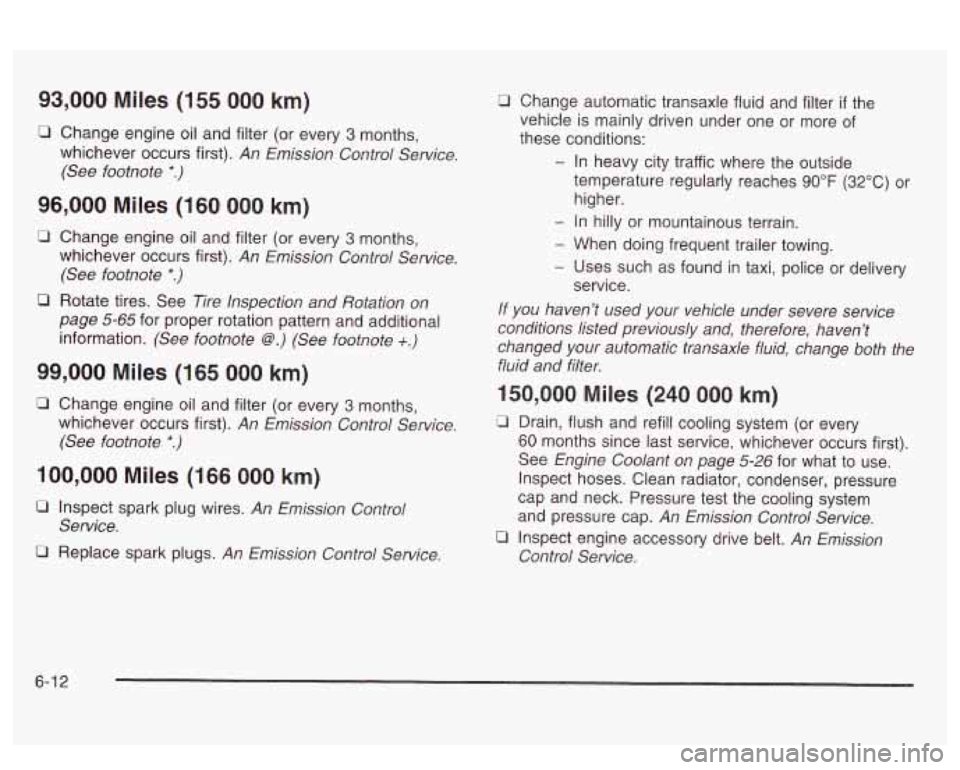
93,000 Miles (155 000 km)
0 Change engine oil and filter (or every 3 months,
whichever occurs first).
An Emission Control Service.
(See footnote
*.)
96,000 Miles (160 000 km)
Q Change engine oil and filter (or every 3 months,
whichever occurs first).
An Emission Control Service.
(See footnote
*.)
0 Rotate tires. See Tire Inspection and Rotation on
page
5-65 for proper rotation pattern and additional
information.
(See footnote @.) (See footnote +.)
99,000 Miles (165 000 km)
0 Change engine oil and filter (or every 3 months,
whichever occurs first).
An Emission Control Service.
(See footnote
*.)
100,000 Miles (166 000 km)
0 Inspect spark plug wires. An Emission Control
Service.
0 Replace spark plugs. An Emission Control Service.
0 Change automatic transaxle fluid and filter if the
vehicle is mainly driven under one or more of
these conditions:
- In heavy city traffic where the outside
temperature regularly reaches
90°F (32°C) or
higher.
- In hilly or mountainous terrain.
- When doing frequent trailer towing.
- Uses such as found in taxi, police or delivery
service.
If you haven’t used your vehicle under severe service
conditions listed previously and, therefore, haven’t
changed your automatic transaxle fluid, change both the
fluid and filter.
150,000 Miles (240 000 km)
0 Drain, flush and refill cooling system (or every
60 months since last service, whichever occurs first).
See
Engine Coolant on page 5-26 for what to use.
Inspect hoses. Clean radiator, condenser, pressure
cap and neck. Pressure test the cooling system
and pressure cap.
An Emission Control Service.
0 Inspect engine accessory drive belt. An Emission
Control Service.
6-13
Page 376 of 418
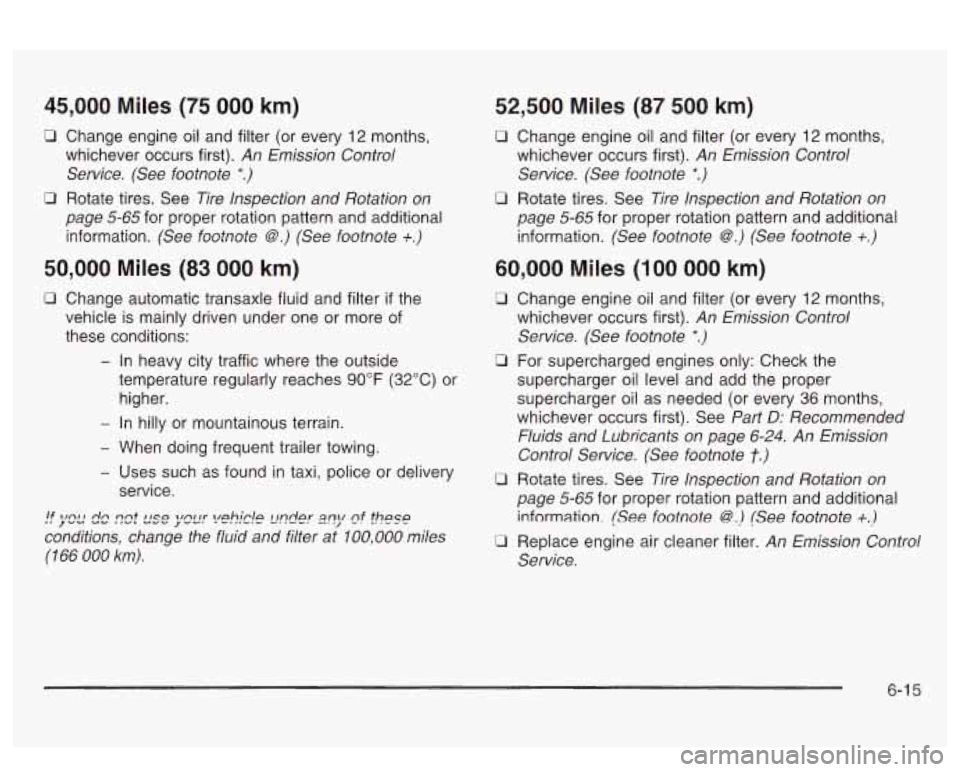
45,000 Miles (75 000 km)
0 Change engine oil and filter (or every 12 months,
whichever occurs first).
An Emission Control
Service. (See footnote
*.)
0 Rotate tires. See Tire Inspection and Rotation on
page
5-65 for proper rotation pattern and additional
information.
(See footnote @.) (See footnote +.)
50,000 Miles (83 000 km)
0 Change automatic transaxle fluid and filter if the
vehicle is mainly driven under one or more of
these conditions:
- In heavy city traffic where the outside
temperature regularly reaches
90°F (32°C) or
higher.
- In hilly or mountainous terrain.
- When doing frequent trailer towing.
- Uses such as found in taxi, police or delivery
service.
If Imrr An nnt I Icn yehjde ~~.ncfer 2n1/ nf thpcp I, /'" U" S.". U"V J -. -..---
conditions, change the fluid and filter at 100,000 miles
(I 66 000 km).
52,500 Miles (87 500 km)
0 Change engine oil and filter (or every 12 months,
whichever occurs first).
An Emission Control
Service. (See footnote
*.)
page 5-65 for proper rotation pattern and additional
information.
(See footnote @I.) (See footnote +.)
0 Rotate tires. See Tire Inspection and Rotation on
60,000 Miles (100 000 km)
Cl Change engine oil and filter (or every 12 months,
whichever occurs first).
An Emission Control
Service. (See footnote
*.)
0 For supercharged engines only: Check the
supercharger oil level and add the proper
supercharger oil as needed
(or every 36 months,
whichever occurs first). See
Part D: Recommended
Fluids and Lubricants on page
6-24. An Emission
Control Service. (See footnote
t.)
0 Rotate tires. See Tire Inspection and Rotation on
page
5-65 for proper rotation pattern and additional
information (See footnote @.) !See footnote +.)
0 Replace engine air cleaner filter. An Emission Control
Service.
6-1 5