ABS PONTIAC BONNEVILLE 2003 Owners Manual
[x] Cancel search | Manufacturer: PONTIAC, Model Year: 2003, Model line: BONNEVILLE, Model: PONTIAC BONNEVILLE 2003Pages: 418, PDF Size: 20.24 MB
Page 136 of 418
Head-Up Display (HUD)
If the HUD image is too bright, or too high in
your field
of view, it may take you more time to
see things you need to see when it's dark
outside. Be sure to keep the HUD image dim
and placed low in your field of view.
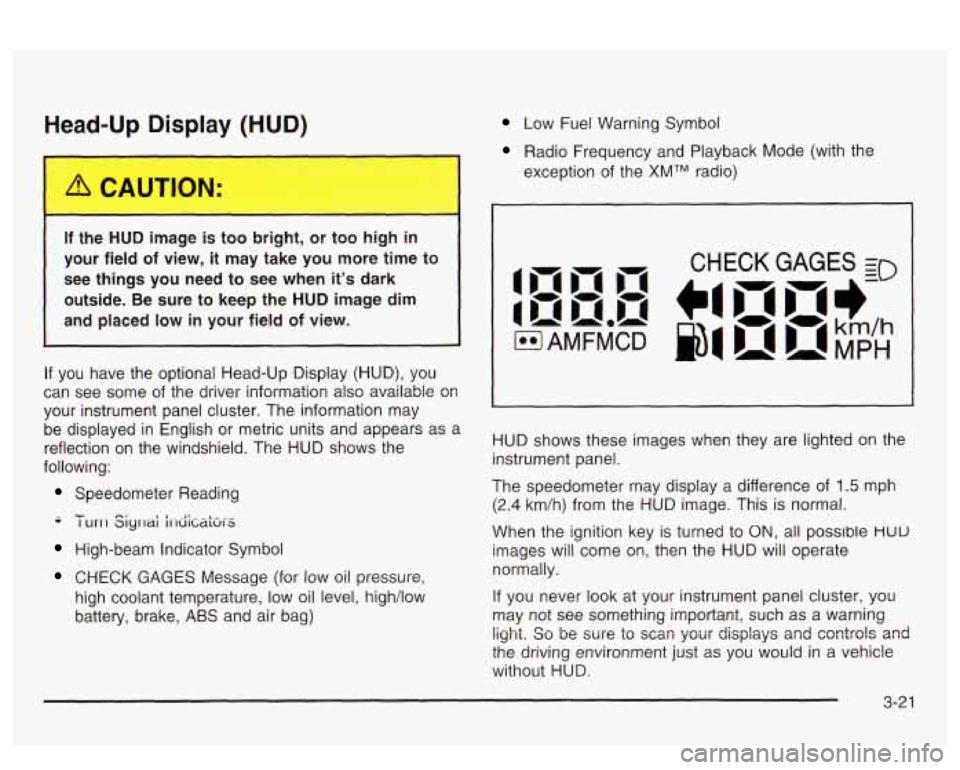
If you have the optional Head-Up Display (HUD), you
can see
some of the driver information also available 08
your instrument panel cluster. The information may
be displayed in English
or metric units and appears as a
reflection on the windshield. The HUD shows the
following:
Speedometer Reading
-- - I urrl Siyrlai i1-diCaki-S
High-beam Indicator Symbol
CHECK GAGES Message (for low oil pressure,
high coolant temperature, low oil level, high/low
battery, brake,
ABS and air bag)
Low Fuel Warning Symbol
Radio Frequency and Playback Mode (with the
exception of the
XMTM radio)
HUD shows these images when they are lighted on the
instrument panel.
The speedometer may display a difference of
1.5 mph
(2.4 km/h) from the HUD image. This is normal.
When the ignition key is turned to
ON, all possible HUU
images will come on, then the HUD will operate
normally.
If you never look at your instrument panel cluster, you
may not see something important, such as a warning
light. So be wre to scm your displays and csntrols and
the driving environment just as you would in a vehicle
without HUD.
Page 139 of 418
Notice: Adding some electrical equipment to your
vehicle can damage
it or keep other things from
working as they should. This wouldn’t be covered by
your warranty. Check with your dealer before adding electrical equipment, and never use anything
that exceeds the amperage rating.
When adding electrical equipment, be sure to follow the
proper installation instructions included with the
equipment.
Notice: Power outlets are designed for accessory
plugs only.
Do not hang any type of accessory
or accessory bracket from the plug. Improper use of
the power outlet can cause damage not covered
by your warranty.
Ashtrays and Cigarette Lighter
Push down on the cover to reveal the front ashtray.
To clean the ashtray,
lift it out by pulling on the finger
holes on each side.
On models without a console, an ashtray is located
underneath the instrument panel.
To clean the ashtray,
lift it out by pulling up on the tabs on either side.
It snaps back into place.
To open a rear ashtray, lift the cover
Notice: Don’t put papers or other flammable
items into your ashtrays. Hot cigarettes or other
smoking materials could ignite them, causing
a damaging fire.
The cigarette lighter is located next to the storage tray.
To use a lighter, just push the center in all the way
and let
it go. When it is ready, the center will pop back
out by itself. Pull out the entire unit to use it.
Notice: Don’t hold a cigarette lighter in with your
hand while
it is heating. If you do, it won’t be able to
back away from the heating element when it’s
ready. That can make
it overheat, damaging the
lighter and the heating element.
The cigarette lighter will only operate when the ignition
key is in
ON and for 10 minutes after turning the
ignition
OFF. If you would like the lighter to operate
regardless of ignition position, and for extended periods
of time, see “Engine Compartment Fuse Block under
Fuses and Circuit Breakers on page 5-92 or see
your dealer.
3-24
Page 224 of 418
And, of course, actual stopping distances vary greatly
with the surface of the road (whether it’s pavement
or gravel); the condition of the road (wet, dry, icy); tire
tread; the condition of your brakes; the weight of
the vehicle and the amount of brake force applied.
Avoid needless heavy braking. Some people drive in
spurts
- heavy acceleration followed by heavy braking
- rather than keeping pace with traffic. This is a
mistake. Your brakes may not have time to cool between
hard stops. Your brakes will wear out much faster
if
you do a lot of heavy braking. If you keep pace with the
traffic and allow realistic following distances, you will
eliminate a lot of unnecessary braking. That means
better braking and longer brake life.
If your engine ever stops while you‘re driving, brake
normally but don’t pump your brakes. If you
do,
the pedal may get harder to push down. If your engine
stops, you will still have some power brake assist.
But you will use it when you brake. Once the power
assist is used up, it may take longer to stop and
the brake pedal will be harder to push.
Anti-lock Brake System (ABS)
Your vehicle has anti-lock brakes. ABS is an advanced
electronic braking system that will help prevent a
braking skid.
When you start your engine, or when you begin to drive
away, your anti-lock brake system will check itself.
You may hear a momentary motor or clicking noise while
this test is going on, and you may even notice that
your brake pedal moves or pulses a little. This is normal.
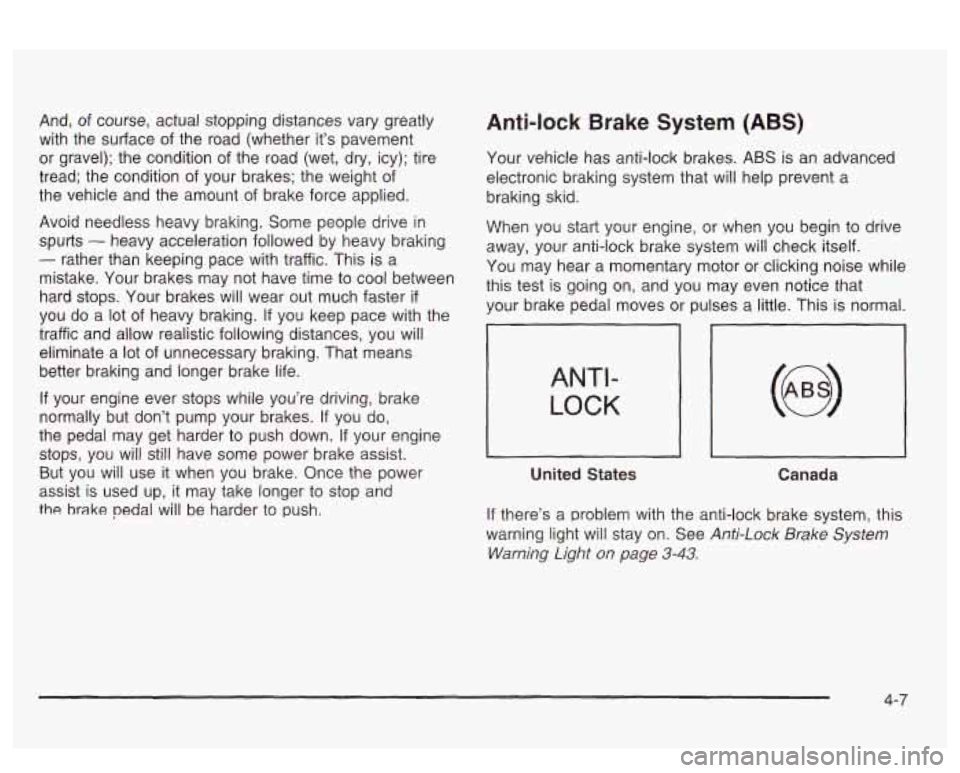
ANTI-
LOCK
United States
Canada
If there’s a problem with the anti-lock brake system, this
warning light will stay on. See
Anti-Lock Brake System
Warning Light
on page 3-43.
4-7
Page 225 of 418
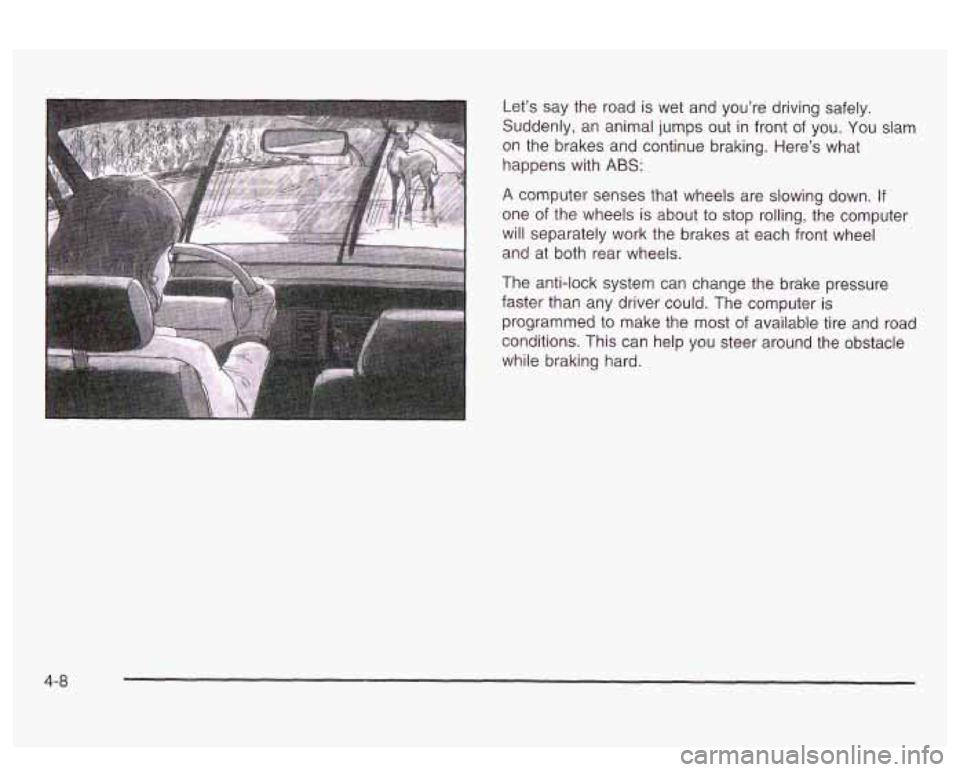
Let’s say the road is wet and you’re driving safely.
Suddenly, an animal jumps out in front of you. You slam
on the brakes and continue braking. Here’s what
happens with
ABS:
A computer senses that wheels are slowing down. If
one of the wheels is about to stop rolling, the computer
will separately work the brakes at each front wheel
and at both rear wheels.
The anti-lock system can change the brake pressure
faster than any driver could. The computer is
programmed to make the
most of available tire and road
conditions. This can help you steer around the obstacle
while braking hard.
4-a
Page 258 of 418
Driving On Grades
Reduce speed and shift to a lower gear before you start
down a long or steep downgrade. If you don’t shift
down, you might have to use your brakes
so much that
they would get hot and no longer work well.
On a long uphill grade, shift down to
THIRD (3) and
reduce your speed to around 45 mph
(70 km/h) to
reduce the possibility
of the engine and transaxle
overheating.
Parking on Hills
You really should not park your vehicle, with a
trailer attached, on a hill.
If something goes
wrong, your rig could start
to move. People
can be injured, and both your vehicle and the
trailer can be damaged.
But if you ever have to park your rig on a hill, here’s
how to
do it:
1. Apply your regular brakes, but don’t shift into
2. Have someone place chocks under the trailer
PARK (P) yet.
wheels.
3. When the wheel chocks are in place, release the
regular brakes until the chocks absorb the load.
4. Reapply the regular brakes. Then apply your
parking brake, and then shift to PARK (P).
5. Release the regular brakes.
When YQU Are Ready to Leave After
Parking on a Hill
1. Apply your regular brakes and hold the pedal down
while you:
* start your engine,
shift into a gear, and
0 reiease the parking brake.
2. Let up on the brake pedal.
3. Drive slowly until the trailer is clear of the chocks.
4. Stop and have someone pick up and store the
chocks.
4-41
Page 281 of 418
What Kind of Oil to Use
Use only the recommended supercharger oil. See Part
D: Recommended Fluids and Lubricants on page 6-24.
How to Check and Add Oil
Park the vehicle on a level surface. Check oil only when
the engine is cold. Allow the engine to cool two to
three hours after running.
Engine Air CleanedFilter
If you remove the supercharger oil fill plug
while the engine
is hot, pressure may cause
hot oil to blow out
of the oil fill hole. You may
be burned.
Do not remove the plug until the
engine cools.
1. Clean the area around the oil fill plug before
2. Remove the oil fill plug.
removing it.
3. The oil level
is correct when it just reaches the
bottom of the threads of the inspection hole.
4. Replace the oil plug with the O-ring in place.
Tighten to
88 Ib-in (1 0 N*m ).
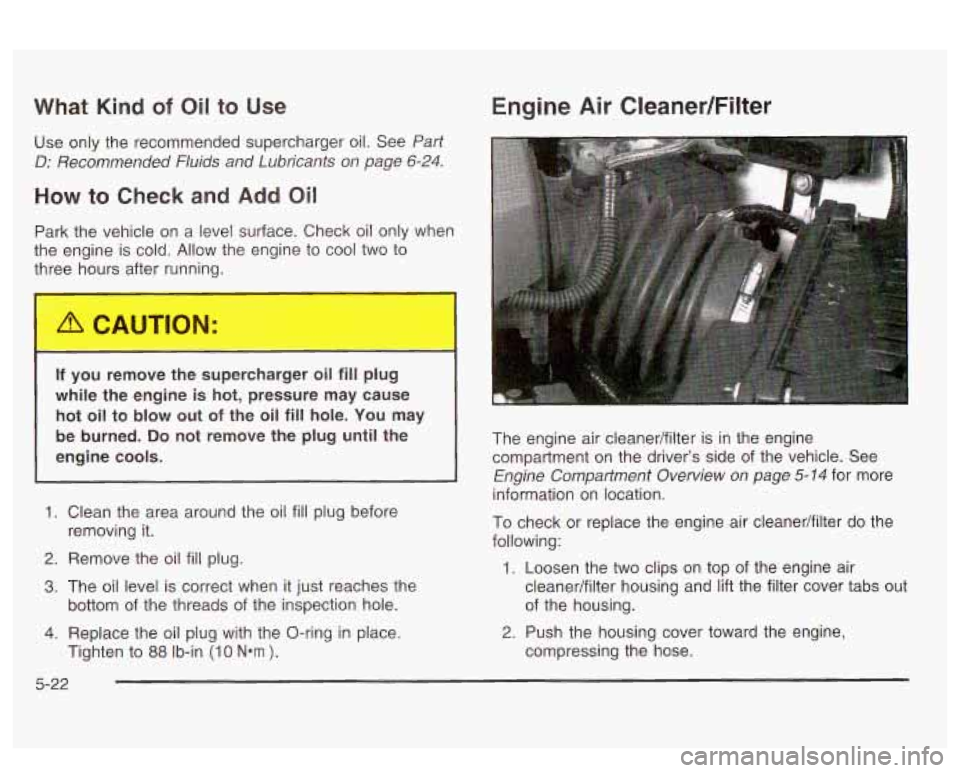
The engine air cleanedfilter is in the engine
compartment on the driver’s side of the vehicle. See
Engine Compartment Overview on page 5-14 for more
information on location.
To check or replace the engine air cleanedfilter do the
following:
1. Loosen the two clips on top of the engine air
cleanedfilter housing and lift the filter cover tabs out
of the housing.
2. Push the housing cover toward the engine,
compressing the hose.
5-22
Page 282 of 418
3. Pull out the filter. Check or replace the engine air
4. To reinstall the housing cover, make sure the filter
cover tabs position through the slots in the housing.
A notch on the sides of the filter cover will indicate
the correct engagement.
cleaner/filter.
5. Fasten the
two clips on the top of the housing when
you are finished.
Refer to the Maintenance Schedule to determine when
to replace the air filter.
See
Part A: Scheduled Maintenance Services on
page
6-4.
Operating : el ne with ? ai :leane r
off can cause you or others to be burned. The
air cleaner not only cleans the air, it stops
flame if the engine backfires. If
it isn’t there
and the engine backfires, you could be burned.
Don’t drive with
it off, and be careful working
on the engine with the air cleaner/filter
off.
I
Notice: If the air cleanedfilter is off, a backfire can
cause a damaging engine fire.
And, dirt can
easily get into your engine, which will damage
it.
Always have the air cleaner/filter in place when
you’re driving.
When to Check and Change
A good time to check your automatic transaxle fluid
level is when the engine oil is changed.
Change both the fluid and filter every
50,000 miles
(83 000 km) if the vehicle is mainly driven under one or
more of
these conditions:
In heavy city traffic where the outside temperature
regularly reaches 90°F (32°C) or higher.
9 In hilly or mountainous terrain.
0 When doing frequent trailer towing.
- I, - SUU~~I 2s IWUIIU ii7 Lam, pwm,c uI U~~lv~Iy 1-...--1 . A-.,: .--I:-- -” Afil;,,nm,
service.
If you do not use your vehicle under any of these
conditions, change the fluid and filter at
100,000 miles
(166 000 km).
See
Part A: Scheduled Maintenance Services on
page
6-4.
5-23
Page 316 of 418
Front Turn Signal and Parking
Lamps
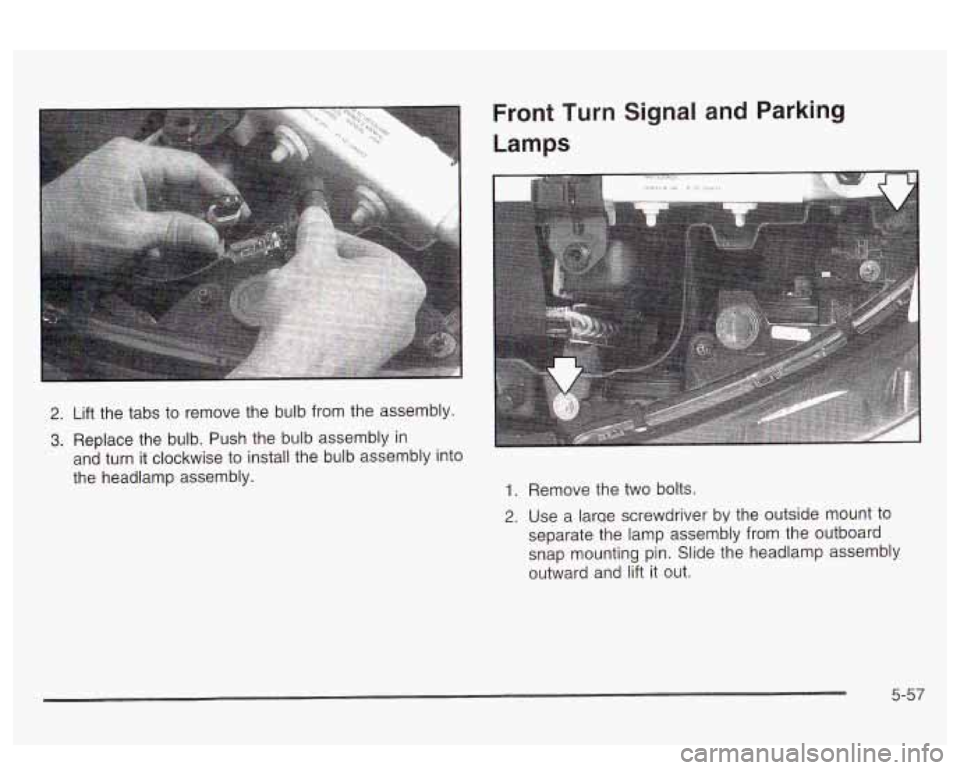
2. Lift the tabs to remove the bulb from the assembly.
3. Replace the bulb. Push the bulb assembly in
and turn it clockwise to install the bulb assembly into
the headlamp assembly.
1. Remove the two bolts.
2. Use a larqe screwdriver by the outside mount to
separate the lamp assembly from the outboard
snap mounting pin. Slide the headlamp assembly
outward and lift
it out.
5-57
Page 400 of 418
A
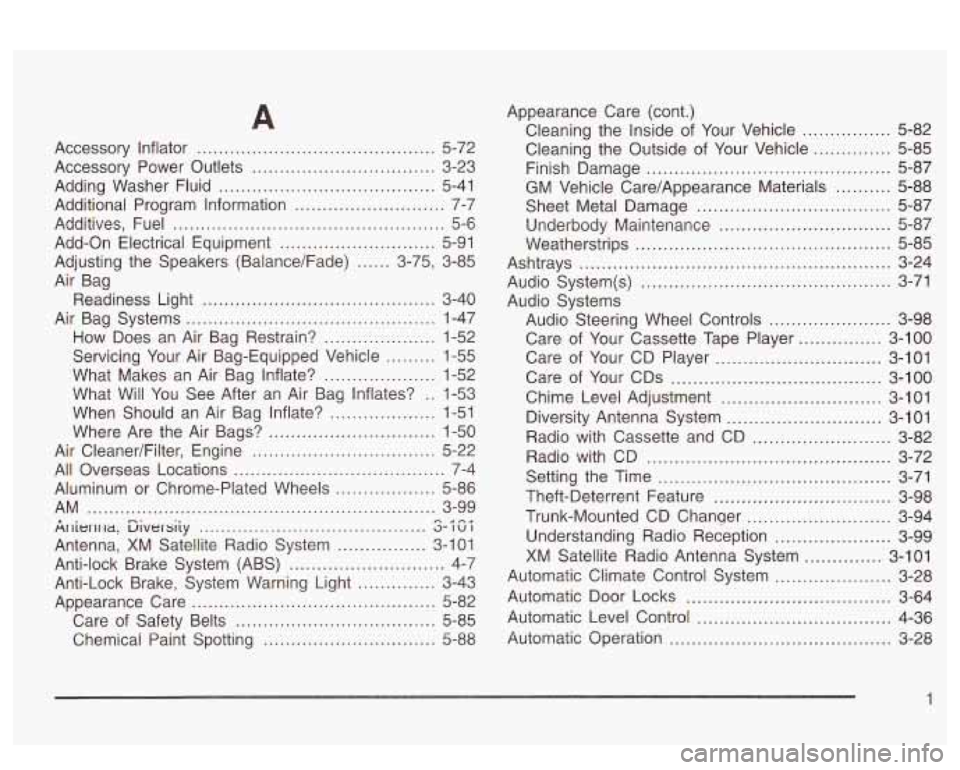
Accessory Inflator ........................................... 5-72
Accessory Power Outlets
................................. 3-23
Adding Washer Fluid
....................................... 5-41
Additional Program Information
........................... 7-7
Additives. Fuel
................................................. 5-6
Add-on Electrical Equipment
............................ 5-91
Adjusting the Speakers (Balance/Fade)
...... 3.75. 3-85
Air Bag
Readiness Light
.......................................... 3-40
Air Bag Systems
............................................. 1-47
How Does an Air Bag Restrain?
.................... 1-52
Servicing Your Air Bag-Equipped Vehicle
......... 1-55
What Makes an Air Bag Inflate? .................... 1-52
What Will You See After an Air Bag Inflates?
.. 1-53
When Should an Air Bag Inflate?
................... 1-51
Where
Are the Air Bags? .............................. 1-50
Air Cleaner/Filter, Engine
................................. 5-22
All Overseas Locations
...................................... 7-4
Aluminum or Chrome-Plated Wheels
.................. 5-86
Ar~ie~~~~a, ulversiiy a- IU I
Antenna, XM Satellite Radio System ................ 3-101
Anti-lock Brake System (ABS)
............................ 4-7
Anti-Lock Brake, System Warning Light
.............. 3-43
Appearance Care
............................................ 5-82
Care of Safety Belts
.................................... 5-85
Chemicai Paint Spotting
............................... 5-88
AM ............................................................... 3-99 R . 0 an* .........................................
Appearance Care (cont.)
Cleaning the Inside of Your Vehicle
................ 5-82
Cleaning the Outside of Your Vehicle
.............. 5-85
Finish Damage
............................................ 5-87
GM Vehicle Care/Appearance Materials
.......... 5-88
Sheet Metal Damage
................................... 5-87
Underbody Maintenance
............................... 5-87
Weatherstrips
.............................................. 5-85
Ashtrays
........................................................ 3-24
Audio System(s)
............................................. 3-71
Audio Systems
Audio Steering Wheel Controls
...................... 3-98
Care of Your Cassette Tape Player
............... 3-100
Care of Your CD Player
.............................. 3-101
Care of Your CDs
...................................... 3-100
Chime Levei Adjustment
............................. 3-101
Diversity Antenna System
............................ 3-1 01
Radio with Cassette and CD
......................... 3-82
Radio with CD
............................................ 3-72
Setting the Time
.......................................... 3-71
Theft-Deterrent Feature
................................ 3-98
Trunk-Mounted CD Chanuer
.......................... 3-94
Understanding Radio Reception
..................... 3-99
XM Satellite Radio Antenna System
.............. 3-101
Automatic Climate Control System
..................... 3-28
Automatic Door Locks
..................................... 3-64
Automatic Level Control
................................... 4-36
Automatic Operation
.................................... 3-28
1