battery replacement PONTIAC BONNEVILLE 2003 Owners Manual
[x] Cancel search | Manufacturer: PONTIAC, Model Year: 2003, Model line: BONNEVILLE, Model: PONTIAC BONNEVILLE 2003Pages: 418, PDF Size: 20.24 MB
Page 70 of 418
Remote Keyless Entry System
If equipped, the keyless entry system operates on a
radio frequency subject to Federal Communications
Commission (FCC) Rules and with Industry Canada.
This device complies with Part 15 of the FCC Rules.
Operation is subject to the following two conditions:
1. This device may not cause interference, and
2. This device must accept any interference received,
including interference that may cause undesired
operation of the device.
This device complies with RSS-210 of Industry Canada.
Operation is subject to the following two conditions:
1. This device may not cause interference, and
2. This device must accept any interference received,
including interference that may cause undesired
operation of the device. Changes
or modifications to this system by other than
an authorized service facility could void authorization to
use this equipment.
At times you may notice a decrease in range. This is
normal for any remote keyless entry system.
If the
transmitter does not work or
if you have to stand closer
to your vehicle for the transmitter to work, try this:
e
e
Check the distance. You may be too far from your
vehicle. You may need to stand closer during
rainy or snowy weather.
Check the location. Other vehicles or objects may
be blocking the signal. Take a few steps to the
left or right, hold the transmitter higher, and
try again.
Check to determine if battery replacement is
necessary. See
“Battery Replacement” under
Remote Keyless Entry System Operation on
page
2-6.
If you are still having trouble, see your dealer or a
q~Ia!ified technician for service.
2-5
Page 74 of 418
Battery Replacement
Under normal use, the battery in your remote keyless
entry transmitter should last about four years.
You can tell the battery is weak
if the transmitter won't
work at the normal range in any location.
If you have
to get close to your vehicle before the transmitter works,
it's probably time to change the battery.
Notice: When replacing the battery, use care not to
touch any of the circuitry. Static from your body
transferred to these surfaces may damage the
transmitter.
To replace the battery, do the following:
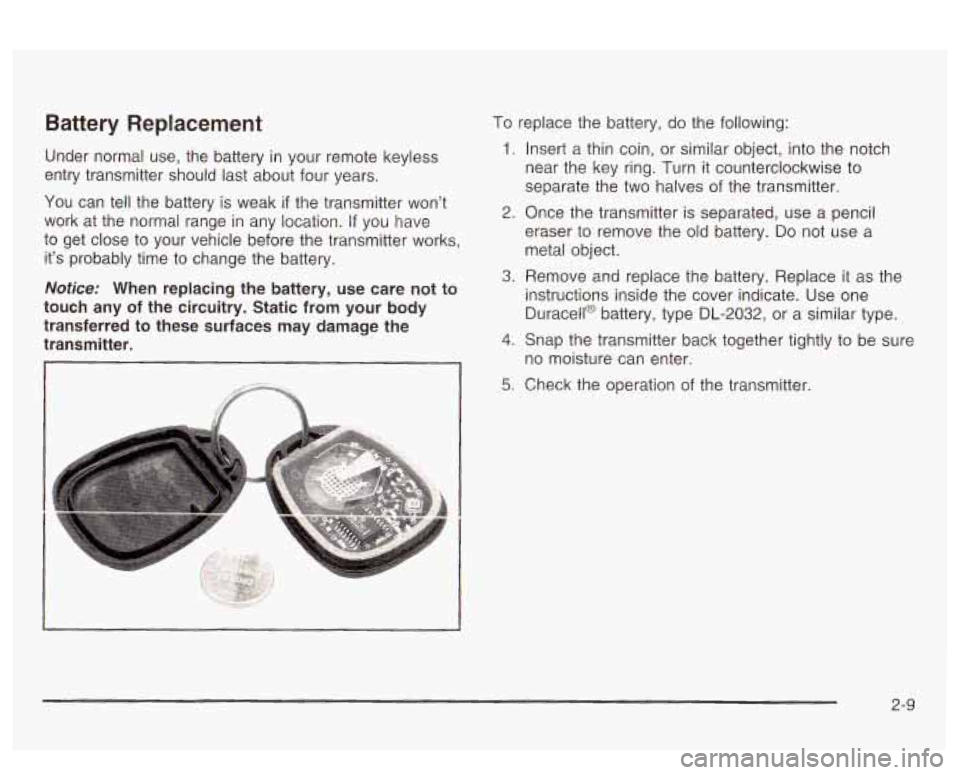
1. Insert a thin coin, or similar object, into the notch
near the key ring. Turn
it counterclockwise to
separate the two halves of the transmitter.
2. Once the transmitter is separated, use a pencil
eraser to remove the old battery.
Do not use a
metal object.
A. Remove and replace the battery. Replace it as the
instructions inside the cover indicate. Use one
Duracell@ battery, type DL-2032, or a similar type.
4. Snap the transmitter back together tightly to be sure
no moisture can enter.
5; Check the operation of the transmitter.
2-9
Page 260 of 418
Section 5 Service and Appearance Care
Service ........................................................ 5.3
Doing Your Own Service Work
......................... 5.3
Adding Equipment to the Outside
of Your
Vehicle
...................................................... 5.4
Fuel ................................................................ 5.5
Gasoline Octane
............................................ 5.5
Gasoline Specifications
.................................... 5.6
California Fuel
............................................... 5.6
Additives
....................................................... 5.6
Fuels in Foreign Countries
............................ 5.7
Filling Your Tank
........................... .......... 5.8
Filling
a Portable Fuel Container ..... .... 5.11
the Hood ............................. .... 5.12
Hood Release
.............................. ........ 5.13
Engine Compartment Overview ...................... -5-1 4
Checking Things Under
Engine Oil ................................................... 5.15
Supercharger Oil .......................................... 5.21
Engine Air Cleaner/t-llter
................................ 5-22
Automatic Transaxle Fluid .............................. 5.23
Engine Coolant
............................................. 5.26
Radiator Pressure Cap
.................................. 5.29
Engine Overheating
....................................... 5.29
Cooling System
............................................ 5.32
Power Steering Fluid
..................................... 5.40
Windshield Washer Fluid
................................ 5.40
Brakes
........................................................ 5.42
Battery
........................................................ 5-44
Jump Starting
............................................... 5-46
Headlamp Aiming .......................... ...... 5.52
Bulb Replacement .................................. -5-56
Halogen Bulbs
.............................................. 5.56
Headlamps
.................................................. 5.56
Front Turn Signal and Parking Lamps
.............. 5-57
Taillamps, Turn Signal, Stoplamps and
Back-up Lamps
......................................... 5-59
fiepiacement
Euibs 3.w - ^^ .......................................
5- I
Page 303 of 418
Notice: Continuing to drive with worn-out brake
pads could result in costly brake repair.
Some driving conditions or climates may cause a brake
squeal when the brakes are first applied or lightly
applied. This does not mean something
is wrong with
your brakes.
Properly torqued wheel nuts are necessary to help
prevent brake pulsation. When tires are rotated, inspect
brake pads for wear and evenly tighten wheel nuts in
the proper sequence to GM torque specifications.
Brake linings should always be replaced as complete
axle sets.
See
Brake System Inspection on page 6-23.
Brake Pedal Travel
See your dealer if the brake pedal does not return to
normal height, or
if there is a rapid increase in
pedal travel. This could be a sign of brake trouble.
Brake Adjustment
Every time you apply the brakes, with or without the
vehicle moving, your brakes adjust for wear.
Replacing Brake System Parts
The braking system on a vehicle is complex. Its many
parts have to be of top quality and work well together
if
the vehicle is to have really good braking. Your
vehicle was designed and tested with top-quality GM
brake parts. When you replace parts of your braking
system
- for example, when your brake linings
wear down and you need new ones put in
- be sure
you get new approved GM replacement parts.
If
you don’t, your brakes may no longer work properly. For
example,
if someone puts in brake linings that are
wrong for your vehicle, the balance between your front
and rear brakes can change
- for the worse. The
braking performance you’ve come to expect can change
in many other ways
if someone puts in the wrong
replacement brake parts.
Battery
Your new vehicle comes with a maintenance free
ACDelco@ battery. When it’s time for a new battery, get
one that has the replacement number shown on the
original battery’s label. We recommend an ACDelco
battery.
Warning: Battery posts, terminals and related
accessories contain lead and lead compounds,
chemicals known to the State of California to cause
cancer and reproductive harm. Wash hands after
handling.
5-44
Page 304 of 418
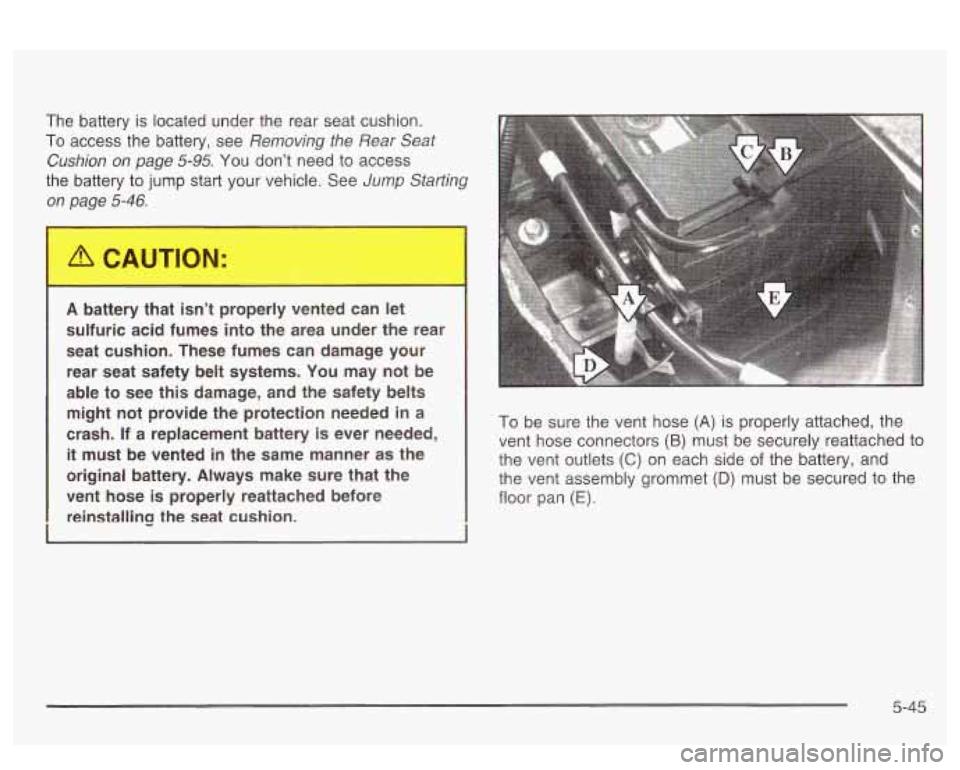
The battery is located under the rear seat cushion.
To access the battery, see Removing the Rear Seat
Cushion on page
5-95. You don't need to access
the battery to jump start your vehicle. See
Jump Starting
on page
5-46.
A battery that isn't properly vented can let
sulfuric acid fumes into the area under the rear
seat cushion. These fumes can damage your
rear seat safety belt systems. You may not be
able to see this damage, and the safety belts
might not provide the protection needed
in a
crash. If a replacement battery
is ever needed,
it must be vented in the same manner as the
original battery. Always make sure that the
vent hose is properly reattached before reinstalling the seat cushion.
To be sure the vent hose (A) is properly attached, the
vent hose connectors
(B) must be securely reattached to
the vent outlets
(C) on each side of the battery, and
the vent assembly grommet
(D) must be secured to the
floor pan
(E).
5-45
Page 401 of 418
Automatic Transaxle Fluid
.......................................................... 5-23
Operation
................................................... 2-28
Automatic Transaxle Check
.............................. 6-1 9
Automatic Transaxle Shift Lock Control
System Check
......................................... 6-20
Backing Up
................................................. 4-40
Battery
.......................... ......................... 5-44
Battery Load Management
............................ 3-20
Battery Replacement
......................................... 2-9
Battery Warning Light
...................................... 3-41
Before Leaving on a Long Trip
......................... 4-22
Body Lubrication Service
.................................. 6-1 9
Boost Gage
................................................... 3-54
Brake
Parking
...................................................... 2-31
System Inspection
....................................... 6-23
Brake Fluid
.................................................... 5-42
Brake Wear
................................................... 5-43
Brakes
.......................................................... 5-42
Braking
........................................................... 4-6
Braking in Emergencies
..................................... 4-9
Break-In, New Vehicle
..................................... 2-25
Bulb Replacement
........................................... 5-56
Front Turn Signal and Parking Lamps ............. 5-57
Halogen Bulbs
............................................ 5-56
System Warning
Light
.................................. 3-42 Bulb
Replacement (cont.)
Headlamp Aiming
........................................ 5-52
Headlamps
................................................. 5-56
Replacement Bulbs
...................................... 5-60
Taillamps. Turn Signal. Stoplamps and Back-up Lamps
........................................ 5-59
Buying New Tires
........................................... 5-67
C
Calibrating the Compass .................................. 3-70
California Fuel
.................................................. 5-6
Canada
........................................................... 7-4
Canadian Owners ................................................ ii
Canadian Roadside Assistance ........................... 7-6
Capacities and Specifications
.......................... 5-1 00
Carbon Monoxide ................... 4-26, 4-36, 2-16, 2-36
Care
of
Care of Your
Safety Belts
............................................ 5-85
Cassette Tape Player
................................. 3-100
CD Player
................................................. 3-101
CDS
......................................................... 3-100
Cassette Tape Messages
................................. 3-91
Cassette Tape Player Service
........................... 6-18
CD Adapter Kits
............................................. 3-92
CD Changer, Trunk-Mounted
............................ 3-94
Center Console Storage Area
........................... 2-46
Center Front Passenger Position, Safety Belts
.... 1-19
Chains, Tires
.................................................. 5-71
2