instrument panel PONTIAC FIREBIRD 1995 User Guide
[x] Cancel search | Manufacturer: PONTIAC, Model Year: 1995, Model line: FIREBIRD, Model: PONTIAC FIREBIRD 1995Pages: 386, PDF Size: 19.66 MB
Page 97 of 386

Daytime Running Lamps (Canada)
Daytime Running Lamps (DRL) make it easier to see
the front
of your vehicle during the day. DIU can be
helpful when it’s raining and in the short periods after
dawn and before sunset. Several countries, including
Canada, require DRL.
A light sensor on top of the instrument panel makes the
DRL work,
so be sure it isn’t covered.
The DRL system.wil1 make your front turn signal lamps
come on when:
The ignition is on
0 The headlamp switch is off, and
The parking brake is released.
When the DRL are on, only your front turn signal lamps
will be on. The taillamps, sidemarker and other lamps
won’t be on. Your instrument panel won’t
be lit up either.
When it’s dark enough outside, your front turn signal
lamps will go out and your headlamps will come on.
The other lamps that come on with your headlamps will
also come on.
When it’s bright enough outside, the regular lamps will
go off, and your front turn signal lamps come on.
As with any vehicle, you should turn on the regular
headlamp system any time you need it.
Lamps On Reminder
If you turn the ignition OFF and leave the lamps on, you
will hear a chime when you open the driver’s door.
2-50
ProCarManuals.com
Page 111 of 386

Instrument Panel
2-64
ProCarManuals.com
Page 113 of 386
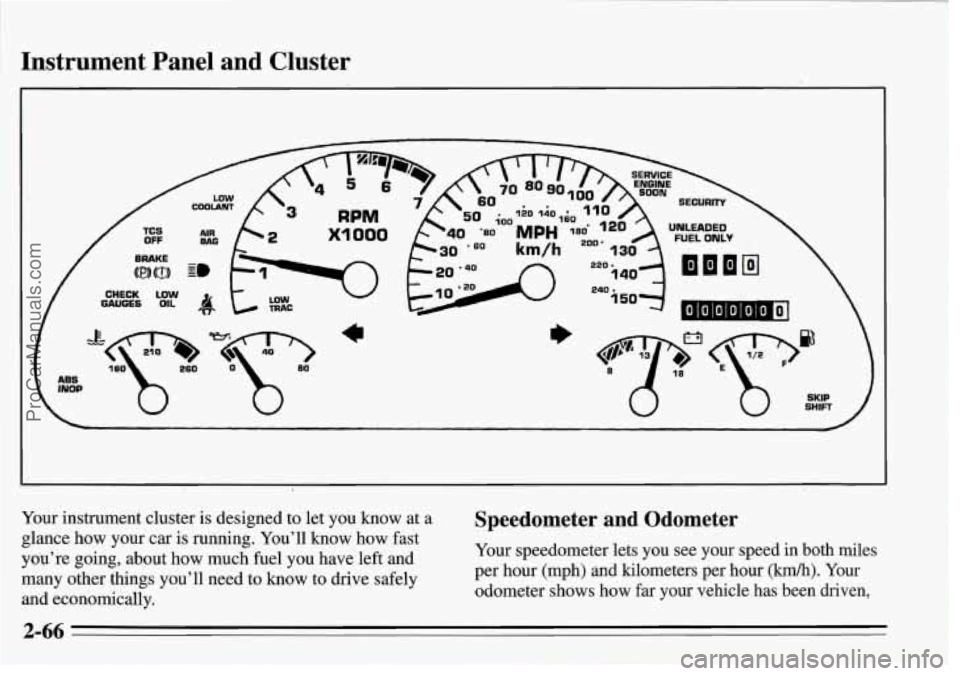
Instrument Panel and Cluster
CHECK LOW GAUGES OIL
Your instrument cluster is designed to let you know at a Speedometer and Odometer
glance how your car is running. You’ll know how fast
you’re going, about how much fuel you have left and
many other things you’ll need to know to drive safely
and economically. Your speedometer lets you see your speed in both miles
per hour (mph) and lulometers per hour
(km/h). Your
odometer shows how far your vehicle has been driven,
2-66
ProCarManuals.com
Page 115 of 386

Safety Belt . . ,.. Reminder Light
When the key is turned to RUN or START, a chime will
come
on €& about eight seconds to remind people to
fasten
their safety belts, unless the driver’s safety belt is
already buckled. The safety belt light will also come on
and
I Ctiy .. on until the driver’s belt is buckled.
Air Bag Readiness Light
There is an air bag readiness light on the instrument
panel, which shows
AIR BAG. The system checks the
air bag’s electrical system for malfunctions. The light
tells you if there
is an electrical problem. The system
check includes the
air bag sensors and modules, the
wiring and the diagnostic module. For more information
on the air bag system, see “Air Bag” in the Index.
AIR
BAG
You will see this light flash for a few seconds when you
turn your ignition to RUN or START. Then the light
should go out. This means the system is ready.
If the air bag readiness light doesn’t come on when you
start your vehicle, or stays on, or comes on when you
are driving, your
air bag system may not work properly.
Have your vehicle serviced right away.
ProCarManuals.com
Page 157 of 386

Avoid needless heavy braking. Some people drive in
spurts
-- heavy acceleration followed by heavy braking
-- rather than keeping pace with traffic. This is a
mistake. Your brakes may not have time to cool between
hard stops. Your brakes will wear out much faster
if you
do a lot
of heavy braking. If you keep pace with the
traffic and allow realistic following distances, you will
eliminate a lot of unnecessary braking. That means
better braking and longer brake
life.
If your engine ever stops while you’re driving, brake
normally but don’t pump your brakes.
If you do, the
pedal may get harder to push down.
If your engine
stops, you will still have some power brake assist. But
you will use it when you brake. Once the power assist is
used up, it may take longer to stop and the brake pedal
will be harder to push.
Anti-Lock Brakes (ABS)
Your Pontiac has an advanced electronic braking system
that will help prevent a braking skid.
INOP
This light on the
instrument panel will
come on briefly when
you start your vehicle.
When you start your vehicle, or when you begin to drive
away, you may hear a momentary motor or clicking
noise. And you may even notice that your brake pedal
moves a little while this is going on. This is the ABS
system testing itself. If there’s a problem with the
anti-lock brake system, the anti-lock brake system
warning light will stay on or flash.
See “Anti-Lock Brake System Warning Light’’ in the
Index.
4-6
ProCarManuals.com
Page 188 of 386

Turn Signals When Towing a Trailer
When you tow a trailer, your vehicle has to have a
different turn signal flasher and extra wiring. The green
arrows on your instrument panel will flash whenever
you signal a turn or lane change. Properly hooked up,
the trailer lamps will also flash, telling other drivers
you’re about to turn, change lanes or stop.
When towing a trailer, the green arrows on your
instrument panel will flash for turns even if the bulbs on
the trailer are burned out. Thus, you may think drivers
behind you are seeing your signal when they are not. It’s
important to check occasionally to be sure the trailer
bulbs are still working.
Driving On Grades
Reduce speed and shift to a lower gear before you start
down a long or steep downgrade.
If you don’t shift
down, you might have to use your brakes
so much that
they would get hot and no longer work well.
On a long uphill grade, shift down and reduce your
speed to around
45 mph (70 km/h) to reduce the
possibility of engine and transmission overheating.
If you are towing a trailer and you have an automatic
transmission with Overdrive, you may prefer
to driving
in THIRD
(D) instead of OVERDRIVE (or, as you need
to, a lower gear). Or, if you have
a manual transmission
with FIFTH (or SIXTH) gear and you are towing a
trailer, it’s better not to use FIFTH (or
SIXTH) gear.
Just drive in FOURTH (drive in FIFTH if you have a
six-speed manual transmission) or, as you need to, a
lower gear.
4-37
ProCarManuals.com
Page 205 of 386

Engine Overheating
You will find a coolant temperature gage on your
Pontiac’s instrument panel. You may also find
a low
coolant warning light on your Pontiac instrument panel.
If Steam Is Coming From Your Engine
NOTICE:
If your engine catches fire because you keep
driving with
no coolant, your vehicle can be
badly damaged. The costly repairs would not be covered by your warranty.
5-16
ProCarManuals.com
Page 236 of 386

Fuel
3.4L L32 (Code S) and 3.8L L36 (Code K)
The 8th digit of your vehicle identification number
(VIN) shows the code letter for your engine. You will
find the VIN at the top left of your instrument panel.
(See “Vehicle Identification Number” in the Index.)
Use regular unleaded gasoline rated at 87 octane or
higher.
It should meet specifications ASTM D4814 in
the United States and CGSB
3.5-92 in Canada. These
fuels should have the proper additives,
so you should not
have to add anything to the fuel.
In the United States and Canada, it’s easy to be sure you
get the right kind of gasoline (unleaded). You’ll see
UNLEADED right on the pump. And only unleaded
nozzles will fit into your vehicle’s filler neck.
Be sure the posted octane is at least 87. If the octane is
less than 87, you may get a heavy knocking noise when
you drive. If it’s bad enough, it can damage your engine.
If you’re using fuel rated at 87 octane or higher and you
still hear heavy knockmg, your engine needs service.
But don’t
worry if you hear a little pinging noise when
you’re accelerating or driving up a hill. That’s normal,
and you don’t have to buy a higher octane fuel to get rid
of pinging. It’s the heavy, constant knock that means
you have a problem.
What about gasoline with blending materials that
contain oxygen (oxygenates), such as MTBE
or alcohol?
MTBE is “methyl tertiary-butyl ether.” Fuel that is no
more than 15% MTBE is fine for your vehicle.
Ethanol is ethyl or grain alcohol. Properly-blended fuel
that is no more than
10% ethanol is fine for your
vehicle.
Methanol is methyl or wood alcohol.
NOTICE:
Fuel that is more than 5% methanol is bad for
your vehicle. Don’t use it. It can corrode metal
parts in your fuel system and also damage plastic and rubber parts. That damage wouldn’t
be
covered under your warranty. And even at 5% or
less, there must be “cosolvents” and corrosion
preventers in this fuel to help avoid these problems.
I.
6-3
ProCarManuals.com
Page 237 of 386

Fuel ~
5.7L LT1 (Code P)
The
8th digit of your vehicle identification number
(VIN) shows the code letter for your engine. You will
find the
VIN at the top left of your instrument panel.
(See “Vehicle Identification Number” in the Index.)
Use premium unleaded gasoline rated at 91 octane or higher
for best
performance. You my use middle grade or regular
unleaded gasolines, but your vehicle may not accelerate
as
well. The gasoline you use should meet speakations
ASTM D4814 in the United States and CGSB 3.5-92 in
Canada. These fuels should have the proper additives, so
you should not have to add anwg to the fuel.
In the United States and Canada, it’s easy to be sure you
get the right kind
of gasoline (unleaded). You’ll see
UNLEADED right on the pump. And only unleaded
nozzles will
fit into your vehicle’s filler neck.
Be sure the posted octane for premium is at least 91 (at
least
89 for middle grade and 87 for regular). If the octane
is less than
87, you may get a heavy hocking noise when
you drive.
If it’s bad enough, it can damage your engine.
If you’re using fuel rated at 91 octane or higher and you
still hear heavy
knocking, your engine needs service.
But don’t worry if you hear a little pinging noise when
you’re accelerating or driving up a hill. That’s normal
and you don’t have to buy a higher octane fuel to get rid
of pinging. It’s the heavy, constant knock that means
you have a problem.
What about gasoline with blending materials that
contain oxygen (oxygenates), such as MTBE
or alcohol?
MTBE is “methyl tertiary-butyl ether.” Fuel that is no
more than
15% MTBE is fine for your vehicle.
Ethanol is ethyl or grain alcohol. Properly-blended fuel
that
is no more than 10% ethanol is fine for your vehicle.
Methanol is methyl or wood alcohol.
NOTICE:
Fuel that is more than 5% methanol is bad for
your vehicle. Don’t use it.
It can corrode metal
parts in your fuel system and also damage plastic
and rubber parts. That damage wouldn’t be
covered under your warranty. And even at
5% or
less, there must be “cosolvents” and corrosion
’ preventers in this fuel to help avoid these
~ problems. I
6-4
_ir ProCarManuals.com
Page 245 of 386

Before closing the hood, be sure all the filler caps are
on.
Then just pull the hood down and close it firmly.
Engine Oil
LOW
OIL
If the LOW OIL light on the instrument panel comes on,
it means you need to check your engine oil level right away. For more information, see
LOW OIL in the Index.
You should check your engine oil level regularly; this is
an added reminder.
It’s a good idea to check your engine oil every time you
get fuel.
In order to get an accurate reading, the oil must
be warm and the vehicle must be on level ground.
ProCarManuals.com