instrument panel PONTIAC FIREBIRD 1996 User Guide
[x] Cancel search | Manufacturer: PONTIAC, Model Year: 1996, Model line: FIREBIRD, Model: PONTIAC FIREBIRD 1996Pages: 386, PDF Size: 19.18 MB
Page 66 of 386

Exit Lighting and Delayed Illumination Last Door Closed Locking and
Your vehicle comes with this feature set in Mode 4. This Lockout Prevention
means that your interior lamps will go on when the key
Your vehicle comes with this feature set in Mode 2.
is removed from the ignition switch and stay on for This means that your power door locks will not lock
25 seconds after closing the doors to help in exiting the
when the keys are in the ignition and a door is open.
vehicle. TO change the factory setting, do the following:
TO change the factory setting, do the following:
1. Turn the courtesy lamps on by turning the instrument 1. press the LOCK switch on the door.
2. Count the number of chimes you hear. The number of chimes tells you which mode your vehicle is
panel brightness control knob all the way up.
of chimes tells you which mode your vehicle is set for.
set for.
2. Count the number of chimes you hear. The number
3. Press the LOCK switch on the door until you hear
3. Turn the courtesy lamp switch to off. the number of chimes that correspond to the mode
4. Turn the courtesy lamp switch from on to off until
you hear the number of chimes that correspond to the Mode 1: Both Off (Doors will 1ocWunlock when you
mode selection you want. press the power door lock switch).
Mode 1: Both Off (Interior lamps will turn on or off at ~ Mode 2: Lockout Prevention Only (If you leave your
the same instant that a door is opened or closed). keys in the ignition and get outl the driver’s door, you
Mode 2: Delayed Illumination Only (Interior lamps will
stay on for
25 seconds after the doors are closed).
Mode 3: Exit Lighting Only (Interior lamps will come
on whenever you remove the ignition key). selection
you want.
won’t be able to lock the doors with the,power door lock
switch). Mode 3: Last Door Closed Locking Only (If the power
door lock switch is used to lock the, vehicle while any
door is open,
y0.u will hear three chimes. The doors will
Mode 4: Both On (This combines Mode 2 and 3). not lock until after all doors are closed).
Mode 4: Both On (This combines Mode 2 and 3).
ProCarManuals.com
Page 71 of 386
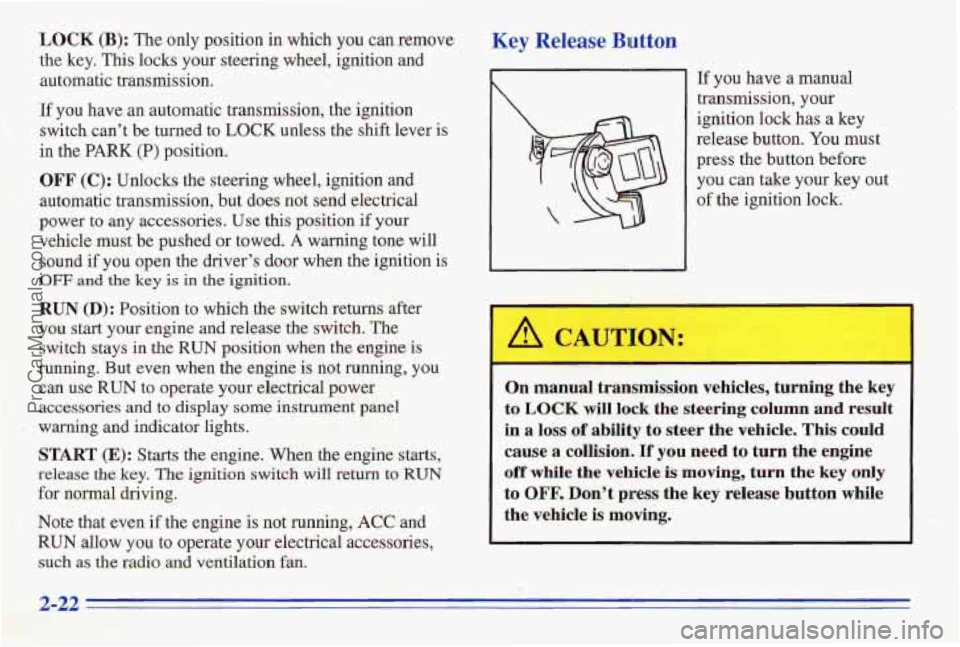
LOCK (B): The only position in which you can remove
the key.
This locks your steering wheel, ignition and
automatic transmission.
If you have an automatic transmission, the ignition
switch can't be turned to
LOCK unless the shift lever is
in the PARK (P) position.
OFF (C): Unlocks the steering wheel, ignition and
automatic transmission, but does not
send electrical
power
to any accessories. Use this position if your
vehicle must be plashed or towed. A warning tone will
sound
if you open the driver's door when the ignition is
OFF and the key is in the ignition.
RUN (D): Position to which the switch returns after
you start your engine and release. the switch. The
switch stays in
the RUN position when the engine is
running. But even when the engine is not running, you
can use RUN to operate your electrical power
accessories and to display some instrument panel
START (E): Starts the engine. When the engine starts,
release the key. The ignition switch will return to RUN
for normal driving.
Note that even if the engine is not running,
ACC and
RUN allow you to operate your electrical accessories,
such as the radio .and ventilation fan.
I warning and indicator lights.
Key Release Button
If you have a manual
transmission, your
ignition lock has
a key
release button. You
must
press the button before
you can take your key out
of the ignition lock.
On manual transmission vehicles, turning the key
to
LOCK will lock the steering column and result
in a loss of ability to steer the vehicle. This could
cause a
collision. If you need to turn the engine
off while the vehicle is moving, turn the key only
to OFF. Don't press the key release button while
the vehicle
is moving.
ProCarManuals.com
Page 93 of 386

Turn Signal and Lane Change Indicator
The turn signal has two upward (for right) and two
downward (for left) positions. These positions allow
you to signal a turn or a lane change.
To signal a turn, move the lever all the way up or
down. When
the turn is finished, the lever will +
return automatically.
An arrow on the instrument
panel will flash in the
direction.
of the turn or lane
change.
As you signal a turn or a lane change, if the arrows don’t
flash but just ‘stay
on, a signal bulb may be burned out
and other drivers won’t see your turn signal.
If a bulb is burned out, replace it to help avoid an
accident. If the arrows don’t go on at all when you
signal a turn, check the fuse (see “Fuses and,Circuit
Breakers” in the Index).
Headlarnp High/Low Beam Changer ’
.. -.
.;: , i.:. : . .. 1 g .- ..
To change the headlamps
from low beam to high or
high to low, pull the turn
signal lever all the way
toward you.
Then release it.
When
the high beams are
con, this light
on the
instrument panel also will
be on.
To signal a lane change, just raise or lower the lever
until the
mow starts to flash. Hold it there until you
complete
your lane change. The lever will return by
itself when you release it.
2-44
ProCarManuals.com
Page 99 of 386

Lamps The main lamp control is a knob that works these lamps:
0 Headlamps
Taillamps
Parking Lamps
0 License Lamps
Sidemarker Lamps
0 Instrument Panel Lights
-'Q- , This setting turns on your headlamps and other
operating lamps.
Pg This setting turns on your parking lamps without
your headlamps.
Turn the hob to OFF to turn off the lamps.
Headlamps On Reminder
If you turn the ignition OFF and leave the lamps on, you
will hear a chime lasting up to 5 seconds. If the laws
are still on when you open the driver's door, the chime
will sound again.
ProCarManuals.com
Page 101 of 386

Daytime Running Lamps (Option)
Daytime Running Lamps (DRL) can make it easier for
others
tu see the front of your vehicle during the day.
DRL can be helpful in many different driving
conditions, but they can be especially helpful in.the
short periods after dawn and before sunset.
A light sensor on top of the instrument panel makes the
DRL work, so be sure it isn’t covered.
The
DRL system will make your front turn signal lamps
come on when:
The ignition is on,
The headlamp switch is OFF, and
The parking brake is released.
When
the DRL are on, only your front turn signal
lamps will be on. The taillamps, sidemarker and other
lamps won’t be on. Your instrument panel won’t be lit
up either.
When it’s dark enough outside, your front turn signal
lamps will
go out and your headlamps will come on.
The other lamps that come on with your headlamps will
also come on.
When it’s bright enough outside, the regular lamps will
go off, and your front turn signal lamps will come on.
As with any vehicle, you should turn on the regular
headlamp system when you need it.
Fog Lamps (Option)
Use your fog lamps for better vision in foggy or misty
conditions. Your parking lamps must be on or your fog
lamps won’t work.
SO To turn the fog lamps on, push the top of the fog
lamp switch,
Push the bottom of the switch to turn the
fog lamps off. A light on the switch will come on when
the fog
lamps are on.
Fog lamps will go off whenever your high beams come
on. When the high beams
go off, the fog lamps will
come
on again.
If your vehicle is equipped with Vehicle and Content
Theft-Deterrent System and your
fog lamp switch is
on,
the fog lamps may flash to indicate operation of
the Vehicle
and Content Theft-Deterrent System.
See “Vehicle and Content Theft-Deterrent System” in
the
Index.
2-52
ProCarManuals.com
Page 102 of 386

Interior Lamps
Instrument Panel Brightness Control
This switch controls the brightness of your
instrument panel lights. Turn the switch to brighten
or
dim the lights. If you turn the switch all the way up your
courtesy lamps will come on.
Courtesy Lamps
When any door is opened, several interior lamps go on.
These lamps are courtesy lamps. They make it easier for
you to enter and leave your vehicle.
Courtesy lamps include the dome lamp and other
lamps
throughout the interior of your vehicle.
To prevent battery rundown, your interior lamps will be
disabled about
10 minutes after the ignition is turned to
OFFm The 10 minute timer will be restarted if you do any
of the following:
1. Turn the ignition on.
2. Open either door.
3.
4.
5.
Press any button on your Remote Lock
Control transmitter.
Turn the interior lamp switch from off to on.
Open the hatch.
Delayed Illumination (Option)
With delayed illumination, when you open a door, your
courtesy lamps will come
on and stay on for 25 seconds
after the doors
are closed. The 25 seconds is shortened
if the ignition is turned to
the RUN position or if the
power locks
are activated. To turn this feature on or off,
see “Feature Customization” in the Index.
Exit Lighting (Option)
With exit lighting, the interior lamps will come on when
you remove the key from the ignition to help you see
while exiting the vehicle. To turn
this feature on or off,
see “Feature Customization” in the Index.
..
ProCarManuals.com
Page 121 of 386
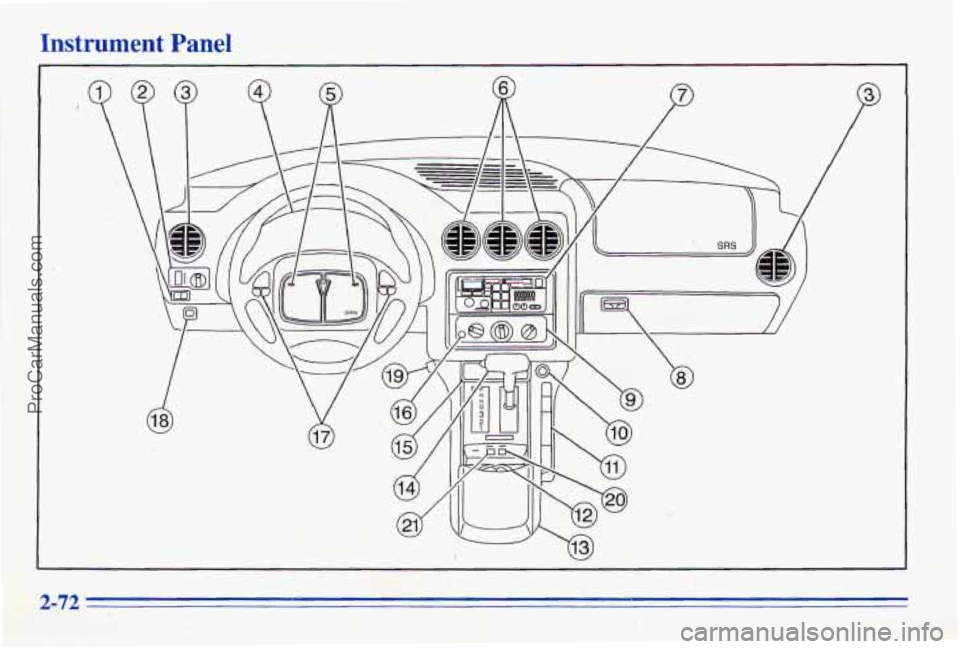
Instrument Panel
I
2-72
ProCarManuals.com
Page 123 of 386

Instrument Panel Cluster
WOES OIL CWKCK LOW
Your instrument cluster is designed to let you know at a glance how your vehicle is running. You’ll know how
fast you’re going, about how much fuel you have left and many
other things you’ll need to know to drive safely
and economically.
2-74 ,
ProCarManuals.com
Page 126 of 386

Air Bag Readiness Light
There is an air bag readiness light on the instrument
panel, which shows AIR
BAG. The system checks the
air bag’s electrical system for malfunctions. The light
tells you if there
is an electrical problem. The system
check includes
the air bag sensors, the air bag modules,
the wiring and the crash sensing and diagnostic module.
For more information on the air bag system, sed “Air
Bag” in the Index.
AIR
BAG
You will see this light flash
for a few seconds when you
turn your ignition to
RUN
or START. Then the light
should go out. This means
the system is ready.
If the air bag readiness light doesn’t come on when you
start your vehicle, or stays on, or comes on when you
are driving, your air bag system may not work properly.
Have your vehicle serviced right away.
Voltmeter
I p4
You can read battery
voltage on
your voltmeter.
If it reads less than 11 volts
or more than 16 volts while
your engine
is running,
and it stays there, you may
have
a problem with the
electrical charging system.
Have it checked right away. Driving with the voltmeter
reading in a warning zone could drain your battery.
If you idle your engine for a while, the voltmeter
reading might move into the yellow zone, If the reading
stays in the yellow zone while you are driving, you may
have a problem with the electrical charging system.
Have it checked. While the voltmeter reads in the
yellow
zone, your battery may not be able to power certain
electrical accessories,
like ABS. (If this happens, your
ABS INOP light will come on. See “Anti-Lock Brake
System Warning Light” in this
part.)
If you must drive a short distance with the voltmeter
reading in a warning zone,
turn off all your accessories,
including your comfort control and audio system.
ProCarManuals.com
Page 198 of 386

Turn Signals When Towing a Trailer
When you tow a trailer, your vehicle may need a
different ‘turn signal flasher and/or extra wiring. Check
with your Pontiac dealer.
The arrows
on your instrument panel will flash
whenever you signal a turn or lane change. Properly
hooked up, the trailer lamps will also flash, telling other
drivers you’re about to turn, change lanes or stop.
When towing a trailer, the arrows on your instrument
panel will flash for turns even if the bulbs on the trailer
are burned out. Thus, you may think drivers behind you
are seeing your signal when they are not. It’s important
to check occasionally to be sure the trailer bulbs are
still working.
1 ’ Driving On Grades
Reduce speed and shift to a lower gear before you start
down a long or steep downgrade.
If you don’t shift
down, you might have to use your brakes
so much that
they would get hot and no longer work well.
On
a long uphill grade, shift down and reduce your
speed to around
45 mph (70 km/h) to reduce the
possibility
of engine and transmission overheating.
If YOU are towing a trailer and you have an automatic
transmission with Overdrive, you may prefer to drive in
THIRD (D) instead of AUTOMATIC OVERDRIVE (0)
(or, as you need to, a lower gear). Or, if you have a
manual transmission with
FJFTH (5) (or SIXTH (6)) gear
and you are towing a trailer, it’s better not to use FIFTH
(5) (or SIXTH) (6) gear. Just drive in FOURTH (4) (drive
in
FIFTH (5) if you have a six-speed manual transmission)
or,
as you need to, a lower gear.
Parking on Hills
You really should not park your vehicle, with a trailer
attached, on a hill. If something goes wrong, your rig
could start to move. People can be injured, and both
your vehicle and the trailer can be damaged.
But if you ever have to park your rig on a hill, here’s
how to do it:
1. Apply your regular brakes, but don’t shift into
2. Have someone place chocks under the trailer wheels.
3. When the wheel chocks are in place, release the
regular brakes until the chocks absorb the load..
’
4. Reapply the regular brakes, Then apply your parking
brake, and then shift to
PARK (P), or REVERSE (R)
for a manual transmission.
5. Release the regular brakes.
PARK (P) yet, or into gear for a manual transmission.
4-37
ProCarManuals.com