brake PONTIAC FIREBIRD 1997 Repair Manual
[x] Cancel search | Manufacturer: PONTIAC, Model Year: 1997, Model line: FIREBIRD, Model: PONTIAC FIREBIRD 1997Pages: 410, PDF Size: 19.2 MB
Page 284 of 410
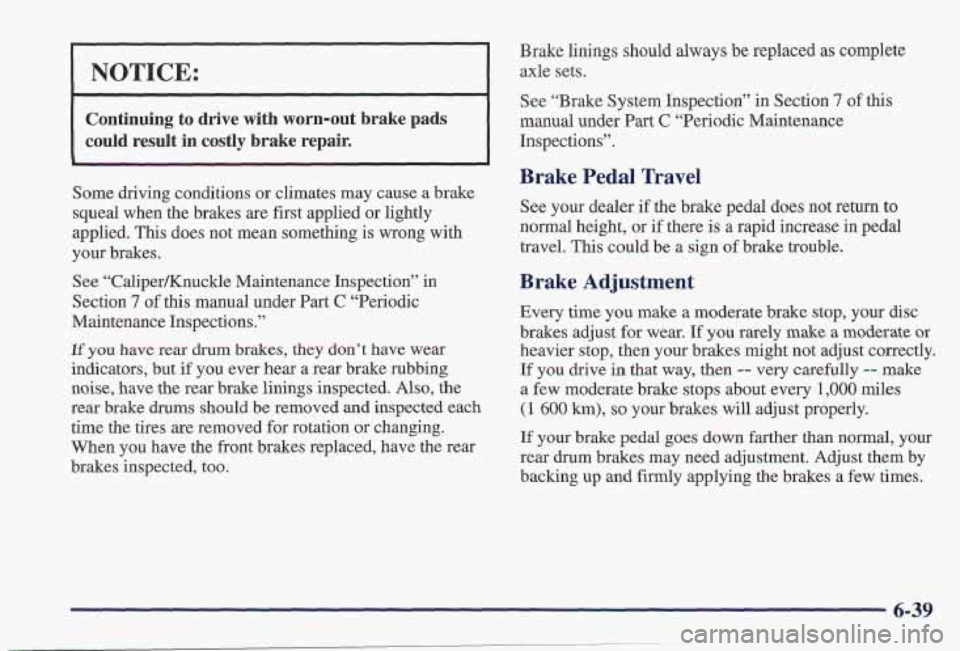
Brake linings should always be replaced as complete
See
“Brake System Inspection” in Section 7 of this
NOTICE: axle sets.
Continuing to drive with worn-out brake pads
Inspections”. could result in costly brake repair.
manual under Part C “Periodic Maintenance
Same driving conditions or climates may cause a brake
squeal when the brakes are. first applied or lightly
applied. This does not mean something is wrong with
your brakes.
See “Caliper/Knuckle Maintenance Inspection’’ in
Section
7 of this manual under Part C “Periodic
Maintenance Inspections.”
If you have rear drum brakes, they don’t have wear
indicators, but
if you ever hear a rear brake rubbing
noise, have the rear brake linings inspected. Also, the
rear brake drums should
be removed and inspected each
time the tires are removed for rotation or changing.
When
you have the front brakes replaced, have the rear
brakes inspected, too.
Brake Pedal Travel
See your dealer if the brake pedal does not return to
normal height, or if there is a rapid increase in pedal
travel.
This could be a sign of brake trouble.
Brake Adjustment
Every time you make a moderate brake stop, your disc
brakes adjust for wear.
If you rarely make a moderate or
heavier stop, then your brakes might not adjust correctly.
If you drive in that way, then -- very carefully -- make
a few moderate brake stops about every 1,000 miles
(1 600 km), so your brakes will adjust properly.
If your brake pedal goes down farther than normal, your
rear drum brakes may need adjustment. Adjust them by
backing up and firmly applying the brakes
a few times.
6-39
Page 285 of 410

Replacing Brake System Parts
The braking system on a modern vehicle is complex. Its
many parts have to be of top quality and work well
together if the vehicle is to have really good braking.
Vehicles we design and test have top-quality
GM brake
parts in them, as your Pontiac does when
it is new.
When you replace parts
of your braking system -- for
example, when your brake linings wear down and you
have to have new ones put in
-- be sure you get new
genuine
GM replacement parts. If you don’t, your
brakes may no longer work properly. For example, if
someone puts in brake linings that are wrong for your
vehicle, the balance between your front and rear brakes
can change
-- for the worse. The braking performance
you’ve come
to expect can change in many other ways if
someone puts in the wrong replacement brake parts.
Battery
Every new Pontiac has a Delco Freedom@ battery. You
never have to add water to one of these. When it’s time
for a new battery, we recommend a Delco Freedom
battery. Get
one that has the replacement number shown
on the original battery’s label.
Vehicle Storage
If you’re not going to drive your vehicle for 25 days
or more, take off the black, negative
(-) cable from
the battery. This will help keep your battery from
running down.
Batteries have acid that can burn you and gas
that can explode. You can be badly hurt if you
aren’t careful. See
‘‘Jump Starting” in the Index
for tips on working around a battery without
getting hurt.
I 1
Contact your dealer to learn how to prepare your vehicle
for longer storage periods.
Also, for your audio
system, see “Theft-Deterrent
Feature”
in the Index.
6-40
Page 301 of 410

Wheel Replacement
Replace any wheel that is bent, cracked, or badly rusted
or corroded. If wheel nuts keep coming loose, the wheel,
wheel bolts and wheel nuts should be replaced.
If the
wheel leaks air, replace
it (except some aluminum
wheels, which can sometimes be repaired). See your
Pontiac dealer if any
of these conditions exist.
Your dealer will know the kind
of wheel you need.
Each new
wheel should have the same load-carrying
capacity, diameter, width, offset and be mounted the
same way as the one it replaces.
If you need to replace any of your wheels, wheel
bolts or wheel nuts, replace them only with new
CM
original equipment parts. This way, you will be sure to
have the right wheel, wheel. bolts and wheel nuts
for
your Pontiac model.
Using the wrong replacement wheels, wheel bolts
or wheel nuts on your vehicle can be dangerous.
It could affect the braking and handling of your
vehicle, make your tires
lose air and make you
lose control. You could have a collision in which
you or others could be injured.
Always use the
correct wheel, wheel bolts and wheel nuts
for
replacement.
NOTICE:
~
The wrong wheel can also cause problems with
bearing life, brake cooling, speedometer or
odometer calibration, headlamp aim, bumper
height, vehicle ground clearance
and tire or tire
chain clearance to the body and chassis.
See “Changing a Flat Tire” in the Index for more
information.
6-56
Page 315 of 410

Main Fuse Block
The other is in the engine compartment. Open the cover
on either of the boxes to expose the €uses.
Look at the silver-colored band inside the fuse. If the
band is broken or melted, replace the fuse.
Be sure you
replace a bad fuse with a new one of the correct size.
If
you ever have a problem on the road and don’t have a
spare €use, you can “borrow”
one. Just pick some
feature
of your car that you can get along without -- like
the radio or cigarette lighter -- and use its fuse, if it is
the size you need. Replace it as soon as you
can.
FUSE USAGE CHART
In 211 3~ 4~3
511 6~ 7n en
9m 100 1111 12)l
STOP/#AZARD TURN 6-U PCM BATT RADIO ACCY
TAIL LTS
HVAC PWR ACCY COURTESY
GAGES AIR BAG ClGARiACCY DEFOG/SEATS
Q IGN 13n 14)) PGM IGN WlPERiWASH BATT WINDOWS
160 I7 170 IP DIMMER ACCY RADIO
SEE OWNER’S MANUAL FOR MORE INFORMATION PRINTED IN U.S.A 10281550
Fuse Usage
STOP/HAZARB Hazard,Flasher, Brake
Switch Assembly
PCM BATT
RADIO ACCY
TURN B-U Traction ControlJ2nd Gear Start
Switch, Back-up Lamp Switch,
Turn Flasher, Daytime Running
Lamps (DRL) Module
Powertrain Control Module
(PCM), Fuel Pump Relay
Delco Audyssey
Radio Amplifier,
Power Antenna, Remote CD
Player (trunk)
6-70
Page 316 of 410

Fuse
TAIL LTS
HVAC PWR ACCY
COURTESY
GAGES
AIR BAG
CIGARIACCY DEFOG/SEATS
Usage
Daytime Running Lamps (DRL)
Module, Headlamp Switch
Selector Switch, Rear Defogger
SwitchITimer
Park Lamp Relay, Hatch Release
Relay, Power Mirror Switch,
Radio, Shock Sensor,
Instrument Cluster
Body Control Module (BCM)
Body Control Module (BCM),
Brake Switch Assembly (BTSI),
Instrument Cluster, Daytime
Running Lamps
(DRL) Module
Diagnostic Energy Reserve
Module (DERM), Dual Pole
Arming Sensor
Cigar Lighter, Data Link
Connector (DLC), Auxiliary
Accessory Wire
Rear Defogger Switch/Timer,
Rear Defogger Timer/Relay,
Power Seats
Fuse
PCM IGN
WIPERIWASH WINDOWS
I/P DIMMER
RADIO
Usage
Powertrain Control Module
(PCM), EVAP Canister Purge
Vacuum Switch, EVAP Canister
Purge Valve, Transmission
Wiper Motor Assembly,
Wipermasher Switch
Power Windows Switch
(RH, LH),
Express-Down Module, Coolant Level Latching Module, Convertible
Top Switch
Door Illumination Lamp (RH,
LH), Headlamp Switch,
Fog Lamp
Switch, Instrument Cluster,
HVAC
Control Assembly, PRNDL
Illumination
Lamp, Ashtray
Lamp, Radio, Steering Wheel
Controls-Radio, Rear Window
Defogger Switch/Timer, Traction
Control Switch
(TCS) and 2nd
Gear Start Switch
Body Control Module (BCM),
Radio, Amplifier, Steering
Wheel
Controls-Radio
6-71
Page 317 of 410

Underhood Electrical Center
Fuse
ABS IGN (SA)
ACTUATORS (15A)
R HDLP DR (154
L HDLP DR (1 5A)
ABS VLV (20A)
Usage
Anti-Lock Brake System
Daytime Running
Lamp
Module, Headlamp
Switch, Cooling Fan
Relay, Exhaust,
Gas
Recirculation, EVAP
Canister Purge Solenoid
Headlamp Door Module
Headlamp
Door Module
Brake Pressure Valve
Fuse
ABS BAT (5A)
HORN (20A)
INJECTOR (15A)
ENG SEN (20A)
IGNITION
(1OA)
Usage
Electronic Brake Control
Module
AIR PUMPFAN
(25A) AIR Pump (V8) Relay,
Pump, Bleed Valve
and Cooling Fan
Horn Relay
Fuel Injectors
Mass Airflow, Heated
Oxygen
Sensor, Reverse
Lockout Solenoid, Skip
Shift Solenoid, Automatic
Transmission, Brake Switch
V6 VIN K: Electronic
Ignition Module
VS
VIN P: Ignition Coil
Module, Crankshaft
Position
Sensor.
A/C-CRUISE (15A) Air Conditioning
Compressor Relay;
Cruise Control Switches
and Module
6-72
Page 318 of 410

Relay
B
C
D
E
F
G
H
J
Usage
Air Conditioning Compressor Anti-Lock Brake SystedTraction Control
System
(TCS)
Cooling Fan 1
AIR Pump
Cooling Fan 2
Not Used
Fog
Lamps
Cooling Fan 3
Replacement Bulbs
Back-up . . . . . . . . . . . . . . . . . . .
Center High-Mounted Stoplamp . .
Front Parking and Turn Signal . .
Headlamp . . . . . . . . . . . . . . . .
Sidemarker . .
Tail Only . . . . .
Tail/Stop/Turn . . .
. . . . . . . . 1156
e.* . . 921
. . . . . . . . . 3157K
. . . . . . H-6545
, . . . . . . . . . . 194
.., .. . . . . . . . . . 194
.................. . 2057
Capacities and Specifications
Engine
Type
VIN Engine Code
K . . .
VIN Engine Code P .
Fuel Delivery . . . . . . . .
...... V6
. * . , . e. . V8
. . . . . . . . Fuel Injection
Valve Arrangement
. . . . .
Piston Displacement
VIN Engine Code K . . .
VIN Engine Code P . . . . .
Firing Order
VIN Engine Code K . . .
VIN Engine Code P .
.., . . . . In-Head
, . ,231 CID (3800)
, , . 350 CID (5.7L)
, . . 1-6-5-4-3-2
.... 1-8-4-3-6-5-7-2
Wheel Nut Torque
. . . . . . . . . . . 100 lb-ft (140 N-m)
Windshield Wiper Blade Replacement
Type
. . . . . ........................ hook
Length
. . . ..... . 24 inches (610 mm)
Page 328 of 410

Short TriplCity Maintenance Schedule
The services shown in this schedule up to 100,000 miles
(166 000 km) should be performed after 100,000 miles
(166
000 km) at the same intervals. The services shown
at
150,000 miles (240 000 km) should be performed at
the same interval after
150,000 miles (240 000 km).
Footnotes
The U.S. Environmental Protection Agency or the
California Air Resources Board has determined that the
failure to perform this maintenance item will not nullify
the emission warranty or limit recall liability prior to the
completion
of the vehicle’s useful life. We, however,
urge that all recommended maintenance services be
performed
at the indicated intervals and the maintenance
be recorded.
# Lubricate the steering and shift linkage.
+ A good time to check your brakes is during tire
rotation. See “Brake System Inspection” under “Periodic
Maintenance Inspection”
in Part C of this schedule.
++ If you drive in a highly corrosive environment, your
front brake calipers may require additional inspection
and service, at every other tire rotation. See
“Caliper/Knuckle Maintenance Inspection” under
“Periodic Maintenance Inspections” in Part C
of
this schedule.
Page 352 of 410

Long Tripmighway Maintenance Schedule
The services shown in this schedule up to 100,000 miles
(166
000 km) should be performed after 100,000 miles
(166
000 km) at the same intervals. The services shown
at
150,000 miles (240 000 km) should be performed at
the same interval after 150,000 miles (240
000 km).
Footnotes
? The U.S. Environmental Protection Agency or the
California Air Resources Board has determined that the
failure to perform this maintenance item will not nullify
the emission warranty or limit recall liability prior
to the
completion of the vehicle’s useful life. We, however,
urge that all recommended maintenance services be
performed at
the indicated intervals and the maintenance
be recorded.
## Lubricate the steering and shift linkage.
+ A good time to check your brakes is during tire
rotation. See “Brake System Inspection” under “Periodic
Maintenance Inspections” in
Part C of this schedule.
++ If you drive in a highly corrosive environment, your
front brake calipers may require additional inspection
and service, at every other tire rotation. See
“Caliper/Knuckle Maintenance Inspection” under
“Periodic Maintenance Inspections” in Part C of
this schedule.
Page 367 of 410
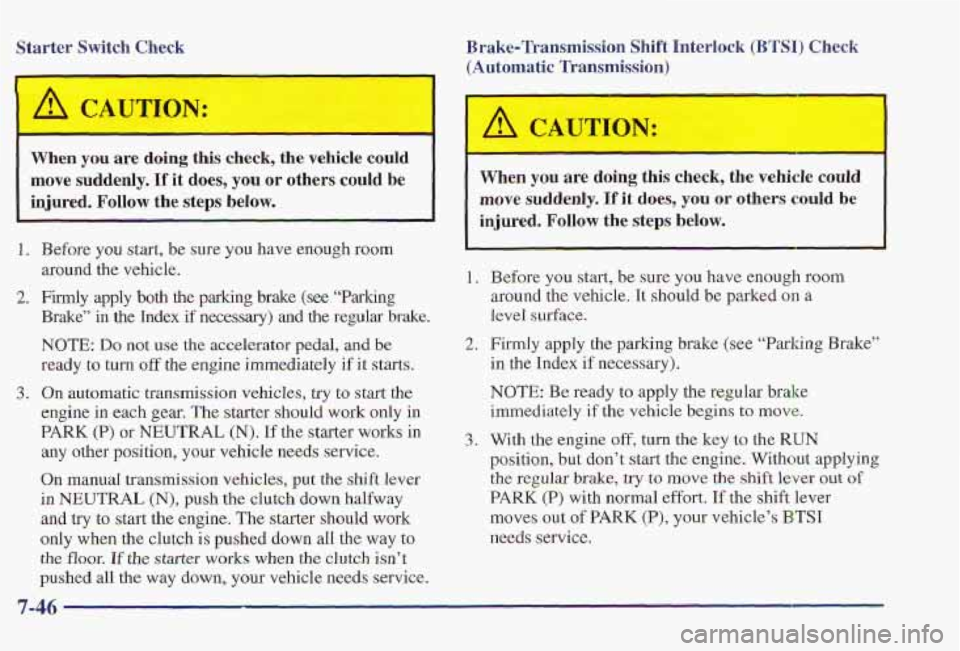
Starter Switch Check When
you are doing this check, the vehicle could
move suddenly.
If it does, you or others could be
injured. Follow the steps below. Brake-Transmission Shift Interlock
(BTSI) Check
(Automatic Transmission)
1.
2,
3.
Before you start, be sure you have enough room
around the vehicle.
Firmly apply
both the parking brake (see “Parking
Brake” in the Index if necessary) and the regular brake.
NOTE: Do not use the accelerator pedal, and be
ready to turn off the engine immediately if it starts.
On automatic transmission vehicles, try to start the
engine in each
gear. The starter should work only in
PARK (P) or NEUTRAL (N). If the starter works in
any other position, your vehicle needs service.
On manual transmission vehicles, put the
shift lever
in
NEUTRAL (N), push the clutch down halfway
and try to start the engine. The starter should work
only when the clutch is
pushed down all the way to
the floor. If the starter works when the clutch isn’t
pushed
all the way down, your vehicle needs service.
When you are doing this check, the vehicle could
move suddenly. If it does, you or others could be
injured. Follow the steps below.
1.
2.
3.
Before you start, be sure you have enough room
around the vehicle. It should be parked
on a
level surface.
Firmly apply the parking brake (see “Parking Brake”
in the Index if necessary).
NOTE: Be ready to apply the regular brake
immediately
if the vehicle begins to move.
With the engine off, turn the key to the RUN
position, but don’t start the engine. Without applying
the regular brake, try to move the shift lever out of
PARK (P) with normal effort. If the shift lever
moves out
of PARK (P), your vehicle’s BTSI
needs service.
7-46