brake PONTIAC FIREBIRD 1997 Owner's Manual
[x] Cancel search | Manufacturer: PONTIAC, Model Year: 1997, Model line: FIREBIRD, Model: PONTIAC FIREBIRD 1997Pages: 410, PDF Size: 19.2 MB
Page 99 of 410

Increasing Speed While Using Cruise Control
There are two ways to go to a higher speed:
0
0
rn
Use the accelerator pedal to get to the higher speed.
Push the button at the end of the lever, then release
the button and the accelerator pedal. You’ll now
cruise at the higher speed.
To increase your speed in very small amounts, move
the switch to
WA for less than half a second and then
release it. Each time you do this, your vehicle will
go
about 1 rnph (1.6 kmh) faster.
Move the cruise switch from
ON to WA. Hold it
there until you get up
to the speed you want, and
then release the switch.
Reducing Speed While Using Cruise Control
There are two ways to reduce your speed while using
cruise control:
0
e
Push in the button at the end of the lever until you
reach the lower speed you want, then release it.
To slow down in very small amounts, push the
button for less than half a second. Each time you do
this, you’ll
go 1 mpk (1.6 km/h) slower.
Passing Another Vehicle While Using Cruise Control
Use the accelerator pedal to increase your speed. When
you take your foot
off the pedal, your vehicle will slow
down to the cruise control speed you set earlier.
Using Cruise Control on Hills
How well your cruise control will work on hills depends
upon your speed, load and the steepness
of the hills.
When going up steep hills,
you may have to step on the
accelerator pedal
to maintain your speed. When going
downhill, you may have to brake or shift to
a lower gear
to keep your speed down. Of course, applying the brake
takes
you out of cruise control. Many drivers find this to
be
too much trouble and don’t use cruise control on
steep hills.
Ending Out of Cruise Csntrol
There are several ways to turn off the cruise control:
rn Step lightly on the brake pedal or push the clutch
pedal, if
you have a manual transmission ; OR
rn Movk the cruise switch to OFF.
Erasing Speed Memory
When you turn off the cruise control or the ignition,
your cruise control set speed memory is erased.
2-50 ~-
Page 102 of 410

Daytime Running Lamps
Daytime Running Lamps (DRL) can make it easier for
others to see the front of your vehicle during the day.
DRL can be helpful in many different driving
conditions, but they can be especially helpful in the
short periods after dawn and before sunset.
In Canada, a light sensor on top of the instrument
panel automatically turns the headlamps on,
so be
sure it isn’t covered.
The DRL system will make your front turn signal lamps
come on when:
The ignition is on,
The headlamp switch is OFF and
0 The parking brake is released.
When
the DRL are on, only your front turn signal lamps
will be on. The taillamps, sidemarker and other lamps
won’t be on.
Your instrument panel won’t be lit up either.
For Canadian vehicles when it’s dark enough outside,
your front turn signal lamps will go out and your
headlamps will come on. The other lamps that come on
with your headlamps will also come on. When it’s bright
enough outside, the regular lamps will go off, and your
front turn signal lamps will come on. On a non-Canadian vehicle the headlamps have
to be
turned on manually when you need them. When the
headlamps are turned
on, the front turn signal lamps
will go out. When you use your turn signals, the front
turn signal lamp and the taillamp on the desired side
will flash.
As with any vehicle, you should turn OM the regular
headlamp system when you need it.
Fog Lamps (If Equipped)
Use your fog lamps for better vision in foggy or misty
conditions. Your parking lamps must be on or your fog
lamps won’t work.
0s To turn the fog lamps on, push the right side of the
fog lamp switch. Push the left side of the switch to turn
the fog lamps
off. A light on the switch will come on
when the fog lamps are on.
Fog lamps will go off whenever your high beams come
on. When the high beams
go off, the fog lamps will
come on again.
If your vehicle is equipped with the Vehicle and Content
Theft-Deterrent System and your fog lamp switch is on,
the fog lamps may flash to indicate operation of the
Vehicle and Content Theft-Deterrent System. See “Vehicle
and Content Theft-Deterrent System” in the Index.
2-53
Page 110 of 410

Accessory Plug
This plug is located inside the front section ahead of the
shift lever
in the console. The plug can be used to
connect electrical equipment such as a cellular phone
or
CB radio. Be sure to follow the installation instructions
included with the equipment.
The plug has three separate wires:
The orange wire connects to the battery.
The pink wire connects to the ignition. Power is only
The black wire connects to the ground.
available
in
RUN.
NOTICE:
When using the accessory plug:
The maximum load of any electrical
equipment should not exceed
3 amps.
0 Be sure to turn off any electrical equipment
when not in use. Leaving electrical
equipment on for extended periods can
drain your battery.
We recornend that you see a qualified technician or your
dealer for the proper installation of your equipment.
Floor Mats
Your Firebird's floor mats are custom fitted to the floor
wells. Be sure the driver's floor mat is in place. If it isn't,
it could interfere with the accelerator or brake pedal.
Twin Lift-off Roof Panels
(If Ecvir-ed)
Don't try try to remove the T-top panels while
the vehicle
is moving. Trying to remove the T-toy
panel while the vehicle
is moving could cause an
accident. The panel could fall into the vehicle anc
cause you to lose control, or it could
fly off and
strike another vehicle.
You or others could be
injured. Remove T-top panels only when the
vehicle
is parked.
Page 117 of 410
Convertible Top
The following procedures explain the proper operation
of your convertible top.
Lowering Your Convertible Top
NOTICE:
Don't leave your convertible out with the top
down for any long periods 'of time. The sun and
the rain can damage your seat material
and other
things inside your vehicle.
1. Park on a level surface. Set the parking brake firmly,
shift an automatic transmission into PARK (PI or a
manual transmission into REVERSE (R). The
ignition must be in the ACC or RUN position. Lower
both sun visors.
NOTICE:
Bun% lower the top if it is damp 'or wet. When
the
top is down, trapped water can cause stains,
mildew and damage to the inside of your vehicle.
Be sure to
dry off the top before you lower it.
NOTICE:
It is' not recommended to lower the top if your
vehicle
is out in cold weather, 0°F (-18" C) or
lower, or you may damage top components.
2-68
Page 120 of 410
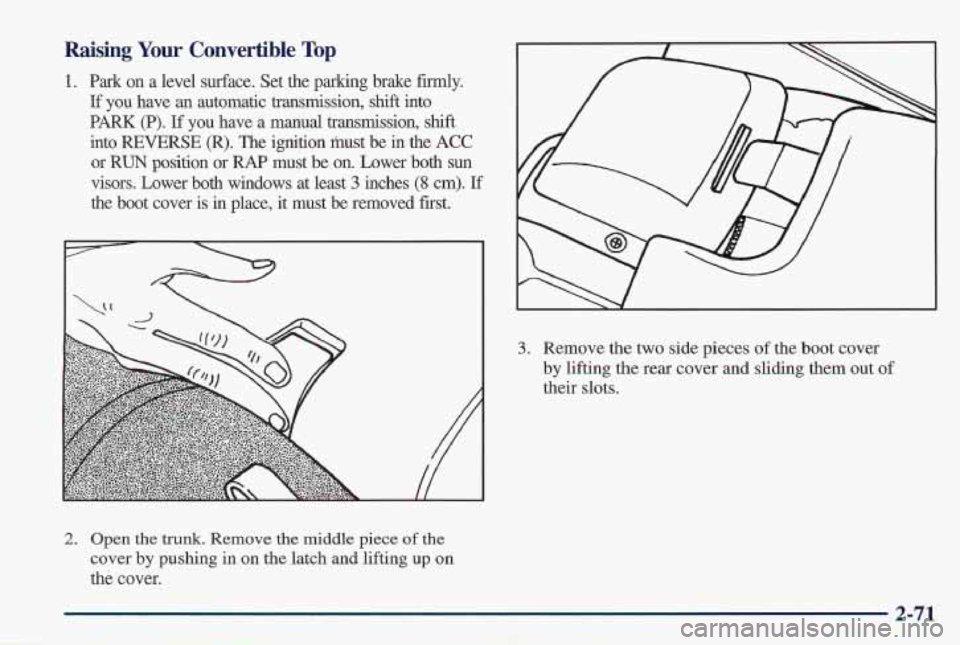
Raising Your Convertible Top
1. Park on a level surface. Set the parking brake firrnly.
If you have an automatic transmission, shift into
PARK
(P). If you have a manual transmission, shift
into REVERSE (R). The ignition must be in the ACC
or RUN position or RAP must be on. Lower both sun
visors. Lower both windows at least
3 inches (8 cm). If
the boot cover is in place, it must be removed first.
3. Remove the two side pieces of the boot cover
by lifting the rear cover and sliding them out
of
their slots.
2. Open the trunk. Remove the middle piece of the
cover by pushing in on the latch and lifting up on
the cover.
Page 124 of 410

A. Fog Lamp Switch (If Equipped)
B. Main Lamp Control
C. Air Vent
D. Instrument Cluster
E.
Horn
E Audio System
G. Glove Box
H. Comfort Controls
I. Cupholder
J. Parking Brake Lever
K.
Storage Console
L. Rear Window Defogger Switch
M. Convertible Top Switch (Automatic) (If Equipped)
N. Traction Control System Switch or Second Gear
0. Cigarette Lighter
P. Shift Lever
Q. Ashtray (Automatic Transmission)
R. Convertible Top Switch (Manual) (If Equipped)
S. Steering Wheel Controls
T. Remote Hatch Release
Start
Switch (If Equipped)
Page 128 of 410

Voltmeter
You can read battery
voltage on your voltmeter.
If it reads less than 11 volts
or more than
16 volts while
your engine is running, and
it stays there, you may have
a problem with the
electrical charging system.
Brake System Warning Light
Your Pontiac’s hydraulic brake system is divided into
two parts.
If one part isn’t working, the other part can
still work and stop you.
For good braking, though, you
need both parts working well.
If the warning light comes on, there could be a brake
problem or the brake fluid level could
be low. Have your
brake system inspected right away.
Have it checked right away. Driving with the voltmeter
reading in a warning zone could drain your battery.
If you idle your engine for a while, the voltmeter
reading might move into the yellow zone.
If the reading
stays in the yellow zone while you are driving, you may
have a problem with the electrical charging system.
Have
it checked. While the voltmeter reads in the yellow
zone, your battery may not be able to power certain
electrical accessories, like
ABS. (If this happens, your
ABS INOP light will come on. See “Anti-Lock Brake
System Warning Light” in this part.)
If you must drive a short distance with
the voltmeter
reading in
a warning zone, turn off all your accessories,
including your air conditioning and audio system.
BRAKE
This light should come on
briefly when you turn
the ignition key to
RUN. If
it doesn’t come on then,
have it fixed
so it will be
ready to warn you if there’s
a problem.
If the light comes on while you are driving, pull off the
road and stop carefully.
You may notice that the pedal is
harder to push. Or, the pedal may
go closer to the floor.
It may take longer to stop. If the light is still on, or if the
anti-lock brake system warning light is flashing, have
the vehicle towed for service. (See “Anti-Lock Brake
Page 129 of 410

System Warning Light” and “Towing Your Vehicle” in Anti-Lock 1- System Warning Eight
the Index.)
Your braKe s cem may not be working properly
if the brake system warning light is on. Driving
~ with the brake system warning light on can lead
to an accident.
If the light is still on or if the
anti-lock brake system warning light
is flashing
after
you’ve pulle’d of€ the road and stopped
~
!
ABS
INOP
With the anti-lock brake
system, this light will come
on when you start your
engine and it will stay
on for three seconds.
That’s normal.
carefully, have the vehicle towed for service. If the light flashes when you’re driving, you don’t have
anti-lock brakes and there could be
a problem with your
regular brakes. Pull off the road and stop carefully. You
When the ignition is on* the brake system warning light may notice that the pedal is harder to push. or, the pedal
on when YOu set Your Parking brake* The may go closer to the floor, It may take longer to stop,
light will stay
on if your parking brake doesn’t release Have the vehicle towed for service. (See “Towing Your
fully.
If it stays on after your parking brake is fully Vehicle” in the Index.)
released, it means you have
a brake problem.
2-80
Page 130 of 410

Traction Control System Warning Light
(If Equipped)
I
Your regular brake system may not be working
properly if the anti-lock brake system warning
light is flashing. Driving with the anti-lock
brake system warning light flashing can lead to
an accident. After you’ve pulled off the road
and stopped carefully, have the vehicle towed
for service.
If the anti-lock brake system warning light stays on
longer than normal after you’ve started your engine, turn
the ignition off. Or, if the light comes on and stays on
when you’re driving, stop as soon as possible and turn
the ignition off. Then start the engine again to reset the
system.
If the light still stays on, or comes on again
while you’re driving, your Pontiac needs service. If the
light is on but not flashing and the regular brake system
warning light isn’t on, you still have brakes, but you
don’t have
anti-lock brakes.
The anti-lock brake system warning light should come
on briefly when you turn the ignition key to RUN. If the
light doesn’t come on then, have it fixed so it will be
ready to warn you if there is a problem.
TCS
OFF
This warning light should
come on briefly as you start
the engine.
If the. warning
light doesn’t come on then,
have it fixed
so it will be
ready to warn you if there’s
a problem.
If it stays on, or comes on when you’re driving, there
may be a problem with your traction control system and
your vehicle may need service. When this warning light
is on, the system will not limit wheel spin. Adjust your
driving accordingly.
If your brakes begin to overheat, the brake portion of the
traction control system will shut down, but the throttle
and engine spark control will continue
to work. The
warning light will not come on when this happens.
Page 131 of 410

The traction control system warning light may come on
for the following reasons:
If you turn the system off by pressing the switch
located at the front
of the console the warning light
will come on and stay on and the light on the switch
will
go out. To turn the system back on, press the
switch again. The warning light should go off.
(See “Traction Control System” in the Index
for more information.)
If the temperature of the throttle control b’egins to
rise, the system will turn off and the warning light
will come
on until the system cools down. The
system does this to prevent damage from
overheating.
If the traction control system warning light comes on
and stays on for an extended period
of time when the
system
is turned on, your vehicle needs service.
Low Traction Light
When your anti-lock system
is adjusting brake pressure
to help avoid
a braking skid,
this light will come on.
LOW
TRAC
If you have the traction control system, this light will
also come
on when the system is limiting wheel spin.
Slippery road conditions may exist if the low traction
light comes on,
so adjust your driving accordingly. The
light will stay on for a few seconds after the anti-lock
system stops a’djusting brake pressure or the traction
control system stops limiting wheel spin.
The low traction
light also comes on briefly when you
turn the ignition
key to RUN. If the light doesn’t come
on then, have
it fixed so it will be there to tell you when
the anti-lock brake system or traction control system
is active.
2-82