ABS PONTIAC FIREBIRD 1997 Owners Manual
[x] Cancel search | Manufacturer: PONTIAC, Model Year: 1997, Model line: FIREBIRD, Model: PONTIAC FIREBIRD 1997Pages: 410, PDF Size: 19.2 MB
Page 64 of 410

Passive Arming
If the ignition was just turned off and a door was
opened, the system will arm
six seconds after all doors
are closed, whether or not you lock them. In all other
cases, the system will wait 30 seconds after all doors are
closed before arming, allowing you time
to get into the
vehicle and put the key in the ignition. The parking
lamps will flash when the system arms. Passive arming
is not enabled from the factory.
Turning Off the Alarm
Disarming the System
There are two ways to disarm the system:
1. Press the UNLOCK button on the key chain
transmitter. If the horn chirps two or three times
when you unlock the car, the alarm sounded in your
absence. Two chirps means that the shock sensor was
set off and three chirps means that a door or hatch
was opened.
proper key.
2. Turn the ignition to the RUN position with the
For more information on customizing the features
mentioned here, see “Feature Customization” in
the Index.
If you started the alarm by pressing the panic button on
the key chain transmitter, you must either push that
button again or turn the ignition switch to the RUN
position to stop the alarm.
If the alarm is sounding due to the shock sensor or a
door or hatch opening, it can be turned
off by either
turning the ignition switch with a proper key inserted or
by pressing any button on the key chain transmitter. If
you
use your key chain transmitter to silence the alarm,
additional things will happen depending upon which
button you press.
Pressing the UNLOCK button will turn the alarm
off, unlock the driver’s door and disarm the system.
0 Pressing the LOCK button will turn the alarm off,
keep the doors locked and keep the system armed.
Pressing the trunk symbol button twice within five
seconds will turn the alarm off, unlock and disarm
the hatch only.
keep the doors locked and keep the system armed.
Pressing the panic button will turn the alarm off,
If the alarm is sounding because an incorrect ign“’ >n
key was used, press any button on the key chain
transmitter to turn the alarm off.
The alarm will stop by itself after two minutes.
2-15
Page 119 of 410
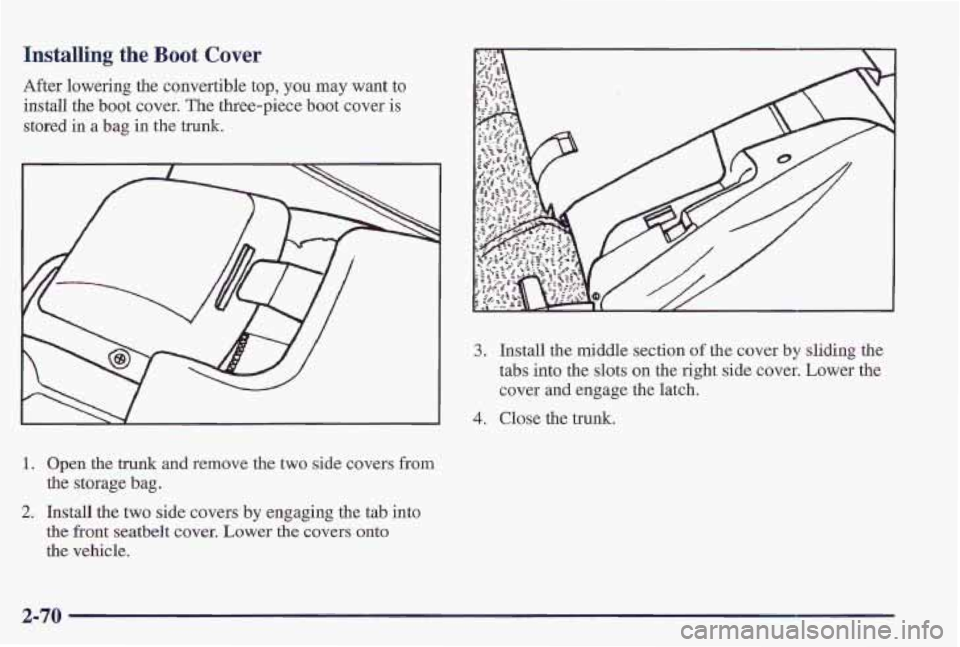
Installing the Boot Cover
After lowering the convertible top, you may want to
install the boot cover, The three-piece boot cover is
stored in
a bag in the trunk.
3. Install the middle section of the cover by sliding the
tabs into the slots on the right side cover. Lower the
cover and engage the latch.
4. Close the trunk.
1. Open the trunk and remove the two side covers from
the storage bag.
2. Install the two side covers by engaging the tab into
the front seatbelt cover. Lower
the covers onto
the vehicle.
2-70
Page 128 of 410

Voltmeter
You can read battery
voltage on your voltmeter.
If it reads less than 11 volts
or more than
16 volts while
your engine is running, and
it stays there, you may have
a problem with the
electrical charging system.
Brake System Warning Light
Your Pontiac’s hydraulic brake system is divided into
two parts.
If one part isn’t working, the other part can
still work and stop you.
For good braking, though, you
need both parts working well.
If the warning light comes on, there could be a brake
problem or the brake fluid level could
be low. Have your
brake system inspected right away.
Have it checked right away. Driving with the voltmeter
reading in a warning zone could drain your battery.
If you idle your engine for a while, the voltmeter
reading might move into the yellow zone.
If the reading
stays in the yellow zone while you are driving, you may
have a problem with the electrical charging system.
Have
it checked. While the voltmeter reads in the yellow
zone, your battery may not be able to power certain
electrical accessories, like
ABS. (If this happens, your
ABS INOP light will come on. See “Anti-Lock Brake
System Warning Light” in this part.)
If you must drive a short distance with
the voltmeter
reading in
a warning zone, turn off all your accessories,
including your air conditioning and audio system.
BRAKE
This light should come on
briefly when you turn
the ignition key to
RUN. If
it doesn’t come on then,
have it fixed
so it will be
ready to warn you if there’s
a problem.
If the light comes on while you are driving, pull off the
road and stop carefully.
You may notice that the pedal is
harder to push. Or, the pedal may
go closer to the floor.
It may take longer to stop. If the light is still on, or if the
anti-lock brake system warning light is flashing, have
the vehicle towed for service. (See “Anti-Lock Brake
Page 129 of 410

System Warning Light” and “Towing Your Vehicle” in Anti-Lock 1- System Warning Eight
the Index.)
Your braKe s cem may not be working properly
if the brake system warning light is on. Driving
~ with the brake system warning light on can lead
to an accident.
If the light is still on or if the
anti-lock brake system warning light
is flashing
after
you’ve pulle’d of€ the road and stopped
~
!
ABS
INOP
With the anti-lock brake
system, this light will come
on when you start your
engine and it will stay
on for three seconds.
That’s normal.
carefully, have the vehicle towed for service. If the light flashes when you’re driving, you don’t have
anti-lock brakes and there could be
a problem with your
regular brakes. Pull off the road and stop carefully. You
When the ignition is on* the brake system warning light may notice that the pedal is harder to push. or, the pedal
on when YOu set Your Parking brake* The may go closer to the floor, It may take longer to stop,
light will stay
on if your parking brake doesn’t release Have the vehicle towed for service. (See “Towing Your
fully.
If it stays on after your parking brake is fully Vehicle” in the Index.)
released, it means you have
a brake problem.
2-80
Page 172 of 410

Anti-Lock Brakes (ABS)
Your vehicle has anti-lock brakes (ABS). ABS is an
advanced electronic braking system that will help
prevent a braking skid.
When you start your engine, or when you begin to drive
away, your anti-lock brake system will check itself.
You
may hear a momentary motor or clicking noise while
this test is going on, and you may even notice that your
brake pedal moves a little. This is normal.
ABS
INOP
If there’s a problem with the
anti-lock brake system, this
warning light will stay
on or
flash. See “Anti-Lock
Brake System Warning
Light” in the Index.
Here’s how anti-lock works. Let’s say the road
is wet.
You’re driving safely. Suddenly an animal jumps out in
front of you.
You slam on the brakes. Here’s what happens with
ABS.
A computer senses that wheels are slowing down. If one
of the wheels is about to st,op rolling, the computer will
separately work the brakes at each front wheel and at
the
rear wheels.
4-7
Page 180 of 410

If you do not have traction control, or if the system is
off, then an acceleration skid is also best handled by
easing your foot off the accelerator pedal.
If your vehicle starts to slide, ease your foot off the
accelerator pedal and quickly steer the way you want the
vehicle to go. If you start steering quickly enough, your
vehicle may straighten out. Always be ready for a
second skid
if it occurs.
Of course, traction is reduced when water, snow, ice,
gravel or other material is on the road. For safety, you’ll
want to slow down and adjust your driving to these
conditions. It
is important to slow down on slippery
surfaces because stopping distance will be longer and
vehicle control more limited.
While driving on a surface with reduced traction, try
your best to avoid sudden steering, acceleration
or
braking (including engine braking by shifting to a
lower gear). Any sudden changes could cause the tires
to slide.
You may not realize the surface is slippery until
your vehicle is skidding. Learn to recognize warning
clues
-- such as enough water, ice or packed snow on
the road to make a “mirrored surface” -- and slow down
when you have any doubt.
Remember: Any anti-lock brake system
(ABS) helps
avoid only the braking skid.
Driving at Night
I
.A
Night driving is more dangerous than day driving.
One reason is that some drivers are likely
to be
impaired -- by alcohol or drugs, with night vision
problems, or by fatigue.
4-15
Page 203 of 410

Parking on Hills
You really should not park your vehicle, with a trailer
attached, on a hill.
If something goes wrong, your rig
could start to move. People can be injured, and both
your vehicle and
the trailer can be damaged.
But if you ever have to park your rig on a hill, here’s
how to do it:
1. Apply your regular brakes, but don’t shift into
PARK (P) yet, or into gear for a manual transmiss’ion.
2. Have someone place chocks under the trailer wheels.
3, When the wheel C~OGBS are in place, release the
regular brakes until the chocks absorb the load.
4. Reapply the regular brakes, Then apply your parking
brake, and then shift to
PARK (P), or REVERSE (R)
for a manual transmission.
5. Release the regular brakes.
When You Are Ready to Leave After
Parking on a Hill
1. Apply your regular brakes and hold the pedal down
while
you:
Start your engine;
Shift into a gear; and
Release the parking brake.
2. Let up on the brake pedal.
3. Drive slowly until the trailer is clear of the chocks.
4. Stop and have someone pick up and store the chocks.
Maintenance When Trailer Towing
Your vehicle will need service more often when you’re
pulling a trailer. See the Maintenance Schedule for more
on this. Things that are especially important in trailer
operation
are automatic transmission fluid (don’t
overfill), engine oil, axle lubricant, belts, cooling system
and brake adjustment. Each
of these is covered in this
manual, and the Index will help you find them quickly,
If you’re trailering, it’s a good idea to review these
sections before
you start your trip.
Check periodically to see that all hitch nuts and bolts
are tight.
4-38
Page 216 of 410

Attach a separate safety chain around outboard end of
each lower control
arm.
I NOTICE:
I
Take care not to damage the brake pipes and
hoses or the
ABS sensor and wiring.
NOTICE:
Towing a vehicle over rough surfaces could
damage
a vehicle. Damage can occur from
vehicle-to-ground or
vehicle-to-wheel-lift-equipment contact. To help
avoid damage, install a towing dolly and raise
vehicle until adequate clearance
is obtained
between the ground
and/or wheel-lift equipment.
5-11
Page 312 of 410

Appearance Care Materials Chart
PART NUMBER USAGE DESCRIPTION SIZE
994954 Exterior
Polish
Polishing Cloth - Wax Treated 23 in. x 25 in. -
1050004
Exterior wash
Wash and Wax
Concentrate 16
02. (0.473 L) 1052870 Cleans
grease, grime and smoke
film Glass Cleaner 23 oz. (0.680 L) I050427
Spot and stain removal
Vinyl
Cleaner 32 oz. (0.946 L) 1050214 Exterior
cleaner and polish
Magic Mirror Cleaner Polish
1 gal. (3.785 L) 1050200
Removes soil and black marks
White Sidewall Tire Cleaner
16 02. (0.473
L)
1050 174 Removes rust and corrosion
Chrome Cleaner and Polish 16
oz. (0.473
L)
10501 73
Also removes old waxes and polishes
Tar and Road Oil
Remover 16 oz. (0.473 L) 10501 72 Shines vehicle without scratching Chamois
2.75
sq. ft.
~
10529 18**
16 02. (0.473 L) 1052925 Protects vinyl, leather and rubber
Armor
All TM Protector 8 oz. (0.237 L)
Attracts and absorbs soils Capture Dry Spot Remover
8 oz. (0.237 L)
1052930 Spray
on wheel cleaner
Wheel Cleaner
16 oz. (0.473
L)
1052929 Cleans
vinyl, cloth,
tires and mats Multi-Purpose Powdered Cleaner
12345002**
16 oz. (0.473 L) Armor All TM Cleaner Cleans vinyl, leather and rubber
12345725
Spot cleans paint and gives high luster
Finish Enhancer
16
oz. (0.473
L)
12377966 Protects finish and removes
fine scratches
Cleaning
Wax
16
02. (0.473 L)
12377964 Shines tires
Silicone Tire
Shine 12
oz. (0.354 L)
See your General Motors Parts Department for these products. *‘N Not recommended for use on instrument panel vinyl.
See
“Fluids and Lubricants” in the Index.
6-67
Page 317 of 410

Underhood Electrical Center
Fuse
ABS IGN (SA)
ACTUATORS (15A)
R HDLP DR (154
L HDLP DR (1 5A)
ABS VLV (20A)
Usage
Anti-Lock Brake System
Daytime Running
Lamp
Module, Headlamp
Switch, Cooling Fan
Relay, Exhaust,
Gas
Recirculation, EVAP
Canister Purge Solenoid
Headlamp Door Module
Headlamp
Door Module
Brake Pressure Valve
Fuse
ABS BAT (5A)
HORN (20A)
INJECTOR (15A)
ENG SEN (20A)
IGNITION
(1OA)
Usage
Electronic Brake Control
Module
AIR PUMPFAN
(25A) AIR Pump (V8) Relay,
Pump, Bleed Valve
and Cooling Fan
Horn Relay
Fuel Injectors
Mass Airflow, Heated
Oxygen
Sensor, Reverse
Lockout Solenoid, Skip
Shift Solenoid, Automatic
Transmission, Brake Switch
V6 VIN K: Electronic
Ignition Module
VS
VIN P: Ignition Coil
Module, Crankshaft
Position
Sensor.
A/C-CRUISE (15A) Air Conditioning
Compressor Relay;
Cruise Control Switches
and Module
6-72