Air PONTIAC FIREBIRD 1998 Repair Manual
[x] Cancel search | Manufacturer: PONTIAC, Model Year: 1998, Model line: FIREBIRD, Model: PONTIAC FIREBIRD 1998Pages: 406, PDF Size: 18.23 MB
Page 273 of 406

If you have the 5.7L V8 engine (with the WS6 option),
your air cleaner will be located over the radiator near the
front of the engine.
To remove the filter, remove the screws (located on the
rear edge of the air cleaner), lift the
air cleaner and
remove the filter.
Automatic Transmission Fluid
When to Check and Change
A good time to check your automatic transmission fluid
level is when
the engine oil is changed.
Change both the fluid and filter every
15,000 miles
(25 000 km) if the vehicle is mainly driven under one
or more
of these conditions:
0 In heavy city traffic where the outside temperature
regularly reaches
90°F (32°C) or higher.
In hilly or mountainous terrain.
Uses such as high performance operation.
When doing frequent trailer towing.
0 Uses such as found in taxi, police or delivery service.
If you
do not use your vehicle under any of these
conditions, change the fluid and filter every
50,000 miles (83 000 km).
See “Scheduled Maintenance Services” in the Index.
6-20
Page 279 of 406

How to Add Fluid When to Check and What to Use
Here’s how to add fluid. Refer to the Maintenance
Schedule to determine what kind of fluid to use. See
“Recommended Fluids and Lubricants” in the Index.
1. Remove the filler plug.
2. Add fluid at the filler plug hole. Add only enough
fluid to bring the fluid level
up to the bottom of the
filler plug hole.
3. Install the filler plug. Be sure the plug is fully seated.
Hydraulic Clutch
The hydraulic clutch linkage in your vehicle is
self-adjusting. The clutch master cylinder reservoir is
filled with hydraulic clutch fluid.
It isn’t
a good idea to “top off’ your clutch fluid. Adding Refer to the Maintenance Schedule to determine how
fluid won’t correct a leak. often you should check the fluid level in your clutch
A fluid loss in this system could indicate a problem. master cylinder reservoir and
for the proper fluid. See
Have the system inspected
and repaired. “Owner Checks and Services’’ and “Recommended
Fluids and Lubricants” in the Index.
6-26
Page 282 of 406

NOTICE:
If you use an improper coolant mixture, your
engine could overheat and be badly damaged.
The repair cost wouldn’t be covered by your
warranty.
Too much water in the mixture can
freeze and crack the engine, radiator, heater
core and other parts.
If you have to add coolant more than four times a year,
have your dealer check your cooling system.
I NOTICE:
If you use the proper coolant, you don’t have to
add extra inhibitors or additives which claim to
improve the system. These can be harmful.
Checking Coolant
When your engine is cold, check the dipstick on the cap
of the coolant recovery tank. The coolant level should
be at
COLD, or a little higher. When your engine is
warm, the level on the dipstick should be up to HOT, or
a little higher.
6-29
Page 284 of 406

Radiator Pressure Cap (All Engines)
I NOTICE:
Your radiator cap is an 18 psi (124 kPa)
pressure-type cap and must be tightly installed to
prevent coolant loss and possible engine damage
from overheating. Be sure the arrows on the cap
line up with the overflow tube on the radiator
filler neck.
When you replace your radiator pressure cap, a GM cap
is recommended.
Thermostat
Engine coolant temperature is controlled by a thermostat
in the engine coolant system. The thermostat stops the
flow of coolant through the radiator until the coolant
reaches a preset temperature.
When you replace your thermostat, a GM thermostat
is
recommended.
Power Steering Fluid
The power steering fluid
reseivoir is locatei toward
the back
of the engine on
the driver’s side.
When to Check Power Steering Fluid
It is not necessary to regularly check power steering fluid
unless you suspect there is a leak in the system or you hear
an unusual noise. A fluid loss in this system could indicate
a problem. Have the system inspected
and repaired.
How To Check Power Steering Fluid
When the engine compartment is cool, wipe the cap and
the top of the reservoir clean, then unscrew the cap and
wipe the dipstick with a clean rag. Replace
the cap and
completely tighten it. Then remove the cap again and
look at the fluid level on the dipstick.
6-31
Page 289 of 406

’ A CAUTION:
The brake wear warning sound means that soon
your brakes won’t work well. That could lead to
an accident. When you hear the brake wear
warning sound, have your vehicle serviced.
I NOTICE:
I I
Continuing to drive with worn-out brake pads
could result in costly brake repair.
Some driving conditions or climates may cause a brake
squeal when the brakes are first applied or lightly
applied. This does not mean something is wrong with
your brakes.
When you have
the front brake pads replaced, have the
rear brakes inspected, too. Brake linings should always
be replaced as complete
axle sets.
See “Brake System Inspection” in Section
7 of
this manual under Part C “Periodic Maintenance
Inspections.”
Brake Pedal Travel
See your dealer if the brake pedal does not return to
normal height, or
if there is a rapid increase in pedal
travel.
This could be a sign of brake trouble.
Brake Adjustment
Every time you make a moderate brake stop, your
disc brakes adjust for wear. If you rarely make a
moderate or heavier stop, then your brakes might not
adjust correctly.
If you drive in that way, then -- very
carefully
-- make a few moderate brake stops about
every
1,000 miles (1 600 km), so your brakes will
adjust properly.
The park brake system has separate brake linings that
do not self adjust for wear. If the park brake lever pulls
up more than the normal eighteen clicks, the parking
brakes may need adjustment. See your dealer.
6-36
Page 297 of 406

Tires
Your new vehicle comes with high-quality tires made by
a leading tire manufacturer. If you ever have questions
about
your tire wmanty and where to obtain service, see
your Pontiac Warranty booklet for details.
I A CAUTION:
Poorly maintained and improperly used tires
are dangerous.
Overloading your tires can cause
overheating as a result
of too much friction.
You could have an air-out
and a serious
accident. See “Loading
Your Vehicle” in
the Index.
Underinflated tires pose the same danger
as overloaded tires. The resulting accident
could cause serious injury. Check all tires
frequently to maintain the recommended
pressure. Tire pressure should be checked
when your tires are cold.
CAUTION: (Continued) CAUTION:
(Continued)
I
Overinflated tires are mo
cut, punctured or broken by a sudden
impact
-- such as when you hit a pothole.
Keep tires at the recommended pressure.
Worn, old tires can cause accidents. If your
tread is badly worn, or
if your tires have
been damaged, replace them.
See “Inflation
-- Tire Pressure” in this section
for inflation pressure adjustment for higher
speed driving.
6-44
Page 298 of 406
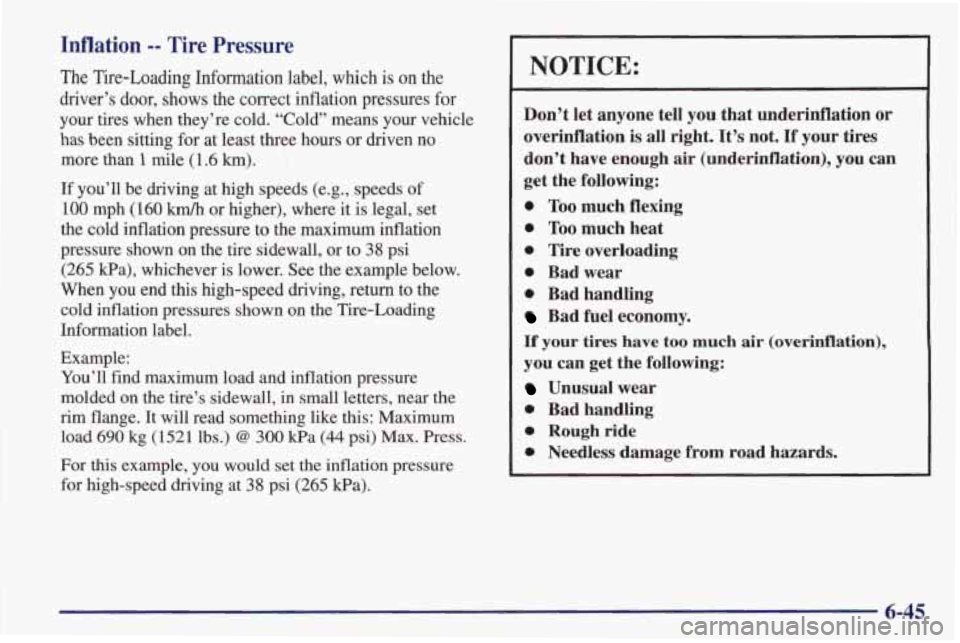
Inflation -- Tire Pressure
The Tire-Loading Information label, which is on the
driver’s door, shows the correct inflation pressures
for
your tires when they’re cold. “Cold” means your vehicle\
has been sitting for at least three hours
or driven no
more than
I mile (1.6 km).
If you’ll be driving at high speeds (e.g., speeds of
100 mph (160 km/h or higher), where it is legal, set
the cold inflation pressure to the maximum inflation
pressure shown on the tire sidewall, or to
38 psi
(265 Wa), whichever is lower. See the example below.
When you end this high-speed driving, return to the cold inflation pressures shown on the Tire-Loading
Information label.
Example: You’ll find maximum load and inflation pressure
molded on the tire’s sidewall, in small letters, near the
rim flange. It will read something like this: Maximum
load
690 kg (1521 lbs.) 0 300 kPa (44 psi) Max. Press.
For this example, you would set the inflation pressure
for high-speed driving at
38 psi (265 Wa).
NOTICE:
Don’t let anyone tell you that underinflation or
overinflation is all right.
It’s not. If your tires
don’t have enough air (underinflation), you can
get the following:
0 Too much flexing
0 Too much heat
0 Tire overloading
0 Bad wear
0 Bad handling
Bad fuel economy.
If your tires have too much air (overinflation),
you can get the following:
Unusual wear
0 Bad handling
0 Rough ride
0 Needless damage from road hazards.
6-45
Page 301 of 406

After the tires have been rotated, adjust the front and
rear inflation pressures as shown on the Tire-Loading
Information label. Make certain that
all wheel nuts
are properly tightened. See “Wheel Nut Torque” in
the Index.
1 A CAUTION:
Rust or dirt on a wheel, or on the parts to which
it
is fastened, can make wheel nuts become loose
after
a time. The wheel could come off and cause
an accident. When you change a wheel, remove
any rust or dirt from places where the wheel
attaches to
the vehicle. In an emergency, you can
use a cloth or a paper towel to do this; but be
sure to use
a scraper or wire brush later, if you
need to, to get all the rust or
dirt off. (See
“Changing
a Flat Tire” in the Index.) When
It’s Time for New Tires
One
way to tell when it’s
time for new
tires is to
check the treadwear
indicators, which will
appear when
your tires have
only
1/16 inch (1.6 mm) or
less
of tread remaining.
You need a new tire
if any of the following statements
are true:
You can see the indicators at three or more places
around the tire.
You can see cord or fabric showing through the
tire’s rubber.
The tread or sidewall is cracked, cut or snagged deep
enough
to show cord or fabric.
The tire has a bump, bulge or split.
0 The tire has a puncture, cut or other damage that
can’t be repaired well because
of the size or location
of the damage.
6-48
Page 304 of 406

Temperature -- A, B, C
The temperature grades are A (the highest), B, and C,
representing the tire’s resistance to the generation of
heat and its ability to dissipate heat when tested under
controlled conditions on a specified indoor laboratory
test wheel. Sustained high temperature can cause the
material
of the tire to degenerate and reduce tire life,
and excessive temperature can lead to sudden tire
failure. The grade
C corresponds to a level of
performance which all passenger car tires must meet under the Federal Motor Vehicle Safety Standard
No. 109. Grades B and A represent higher levels of
performance on the laboratory test wheel than the
minimum required by law.
Warning: The temperature grade
for this tire is
established for a tire that is properly inflated and not
overloaded. Excessive speed, underinflation, or
excessive loading, either separately or in combination,
can cause heat buildup and possible tire failure.
Wheel Alignment and Tire Balance
The wheels on your vehicle were aligned and balanced
carefully at the factory to give you the longest tire life
and best overall performance. Scheduled wheel alignment and wheel balancing are not
needed. However, if you notice unusual tire wear or
your vehicle pulling one way or the other, the alignment
may need to be reset. If you notice your vehicle
vibrating when driving on
a smooth road, your wheels
may need to be rebalanced.
Wheel Replacement
Replace any wheel that is bent, cracked, or badly rusted
or corroded.
If wheel nuts keep coming loose, the wheel,
wheel bolts and wheel nuts should be replaced. If the
wheel leaks air, replace it (except some aluminum
wheels, which can sometimes be repaired). See your
dealer if any
of these conditions exist.
Your dealer will know
the kind of wheel you need.
Each new wheel should have the same load-carrying
capacity, diameter, width, offset and be mounted the
same way as the one it replaces.
If you need to replace any of your wheels, wheel bolts or wheel nuts, replace them only with new GM original
equipment
parts. This way, you will be sure to have
the right wheel, wheel bolts and wheel nuts for your
Pontiac model.
6-51
Page 305 of 406
Used Replacement Wheels
Using the wrong replacement wheels, wheel
bolts or wheel nuts on your vehicle can be
dangerous.
It could affect the braking and
handling
of your vehicle, make your tires lose
air and make you lose control. You could have
a collision in which you or others could be
injured.
Always use the correct wheel, wheel
bolts and wheel nuts for replacement.
I NOTICE:
~
The wrong wheel can also cause problems with
bearing life, brake cooling, speedometer or
odometer calibration, headlamp aim, bumper
height, vehicle ground clearance and tire or
tire chain clearance to the body and chassis.
See “Changing a Flat Tire” in the Index for
more information.
Putting a used wheel on your vehicle is
dangerous. You can’t know how it’s been used or
how far it’s been driven. It could fail suddenly
and cause an accident.
If you have to replace a
wheel, use
a new GM original equipment wheel.
Tire Chains
I NOTICE:
If your vehicle has P235/55R16, P245/50ZR16 or
P275/40ZR17 size tires, don’t use tire chains.
They can damage your vehicle because there’s
not enough clearance.
NOTICE: (Continued)
6-52 1