brake PONTIAC FIREBIRD 1998 Repair Manual
[x] Cancel search | Manufacturer: PONTIAC, Model Year: 1998, Model line: FIREBIRD, Model: PONTIAC FIREBIRD 1998Pages: 406, PDF Size: 18.23 MB
Page 305 of 406
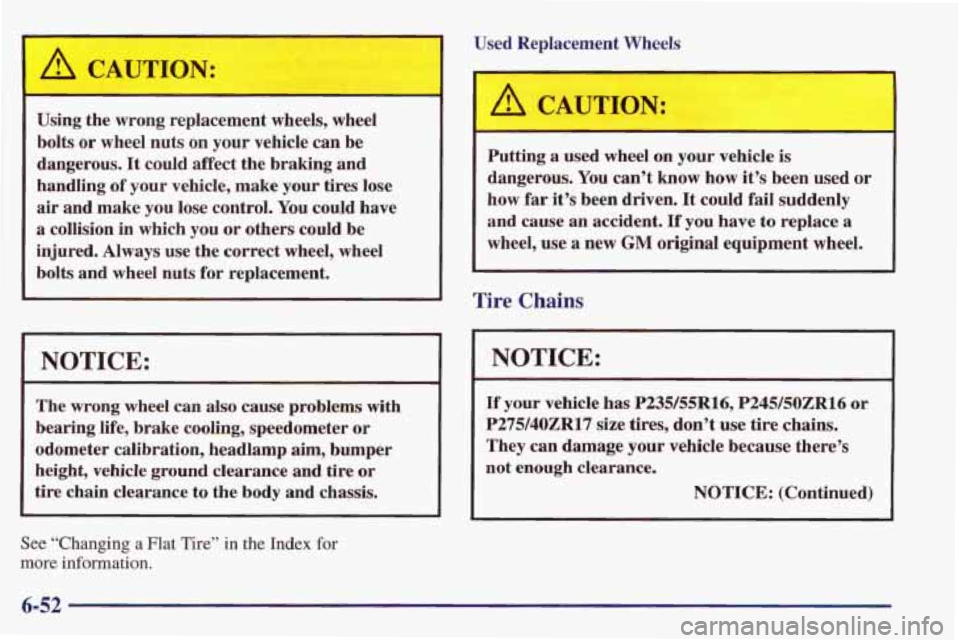
Used Replacement Wheels
Using the wrong replacement wheels, wheel
bolts or wheel nuts on your vehicle can be
dangerous.
It could affect the braking and
handling
of your vehicle, make your tires lose
air and make you lose control. You could have
a collision in which you or others could be
injured.
Always use the correct wheel, wheel
bolts and wheel nuts for replacement.
I NOTICE:
~
The wrong wheel can also cause problems with
bearing life, brake cooling, speedometer or
odometer calibration, headlamp aim, bumper
height, vehicle ground clearance and tire or
tire chain clearance to the body and chassis.
See “Changing a Flat Tire” in the Index for
more information.
Putting a used wheel on your vehicle is
dangerous. You can’t know how it’s been used or
how far it’s been driven. It could fail suddenly
and cause an accident.
If you have to replace a
wheel, use
a new GM original equipment wheel.
Tire Chains
I NOTICE:
If your vehicle has P235/55R16, P245/50ZR16 or
P275/40ZR17 size tires, don’t use tire chains.
They can damage your vehicle because there’s
not enough clearance.
NOTICE: (Continued)
6-52 1
Page 317 of 406

The other two are in the engine compartment. Open the
cover on either
of the boxes to expose the fuses.
Look at the silver-colored band inside the fuse. If the
band is broken or melted, replace
the fuse. Be sure you
replace a bad fuse with a new one of the correct size.
If you ever have a problem on the road and don't have a
spare fuse, you can borrow one. Just pick some feature
of your car that you
can get along without -- like the
radio or cigarette lighter
-- and use its fuse, if it is the
size
you need. Replace it as soon as you can.
Main Fuse Block
III 20 30 40
FUSE USAGE CHART
STOPIHAZARD TURN BIU STG WHL CNTRL RADIO ACCY
--
5u 4--l 7u 8U TAIL LPS HVAC PWR ACCY COURTESY
9-1 lin 121-1
GAUGES AIR BAG CIGIACCY DEFOGISEATS
IP DIMMER ACCY RADIO
SEE OWNER'S MANUAL FOR MORE INFORMATION PRINTED IN U.S.A
Fuse Usage
STOP/HAZARD Hazard Flasher, Brake
Switch Assembly
TURN B/U Traction ControVSecond Gear
Start Switch, Back/Up Lamp
Switch, Turn Flasher, Daytime
Running Lamps
(DRL) Module
Steering Wheel Controls
STG WHEEL
CNTFU
6-64
Page 318 of 406

TAIL LPS HVAC
PWR ACCY
COURTESY
GAUGES
Fuse Usage
RADIO ACCY Delco Monsoon Radio Amplifier, Power Antenna, Remote CD
Player (trunk)
Daytime Running Lamps (DRL)
Module, Headlamp Switch
HVAC Selector Switch, Rear
Defogger Switch/Timer
Park Lamp Relay, Hatch
Release Relay, Power Mirror Switch, Radio,
Shock Sensor,
Instrument Cluster
Body Control Module (BCM)
Body Control Module (BCM),
Brake Switch Assembly
(BTSI),
Instrument Cluster, Daytime
Running Lamps (DRL) Module
AIR BAG Air Bag, Dual Pole Arming Sensor
CIGAFUACCY Cigar Lighter, Data Link
Connector (DLC), Auxiliary
Accessory Wire
Defogger Timermelay, Power Seats
DEFOGBEATS Rear Defogger Switch/Timer, Rear WINDOWS
I/p DIMMER
RADIO
Usage
Steering Wheel Controls
Fuse
STG WHEEL
CNTRL
WIPEWASH Wiper Motor Assembly,
Wiper/Washer Switch
Power Windows Switch
(RH, LH),
Express-Down Module, Coolant
Level Latching Module, Convertible Top Switch
Door Illumination Lamp
(RH,
LH), Headlamp Switch, Fog Lamp
Switch, Instrument Cluster,
HVAC
Control Assembly, PRNDL
Illumination Lamp, Ashtray Lamp,
Radio, Steering Wheel
Controls-Radio, Rear Window
Defogger Switch/Timer, Traction
Control Switch
(TCS) and 2nd
Gear Start Switch
Body Control Module (BCM),
Radio, Amplifier, Steering
Wheel
Controls-Radio
6-65
Page 319 of 406

Underhood Electrical Center
PCM BAT FUEL PUMP AIR WMP
000 LnHDLPDR RH HDLPDR HORN
u-
4
11 r;
15305529 A
Fuse and Relay Center 1
Fuse Usage
ABS BAT SOL Anti-Lock Brake System
TCS
BAT Traction Control System
COOL FAN
PCM BAT
Cooling Fan Control
Powertrain Control Module
Fuse
FUEL PUMP
AIRPUMP
LH HDLP DR
RH HDLP DR
HORN
ABS BAT-1
WL DR HORN
ABS BAT-2
COOL FAN
Relay
FOG LAMP
HORN
FAN #3
FAN #2
FAN #1
Usage
Fuel Pump
AIR Pump Relay and Bleed Valve
Headlamp
Door Module
Headlamp
Door Module
Horn Relay
Anti-Lock Brake System Module
Horn and
Headlamp Doors
Anti-Lock Brake and Traction
Control System
Cooling
Fan Relays
6-66
Page 320 of 406

000
INJ INJ ENG SEN
STRTR ABS IGN PCM ION
000 ENG CTRL NC CRUISE
j 1:
15305530 A
Fuse
INJ
INJ
Fuse and Relay Center 2
Usage
Fuel Injectors (Not used for V6) (LH
injectors for V8 Ignition Module)
Fuel Injectors (All for
V6) (RH
injectors for V8 and Ignition Module)
ENG SEN Mass Air Flow, Heated Oxygen
Sensor,
Skip Shift Solenoid (V8
Only), Reverse Lockout Solenoid,
Brake Switch
STRTR
Powertrain Control Module and
Clutch Pedal Switch
Fuse
ABS IGN
PCM IGN
ENG CTRL
NC CRUISE
ENG CTRL
I/P- 1
IGN
m-2
Relay
AIR SOL
AIR PUMP
AIC COMP
FUELPUMP STARTER
IGN
Usage
Anti-Lock Brake System Module
Powertrain Control Module
Ignition Module
(V6 Only),
Automatic Transmission and
Charcoal
Canister Purge Solenoid
Air Conditioning Compressor Relay, Cruise Control Switches and Module
Engine Controls, Fuel
Pump, PCM,
A.I.R. and Cooling
Fans
HVAC Blower Control and Relay
Ignition Switch, Relay and Starter
Enable Relay
Instrument Panel
Fuse Center
6-67
Page 332 of 406

I Short TripKity Maintenance Schedule I
The services shown in this schedule up to 100,000 miles
(166 OOO km) should be performed after 100,000 miles
(166 000 km) at the same intervals. The services shown
at
150,000 miles (240 000 km) should be performed at
the same interval after
150,000 miles (240 000 km).
See “Owner Checks and Services” and “Periodic
Maintenance Inspections” following.
Footnotes
The U.S. Environmental Protection Agency or the
California Air Resources Board has determined that the
failure to perform this maintenance item will not nullify
the emission warranty or limit recall liability prior
to the
completion of the vehicle’s useful life. We, however,
urge that all recommended maintenance services be
performed at the indicated intervals and the maintenance
be recorded.
+ A good time to check your brakes is during tire
rotation. See “Brake System Inspection” under
“Periodic Maintenance Inspections” in Part
C of
this schedule.
7-7
Page 347 of 406

I - Long Tkipmighway Maintenance Schedule,
The services shown in this schedule up to 100,000 miles
( 166 000 km) should be performed after 100,000 miles
(166
000 km) at the same intervals. The services shown
at
150,000 miles (240 000 km) should be performed at
the same interval after 150,000 miles
(240 000 km).
See “Owner Checks and Services” and “Periodic
Maintenance Inspections’’ following.
Footnotes
The U.S. Environmental Protection Agency or the
California Air Resources
Board has determined that the
failure to
perform this maintenance item will not nullify
the emission warranty
or limit recall liability prior to the
completion of the vehicle’s useful life. We, however,
urge that all recommended maintenance services be
performed
at the indicated intervals and the maintenance
be recorded.
+ A good time to check your brakes is during tire
rotation. See “Brake System Inspection” under
“Periodic Maintenance Inspections” in Part
C of
this schedule.
7-22
Page 359 of 406

Starter Switch Check
r
Brake-Transmission Shift Interlock (BTSI) Check
(Automatic Transmission)
When you are doing this check, the vehicle could
move suddenly.
If it does, you or others could be
injured. Follow the steps below.
1. Before you start, be sure you have enough room around the vehicle.
2. Firmly apply both the parking brake (see “Parking
Brake,’
in the Index if necessary) and the regular brake.
NOTE: Do not use the accelerator pedal, and be
ready to turn
off the engine immediately if it starts.
3. On automatic transmission vehicles, try to start the
engine
in each gear. The starter should work only in
PARK (P) or NEUTRAL
(N). If the starter works in
any other position, your vehicle needs service.
On manual transmission vehicles, put the shift lever
in
NEUTRAL (N), push the clutch down halfway
and
try to start the engine. The starter should work
only when the clutch
is pushed down all the way to
the
floor. If the starter works when the clutch isn’t
pushed all the way down,
your vehicle needs service.
-
A CAUTION:
When you are doing this check, the vehicle could
move suddenly.
If it does, you or others could be
injured. Follow the steps below.
1
1. Before you start, be sure you have enough room
around the vehicle.
It should be parked on a
level surface.
2. Firmly apply the parking brake (see “Parking Brake”
in the Index if necessary).
NOTE: Be ready to apply the regular brake
immediately if
the vehicle begins to move.
3. With the engine off, turn the key to the RUN
position, but don’t start the engine. Without applying
the regular brake,
try to move the shift lever out of
PARK
(P) with normal effort. If the shift lever
moves out of PARK
(P), your vehicle’s BTSI
needs service.
Page 360 of 406

Ignition Transmission Lock Check
While parked, and with the
parking brake set, try to turn
the ignition key to LOCK in each shift lever position.
With an automatic transmission, the key should turn
to LOCK only when the shift lever is in PARK (P).
With a manual transmission, the key should turn to
On vehicles with a key release button, try to turn the key
to LOCK without pressing the button. The key should
turn to LOCK only when you press the key button. LOCK only when the
shift lever is in REVERSE (R).
On
all vehicles, the key should come out only in LOCK.
Parking Brake and Automatic Transmission
PA-” :P) M ’nanisl k
Park on a fairly steep hill, with the vehicle facing
downhill. Keeping your foot on the regular brake,
set the parking brake.
To check the parking brake’s holding ability:
With the engine running and transmission in
NEUTRAL (N), slowly remove foot pressure from
the regular brake pedal. Do this until the vehicle is
held by the parking brake only.
0 To check the PARK (P) mechanism’s holding ability:
With the engine running, shift to PARK
(P). Then
release all brakes.
Underbody Flushing Service At least every spring, use plain water to flush any
corrosive materials from the underbody. Take
care to
clean thoroughly any areas where mud and other debris
can collect.
When you are doing this check, your vehicle
could begin to move. You or others could be
injured and property could be damaged. Make
sure there
is room in front of your vehicle in case
it begins to roll. Be ready to apply the regular
brake
at once should the vehicle begin to move.
7-35
Page 362 of 406

Throttle System Inspection
Inspect the throttle system for interference or binding,
and for damaged or missing parts. Replace parts as
needed. Replace any components that have high effort
or excessive wear.
Do not lubricate accelerator and
cruise control cables.
Rear Axle Service
Check the gear lubricant level in the rear axle and add if
needed. See “Rear Axle” in the Index. A fluid loss
may indicate
a problem. Check the axle and repair it
if needed.
Brake System Inspection
Inspect the complete system. Inspect brake lines and
hoses for proper hook-up, binding, leaks, cracks,
chafing, etc. Inspect disc brake pads for wear and rotors
for surface condition. Inspect other brake parts, including calipers, parking brake, etc. Check parking
brake adjustment. You may need to have your brakes
inspected more often if your driving habits or conditions
result in frequent braking.
7-37