brake PONTIAC FIREBIRD 1998 Owner's Manual
[x] Cancel search | Manufacturer: PONTIAC, Model Year: 1998, Model line: FIREBIRD, Model: PONTIAC FIREBIRD 1998Pages: 406, PDF Size: 18.23 MB
Page 117 of 406

Accessory Plug
This plug is located inside the front section ahead of the
shift lever in the console. The plug can be used to
connect electrical equipment such
as a cellular phone or
CB radio. Be sure to follow the installation instructions
included with the equipment.
I NOTICE:
When using the accessory plug:
0 The maximum load of any electrical
equipment should not exceed
3 amps.
Be sure to turn off any electrical equipment
when not
in use. Leaving electrical
equipment on
for extended periods can
drain your battery.
We recommend that you see a qualified technician or your
dealer for the proper installation of your equipment.
Floor Mats
Your vehicle’s floor mats are custom-fitted to the floor
wells. Be sure the driver’s floor
mat is in place. If it
isn’t, it could interfere with the accelerator, clutch or
brake pedal.
Twin Lift-off Roof Panels
(If Equipped)
Don’t try try to remove the T-top panels while
the vehicle
is moving. Trying to remove the T-top
panel while the vehicle is moving could cause an
accident. The panel could fall into the
vehicle and
cause you to lose control, or it could
fly off and
strike another vehicle. You or others could be
iqjured. Remove
T-top panels only when the
vehicle is parked.
2-62
Page 124 of 406

Convertible Top
The following procedures explain the proper operation
of your convertible top.
Lowering Your Convertible Top
I NOTICE:
I I
I
It is not recommended that you raise or lower the
top while the vehicle is moving.
I
I
I 1
NOTICE:
Don’t leave your convertible out with the top
down for any long periods
of time. The sun and
the rain can damage your seat material and other
things inside
your vehicle.
1. It is recommended that you park on a level surface.
Set the parking brake firmly and shift an automatic
transmission into
PARK (P) or a manual
transmission into
REVERSE (R). The ignition must
be in
ACC or RUN. Lower both sun visors.
NOTICE:
Don’t lower the top if it is damp or wet. When
the top
is down, trapped water can cause stains,
mildew and damage
to the inside of your vehicle.
Be sure to dry off the top before you lower it.
I NOTICE:
It is not recommended to lower the top if your
vehicle
is out in cold weather, (0°F (-18OC) or
lower), or you may damage top components.
2-69
Page 127 of 406

Raising Your Convertible Top
1. It is recommended that you park on a level surface.
Set the parking brake firmly. If you have an
automatic transmission, shift into PARK
(P).
If you have a manual transmission, shift into
REVERSE (R). The ignition must be in ACC, RUN
or RAP must be on. Lower both sun visors. Lower
both windows at least three inches
(8 cm). If the boot
cover is in place, it must be removed first.
I NOTICE:
I
It is not recommended that you raise or lower the
top while the vehicle is moving.
L
2. Open the hatch. Remove the middle piece of the
cover by pushing in on the latch and lifting up
on
the cover.
2-72
Page 132 of 406
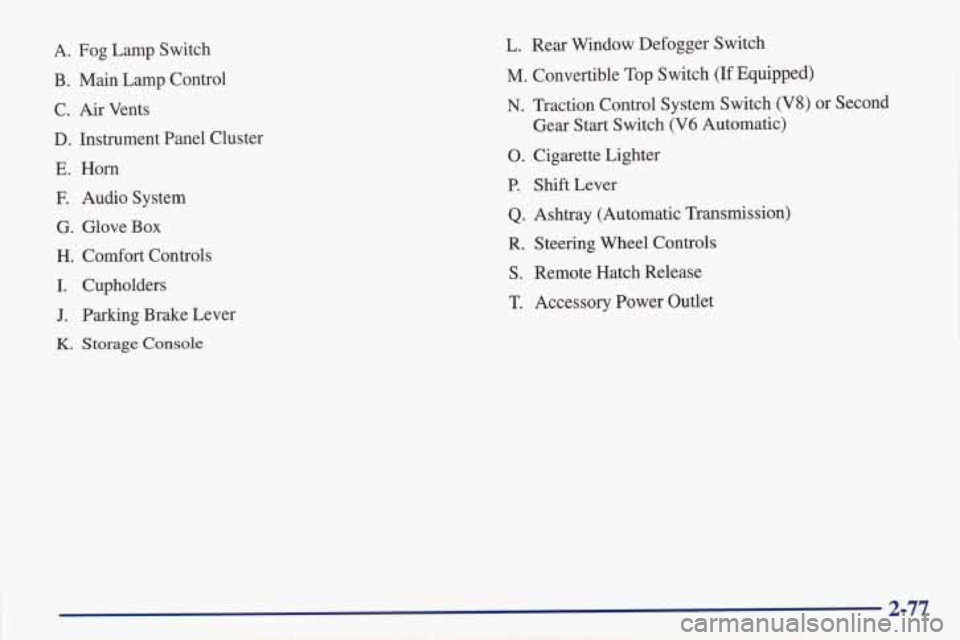
A. Fog Lamp Switch
B. Main Lamp Control C. Air Vents
D. Instrument Panel Cluster
E. Horn
E Audio System
G. Glove
Box
H. Comfort Controls
I. Cupholders
J. Parking Brake Lever
K. Storage Console
L. Rear Window Defogger Switch
M. Convertible Top Switch (If Equipped)
N. Traction Control System Switch (V8) or Second
Gear Start Switch (V6 Automatic)
0. Cigarette Lighter
P. Shift Lever
Q. Ashtray (Automatic Transmission)
R. Steering Wheel Controls
S. Remote Hatch Release
T. Accessory Power Outlet
2-77
Page 136 of 406
Air Bag Readiness Light
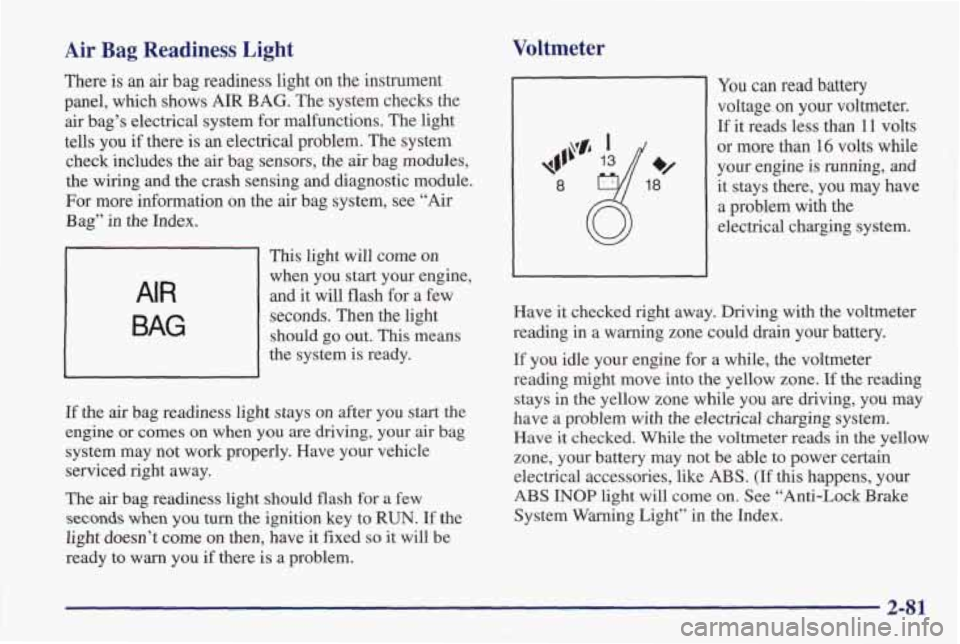
There is an air bag readiness light on the instrument
panel, which shows AIR
BAG. The system checks the
air bag’s electrical system for malfunctions. The light
tells you if there is an electrical problem. The system
check includes
the air bag sensors, the air bag modules,
the wiring and the crash sensing and diagnostic module.
For more information on the air bag system, see “Air
Bag” in the Index.
AIR
BAG
This light will come on
when you start your engine,
and it will flash for a few
seconds. Then the light
should
go out. This means
the system is ready.
If the air bag readiness light stays
on after you start the
engine or comes on when you are driving, your air bag
system may not work properly. Have your vehicle
serviced right away.
The air bag readiness light should flash for
a few
seconds when you turn the ignition key to RUN. If the
light doesn’t come on then, have it fixed
so it will be
ready to warn you
if there is a problem.
Voltmeter
You can read battery
voltage on your voltmeter.
If it reads less than 11 volts
or more than 16 volts while
your engine is running, and
it stays there, you may have
a problem with the
electrical charging system.
Have it checked right away. Driving with the voltmeter
reading in a warning zone could drain your battery.
If you idle your engine for a while, the voltmeter
reading might move into
the yellow zone. If the reading
stays in the yellow zone while you are driving, you may
have a problem with the electrical charging system.
Have
it checked. While the voltmeter reads in the yellow
zone, your battery may not be able to power certain electrical accessories, like
ABS. (If this happens, your
ABS INOP light will come on. See “Anti-Lock Brake
System Warning Light” in the Index.
2-81
Page 137 of 406
If you must drive a short distance with the voltmeter
reading
in a warning zone, turn off all your accessories,
including
your air conditioning and audio system.
Brake System Warning Light
Your vehicle’s hydraulic brake system is divided into
two parts. If one part isn’t working, the other part can
still work and stop you. For good braking, though, you
need
both parts working well.
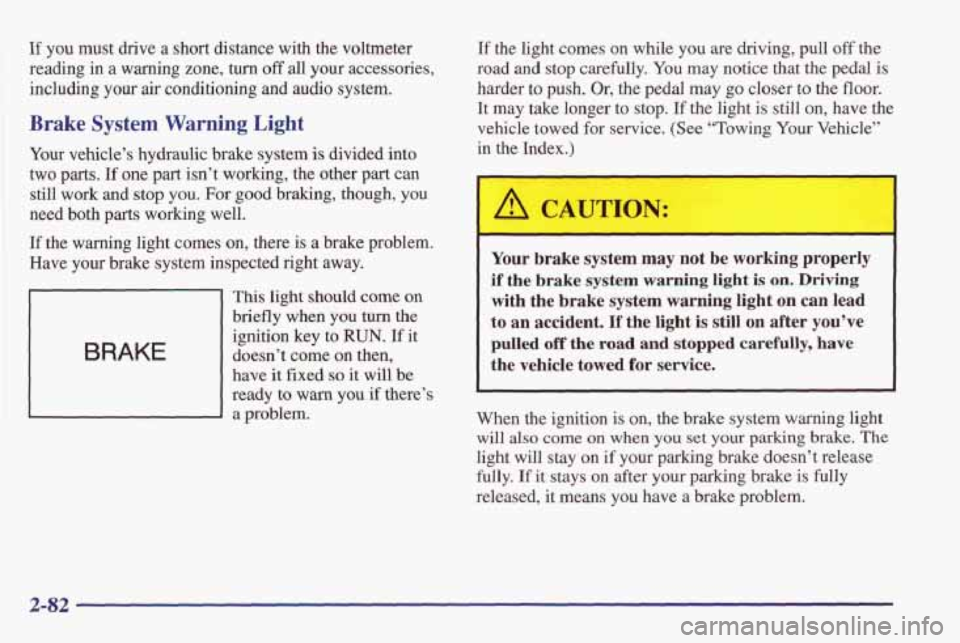
If the warning light comes on, there is a brake problem.
Have your brake system inspected right away.
This light should come on
briefly when you
turn the
ignition key to
RUN. If it
doesn’t come
on then,
have it fixed
so it will be
ready to
warn you if there’s
a problem.
If the light comes on while you are driving, pull off the
road
and stop carefully. You may notice that the pedal is
harder to push.
Or, the pedal may go closer to the floor.
It may take longer to stop. If the light is still on, have the
vehicle towed for service. (See “Towing
Your Vehicle”
in the Index.)
I A CAUTION:
Your brake system may not be working properly
if the brake system warning light is on. Driving
with the brake system warning light on can lead
to an accident. If the light is still on after you’ve
pulled off the road and stopped carefully, have
the vehicle towed for service.
When the ignition is on, the brake system warning light
will also come on when you set your parking brake. The
light will stay on if your parking brake doesn’t release
fully.
If it stays on after your parking brake is fully
released,
it means you haye 3 bg,&e problem.
2-82
Page 138 of 406

Anti-Lock Brake System Warning Light
ABS
INOP
With the anti-lock brake system, this light will come
on when you start your
engine and
it will stay
on for three seconds.
That’s normal.
If the anti-lock brake system warning light stays on
longer than normal after you’ve started your engine, turn
the ignition
off. Or, if the light comes on and stays on
when you’re driving, stop as soon as possible and turn
the ignition off. Then start the engine again to reset the
system.
If the light still stays on, or comes on again
while you’re driving, your vehicle needs service. If the
light is on and the regular brake system warning light
isn’t on, you still have brakes, but you don’t have
anti-lock brakes. Adjust your driving accordingly.
The anti-lock brake system warning light should come
on briefly when you turn the ignition key to
RUN. If the
light doesn’t come on then, have
it fixed so it will be
ready to warn you if there is a problem.
Traction Control System Warning Light
(Option)
This warning light should
come on briefly
as you start
the engine. If the warning
light doesn’t come on
then,
have it fixed so it will be
ready to warn you if there’s
a problem.
If it stays on, or comes on when you’re driving, there
may be a problem with your traction control system and
your vehicle may need service. When this warning light
is on, the system will not
limit wheel spin. Adjust your
driving accordingly.
The traction control system warning light will come on
if
you turn the system off by pressing the TCS button
located in front
of the console, the warning light will
come on and stay on. To turn the system back on,
press the button again. The warning light should go
off. (See “Traction Control System” in the Index for
more information.)
If
the traction control system warning light comes on
and stays on for an extended period of time when the
system is turned on, your vehicle needs service.
2-83
Page 139 of 406

Low Traction Light
LOW
TRAC
When your anti-lock system
is adjusting brake pressure
to help avoid
a braking skid,
this light will come on.
If you have the traction control system, this light will
also come on when the system is limiting wheel spin.
You may feel or hear the system working, but this is
normal. Slippery road conditions may exist if the low
traction light
comes on, so adjust your driving
accordingly. The light will stay on for a few seconds
after the traction control system stops limiting
wheel spin.
The low traction light
also comes on briefly when you
turn the ignition key to
RUN. If the light doesn’t come
on then, have it fixed so it will be there to tell you when
the anti-lock
brake system or traction control system
is active.
Engine Coolant Temperature Gage
This gage shows the engine
coolant temperature.
If the
gage pointer moves into
the red area,
your engine
is too hot! It means that
your engine coolant
has overheated.
If you have been operating your vehicle under normal
driving conditions,
you should pull off the road, stop
your vehicle and turn off the engine as soon as possible.
In “Problems on the Road,” this manual shows what to
do. See “Engine Overheating” in the Index.
2-84
Page 171 of 406

I
Defensive Driving
The best advice anyone can give about driving is:
Drive defensively, Please
start with a very important safety device in your
Pontiac: Buckle up. (See “Safety Belts”
in the Index.)
Defensive driving really means “be ready for anything.”
On city streets,
rural roads or freeways, it means
“always expect the unexpected.”
Assume that pedestrians or other drivers are going
to be
careless and make mistakes. Anticipate what they might
do. Be ready for their mistakes.
Rear-end collisions
are about the most preventable of
accidents. Yet they are common.
Allow enough following
distance. It’s the best defensive driving maneuver, in
both
city and rural driving. You never know when the vehicle in
front of you is going to brake or turn suddenly.
Defensive driving requires that a driver concentrate on the
driving
task. Anythmg that distracts from the driving
task -- such as concentrating on a cellular telephone call,
reading, or reaching for something on the floor -- makes
proper defensive
driving more difficult and can even cause
a collision, with resulting injury. Ask a passenger to help
do
things like this, or pull off the road in a safe place to do
them yourself. These simple defensive driving techniques
could save your
life.
4-2
Page 174 of 406

showers will speed that up. “I’ll be careful” isn’t \
the
right answer. What
if there’s an emergency, a need to
take sudden action, as when a child darts into the street?
A person with even a moderate BAC might not be able
to react quickly enough to avoid the collision.
There’s something else about drinking and driving that
many people don’t know. Medical research shows that
alcohol in a person’s system can make crash injuries
worse, especially injuries to the brain, spinal cord or heart. This means that when anyone who has been drinking
-- driver or passenger -- is in a crash, that
person’s chance of being killed or permanently disabled
is higher than if the person had not been drinking.
Drinking and then driving is very dangerous. Your
reflexes, perceptions, attentiveness
and judgment
can be affected by even a small amount of alcohol.
You
can have a serious -- or even fatal -- collision
if you drive after drinking. Please don’t drink and
drive or ride with a driver who has been drinking.
Ride home
in a cab; or if you’re with a group,
designate a driver who
will not drink.
Control of a Vehicle
You have three systems that make your vehicle go where
you want it to
go. They are the brakes, the steering and
the accelerator. All three systems have to
do their work
at the places where the tires meet the road.
Sometimes, as when you’re driving on snow or ice, it’s
easy to ask more
of those control systems than the tires
and road can provide. That means you can lose
control
of your vehicle.