key PONTIAC G3 2009 Owners Manual
[x] Cancel search | Manufacturer: PONTIAC, Model Year: 2009, Model line: G3, Model: PONTIAC G3 2009Pages: 348, PDF Size: 2.16 MB
Page 1 of 348
Seats and Restraint System............................. 1-1
Head Restraints
......................................... 1-2
Front Seats
............................................... 1-4
Rear Seats
............................................... 1-8
Safety Belts
.............................................1-14
Child Restraints
.......................................1-32
Airbag System
.........................................1-58
Restraint System Check
............................1-72
Features and Controls..................................... 2-1
Keys
........................................................ 2-2
Doors and Locks
....................................... 2-6
Windows
.................................................2-11
Theft-Deterrent Systems
............................2-13
Starting and Operating Your Vehicle
...........2-16
Mirrors
....................................................2-32
OnStar
®System
......................................2-34
Storage Areas
.........................................2-37
Sunroof
..................................................2-38
Instrument Panel............................................. 3-1
Instrument Panel Overview
.......................... 3-4
Climate Controls
......................................3-18
Warning Lights, Gages, and Indicators
........3-23
Audio System(s)
.......................................3-38Driving Your Vehicle....................................... 4-1
Your Driving, the Road, and the Vehicle
....... 4-2
Towing
...................................................4-28
Service and Appearance Care.......................... 5-1
Service
..................................................... 5-3
Fuel
......................................................... 5-5
Checking Things Under the Hood
...............5-10
Headlamp Aiming
.....................................5-42
Bulb Replacement
....................................5-42
Windshield Wiper Blade Replacement
.........5-49
Tires
......................................................5-50
Appearance Care
.....................................5-79
Vehicle Identication
.................................5-86
Electrical System
......................................5-87
Capacities and Specications
.....................5-93
Maintenance Schedule..................................... 6-1
Maintenance Schedule
................................ 6-2
Customer Assistance Information.................... 7-1
Customer Assistance and Information
........... 7-2
Reporting Safety Defects
...........................7-14
Vehicle Data Recording and Privacy
...........7-16
Index................................................................ 1
2009 Pontiac G3 Owner ManualM
Page 13 of 348
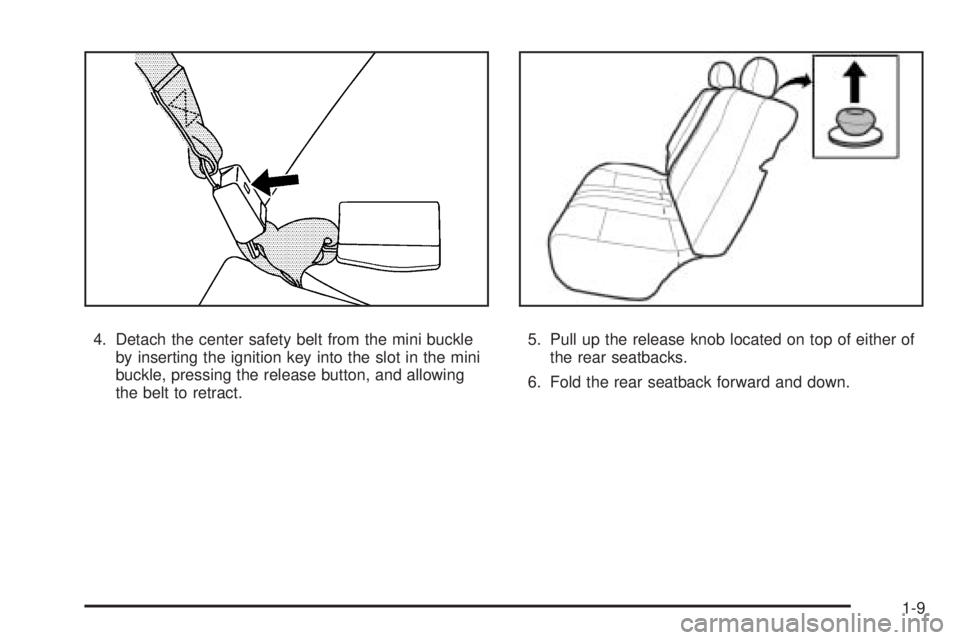
4. Detach the center safety belt from the mini buckle
by inserting the ignition key into the slot in the mini
buckle, pressing the release button, and allowing
the belt to retract.5. Pull up the release knob located on top of either of
the rear seatbacks.
6. Fold the rear seatback forward and down.
1-9
Page 15 of 348
Rear Seat Operation (Hatchback)
Folding the Rear Seats
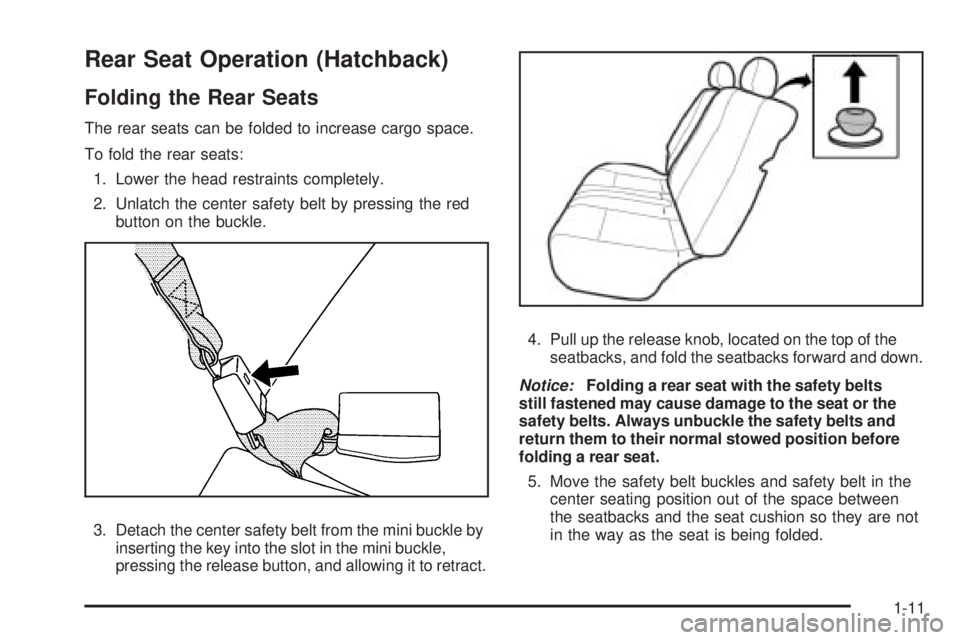
The rear seats can be folded to increase cargo space.
To fold the rear seats:
1. Lower the head restraints completely.
2. Unlatch the center safety belt by pressing the red
button on the buckle.
3. Detach the center safety belt from the mini buckle by
inserting the key into the slot in the mini buckle,
pressing the release button, and allowing it to retract.4. Pull up the release knob, located on the top of the
seatbacks, and fold the seatbacks forward and down.
Notice:Folding a rear seat with the safety belts
still fastened may cause damage to the seat or the
safety belts. Always unbuckle the safety belts and
return them to their normal stowed position before
folding a rear seat.
5. Move the safety belt buckles and safety belt in the
center seating position out of the space between
the seatbacks and the seat cushion so they are not
in the way as the seat is being folded.
1-11
Page 35 of 348
Safety Belt Pretensioners
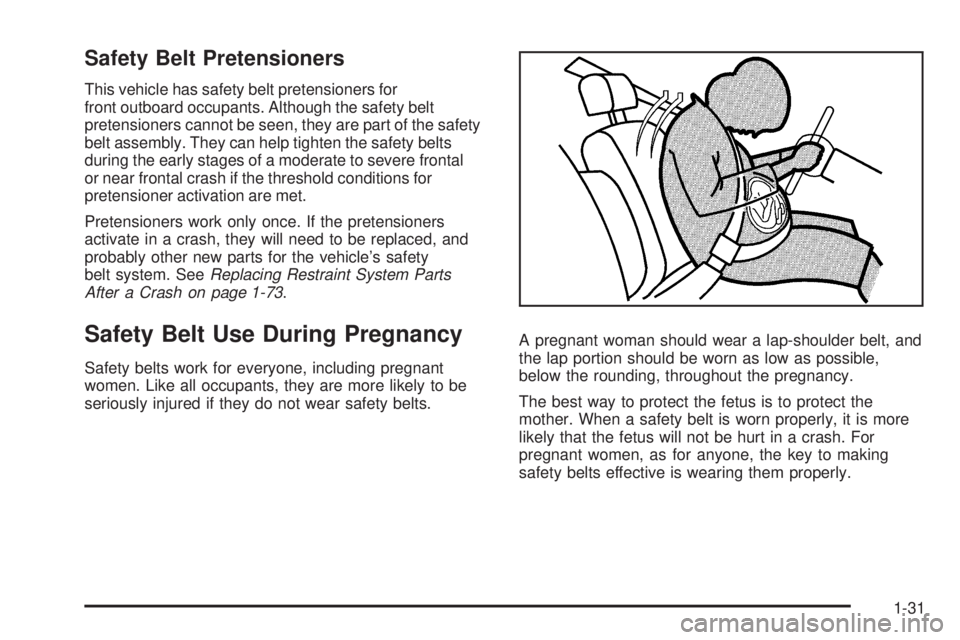
This vehicle has safety belt pretensioners for
front outboard occupants. Although the safety belt
pretensioners cannot be seen, they are part of the safety
belt assembly. They can help tighten the safety belts
during the early stages of a moderate to severe frontal
or near frontal crash if the threshold conditions for
pretensioner activation are met.
Pretensioners work only once. If the pretensioners
activate in a crash, they will need to be replaced, and
probably other new parts for the vehicle’s safety
belt system. SeeReplacing Restraint System Parts
After a Crash on page 1-73.
Safety Belt Use During Pregnancy
Safety belts work for everyone, including pregnant
women. Like all occupants, they are more likely to be
seriously injured if they do not wear safety belts.A pregnant woman should wear a lap-shoulder belt, and
the lap portion should be worn as low as possible,
below the rounding, throughout the pregnancy.
The best way to protect the fetus is to protect the
mother. When a safety belt is worn properly, it is more
likely that the fetus will not be hurt in a crash. For
pregnant women, as for anyone, the key to making
safety belts effective is wearing them properly.
1-31
Page 79 of 348
Keys...............................................................2-2
Remote Keyless Entry (RKE) System................2-3
Remote Keyless Entry (RKE) System
Operation...................................................2-4
Doors and Locks.............................................2-6
Door Locks....................................................2-6
Central Door Unlocking System........................2-6
Door Ajar Reminder........................................2-7
Rear Door Security Locks................................2-7
Trunk (Sedan)................................................2-8
Liftgate (Hatchback)......................................2-10
Windows........................................................2-11
Manual Windows..........................................2-12
Power Windows............................................2-12
Sun Visors...................................................2-13
Theft-Deterrent Systems..................................2-13
Immobilizer..................................................2-13
Immobilizer Operation....................................2-14
Content Theft-Deterrent.................................2-15
Starting and Operating Your Vehicle................2-16
New Vehicle Break-In....................................2-16
Ignition Positions..........................................2-17
Starting the Engine.......................................2-18Engine Heater..............................................2-19
Automatic Transmission Operation...................2-20
Manual Transmission Operation......................2-24
Parking Brake..............................................2-26
Shifting Into Park (Automatic Transmission)......2-27
Shifting Out of Park......................................2-28
Parking the Vehicle (Manual Transmission).......2-29
Parking Over Things That Burn.......................2-30
Engine Exhaust............................................2-30
Running the Vehicle While Parked..................2-31
Mirrors...........................................................2-32
Manual Rearview Mirror
.................................2-32
Outside Manual Mirrors..................................2-32
Outside Power Mirrors...................................2-33
Outside Convex Mirror...................................2-33
Outside Heated Mirrors..................................2-33
OnStar
®System.............................................2-34
Storage Areas................................................2-37
Glove Box...................................................2-37
Cupholders..................................................2-37
Sunglasses Storage Compartment...................2-38
Sunroof.........................................................2-38
Section 2 Features and Controls
2-1
Page 80 of 348
Keys
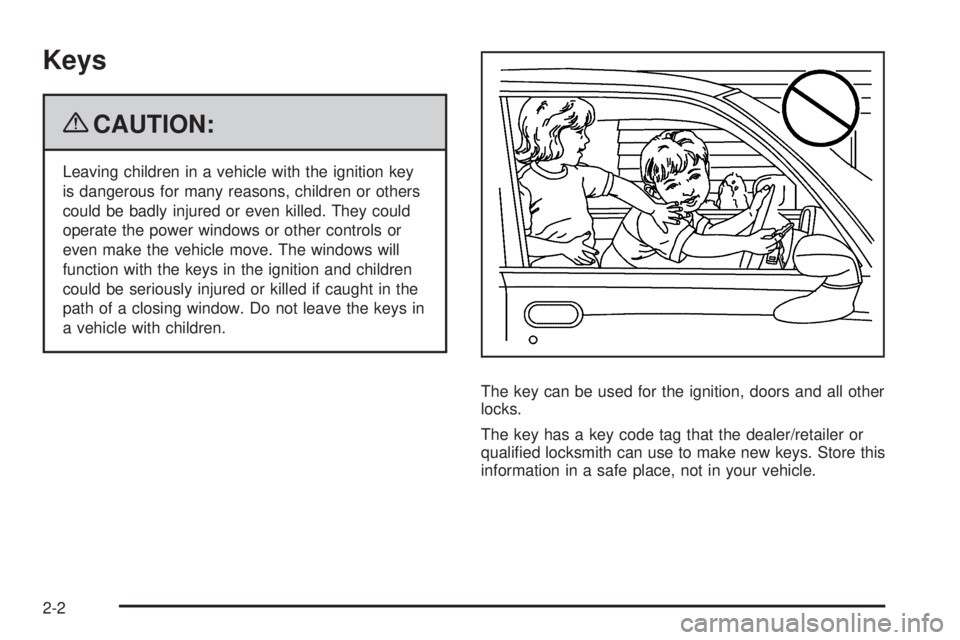
{CAUTION:
Leaving children in a vehicle with the ignition key
is dangerous for many reasons, children or others
could be badly injured or even killed. They could
operate the power windows or other controls or
even make the vehicle move. The windows will
function with the keys in the ignition and children
could be seriously injured or killed if caught in the
path of a closing window. Do not leave the keys in
a vehicle with children.
The key can be used for the ignition, doors and all other
locks.
The key has a key code tag that the dealer/retailer or
qualied locksmith can use to make new keys. Store this
information in a safe place, not in your vehicle.
2-2
Page 81 of 348
Your vehicle may have an electronic immobilizer
designed to protect your car against theft. If so, only
keys with the correct electronic code can be used to start
the vehicle. SeeImmobilizer Operation on page 2-14
for additional information. If a replacement key or an
additional key is needed, it must be purchased from
your dealer/retailer or certied locksmith.
Notice:If you ever lock your keys in the vehicle,
you may have to damage the vehicle to get in.
Be sure you have spare keys.
In an emergency, contact Roadside Assistance.
SeeRoadside Assistance Program on page 7-7
for more information.
Remote Keyless Entry (RKE)
System
If this vehicle has the Remote Keyless Entry (RKE)
system, it operates on a radio frequency subject
to Federal Communications Commission (FCC)
Rules and with Industry Canada.
This device complies with Part 15 of the FCC Rules.
Operation is subject to the following two conditions:
1. This device may not cause interference.
2. This device must accept any interference received,
including interference that may cause undesired
operation of the device.This device complies with RSS-210 of Industry Canada.
Operation is subject to the following two conditions:
1. This device may not cause interference.
2. This device must accept any interference received,
including interference that may cause undesired
operation of the device.
Changes or modications to this system by other than
an authorized service facility could void authorization to
use this equipment.
If there is a decrease in the RKE operating range,
try this:
Check the distance. The transmitter may be too far
from the vehicle. Stand closer during rainy or snowy
weather.
Check the location. Other vehicles or objects may be
blocking the signal. Take a few steps to the left or
right, hold the transmitter higher, and try again.
Check the transmitter’s battery. See “Battery
Replacement” later in this section.
If the transmitter is still not working correctly, see
your dealer/retailer or a qualied technician for
service.
2-3
Page 82 of 348
Remote Keyless Entry (RKE)
System Operation
The Remote Keyless Entry (RKE) transmitter functions
work up to 65 feet (20 m) away from the vehicle.
There are other conditions which can affect the
performance of the transmitter. SeeRemote Keyless
Entry (RKE) System on page 2-3.The following functions may be available if the vehicle
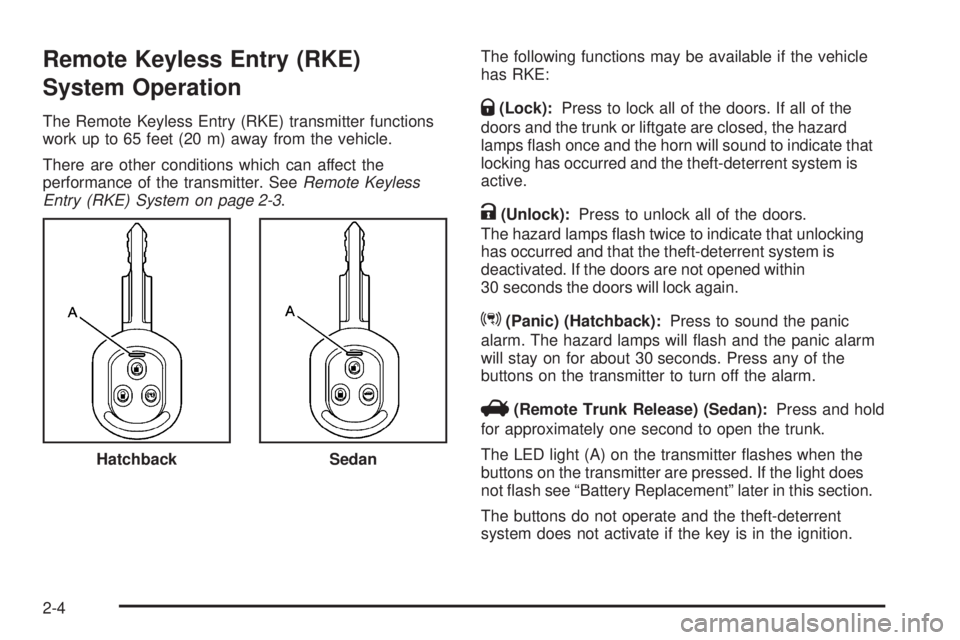
has RKE:Q(Lock):Press to lock all of the doors. If all of the
doors and the trunk or liftgate are closed, the hazard
lamps ash once and the horn will sound to indicate that
locking has occurred and the theft-deterrent system is
active.
K(Unlock):Press to unlock all of the doors.
The hazard lamps ash twice to indicate that unlocking
has occurred and that the theft-deterrent system is
deactivated. If the doors are not opened within
30 seconds the doors will lock again.
3(Panic) (Hatchback):Press to sound the panic
alarm. The hazard lamps will ash and the panic alarm
will stay on for about 30 seconds. Press any of the
buttons on the transmitter to turn off the alarm.
V(Remote Trunk Release) (Sedan):Press and hold
for approximately one second to open the trunk.
The LED light (A) on the transmitter ashes when the
buttons on the transmitter are pressed. If the light does
not ash see “Battery Replacement” later in this section.
The buttons do not operate and the theft-deterrent
system does not activate if the key is in the ignition. Hatchback
Sedan
2-4
Page 84 of 348
Doors and Locks
Door Locks
{CAUTION:
Unlocked doors can be dangerous.
Passengers, especially children, can easily
open the doors and fall out of a moving
vehicle. When a door is locked, the handle
will not open it. The chance of being thrown
out of the vehicle in a crash is increased if
the doors are not locked. So, all passengers
should wear safety belts properly and the
doors should be locked whenever the vehicle
is driven.
Young children who get into unlocked vehicles
may be unable to get out. A child can be
overcome by extreme heat and can suffer
permanent injuries or even death from heat
stroke. Always lock the vehicle whenever
leaving it.
Outsiders can easily enter through an unlocked
door when you slow down or stop your vehicle.
Locking your doors can help prevent this from
happening.There are several ways to lock and unlock the vehicle.
From the outside, use your key or the Remote
Keyless Entry (RKE) transmitter. SeeRemote Keyless
Entry (RKE) System Operation on page 2-4.
To manually unlock the front doors from the outside,
insert the key and turn it toward the front of the vehicle.
To manually lock the doors from the outside, insert
the key and turn it toward the rear of the vehicle.
All doors, except for the driver door, can be locked by
pushing down the manual door lock and then closing
the door. On vehicles with power locks, the driver door
can only by locked from the outside by using the key
or the optional RKE transmitter.
From the inside, all of the doors can be locked and
unlocked by pushing or pulling the manual door
lock located on each door.
Central Door Unlocking System
The vehicle may be equipped with the central door
unlocking system. This system is activated from
the driver door.
From the outside, lock or unlock all the doors by using
either the key or the RKE transmitter, if equipped.
From the inside, lock or unlock all the doors by using
the driver door lock switch.
2-6
Page 86 of 348
Trunk (Sedan)
{CAUTION:
Exhaust gases can enter the vehicle if it is driven
with the liftgate, trunk/hatch open, or with any
objects that pass through the seal between the
body and the trunk/hatch or liftgate. Engine exhaust
contains Carbon Monoxide (CO) which cannot be
seen or smelled. It can cause unconsciousness
and even death.
If the vehicle must be driven with the liftgate, or
trunk/hatch open:
Close all of the windows.
Fully open the air outlets on or under the
instrument panel.
Adjust the Climate Control system to a setting
that brings in only outside air and set the fan
speed to the highest setting. See Climate
Control System in the Index.
If the vehicle is equipped with a power liftgate,
disable the power liftgate function.
For more information about carbon monoxide, see
Engine Exhaust on page 2-30.To open the trunk on a sedan from outside of the
vehicle, insert the key into the lock cylinder and turn the
key clockwise or use the RKE transmitter, if equipped.
SeeRemote Keyless Entry (RKE) System Operation on
page 2-4.
Remote Trunk Release
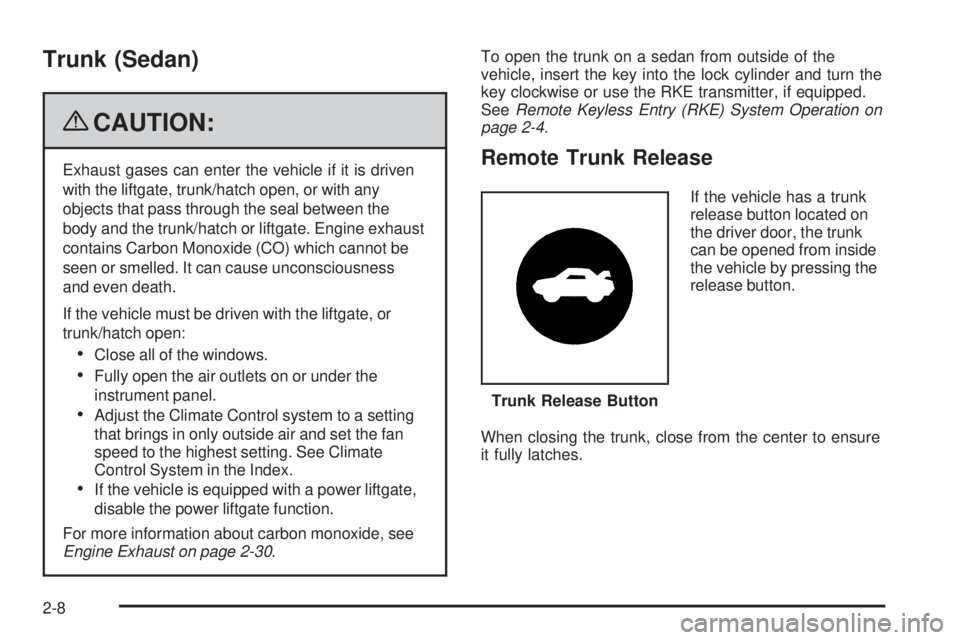
If the vehicle has a trunk
release button located on
the driver door, the trunk
can be opened from inside
the vehicle by pressing the
release button.
When closing the trunk, close from the center to ensure
it fully latches.Trunk Release Button
2-8