cooling PONTIAC G3 2010 User Guide
[x] Cancel search | Manufacturer: PONTIAC, Model Year: 2010, Model line: G3, Model: PONTIAC G3 2010Pages: 368, PDF Size: 3.94 MB
Page 254 of 368

4. With the coolant surge tank pressure cap off, startthe engine and let it run until you can feel the
upper radiator hose getting hot. Watch out for the
engine cooling fan.
By this time, the coolant level inside the coolant
surge tank may be lower. If the level is lower than
the Maximum mark, add more of the proper
mixture to the coolant surge tank until the level
reaches the mark.
5. Replace the pressure cap. Be sure the pressure cap is hand-tight and fully seated.
Notice: If the pressure cap is not tightly installed,
coolant loss and possible engine damage may
occur. Be sure the cap is properly and tightly
secured.
Engine Overheating
The vehicle has an indicator to warn of the engine
overheating.
There is a coolant temperature gage on the instrument
panel cluster. See Engine Coolant Temperature Gage
on page 4‑28.
You may decide not to lift the hood when this warning
appears, but instead get service help right away. See
Roadside Assistance Program on page 8‑6.
If you do decide to lift the hood, make sure the vehicle
is parked on a level surface. Then check to see if the engine cooling fan is running.
If the engine is overheating, the fan should be running.
If it is not, do not continue to run the engine and have
the vehicle serviced.
Notice:
Engine damage from running the engine
without coolant is not covered by the warranty.
Notice: If the engine catches fire because of being
driven with no coolant, your vehicle can be badly
damaged. The costly repairs would not be covered
by the vehicle warranty.
If Steam Is Coming From The Engine
Compartment
{WARNING:
Steam from an overheated engine can burn you
badly, even if you just open the hood. Stay away
from the engine if you see or hear steam coming
from it. Just turn it off and get everyone away from
the vehicle until it cools down. Wait until there is
no sign of steam or coolant before you open
the hood.
(Continued)
6-30
Page 291 of 368

Wheel Alignment and Tire Balance
The tires and wheels on your vehicle were aligned and
balanced carefully at the factory to give you the longest
tire life and best overall performance. Adjustments to
wheel alignment and tire balancing will not be
necessary on a regular basis. However, if you notice
unusual tire wear or your vehicle pulling to one side or
the other, the alignment might need to be checked.
If you notice your vehicle vibrating when driving on a
smooth road, the tires and wheels might need to be
rebalanced. See your dealer/retailer for proper
diagnosis.
Wheel Replacement
Replace any wheel that is bent, cracked, or badly
rusted or corroded. If wheel nuts keep coming loose,
the wheel, wheel bolts, and wheel nuts should be
replaced. If the wheel leaks air, replace it (except some
aluminum wheels, which can sometimes be repaired).
See your dealer/retailer if any of these conditions exist.
Your dealer/retailer will know the kind of wheel
you need.
Each new wheel should have the same load-carrying
capacity, diameter, width, offset, and be mounted the
same way as the one it replaces.If you need to replace any of your wheels, wheel bolts,
wheel nuts, or Tire Pressure Monitor System (TPMS)
sensors, replace them only with new GM original
equipment parts. This way, you will be sure to have the
right wheel, wheel bolts, wheel nuts, and TPMS sensors
for your vehicle.
{WARNING:
Using the wrong replacement wheels, wheel bolts,
or wheel nuts on your vehicle can be dangerous.
It could affect the braking and handling of your
vehicle, make your tires lose air and make you
lose control. You could have a collision in which
you or others could be injured. Always use the
correct wheel, wheel bolts, and wheel nuts for
replacement.
Notice: The wrong wheel can also cause problems
with bearing life, brake cooling, speedometer or
odometer calibration, headlamp aim, bumper height,
vehicle ground clearance, and tire or tire chain
clearance to the body and chassis.
See Changing a Flat Tire
on page 6‑70for more
information.
6-67
Page 314 of 368

FusesUsage
FAN HI Cooling Fan HI Relay ABS‐1 EBCM
ABS‐2 EBCM Fuses
Usage
SJB BATT Instrument Panel Fuse Block ACC/IG1 IGN1 Relay IG2/ST IGN2 Relay, Starter Relay
6-90
Page 315 of 368

FusesUsage
ACC/RAP Instrument Panel Fuse Block
P/WINDOW‐2 Power Window Switch
P/W
WINDOW‐1 Power Window Switch
FAN LOW Cooling Fan LOW Relay A/CON A/C Compressor Relay
PKLP LH Tail Lamp (LH), Side Marker (LH),
Turn Signal & Parking Lamp (LH),
License Lamp
PKLP RH Tail Lamp (RH), Side Marker (RH),
Turn Signal & Parking Lamp (RH),
License Lamp, I/P Fuse Block
ECU ECM, TCM
FRT FOG Front Fog Lamp Relay F/PUMP Fuel Pump Relay
HAZARD Hazard Switch, Hood Contact
Switch
HDLP HI LH Head Lamp (LH), IPC Fuses
Usage
HDLP HI RH Head Lamp (RH) IPC IPC
HDLP LO LH Head Lamp (LH), I/P Fuse Block
HDLP LO RH Head Lamp (RH) EMS‐1 ECM, Injector
DLIS Ignition Switch
EMS‐2 EVAP Canister Purge Solenoid,
Thermostat Heater, HO2S, MAF
Sensor
SPARE Not Used
Relays Usage
F/PUMP RELAY Fuel Pump
STARTER RELAY Starter
PARK LAMP RELAY Park Lamp
6-91
Page 316 of 368
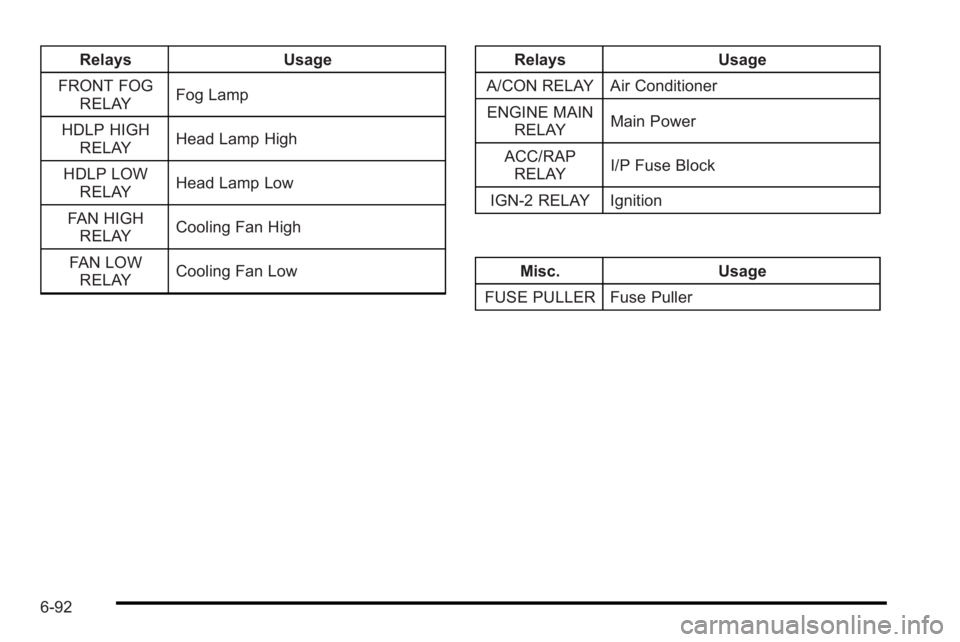
RelaysUsage
FRONT FOG RELAY Fog Lamp
HDLP HIGH RELAY Head Lamp High
HDLP LOW RELAY Head Lamp Low
FAN HIGH RELAY Cooling Fan High
FAN LOW RELAY Cooling Fan Low Relays
Usage
A/CON RELAY Air Conditioner ENGINE MAIN RELAY Main Power
ACC/RAP RELAY I/P Fuse Block
IGN‐2 RELAY Ignition
Misc. Usage
FUSE PULLER Fuse Puller
6-92
Page 317 of 368
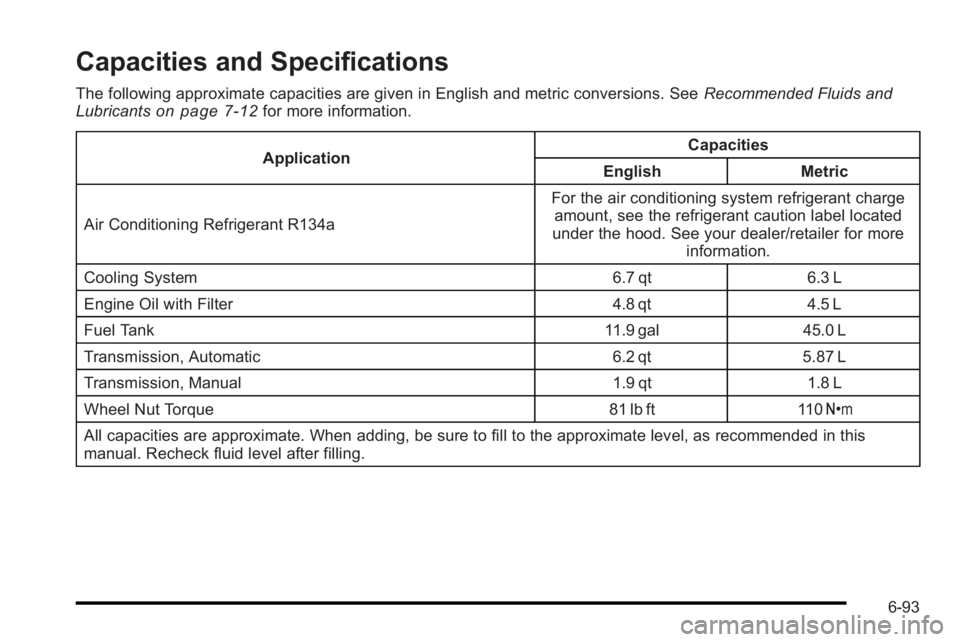
Capacities and Specifications
The following approximate capacities are given in English and metric conversions. SeeRecommended Fluids and
Lubricantson page 7‑12for more information.
Application Capacities
English Metric
Air Conditioning Refrigerant R134a For the air conditioning system refrigerant charge
amount, see the refrigerant caution label located
under the hood. See your dealer/retailer for more
information.
Cooling System 6.7 qt6.3 L
Engine Oil with Filter 4.8 qt4.5 L
Fuel Tank 11.9 gal45.0 L
Transmission, Automatic 6.2 qt5.87 L
Transmission, Manual 1.9 qt1.8 L
Wheel Nut Torque 81 lb ft110Y
All capacities are approximate. When adding, be sure to fill to the approximate level, as recommended in this
manual. Recheck fluid level after filling.
6-93
Page 322 of 368

MaintenanceI
.Change engine oil and filter. See Engine Oilon
page 6‑15. An Emission Control Service.
.Engine coolant level check. See Engine Coolanton page 6‑25.
.Windshield washer fluid level check. See
Windshield Washer Fluid on page 6‑33.
.Tire inflation check. SeeInflation - Tire Pressureon page 6‑57.
.Tire wear inspection. See Tire Inspection and
Rotation on page 6‑61.
.Rotate tires. See Tire Inspection and Rotationon
page 6‑61.
.Fluids visual leak check (or every 12 months,
whichever occurs first). A leak in any system must
be repaired and the fluid level checked.
.Engine air cleaner filter inspection (vehicles driven
in dusty conditions only). See Engine Air Cleaner/
Filter on page 6‑19.
.Brake system inspection (or every 12 months,
whichever occurs first).
Maintenance II
.Perform all services described in Maintenance I.
.Steering and suspension inspection. Visual
inspection for damaged, loose, or missing parts or
signs of wear.
.Engine cooling system inspection. Visual
inspection of hoses, pipes, fittings, and clamps and
replacement, if needed.
.Windshield wiper blade inspection for wear,
cracking, or contamination and windshield and
wiper blade cleaning, if contaminated. See
Windshield and Wiper Blades
on page 6‑83. Worn
or damaged wiper blade replacement. See
Windshield Wiper Blade Replacement
on
page 6‑49.
.Body hinges and latches, key lock cylinders, and
trunk lid hinges and latches lubrication. See
Recommended Fluids and Lubricants
on
page 7‑12. More frequent lubrication may be
required when vehicle is exposed to a corrosive
environment. Applying silicone grease on
weatherstrips with a clean cloth makes them last
longer, seal better, and not stick or squeak.
.Restraint system component check. See Checking
the Restraint Systems on page 2‑72.
7-4
Page 324 of 368
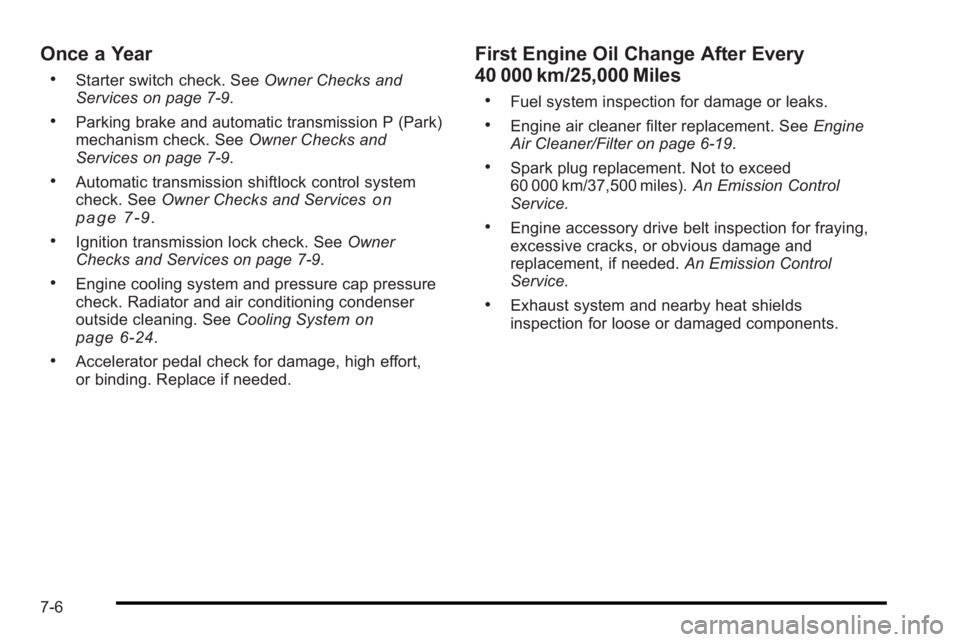
Once a Year
.Starter switch check. SeeOwner Checks and
Services on page 7‑9.
.Parking brake and automatic transmission P (Park)
mechanism check. See Owner Checks and
Services on page 7‑9.
.Automatic transmission shiftlock control system
check. See Owner Checks and Serviceson
page 7‑9.
.Ignition transmission lock check. See Owner
Checks and Services on page 7‑9.
.Engine cooling system and pressure cap pressure
check. Radiator and air conditioning condenser
outside cleaning. See Cooling System
on
page 6‑24.
.Accelerator pedal check for damage, high effort,
or binding. Replace if needed.
First Engine Oil Change After Every
40 000 km/25,000 Miles
.Fuel system inspection for damage or leaks.
.Engine air cleaner filter replacement. See Engine
Air Cleaner/Filter on page 6‑19.
.Spark plug replacement. Not to exceed
60 000 km/37,500 miles). An Emission Control
Service.
.Engine accessory drive belt inspection for fraying,
excessive cracks, or obvious damage and
replacement, if needed. An Emission Control
Service.
.Exhaust system and nearby heat shields
inspection for loose or damaged components.
7-6
Page 325 of 368
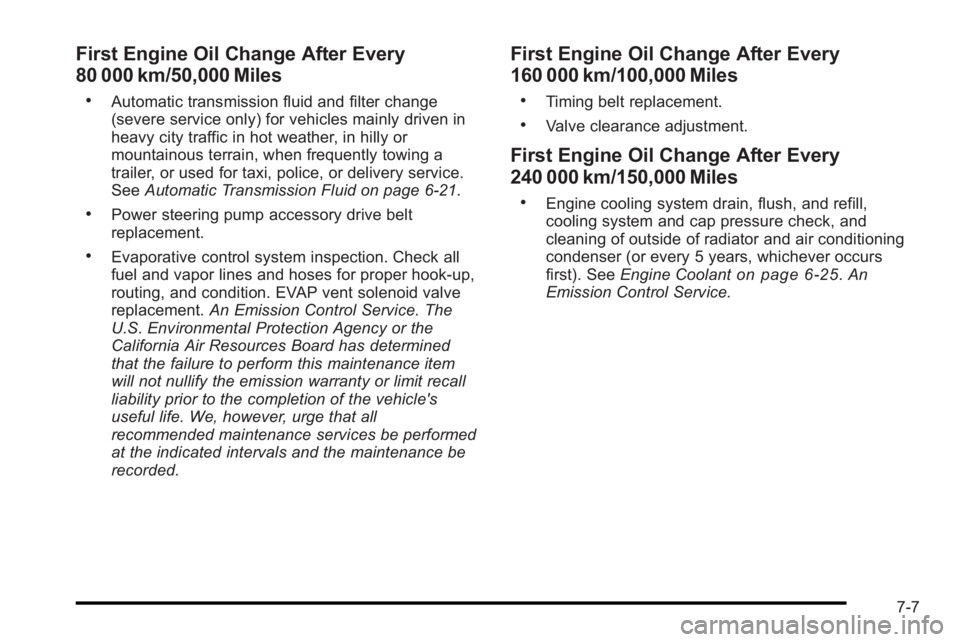
First Engine Oil Change After Every
80 000 km/50,000 Miles
.Automatic transmission fluid and filter change
(severe service only) for vehicles mainly driven in
heavy city traffic in hot weather, in hilly or
mountainous terrain, when frequently towing a
trailer, or used for taxi, police, or delivery service.
SeeAutomatic Transmission Fluid on page 6‑21.
.Power steering pump accessory drive belt
replacement.
.Evaporative control system inspection. Check all
fuel and vapor lines and hoses for proper hook‐up,
routing, and condition. EVAP vent solenoid valve
replacement. An Emission Control Service. The
U.S. Environmental Protection Agency or the
California Air Resources Board has determined
that the failure to perform this maintenance item
will not nullify the emission warranty or limit recall
liability prior to the completion of the vehicle's
useful life. We, however, urge that all
recommended maintenance services be performed
at the indicated intervals and the maintenance be
recorded.
First Engine Oil Change After Every
160 000 km/100,000 Miles
.Timing belt replacement.
.Valve clearance adjustment.
First Engine Oil Change After Every
240 000 km/150,000 Miles
.Engine cooling system drain, flush, and refill,
cooling system and cap pressure check, and
cleaning of outside of radiator and air conditioning
condenser (or every 5 years, whichever occurs
first). See Engine Coolant
on page 6‑25.An
Emission Control Service.
7-7
Page 326 of 368
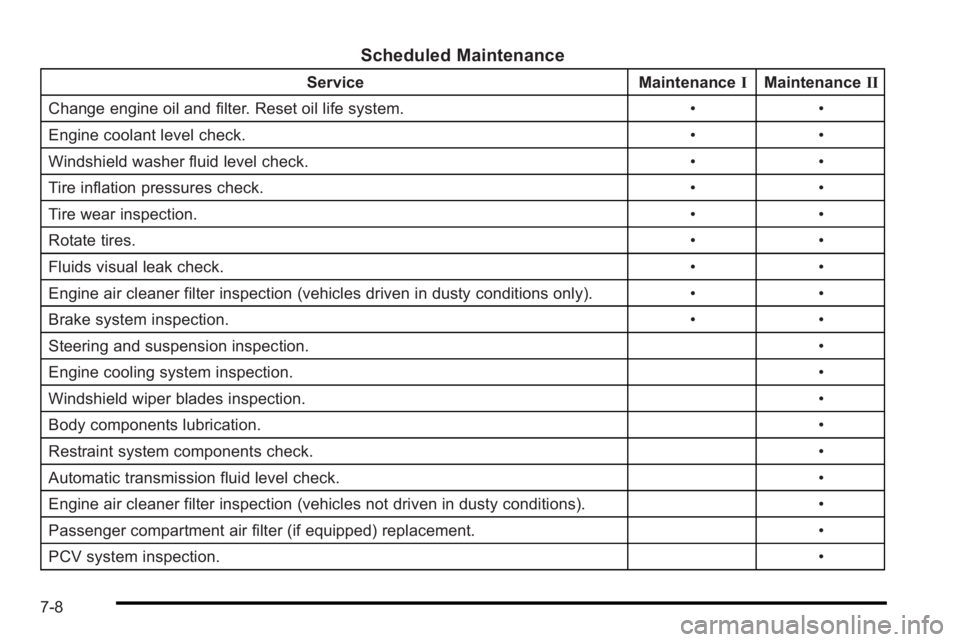
Scheduled Maintenance
ServiceMaintenanceIMaintenance II
Change engine oil and filter. Reset oil life system. ••
Engine coolant level check. ••
Windshield washer fluid level check. ••
Tire inflation pressures check. ••
Tire wear inspection. ••
Rotate tires. ••
Fluids visual leak check. ••
Engine air cleaner filter inspection (vehicles driven in dusty conditions only). ••
Brake system inspection. ••
Steering and suspension inspection. •
Engine cooling system inspection. •
Windshield wiper blades inspection. •
Body components lubrication. •
Restraint system components check. •
Automatic transmission fluid level check. •
Engine air cleaner filter inspection (vehicles not driven in dusty conditions). •
Passenger compartment air filter (if equipped) replacement. •
PCV system inspection. •
7-8