ECU PONTIAC G3 2010 Owner's Guide
[x] Cancel search | Manufacturer: PONTIAC, Model Year: 2010, Model line: G3, Model: PONTIAC G3 2010Pages: 368, PDF Size: 3.94 MB
Page 112 of 368
Opening a Rear Door When the
Security Lock is On
1. Unlock the door from the inside.
2. Open the door from the outside.
If you do not cancel the security lock, adults or older
children who ride in the rear will not be able to open the
rear door from the inside.
Canceling the Rear Door Security Lock
1. Unlock the door from the inside and open the door from the outside.
2. Move the lever down to unlock.
3. Repeat Steps 1 and 2 to the other rear door lock.
The rear door locks can now be locked and unlocked
normally.
Trunk
{WARNING:
Exhaust gases can enter the vehicle if it is driven
with the liftgate, trunk/hatch open, or with any
objects that pass through the seal between the
body and the trunk/hatch or liftgate. Engine
exhaust contains Carbon Monoxide (CO) which
cannot be seen or smelled. It can cause
unconsciousness and even death.
If the vehicle must be driven with the liftgate,
or trunk/hatch open:
.Close all of the windows.
.Fully open the air outlets on or under the
instrument panel.
.Adjust the Climate Control system to a setting
that brings in only outside air and set the fan
speed to the highest setting. See Climate
Control System in the Index.
.If the vehicle is equipped with a power liftgate,
disable the power liftgate function.
For more information about carbon monoxide, see
Engine Exhaust on page 3‑32.
3-8
Page 114 of 368
Emergency Trunk Release Handle
Notice:Do not use the emergency trunk release
handle as a tie-down or anchor point when securing
items in the trunk as it could damage the handle.
The emergency trunk release handle is only
intended to aid a person trapped in a latched trunk,
enabling them to open the trunk from the inside.
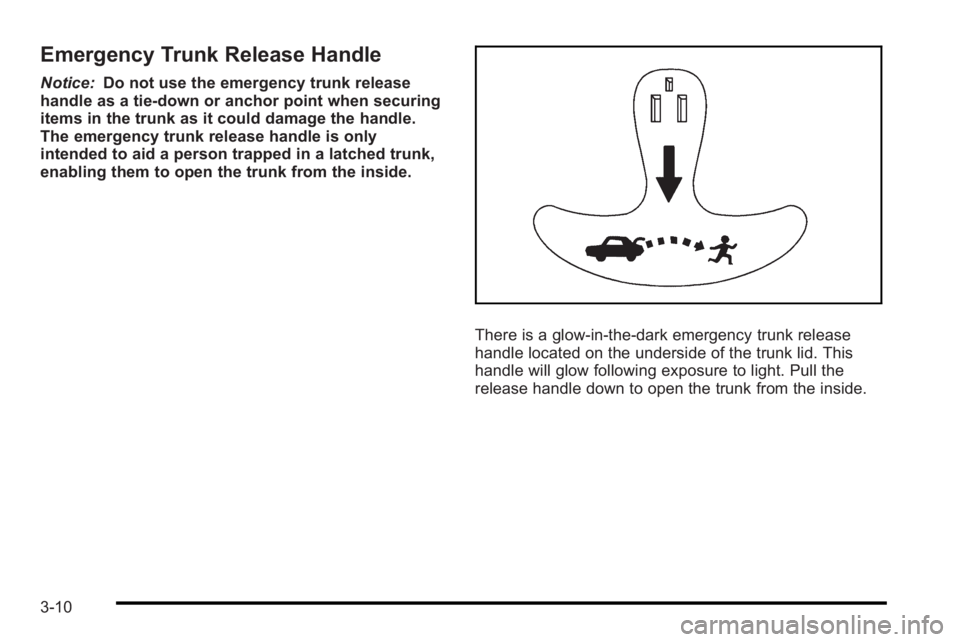
There is a glow-in-the-dark emergency trunk release
handle located on the underside of the trunk lid. This
handle will glow following exposure to light. Pull the
release handle down to open the trunk from the inside.
3-10
Page 119 of 368
When trying to start the vehicle, if the engine does not
start and the security light flashes or comes on, there
may be a problem with the theft-deterrent system.
Turn the ignition off and try again.
If the engine still does not start, and the key appears to
be undamaged, try another key. At this time, you may
also want to check the fuse. SeeFuses and Circuit
Breakers
on page 6‑87. If the engine still does not start
with the other key, your vehicle needs service. If your
vehicle does start, the first key may be faulty. See your
dealer/retailer who can have a new key made.
Up to 10 keys may be programmed for the vehicle.
If you lose or damage your keys, only a dealer/retailer
can have new keys made.
If you are ever driving and the security light comes on
and stays on, you will be able to restart the engine if
you turn it off. The theft-deterrent system, however, is
not working properly and must be serviced by your
dealer/retailer. Your vehicle is not protected by the
theft-deterrent system at this time.
In an emergency, contact Roadside Assistance.
See Roadside Assistance Program on page 8‑6.
Content Theft-Deterrent
Your vehicle may have a content theft-deterrent system.
The theft-deterrent system will not arm when you lock
the doors using the key or the manual door lock. It arms
only when you use the remote keyless entry transmitter.
Arming the System
To arm the system, do the following:
1. Close the doors, the windows, the hood, and the trunk or liftgate.
Make sure that the windows are closed, as the
system can be armed even if the windows
are open.
2. Turn the key to LOCK/OFF and remove the key from the ignition.
If the key is inserted in the ignition, the transmitter
will not arm the theft-deterrent system.
3-15
Page 120 of 368

3. Lock the doors by pressing the lock button on theremote keyless entry transmitter.
.The LED light on the transmitter will flash once.
.All of the doors will lock.
.The hazard warning lamps will flash once and
the horn will sound.
.The security light will flash continuously to
indicate that the theft-deterrent system is
armed. The security light is located on the
center of the instrument panel near the clock.
To avoid activating the alarm by accident, do one of the
following:
.Unlock the driver's or passenger's front door using
the key.
.Press the unlock button on the remote keyless
entry transmitter.
Unlocking a door any other way will activate the alarm
when a door or the trunk or liftgate is opened.
If you do not want to arm the theft-deterrent system,
lock the vehicle using the key or the manual door locks.
Disarming the System
To disarm the system, do one of the following:
.Unlock the driver's or passenger's front door using
the key.
.Press the unlock button on the remote keyless
entry transmitter.
‐ The LED light on the transmitter will flash once.
‐ All of the doors will unlock.
‐ The hazard warning lamps will flash twice.
If the door is not opened or if the engine is not started
within 30 seconds after disarming the system using the
transmitter, all of the doors will automatically lock and
the theft-deterrent mode will rearm.
3-16
Page 220 of 368
If there is a heavy load, it should be spread out.
See“Steps for Determining Correct Load Limit”
earlier in this section.
{WARNING:
Do not load the vehicle any heavier than the
Gross Vehicle Weight Rating (GVWR),
or either the maximum front or rear Gross
Axle Weight Rating (GAWR). If you do, parts
on the vehicle can break, and it can change
the way your vehicle handles. These could
cause you to lose control and crash. Also,
overloading can shorten the life of the
vehicle.
Notice:Overloading the vehicle may cause
damage. Repairs would not be covered by the
vehicle warranty. Do not overload the vehicle. If you put things inside your vehicle
—like
suitcases, tools, packages, or anything
else —they will go as fast as the vehicle goes.
If you have to stop or turn quickly, or if there is a
crash, they will keep going.
{WARNING:
Things you put inside your vehicle can strike
and injure people in a sudden stop or turn,
or in a crash.
.Put things in the cargo area of your
vehicle. Try to spread the weight evenly.
.Never stack heavier things, like
suitcases, inside the vehicle so that some
of them are above the tops of the seats.
.Do not leave an unsecured child restraint
in your vehicle.
.When you carry something inside the
vehicle, secure it whenever you can.
.Do not leave a seat folded down unless
you need to.
5-24
Page 237 of 368
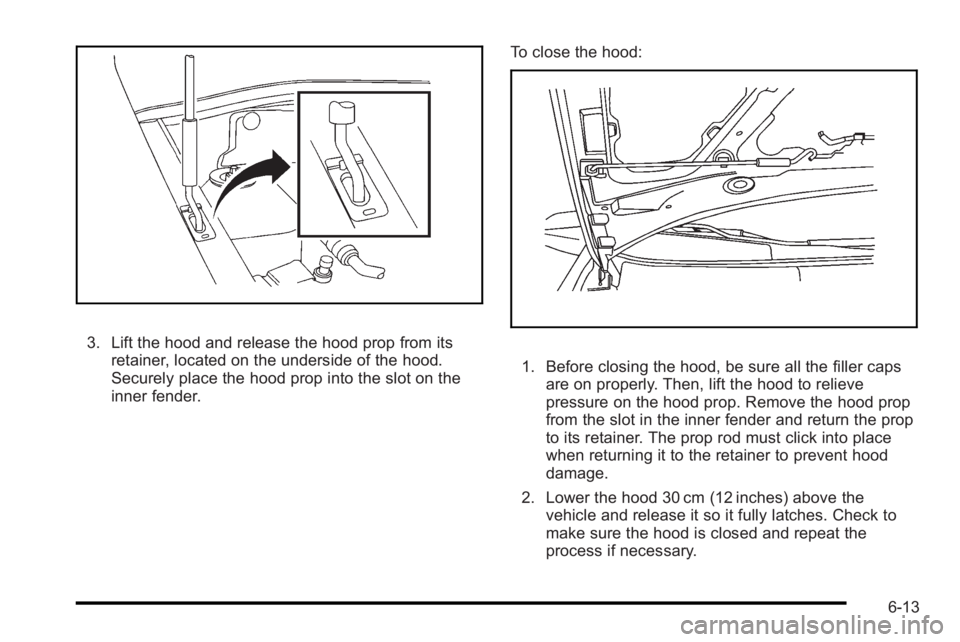
3. Lift the hood and release the hood prop from itsretainer, located on the underside of the hood.
Securely place the hood prop into the slot on the
inner fender. To close the hood:
1. Before closing the hood, be sure all the filler caps
are on properly. Then, lift the hood to relieve
pressure on the hood prop. Remove the hood prop
from the slot in the inner fender and return the prop
to its retainer. The prop rod must click into place
when returning it to the retainer to prevent hood
damage.
2. Lower the hood 30 cm (12 inches) above the vehicle and release it so it fully latches. Check to
make sure the hood is closed and repeat the
process if necessary.
6-13
Page 254 of 368

4. With the coolant surge tank pressure cap off, startthe engine and let it run until you can feel the
upper radiator hose getting hot. Watch out for the
engine cooling fan.
By this time, the coolant level inside the coolant
surge tank may be lower. If the level is lower than
the Maximum mark, add more of the proper
mixture to the coolant surge tank until the level
reaches the mark.
5. Replace the pressure cap. Be sure the pressure cap is hand-tight and fully seated.
Notice: If the pressure cap is not tightly installed,
coolant loss and possible engine damage may
occur. Be sure the cap is properly and tightly
secured.
Engine Overheating
The vehicle has an indicator to warn of the engine
overheating.
There is a coolant temperature gage on the instrument
panel cluster. See Engine Coolant Temperature Gage
on page 4‑28.
You may decide not to lift the hood when this warning
appears, but instead get service help right away. See
Roadside Assistance Program on page 8‑6.
If you do decide to lift the hood, make sure the vehicle
is parked on a level surface. Then check to see if the engine cooling fan is running.
If the engine is overheating, the fan should be running.
If it is not, do not continue to run the engine and have
the vehicle serviced.
Notice:
Engine damage from running the engine
without coolant is not covered by the warranty.
Notice: If the engine catches fire because of being
driven with no coolant, your vehicle can be badly
damaged. The costly repairs would not be covered
by the vehicle warranty.
If Steam Is Coming From The Engine
Compartment
{WARNING:
Steam from an overheated engine can burn you
badly, even if you just open the hood. Stay away
from the engine if you see or hear steam coming
from it. Just turn it off and get everyone away from
the vehicle until it cools down. Wait until there is
no sign of steam or coolant before you open
the hood.
(Continued)
6-30
Page 292 of 368
Used Replacement Wheels
{WARNING:
Putting a used wheel on the vehicle is dangerous.
You cannot know how it has been used or how far
it has been driven. It could fail suddenly and
cause a crash. If you have to replace a wheel, use
a new GM original equipment wheel.
Tire Chains
Notice:Use tire chains only where legal and only
when you must. Use only SAE Class“S” type chains
that are the proper size for your tires. Install themon
the front tires and tighten them as tightly as
possible with the ends securelyfastened. Drive
slowly and follow the chain manufacturer's
instructions. If youcan hear the chains contacting
your vehicle, stop and retighten them. If the
contactcontinues, slow down until it stops. Driving
too fast or spinning the wheels withchains on will
damage your vehicle.
6-68
Page 302 of 368
Storing a Flat or Spare Tire and
Tools
{WARNING:
Storing a jack, a tire, or other equipment in the
passenger compartment of the vehicle could
cause injury. In a sudden stop or collision, loose
equipment could strike someone. Store all these
in the proper place.
To store a flat or compact spare tire and tools: 1. Store the flat tire or the compact spare in the compact spare tire compartment.
2. Secure the retainer.
3. Store the tools securely in the foam tray and place the tray back in the cargo area.
4. Replace the trim cover.
The compact spare tire is for temporary use only.
Replace the compact spare tire with a full-size tire as
soon as you can. See Compact Spare Tire
on
page 6‑78.
Compact Spare Tire
{WARNING:
Driving with more than one compact spare tire at
a time could result in loss of braking and handling.
This could lead to a crash and you or others could
be injured. Use only one compact spare tire at
a time.
The compact spare tire was fully inflated when the
vehicle was new, it can lose air after a time. Check the
inflation pressure regularly. It should be 60 psi
(414 kPa).
After installing the compact spare on your vehicle, you
should stop as soon as possible and make sure your
spare tire is correctly inflated. The compact spare is
intended to perform well at speeds up to 50 mph
(80 km/h), so you can finish your trip and have your
full-size tire repaired or replaced where you want.
Replace your spare with a full-size tire as soon as
you can.
6-78
Page 311 of 368
Fuses and Circuit Breakers
The wiring circuits in the vehicle are protected from
short circuits by a combination of fuses, circuit breakers
and fusible thermal links. This greatly reduces the
chance of fires caused by electrical problems.
Look at the silver-colored band inside the fuse. If the
band is broken or melted, replace the fuse. Be sure you
replace a bad fuse with a new one of the identical size
and rating.
Fuses of the same amperage can be temporarily
borrowed from another fuse location, if a fuse goes out.
Replace the fuse as soon as you can.
Instrument Panel Fuse Block
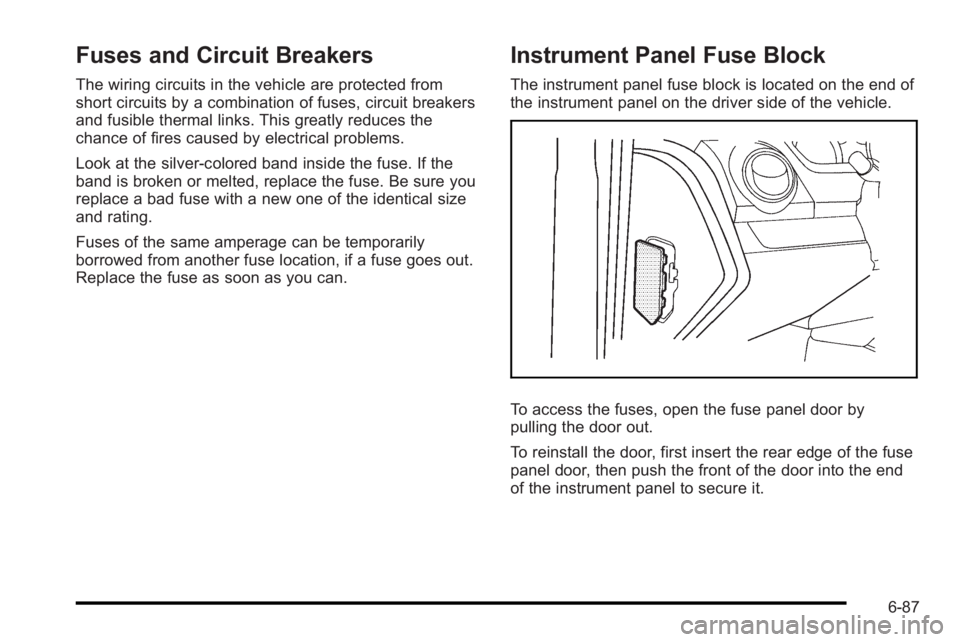
The instrument panel fuse block is located on the end of
the instrument panel on the driver side of the vehicle.
To access the fuses, open the fuse panel door by
pulling the door out.
To reinstall the door, first insert the rear edge of the fuse
panel door, then push the front of the door into the end
of the instrument panel to secure it.
6-87