hood open PONTIAC G3 2010 Owners Manual
[x] Cancel search | Manufacturer: PONTIAC, Model Year: 2010, Model line: G3, Model: PONTIAC G3 2010Pages: 368, PDF Size: 3.94 MB
Page 9 of 368
A.Outlet Adjustment on page 4‑18.
B. Instrument Panel Cluster on page 4‑21.
C. Clock on page 4‑15.
D. Hood Release on page 6‑12.
E. Horn on page 4‑3.
F. Audio System(s) on page 4‑36.
G. Climate Control System on page 4‑15.
H. Ashtray. See Ashtray(s) and Cigarette Lighter
on
page 4‑14.
I. Cupholders on page 3‑36.
J. Cigarette Lighter. See Ashtray(s) and Cigarette
Lighter on page 4‑14.
K. Hazard Warning Flashers on page 4‑3.
L. Glove Box on page 3‑36.
Initial Drive Information
This section provides a brief overview about some of
the important features that may or may not be on your
specific vehicle.
For more detailed information, refer to each of the
features which can be found later in this owner manual.
Remote Keyless Entry (RKE) System
The RKE transmitter is used to remotely lock and
unlock the doors from up to 20 m (65 feet) away from
the vehicle.
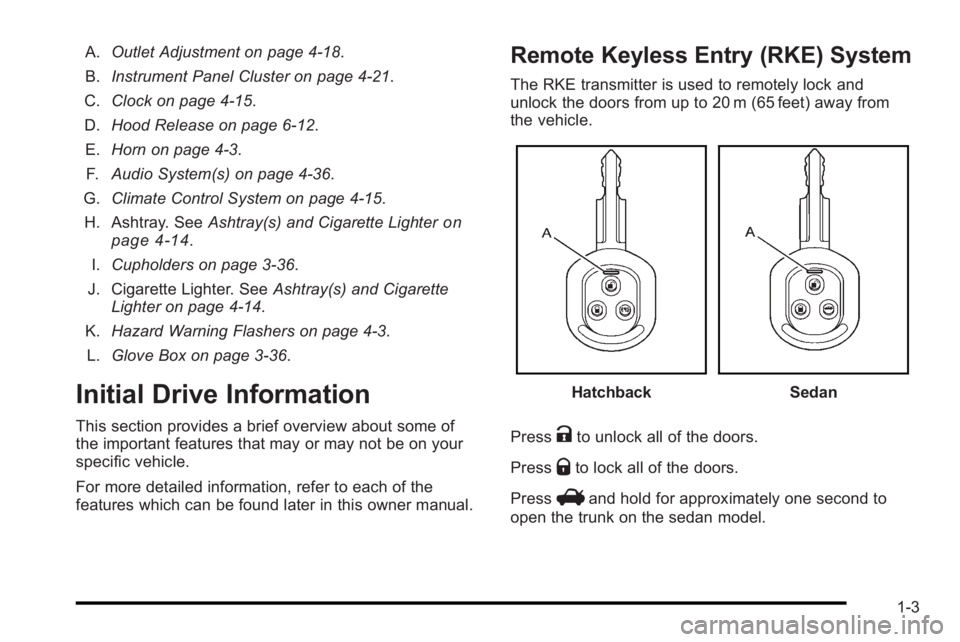
HatchbackSedan
Press
Kto unlock all of the doors.
Press
Qto lock all of the doors.
Press
Vand hold for approximately one second to
open the trunk on the sedan model.
1-3
Page 27 of 368
Hood Release
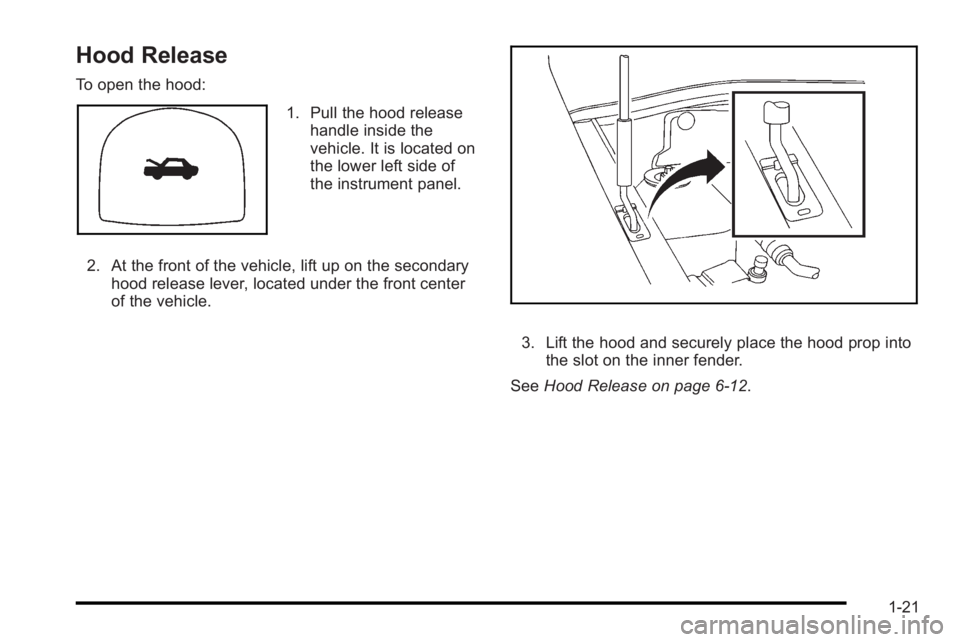
To open the hood:
1. Pull the hood releasehandle inside the
vehicle. It is located on
the lower left side of
the instrument panel.
2. At the front of the vehicle, lift up on the secondary hood release lever, located under the front center
of the vehicle.
3. Lift the hood and securely place the hood prop intothe slot on the inner fender.
See Hood Release on page 6‑12.
1-21
Page 119 of 368
When trying to start the vehicle, if the engine does not
start and the security light flashes or comes on, there
may be a problem with the theft-deterrent system.
Turn the ignition off and try again.
If the engine still does not start, and the key appears to
be undamaged, try another key. At this time, you may
also want to check the fuse. SeeFuses and Circuit
Breakers
on page 6‑87. If the engine still does not start
with the other key, your vehicle needs service. If your
vehicle does start, the first key may be faulty. See your
dealer/retailer who can have a new key made.
Up to 10 keys may be programmed for the vehicle.
If you lose or damage your keys, only a dealer/retailer
can have new keys made.
If you are ever driving and the security light comes on
and stays on, you will be able to restart the engine if
you turn it off. The theft-deterrent system, however, is
not working properly and must be serviced by your
dealer/retailer. Your vehicle is not protected by the
theft-deterrent system at this time.
In an emergency, contact Roadside Assistance.
See Roadside Assistance Program on page 8‑6.
Content Theft-Deterrent
Your vehicle may have a content theft-deterrent system.
The theft-deterrent system will not arm when you lock
the doors using the key or the manual door lock. It arms
only when you use the remote keyless entry transmitter.
Arming the System
To arm the system, do the following:
1. Close the doors, the windows, the hood, and the trunk or liftgate.
Make sure that the windows are closed, as the
system can be armed even if the windows
are open.
2. Turn the key to LOCK/OFF and remove the key from the ignition.
If the key is inserted in the ignition, the transmitter
will not arm the theft-deterrent system.
3-15
Page 124 of 368

3. If the engine still will not start, or starts but thenstops, it could be flooded with too much gasoline.
Try pushing the accelerator pedal all the way to the
floor and holding it there as you hold the key in
START for about three seconds. If the vehicle
starts briefly but then stops again, do the same
thing, but this time keep the pedal down for five or
six seconds. This clears the extra gasoline from
the engine.
Notice: The engine is designed to work with the
electronics in the vehicle. If electrical parts or
accessories are added, you could change the way
the engine operates. Before adding electrical
equipment, check with your dealer/retailer. If you
do not, the engine might not perform properly.
Any resulting damage would not be covered by the
vehicle warranty.
Engine Heater
The engine heater can provide easier starting and
better fuel economy during engine warm-up in cold
weather conditions at or below −18°C (0°F).Vehicles with an engine heater should be plugged in at
least four hours before starting. To assist you in finding
the cord, the vehicle will have one of the following
designs:
Removable Extension Cord
1. Turn off the engine.
2. Remove the extension cord from the trunk. Open
the hood and connect the electrical cord with the
extension cord.
3-20
Page 125 of 368
3. Plug the extension cord into a normal, grounded110-Volt AC outlet.
{WARNING:
Plugging the cord into an ungrounded outlet could
cause an electrical shock. Also, the wrong kind of
extension cord could overheat and cause a fire.
You could be seriously injured. Plug the cord into
a properly grounded three-prong 110-volt AC
outlet. If the cord will not reach, use a heavy-duty
three-prong extension cord rated for at least
15 amps.
4. Before starting the engine, be sure to unplug both the extension cord and under hood electrical cord,
and store them as they were before. This will keep
them away from moving engine parts, and prevent
damage.
The length of time the heater should remain plugged in
depends on several factors. Ask a dealer/retailer in the
area where you will be parking the vehicle for the best
advice on this.
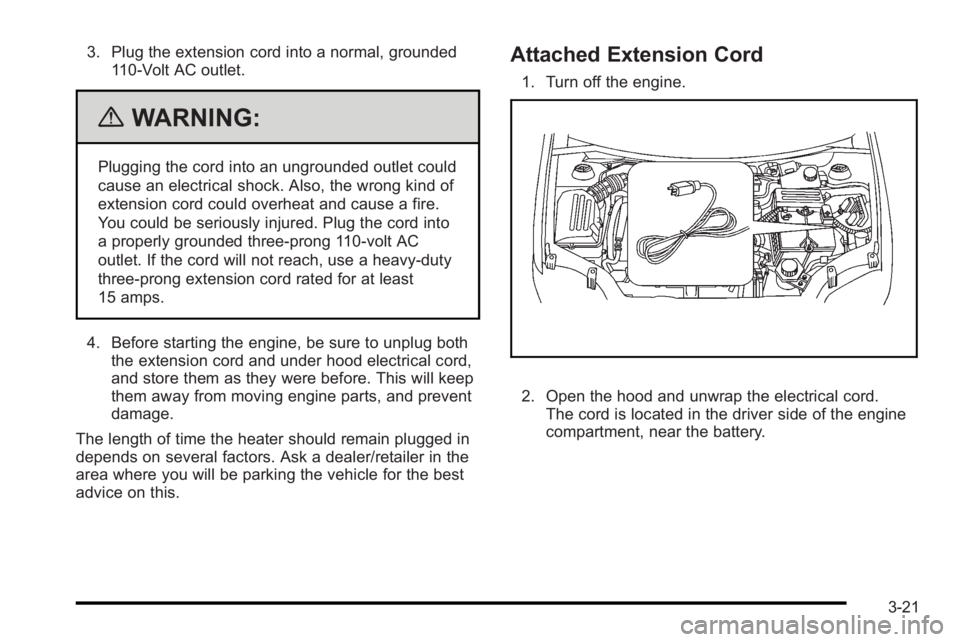
Attached Extension Cord
1. Turn off the engine.
2. Open the hood and unwrap the electrical cord. The cord is located in the driver side of the engine
compartment, near the battery.
3-21
Page 160 of 368
Rear Window and Outside Mirror
Defogger
For vehicles with a rear window and outside mirror
defogger, they only work when the ignition is turned
to ON/RUN.
The rear window defogger uses a warming grid to
remove fog or frost from the rear window.
<(Rear Window Defogger) : Press to turn the rear
window and outside mirror defogger on or off. An
indicator light comes on to show that the feature is on.
If the vehicle does not have air conditioning, the rear
window defogger may turn off about 10 minutes after
the button is pressed. If it remains on, it can be turned
off by pressing
defogger turns off about 10 minutes after the button is
pressed. The defogger can also be turned off by turning
the engine off.
Notice: Do not use anything sharp on the inside of
the rear window. If you do, you could cut or damage
the warming grid, and the repairs would not be
covered by the vehicle warranty. Do not attach a
temporary vehicle license, tape, a decal or anything
similar to the defogger grid.
Outlet Adjustment
To open an outlet, press on its cover. Turn the cover to
change the direction of the airflow.
Operation Tips
.Clear away any ice, snow or leaves from the air
inlets at the base of the windshield that may block
the flow of air into the vehicle.
.Use of non-GM approved hood deflectors may
adversely affect the performance of the system.
.Keep the path under the front seats clear of
objects to help circulate the air inside of the vehicle
more effectively.
Passenger Compartment Air Filter
For vehicles with a passenger compartment air filter, it
is located behind the glove box. It can be accessed
after removing the glove box from its housing.
Pollen and dust are removed by the filter. The filter
should be replaced as part of routine scheduled
maintenance. For a replacement filter see your dealer/
retailer. See Scheduled Maintenance
on page 7‑3for
replacement intervals.
4-18
Page 230 of 368

Gasoline Octane
Use regular unleaded gasoline with a posted octane
rating of 87 or higher. If the octane rating is less than
87, an audible knocking noise, commonly referred to as
spark knock, might be heard when driving. If this
occurs, use a gasoline rated at 87 octane or higher as
soon as possible. If heavy knocking is heard when
using gasoline rated at 87 octane or higher, the engine
needs service.
Gasoline Specifications
At a minimum, gasoline should meet ASTM
specification D 4814 in the United States or
CAN/CGSB‐3.5 or 3.511 in Canada. Some gasolines
contain an octane-enhancing additive called
methylcyclopentadienyl manganese tricarbonyl (MMT).
We recommend against the use of gasolines containing
MMT. SeeAdditives
on page 6‑7for additional
information.
California Fuel
If the vehicle is certified to meet California Emissions
Standards, it is designed to operate on fuels that meet
California specifications. See the underhood emission
control label. If this fuel is not available in states
adopting California emissions standards, the vehicle will
operate satisfactorily on fuels meeting federal
specifications, but emission control system performance
might be affected. The malfunction indicator lamp could
turn on and the vehicle might fail a smog‐check test.
See Malfunction Indicator Lamp
on page 4‑29. If this
occurs, return to your authorized dealer/retailer for
diagnosis. If it is determined that the condition is caused
by the type of fuel used, repairs might not be covered
by the vehicle warranty.
6-6
Page 236 of 368
Hood Release
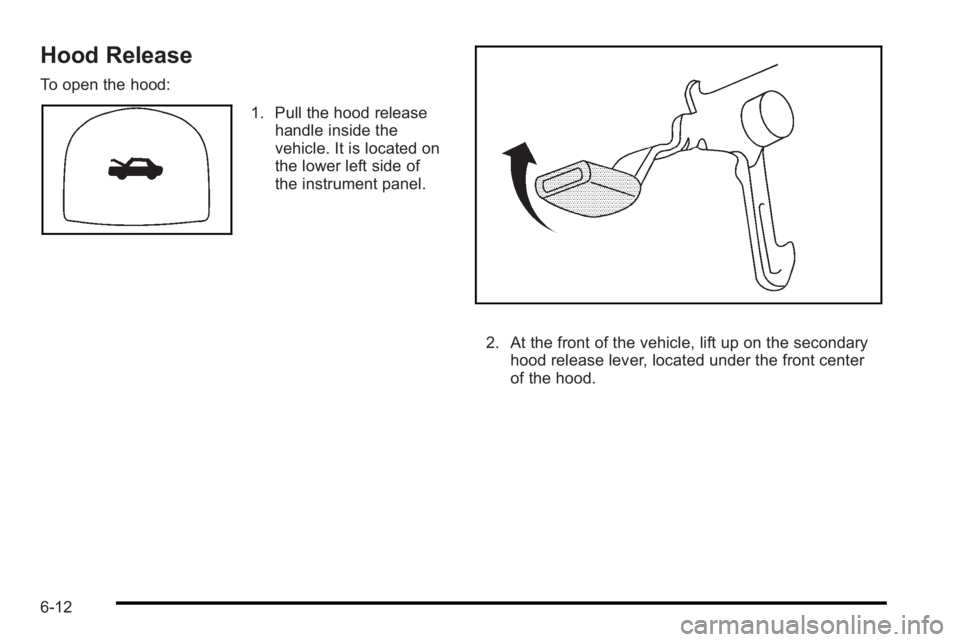
To open the hood:
1. Pull the hood releasehandle inside the
vehicle. It is located on
the lower left side of
the instrument panel.
2. At the front of the vehicle, lift up on the secondaryhood release lever, located under the front center
of the hood.
6-12
Page 254 of 368

4. With the coolant surge tank pressure cap off, startthe engine and let it run until you can feel the
upper radiator hose getting hot. Watch out for the
engine cooling fan.
By this time, the coolant level inside the coolant
surge tank may be lower. If the level is lower than
the Maximum mark, add more of the proper
mixture to the coolant surge tank until the level
reaches the mark.
5. Replace the pressure cap. Be sure the pressure cap is hand-tight and fully seated.
Notice: If the pressure cap is not tightly installed,
coolant loss and possible engine damage may
occur. Be sure the cap is properly and tightly
secured.
Engine Overheating
The vehicle has an indicator to warn of the engine
overheating.
There is a coolant temperature gage on the instrument
panel cluster. See Engine Coolant Temperature Gage
on page 4‑28.
You may decide not to lift the hood when this warning
appears, but instead get service help right away. See
Roadside Assistance Program on page 8‑6.
If you do decide to lift the hood, make sure the vehicle
is parked on a level surface. Then check to see if the engine cooling fan is running.
If the engine is overheating, the fan should be running.
If it is not, do not continue to run the engine and have
the vehicle serviced.
Notice:
Engine damage from running the engine
without coolant is not covered by the warranty.
Notice: If the engine catches fire because of being
driven with no coolant, your vehicle can be badly
damaged. The costly repairs would not be covered
by the vehicle warranty.
If Steam Is Coming From The Engine
Compartment
{WARNING:
Steam from an overheated engine can burn you
badly, even if you just open the hood. Stay away
from the engine if you see or hear steam coming
from it. Just turn it off and get everyone away from
the vehicle until it cools down. Wait until there is
no sign of steam or coolant before you open
the hood.
(Continued)
6-30
Page 263 of 368

4. Open the hoods and locate the batteries. Find thepositive (+) and negative (−) terminal locations on
each vehicle. See Engine Compartment Overview
on page 6‑14for more information on location.
{WARNING:
An electric fan can start up even when the engine
is not running and can injure you. Keep hands,
clothing and tools away from any underhood
electric fan.
{WARNING:
Using a match near a battery can cause battery
gas to explode. People have been hurt doing this,
and some have been blinded. Use a flashlight if
you need more light.
Be sure the battery has enough water. You do not
need to add water to the battery installed in your
new vehicle. But if a battery has filler caps, be
(Continued)
WARNING: (Continued)
sure the right amount of fluid is there. If it is low,
add water to take care of that first. If you don't,
explosive gas could be present.
Battery fluid contains acid that can burn you. Do
not get it on you. If you accidentally get it in your
eyes or on your skin, flush the place with water
and get medical help immediately.
{WARNING:
Fans or other moving engine parts can injure you
badly. Keep your hands away from moving parts
once the engine is running.
5. Check that the jumper cables do not have loose or missing insulation. If they do, you could get a
shock. The vehicles could be damaged too.
Before you connect the cables, here are some
things you should know. Positive (+) will go to
positive (+) or to a remote positive (+) terminal if
6-39