change wheel PONTIAC G5 2007 User Guide
[x] Cancel search | Manufacturer: PONTIAC, Model Year: 2007, Model line: G5, Model: PONTIAC G5 2007Pages: 428, PDF Size: 2.46 MB
Page 233 of 428

A cornering skid is best handled by easing your
foot off the accelerator pedal.
If you have the Enhanced Traction System (ETS),
remember: It helps to avoid only the acceleration
skid. SeeEnhanced Traction System (ETS)
on page 226. If you do not have the Enhanced
Traction System, or if the system is off, then
an acceleration skid is also best handled by easing
your foot off the accelerator pedal.
If your vehicle starts to slide, ease your foot off
the accelerator pedal and quickly steer the
way you want the vehicle to go. If you start
steering quickly enough, your vehicle may
straighten out. Always be ready for a second skid
if it occurs.
Of course, traction is reduced when water, snow,
ice, gravel, or other material is on the road.
For safety, you will want to slow down and adjust
your driving to these conditions. It is important
to slow down on slippery surfaces because
stopping distance will be longer and vehicle control
more limited.While driving on a surface with reduced traction, try
your best to avoid sudden steering, acceleration, or
braking, including reducing vehicle speed by
shifting to a lower gear. Any sudden changes could
cause the tires to slide. You may not realize the
surface is slippery until your vehicle is skidding.
Learn to recognize warning clues — such as
enough water, ice, or packed snow on the road to
make a mirrored surface — and slow down when
you have any doubt.
If you have the Anti-Lock Brake System (ABS),
remember: It helps avoid only the braking skid.
If you do not have ABS, then in a braking
skid, where the wheels are no longer rolling,
release enough pressure on the brakes to get the
wheels rolling again. This restores steering
control. Push the brake pedal down steadily when
you have to stop suddenly. As long as the
wheels are rolling, you will have steering control.
233
Page 257 of 428

Towing a Trailer
(Automatic Transaxle)
{CAUTION:
If you do not use the correct equipment
and drive properly, you can lose control
when you pull a trailer. For example, if the
trailer is too heavy, the brakes may not
work well — or even at all. You and your
passengers could be seriously injured.
You may also damage your vehicle; the
resulting repairs would not be covered by
your warranty. Pull a trailer only if you have
followed all the steps in this section. Ask
your dealer for advice and information
about towing a trailer with your vehicle.Your vehicle can tow a trailer if it is equipped with
an automatic transaxle and the proper trailer towing
equipment. If your vehicle is not equipped as stated
previously, do not tow a trailer. To identify the
trailering capacity of your vehicle, you should read
the information in “Weight of the Trailer” that
appears later in this section. Trailering is different
than just driving your vehicle by itself. Trailering
means changes in handling, acceleration, braking,
durability and fuel economy. Successful, safe
trailering takes correct equipment, and it has to be
used properly.
That is the reason for this part. In it are many
time-tested, important trailering tips and safety
rules. Many of these are important for your safety
and that of your passengers. So please read
this section carefully before you pull a trailer.
Load-pulling components such as the engine,
transaxle, wheel assemblies and tires are forced
to work harder against the drag of the added
weight. The engine is required to operate
at relatively higher speeds and under greater
loads, generating extra heat. Also, the trailer adds
considerably to wind resistance, increasing the
pulling requirements.
257
Page 329 of 428

When rotating your tires, always use the correct
rotation pattern shown here.
Do not include the compact spare tire in your tire
rotation.
After the tires have been rotated, adjust the front
and rear ination pressures as shown on the
Tire and Loading Information label.
Make certain that all wheel nuts are properly
tightened. See “Wheel Nut Torque” under
Capacities and Specications on page 369.
{CAUTION:
Rust or dirt on a wheel, or on the parts to
which it is fastened, can make wheel nuts
become loose after time. The wheel could
come off and cause an accident. When
you change a wheel, remove any rust or
dirt from places where the wheel attaches
to the vehicle. In an emergency, you can
use a cloth or a paper towel to do this;
but be sure to use a scraper or wire brush
later, if needed, to get all the rust or dirt
off. SeeChanging a Flat Tire on page 338.
329
Page 337 of 428

Notice:If your vehicle has a tire size other than
P205/55R16 or P205/50R17, use tire chains only
where legal and only when you must. Use only
SAE Class S-type chains that are the proper
size for your tires. Install them on the front tires
and tighten them as tightly as possible with the
ends securely fastened. Drive slowly and follow
the chain manufacturer’s instructions. If you
can hear the chains contacting your vehicle,
stop and retighten them. If the contact
continues, slow down until it stops. Driving
too fast or spinning the wheels with chains on
will damage your vehicle.
If a Tire Goes Flat
It is unusual for a tire to blowout while you are
driving, especially if you maintain your vehicle’s
tires properly. If air goes out of a tire, it is much
more likely to leak out slowly. But if you should ever
have a blowout, here are a few tips about what to
expect and what to do:
If a front tire fails, the at tire will create a drag that
pulls the vehicle toward that side. Take your foot off
the accelerator pedal and grip the steering wheel
rmly. Steer to maintain lane position, and then
gently brake to a stop well out of the traffic lane.A rear blowout, particularly on a curve, acts much
like a skid and may require the same correction you
would use in a skid. In any rear blowout remove
your foot from the accelerator pedal. Get the vehicle
under control by steering the way you want the
vehicle to go. It may be very bumpy and noisy, but
you can still steer. Gently brake to a stop, well off
the road if possible.
{CAUTION:
Lifting a vehicle and getting under it to
do maintenance or repairs is dangerous
without the appropriate safety equipment
and training. The jack provided with your
vehicle is designed only for changing a at
tire. If it is used for anything else, you or
others could be badly injured or killed if the
vehicle slips off the jack. Use the jack
provided with your vehicle only for
changing a at tire.
If a tire goes at, the next part shows how to use the
jacking equipment to change a at tire safely.
337
Page 338 of 428

Changing a Flat Tire
If a tire goes at, avoid further tire and wheel
damage by driving slowly to a level place. Turn on
your hazard warning ashers.
{CAUTION:
Changing a tire can be dangerous. The
vehicle can slip off the jack and roll over
or fall on you or other people. You and
they could be badly injured or even killed.
Find a level place to change your tire. To
help prevent the vehicle from moving:
1. Set the parking brake rmly.
2. Put an automatic transaxle shift lever
in PARK (P), or shift a manual
transaxle to FIRST (1) or REVERSE (R).
CAUTION: (Continued)
CAUTION: (Continued)
3. Turn off the engine and do not restart
while the vehicle is raised.
4. Do not allow passengers to remain in
the vehicle.
To be even more certain the vehicle will
not move, you should put blocks at the
front and rear of the tire farthest away
from the one being changed. That would
be the tire on the other side, at the
opposite end of the vehicle.
When you have a at tire, use the following
example as a guide to assist you in the placement
of wheel blocks.
338
Page 346 of 428
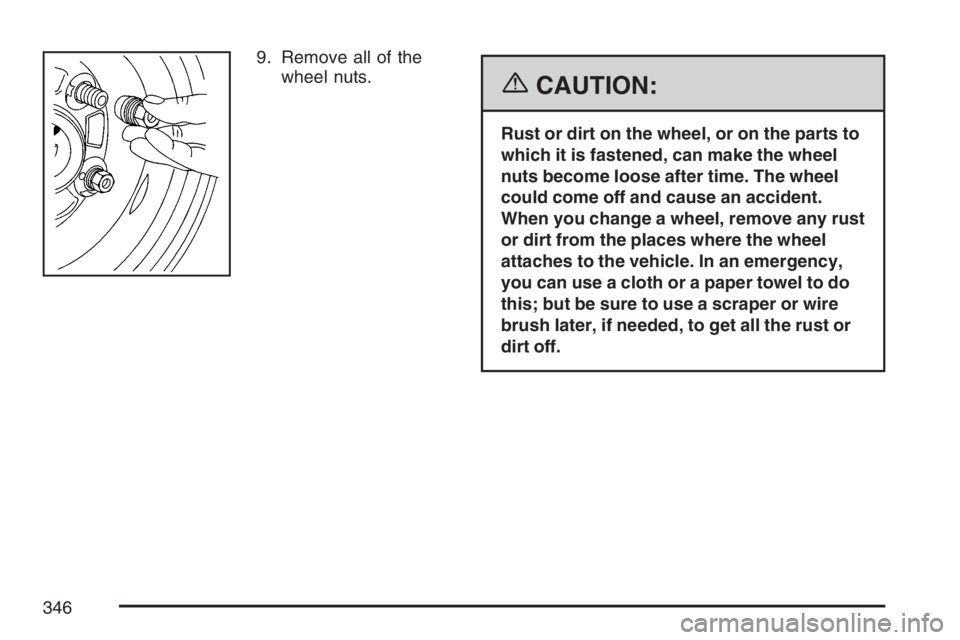
9. Remove all of the
wheel nuts.
{CAUTION:
Rust or dirt on the wheel, or on the parts to
which it is fastened, can make the wheel
nuts become loose after time. The wheel
could come off and cause an accident.
When you change a wheel, remove any rust
or dirt from the places where the wheel
attaches to the vehicle. In an emergency,
you can use a cloth or a paper towel to do
this; but be sure to use a scraper or wire
brush later, if needed, to get all the rust or
dirt off.
346
Page 403 of 428
Canadian Vehicles:For warranty repairs during
the Complete Vehicle Coverage period of the
General Motors of Canada New Vehicle Limited
Warranty, alternative transportation may be
available under the Courtesy Transportation
Program. Please consult your dealer for details.
General Motors reserves the right to unilaterally
modify, change or discontinue Courtesy
Transportation at any time and to resolve all
questions of claim eligibility pursuant to the terms
and conditions described herein at its sole
discretion.
Vehicle Data Collection and
Event Data Recorders
Your vehicle, like other modern motor vehicles,
has a number of sophisticated computer systems
that monitor and control several aspects of the
vehicle’s performance. Your vehicle uses on-board
vehicle computers to monitor emission control
components to optimize fuel economy, to monitor
conditions for airbag deployment and, if so
equipped, to provide anti-lock braking and to help
the driver control the vehicle in difficult driving
situations.Some information may be stored during regular
operations to facilitate repair of
detected malfunctions; other information is
stored only in a crash event by computer systems,
such as those commonly called Event Data
Recorders (EDR).
In a crash event, computer systems, such as the
airbag Sensing and Diagnostic Module (SDM)
in your vehicle may record information about the
condition of the vehicle and how it was operated,
such as data related to engine speed, brake
application, throttle position, vehicle speed, safety
belt usage, airbag readiness, airbag performance,
and the severity of a collision. If your vehicle is
equipped with StabiliTrak
®, steering performance,
including yaw rate, steering wheel angle, and
lateral acceleration, is also recorded. This
information has been used to improve vehicle
crash performance and may be used to improve
crash performance of future vehicles and
driving safety. Unlike the data recorders on many
airplanes, these on-board systems do not
record sounds, such as conversation of vehicle
occupants.
403
Page 425 of 428

Servicing Your Airbag-Equipped Vehicle......... 78
Setting the Time.................................186, 187
Sheet Metal Damage................................... 359
Shifting Into Park (P)................................... 119
Shifting Out of Park (P)............................... 121
Shoulder Belt Height Adjuster........................ 30
Signals, Turn and Lane-Change.................. 140
Spare Tire
Compact.................................................. 352
Installing.................................................. 344
Removing................................................ 339
Storing..................................................... 349
Specications, Capacities............................ 369
Speedometer............................................... 159
Starting Your Engine................................... 110
Steering...................................................... 227
Steering Wheel Controls, Audio................... 214
Steering Wheel, Tilt Wheel.......................... 139
Storage Areas
Center Console Storage Area................... 131
Convenience Net..................................... 131
Cupholder(s)............................................ 131
Driver’s Storage Compartment................. 131
Glove Box................................................ 131
Stuck in Sand, Mud, Ice, or Snow............... 248
Sun Visors.................................................. 102
Snroof......................................................... 132T
Tachometer................................................. 159
Taillamps
Turn Signal Lamps................................... 316
Turn Signal, Stoplamps and
Back-up Lamps..................................... 316
Theft-Deterrent, Radio................................. 214
Theft-Deterrent Systems .............................. 102
Content Theft-Deterrent............................ 102
PASS-Key
®III+........................................ 104
PASS-Key®III+ Operation........................ 104
Tilt Wheel.................................................... 139
Tires........................................................... 320
Aluminum or Chrome-Plated Wheels,
Cleaning............................................... 358
Buying New Tires..................................... 330
Chains..................................................... 336
Changing a Flat Tire................................ 338
Cleaning.................................................. 359
Compact Spare Tire................................. 352
Different Size........................................... 332
If a Tire Goes Flat................................... 337
Ination - Tire Pressure............................ 327
Inspection and Rotation............................ 328
Installing the Spare Tire........................... 344
425
Page 426 of 428
Tires (cont.)
Removing the Flat Tire............................. 344
Removing the Spare Tire and Tools......... 339
Storing a Flat or Spare Tire and Tools..... 349
Tire Sidewall Labeling.............................. 321
Tire Terminology and Denitions............... 324
Uniform Tire Quality Grading.................... 333
Wheel Alignment and Tire Balance........... 334
Wheel Replacement................................. 335
When It Is Time for New Tires................. 330
Towing
Recreational Vehicle................................. 254
Towing a Trailer..............................256, 257
Your Vehicle............................................. 254
Traction
Enhanced Traction System (ETS)............. 226
Enhanced Traction System (ETS)
Warning Light....................................... 166Transaxle
Fluid, Automatic....................................... 286
Fluid, Manual........................................... 286
Transaxle Operation, Automatic................... 113
Transaxle Operation, Manual....................... 116
Transmission
Up-Shift Light........................................... 164
Trunk............................................................ 98
Turn and Lane-Change Signals................... 140
Turn Signal/Multifunction Lever.................... 139
U
Understanding Radio Reception................... 215
Uniform Tire Quality Grading....................... 333
Up-Shift Light.............................................. 164
426