belt PONTIAC G5 2010 Owner's Guide
[x] Cancel search | Manufacturer: PONTIAC, Model Year: 2010, Model line: G5, Model: PONTIAC G5 2010Pages: 422, PDF Size: 2.22 MB
Page 65 of 422
Infants and Young Children
Everyone in a vehicle needs protection! This includes
infants and all other children. Neither the distance
traveled nor the age and size of the traveler changes
the need, for everyone, to use safety restraints. In fact,
the law in every state in the United States and in
every Canadian province says children up to some age
must be restrained while in a vehicle.{WARNING:
Children can be seriously injured or strangled if a
shoulder belt is wrapped around their neck and
the safety belt continues to tighten. Never leave
children unattended in a vehicle and never allow
children to play with the safety belts.
Airbags plus lap-shoulder belts offer protection for
adults and older children, but not for young children and
infants. Neither the vehicle’s safety belt system nor
its airbag system is designed for them. Every time
infants and young children ride in vehicles, they should
have the protection provided by appropriate child
restraints.
Children who are not restrained properly can strike
other people, or can be thrown out of the vehicle.
2-35
Page 69 of 422
{WARNING:
A young child’s hip bones are still so small that
the vehicle’s regular safety belt may not remain
low on the hip bones, as it should. Instead, it may
settle up around the child’s abdomen. In a crash,
the belt would apply force on a body area that is
unprotected by any bony structure. This alone
could cause serious or fatal injuries. To reduce the
risk of serious or fatal injuries during a crash,
young children should always be secured in
appropriate child restraints.
Child Restraint Systems
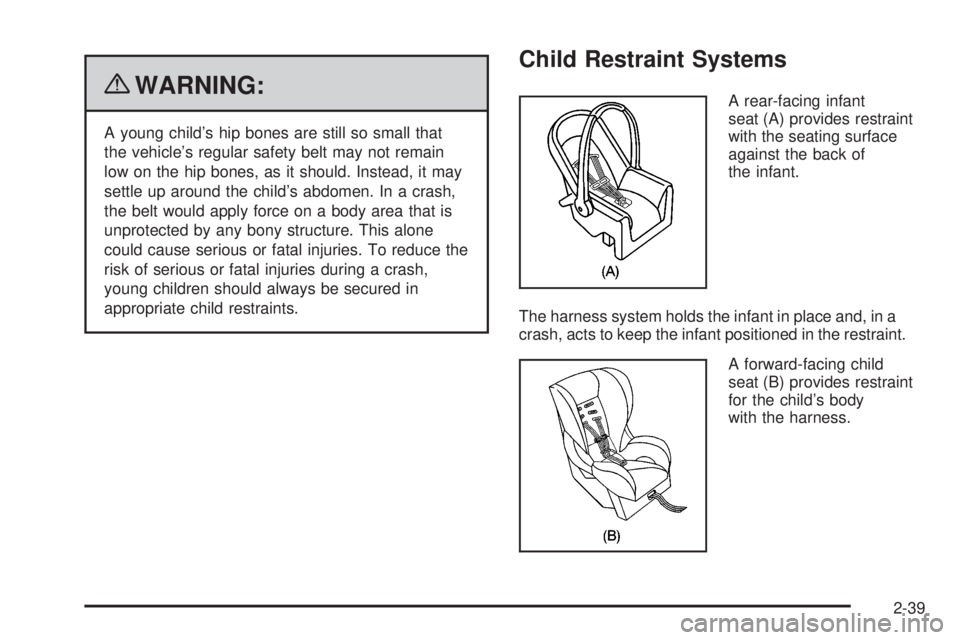
A rear-facing infant
seat (A) provides restraint
with the seating surface
against the back of
the infant.
The harness system holds the infant in place and, in a
crash, acts to keep the infant positioned in the restraint. A forward-facing child
seat (B) provides restraint
for the child’s body
with the harness.
2-39
Page 70 of 422
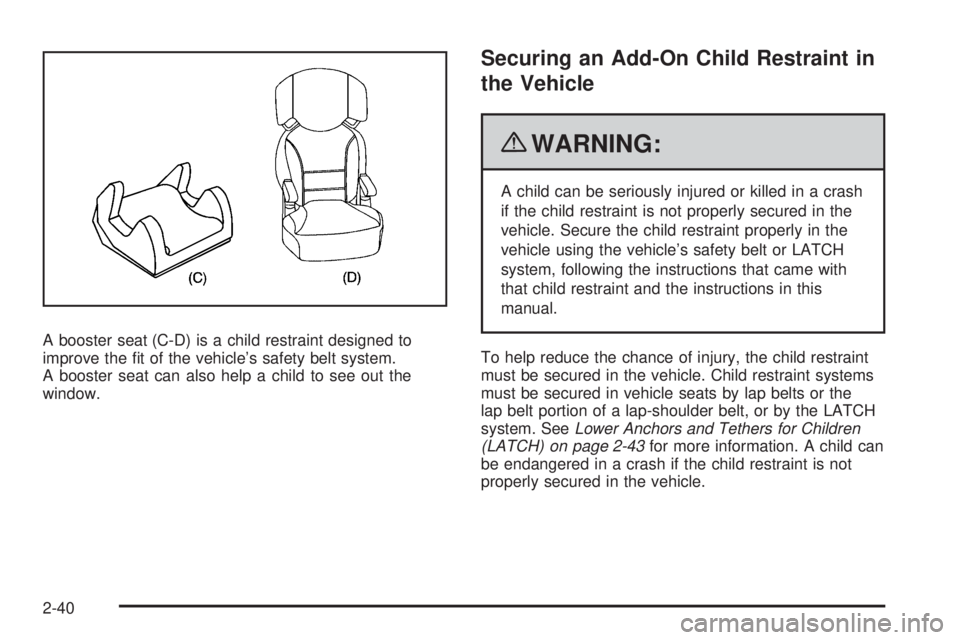
A booster seat (C-D) is a child restraint designed to
improve the fit of the vehicle’s safety belt system.
A booster seat can also help a child to see out the
window.
Securing an Add-On Child Restraint in
the Vehicle
{WARNING:
A child can be seriously injured or killed in a crash
if the child restraint is not properly secured in the
vehicle. Secure the child restraint properly in the
vehicle using the vehicle’s safety belt or LATCH
system, following the instructions that came with
that child restraint and the instructions in this
manual.
To help reduce the chance of injury, the child restraint
must be secured in the vehicle. Child restraint systems
must be secured in vehicle seats by lap belts or the
lap belt portion of a lap-shoulder belt, or by the LATCH
system. See Lower Anchors and Tethers for Children
(LATCH) on page 2-43 for more information. A child can
be endangered in a crash if the child restraint is not
properly secured in the vehicle.
2-40
Page 71 of 422
When securing an add-on child restraint, refer to the
instructions that come with the restraint which may be on
the restraint itself or in a booklet, or both, and to this
manual. The child restraint instructions are important, so
if they are not available, obtain a replacement copy
from the manufacturer.
Keep in mind that an unsecured child restraint can
move around in a collision or sudden stop and injure
people in the vehicle. Be sure to properly secure
any child restraint in the vehicle — even when no child
is in it.
Securing the Child Within the Child
Restraint
{WARNING:
A child can be seriously injured or killed in a crash
if the child is not properly secured in the child
restraint. Secure the child properly following the
instructions that came with that child restraint.
Where to Put the Restraint
According to accident statistics, children and infants are
safer when properly restrained in a child restraint
system or infant restraint system secured in a rear
seating position.
We recommend that children and child restraints be
secured in a rear seat, including: an infant or a
child riding in a rear-facing child restraint; a child riding
in a forward-facing child seat; an older child riding in
a booster seat; and children, who are large enough,
using safety belts.
2-41
Page 73 of 422
Keep in mind that an unsecured child restraint can
move around in a collision or sudden stop and injure
people in the vehicle. Be sure to properly secure
any child restraint in the vehicle — even when no child
is in it.
Lower Anchors and Tethers for
Children (LATCH)
The LATCH system holds a child restraint during driving
or in a crash. This system is designed to make
installation of a child restraint easier. The LATCH
system uses anchors in the vehicle and attachments on
the child restraint that are made for use with the
LATCH system.
Make sure that a LATCH-compatible child restraint is
properly installed using the anchors, or use the vehicle’s
safety belts to secure the restraint, following the
instructions that came with that restraint, and also the
instructions in this manual. When installing a child
restraint with a top tether, you must also use either the
lower anchors or the safety belts to properly secure
the child restraint. A child restraint must never be
installed using only the top tether and anchor.
In order to use the LATCH system in your vehicle, you
need a child restraint that has LATCH attachments.
The child restraint manufacturer will provide youwith instructions on how to use the child restraint and its
attachments. The following explains how to attach a
child restraint with these attachments in your vehicle.
Not all vehicle seating positions or child restraints have
lower anchors and attachments or top tether anchors
and attachments.
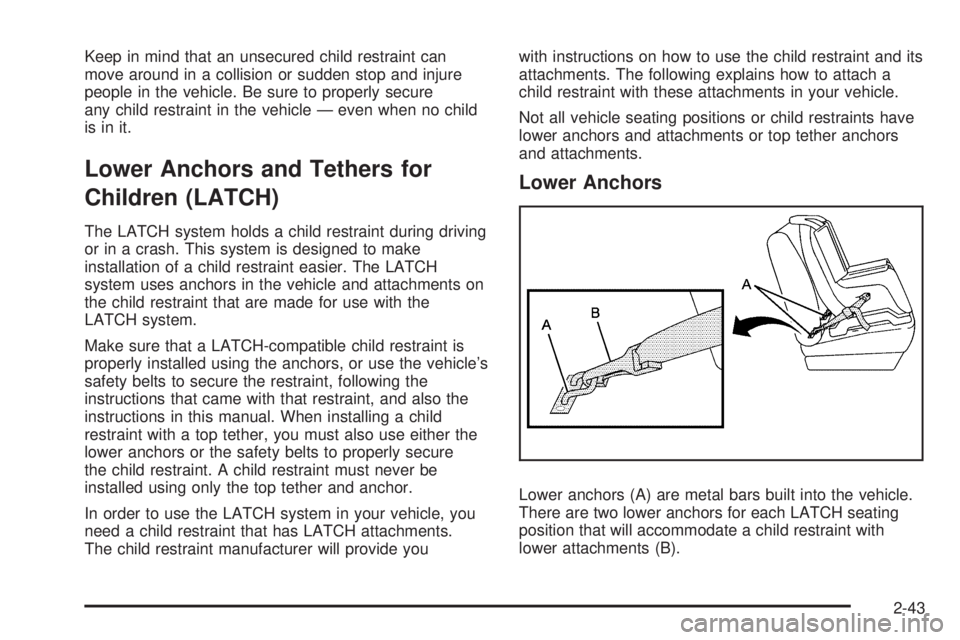
Lower Anchors
Lower anchors (A) are metal bars built into the vehicle.
There are two lower anchors for each LATCH seating
position that will accommodate a child restraint with
lower attachments (B).
2-43
Page 76 of 422
Securing a Child Restraint Designed for
the LATCH System
{WARNING:
If a LATCH-type child restraint is not attached to
anchors, the child restraint will not be able to
protect the child correctly. In a crash, the child
could be seriously injured or killed. Install a
LATCH-type child restraint properly using the
anchors, or use the vehicle’s safety belts to secure
the restraint, following the instructions that came
with the child restraint and the instructions in this
manual.
{WARNING:
Do not attach more than one child restraint to a
single anchor. Attaching more than one child
restraint to a single anchor could cause the anchor
or attachment to come loose or even break during
a crash. A child or others could be injured. To
reduce the risk of serious or fatal injuries during a
crash, attach only one child restraint per anchor.
{WARNING:
Children can be seriously injured or strangled if a
shoulder belt is wrapped around their neck and
the safety belt continues to tighten. Buckle any
unused safety belts behind the child restraint so
children cannot reach them. Pull the shoulder belt
all the way out of the retractor to set the lock, if
your vehicle has one, after the child restraint has
been installed.
2-46
Page 77 of 422
Notice:Do not let the LATCH attachments rub
against the vehicle’s safety belts. This may damage
these parts. If necessary, move buckled safety
belts to avoid rubbing the LATCH attachments.
Do not fold the empty rear seat with a safety belt
buckled. This could damage the safety belt or
the seat. Unbuckle and return the safety belt to its
stowed position, before folding the seat.
1. Attach and tighten the lower attachments to the lower anchors. If the child restraint does not have
lower attachments or the desired seating position
does not have lower anchors, secure the child
restraint with the top tether and the safety belts.
Refer to your child restraint manufacturer
instructions and the instructions in this manual.
1.1. Find the lower anchors for the desired seating position.
1.2. Put the child restraint on the seat.
1.3. Attach and tighten the lower attachments on the child restraint to the lower anchors. 2. If the child restraint manufacturer recommends that
the top tether be attached, attach and tighten the
top tether to the top tether anchor, if equipped.
Refer to the child restraint instructions and
the following steps:
2.1. Find the top tether anchor.
2.2. Open the top tether anchor cover to expose the anchor.
2.3. If you have an adjustable headrest or head restraint, raise the headrest or head restraint.
2.4. Route, attach, and tighten the top tether according to your child restraint instructions
and the following instructions:
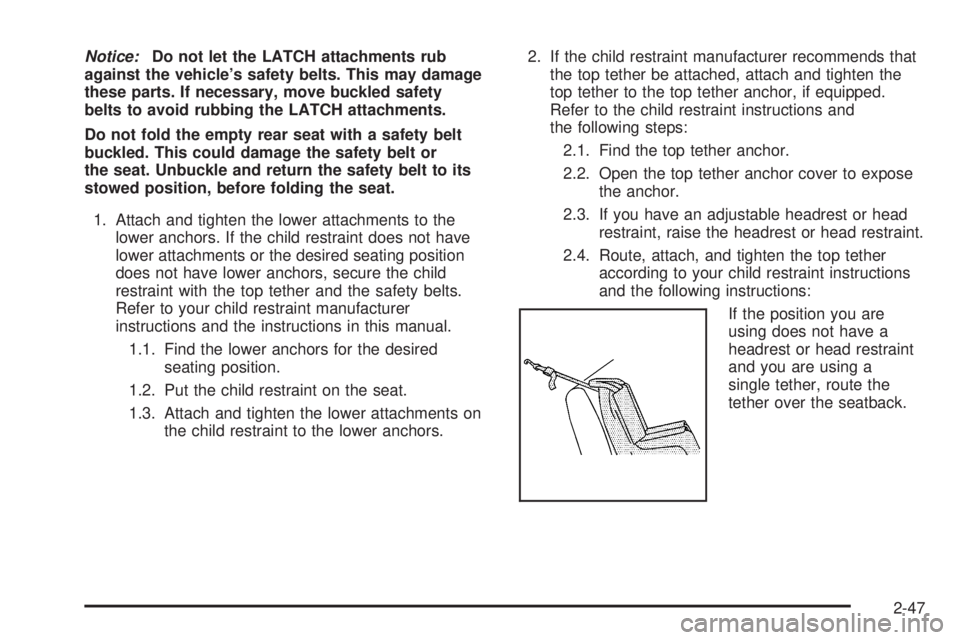
If the position you are
using does not have a
headrest or head restraint
and you are using a
single tether, route the
tether over the seatback.
2-47
Page 79 of 422
Securing a Child Restraint in a Rear
Seat Position
When securing a child restraint in a rear seating
position, study the instructions that came with your child
restraint to make sure it is compatible with this vehicle.
If your child restraint has the LATCH system, seeLower
Anchors and Tethers for Children (LATCH) on
page 2-43 for how to install your child restraint using
LATCH. If you secure a child restraint using a safety belt
and it uses a top tether, see Lower Anchors and
Tethers for Children (LATCH) on page 2-43 for top
tether anchor locations.
Do not secure a child restraint in a position without a
top tether anchor if a national or local law requires that
the top tether be anchored, or if the instructions that
come with the child restraint say that the top strap must
be anchored. In Canada, the law requires that forward-facing child
restraints have a top tether, and that the tether be
attached.
If your child restraint does not have the LATCH system,
you will be using the safety belt to secure the child
restraint in this position. Be sure to follow the
instructions that came with the child restraint. Secure
the child in the child restraint when and as the
instructions say.
If you need to install more than one child restraint in the
rear seat, be sure to read
Where to Put the Restraint
on page 2-41.
1. Put the child restraint on the seat.
2. Pick up the latch plate, and run the lap and shoulder portions of the vehicle’s safety belt through or
around the restraint. The child restraint instructions
will show you how.
2-49
Page 80 of 422
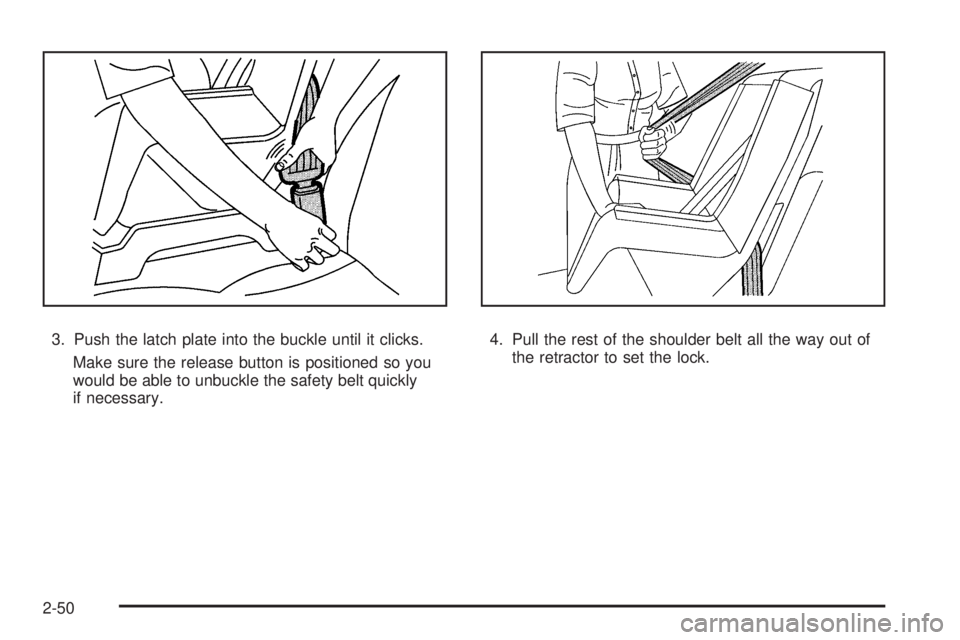
3. Push the latch plate into the buckle until it clicks.Make sure the release button is positioned so you
would be able to unbuckle the safety belt quickly
if necessary. 4. Pull the rest of the shoulder belt all the way out of
the retractor to set the lock.
2-50
Page 81 of 422
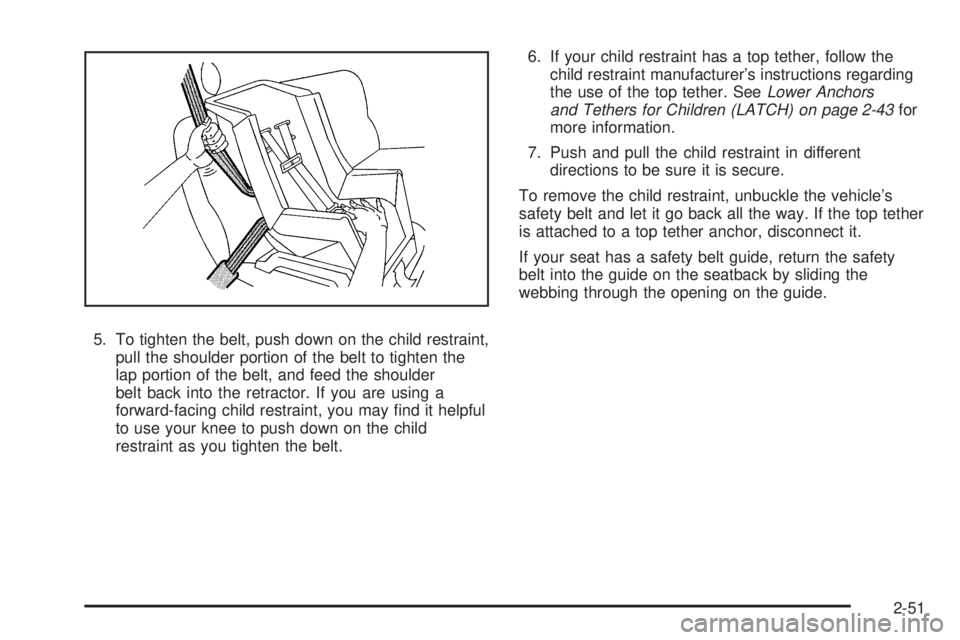
5. To tighten the belt, push down on the child restraint,pull the shoulder portion of the belt to tighten the
lap portion of the belt, and feed the shoulder
belt back into the retractor. If you are using a
forward-facing child restraint, you may find it helpful
to use your knee to push down on the child
restraint as you tighten the belt. 6. If your child restraint has a top tether, follow the
child restraint manufacturer’s instructions regarding
the use of the top tether. See Lower Anchors
and Tethers for Children (LATCH) on page 2-43 for
more information.
7. Push and pull the child restraint in different directions to be sure it is secure.
To remove the child restraint, unbuckle the vehicle’s
safety belt and let it go back all the way. If the top tether
is attached to a top tether anchor, disconnect it.
If your seat has a safety belt guide, return the safety
belt into the guide on the seatback by sliding the
webbing through the opening on the guide.
2-51