transmission PONTIAC G5 2010 Service Manual
[x] Cancel search | Manufacturer: PONTIAC, Model Year: 2010, Model line: G5, Model: PONTIAC G5 2010Pages: 422, PDF Size: 2.22 MB
Page 283 of 422

{WARNING:
Operating the engine with the air cleaner/filter off
can cause you or others to be burned. The air
cleaner not only cleans the air; it helps to stop
flames if the engine backfires. If it is not there and
the engine backfires, you could be burned. Do not
drive with it off, and be careful working on the
engine with the air cleaner/filter off.
Notice: If the air cleaner/lter is off, a backre can
cause a damaging engine re. And, dirt can easily get
into the engine, which will damage it. Always have
the air cleaner/lter in place when you are driving.
Automatic Transmission Fluid
How to Check Automatic Transmission
Fluid
It is not necessary to check the transmission fluid level.
A transmission fluid leak is the only reason for fluid loss. If
a leak occurs, take the vehicle to the dealer/retailer
service department and have it repaired as soon as
possible. Change the fluid and filter at the intervals listed in
Scheduled Maintenance on page 7-3
, and be sure to
use the fluid listed in Recommended Fluids and
Lubricants on page 7-10 .
Notice: Use of the incorrect automatic transmission
uid may damage the vehicle, and the damages may
not be covered by the vehicle’s warranty. Always use
the automatic transmission uid listed in
Recommended Fluids and Lubricants on page 7-10 .
Hydraulic Clutch
The hydraulic clutch linkage in your vehicle is
self-adjusting. This system does not have its own
reservoir. It receives fluid from the brake master cylinder
reservoir.
SeeBrakes on page 6-29 for more information.
6-19
Page 292 of 422

If No Steam Is Coming From Your
Engine
An engine coolant temperature warning can indicate a
serious problem. SeeEngine Coolant Temperature
Warning Light on page 4-29 .
If you get an engine coolant temperature warning, but
see or hear no steam, the problem may not be too
serious. Sometimes the engine can get a little too hot
when you:
•Climb a long hill on a hot day.
•Stop after high-speed driving.
•Idle for long periods in traffic.
•Tow a trailer.
If you get the engine coolant temperature warning with
no sign of steam, try this for a minute or so: 1. If you have an air conditioner and it is on, turn it off.
2. In heavy traffic, let the engine idle in N (Neutral) for automatic transmission or NEUTRAL for manual
transmission, while stopped. If it is safe to do so, pull
off the road, shift to P (Park) or N (Neutral) and let
the engine idle.
3. Turn on your heater to full hot at the highest fan speed and open the windows as necessary. If you no longer have the overheat warning, you can
drive. Just to be safe, drive slower for about 10 minutes.
If the warning does not come back on, you can drive
normally.
If the warning continues and you have not stopped, pull
over, stop, and park your vehicle right away.
If there is still no sign of steam, you can idle the engine
for three minutes while you are parked. If you still have
the warning, turn off the engine and get everyone out of
the vehicle until it cools down.
You may decide not to lift the hood but to get service
help right away.Windshield Washer Fluid
What to Use
When you need windshield washer fluid, be sure to read
the manufacturer’s instructions before use. If you will be
operating your vehicle in an area where the temperature
may fall below freezing, use a fluid that has sufficient
protection against freezing.
6-28
Page 293 of 422

Adding Washer Fluid
Open the cap with the
washer symbol on it. Add
washer fluid until the tank is
full. SeeEngine
Compartment Overview on
page 6-12 for reservoir
location.
Notice:
When using concentrated washer uid, follow
the manufacturer’s instructions for adding water.
Do not mix water with ready-to-use washer uid.
Water can cause the solution to freeze and
damage your washer uid tank and other parts of
the washer system. Also, water does not clean as
well as washer uid.
Fill the washer uid tank only three-quarters full
when it is very cold. This allows for uid
expansion if freezing occurs, which could
damage the tank if it is completely full.
Do not use engine coolant (antifreeze) in your
windshield washer. It can damage the vehicle’s
windshield washer system and paint.
Brakes
Brake Fluid
The brake master
cylinder and, on manual
transmission vehicles,
the clutch hydraulic system
use the same reservoir
filled with DOT 3
brake fluid.
See Engine Compartment Overview on page 6-12 for
the location of the reservoir.
There are only two reasons why the brake fluid level in
the reservoir might go down:
•The brake fluid level goes down because of normal
brake lining wear. When new linings are installed,
the fluid level goes back up.
•A fluid leak in the brake and/or clutch hydraulic
system can also cause a low fluid level. Have
the brake and/or clutch hydraulic system fixed, since
a leak means that sooner or later the brakes
and/or clutch will not work well.
6-29
Page 298 of 422
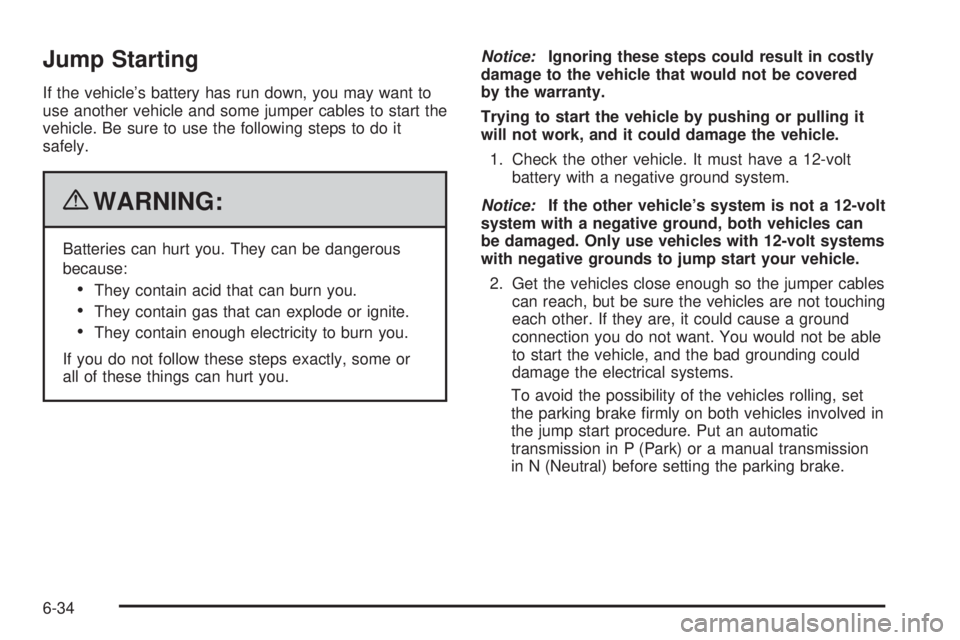
Jump Starting
If the vehicle’s battery has run down, you may want to
use another vehicle and some jumper cables to start the
vehicle. Be sure to use the following steps to do it
safely.
{WARNING:
Batteries can hurt you. They can be dangerous
because:
•They contain acid that can burn you.
•They contain gas that can explode or ignite.
•They contain enough electricity to burn you.
If you do not follow these steps exactly, some or
all of these things can hurt you. Notice:
Ignoring these steps could result in costly
damage to the vehicle that would not be covered
by the warranty.
Trying to start the vehicle by pushing or pulling it
will not work, and it could damage the vehicle.
1. Check the other vehicle. It must have a 12-volt battery with a negative ground system.
Notice: If the other vehicle’s system is not a 12-volt
system with a negative ground, both vehicles can
be damaged. Only use vehicles with 12-volt systems
with negative grounds to jump start your vehicle.
2. Get the vehicles close enough so the jumper cables can reach, but be sure the vehicles are not touching
each other. If they are, it could cause a ground
connection you do not want. You would not be able
to start the vehicle, and the bad grounding could
damage the electrical systems.
To avoid the possibility of the vehicles rolling, set
the parking brake firmly on both vehicles involved in
the jump start procedure. Put an automatic
transmission in P (Park) or a manual transmission
in N (Neutral) before setting the parking brake.
6-34
Page 316 of 422
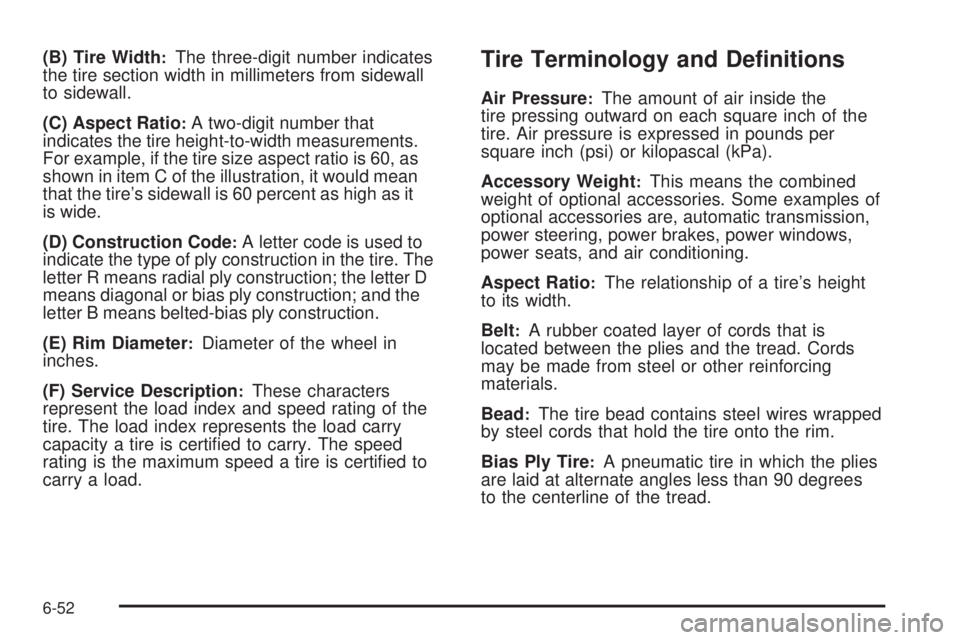
(B) Tire Width:The three-digit number indicates
the tire section width in millimeters from sidewall
to sidewall.
(C) Aspect Ratio
:A two-digit number that
indicates the tire height-to-width measurements.
For example, if the tire size aspect ratio is 60, as
shown in item C of the illustration, it would mean
that the tire’s sidewall is 60 percent as high as it
is wide.
(D) Construction Code
:A letter code is used to
indicate the type of ply construction in the tire. The
letter R means radial ply construction; the letter D
means diagonal or bias ply construction; and the
letter B means belted-bias ply construction.
(E) Rim Diameter
:Diameter of the wheel in
inches.
(F) Service Description
:These characters
represent the load index and speed rating of the
tire. The load index represents the load carry
capacity a tire is certified to carry. The speed
rating is the maximum speed a tire is certified to
carry a load.
Tire Terminology and Denitions
Air Pressure:The amount of air inside the
tire pressing outward on each square inch of the
tire. Air pressure is expressed in pounds per
square inch (psi) or kilopascal (kPa).
Accessory Weight
:This means the combined
weight of optional accessories. Some examples of
optional accessories are, automatic transmission,
power steering, power brakes, power windows,
power seats, and air conditioning.
Aspect Ratio
:The relationship of a tire’s height
to its width.
Belt
:A rubber coated layer of cords that is
located between the plies and the tread. Cords
may be made from steel or other reinforcing
materials.
Bead
:The tire bead contains steel wires wrapped
by steel cords that hold the tire onto the rim.
Bias Ply Tire
:A pneumatic tire in which the plies
are laid at alternate angles less than 90 degrees
to the centerline of the tread.
6-52
Page 344 of 422

3. Remove the retainer that holds the tire sealant andcompressor kit.
4. Remove the kit from the foam container.
To store the tire sealant and compressor kit, reverse the
steps.
Changing a Flat Tire
If a tire goes flat, avoid further tire and wheel damage
by driving slowly to a level place. Turn on the hazard
warning flashers. See Hazard Warning Flashers
on page 4-3.
{WARNING:
Changing a tire can be dangerous. The vehicle
can slip off the jack and roll over or fall on you or
other people. You and they could be badly injured
or even killed. Find a level place to change your
tire. To help prevent the vehicle from moving:
1. Set the parking brake firmly.
2. Put an automatic transmission shift lever in P (Park), or shift a manual transmission to
1 (First) or R (Reverse).
3. Turn off the engine and do not restart while the vehicle is raised.
4. Do not allow passengers to remain in the vehicle.
To be even more certain the vehicle will not move,
you should put blocks at the front and rear of the
tire farthest away from the one being changed.
That would be the tire on the other side, at the
opposite end of the vehicle.
6-80
Page 369 of 422

FusesUsage
18 Empty
19 Electric Power Steering, Steering
Wheel Control
20 Sunroof
21 Spare
22 Empty
23 Audio System
24 XM Radio™, OnStar™
25 Engine Control Module,
Transmission Control Module
26 Door Locks
27 Interior Lights
28 Steering Wheel Control Illumination
29 Power WindowsRelays Usage
30 Climate Control System
31 Empty
32 Retained Accessory Power (RAP)
Engine Compartment Fuse Block
The engine compartment fuse block is located on the
driver side of the vehicle. Lift off the cover to check the
fuses. See Engine Compartment Overview on
page 6-12 for more information on location.
Notice: Spilling liquid on any electrical components
on the vehicle may damage it. Always keep the
covers on any electrical component.
6-105
Page 371 of 422
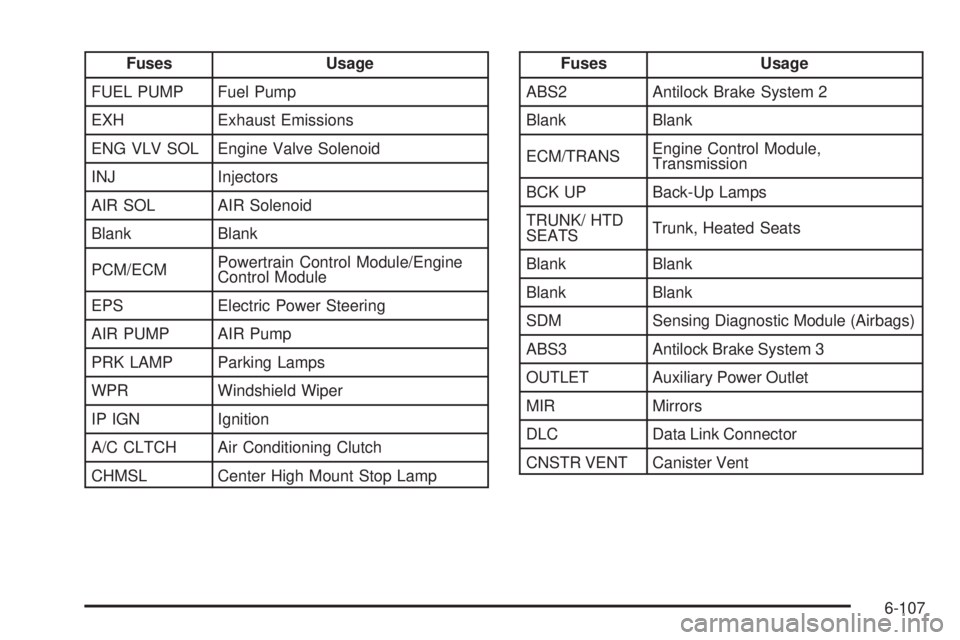
FusesUsage
FUEL PUMP Fuel Pump
EXH Exhaust Emissions
ENG VLV SOL Engine Valve Solenoid
INJ Injectors
AIR SOL AIR Solenoid
Blank Blank
PCM/ECM Powertrain Control Module/Engine
Control Module
EPS Electric Power Steering
AIR PUMP AIR Pump
PRK LAMP Parking Lamps
WPR Windshield Wiper
IP IGN Ignition
A/C CLTCH Air Conditioning Clutch
CHMSL Center High Mount Stop LampFuses Usage
ABS2 Antilock Brake System 2
Blank Blank
ECM/TRANS Engine Control Module,
Transmission
BCK UP Back-Up Lamps
TRUNK/ HTD
SEATS Trunk, Heated Seats
Blank Blank
Blank Blank
SDM Sensing Diagnostic Module (Airbags)
ABS3 Antilock Brake System 3
OUTLET Auxiliary Power Outlet
MIR Mirrors
DLC Data Link Connector
CNSTR VENT Canister Vent
6-107
Page 374 of 422

ApplicationCapacities
English Metric
Transmission Fluid (Drain and Refill) Transmission, Automatic 7.0 qt6.6 L
Transmission, Manual 1.7 qt1.6 L
Wheel Nut Torque 100 lb ft140Y
All capacities are approximate. When adding, be sure to fill to the approximate level, as recommended in this
manual.
Engine Specications
Engine VIN Code Transmission Spark Plug Gap
2.2L L4 Engine 5Automatic
Manual 0.040 in (1.01 mm)
6-110
Page 378 of 422

•Fluids visual leak check (or every 12 months,
whichever occurs first). A leak in any system must
be repaired and the fluid level checked.
•Engine air cleaner filter inspection (vehicles driven
in dusty conditions only). SeeEngine Air Cleaner/
Filter on page 6-18.
•Brake system inspection (or every 12 months,
whichever occurs first).
Maintenance II
•Perform all services described in Maintenance I.
•Steering and suspension inspection. Visual
inspection for damaged, loose, or missing parts or
signs of wear.
•Engine cooling system inspection. Visual inspection
of hoses, pipes, fittings, and clamps and
replacement, if needed.
•Windshield wiper blade inspection for wear, cracking,
or contamination and windshield and wiper blade
cleaning, if contaminated. SeeWindshield and Wiper
Blades on page 6-98. Worn or damaged wiper blade
replacement. See Windshield Wiper Blade
Replacement on page 6-47 .
•Body hinges and latches, key lock cylinders, and
trunk lid hinges and latches lubrication. See
Recommended Fluids and Lubricants on page 7-10 .
More frequent lubrication may be required when
vehicle is exposed to a corrosive environment.
Applying silicone grease on weatherstrips with a
clean cloth makes them last longer, seal better, and
not stick or squeak.
•Restraint system component check. See Checking
the Restraint Systems on page 2-71 .
•Automatic transmission fluid level check and adding
fluid, if needed. SeeAutomatic Transmission Fluid
on page 6-19.
•Engine air cleaner filter inspection. See Engine Air
Cleaner/Filter on page 6-18 .
•Passenger compartment air filter replacement (or
every 12 months, whichever occurs first). More
frequent replacement may be required if vehicle is
driven regularly under dusty conditions.
7-4