air condition PONTIAC G5 2010 Owners Manual
[x] Cancel search | Manufacturer: PONTIAC, Model Year: 2010, Model line: G5, Model: PONTIAC G5 2010Pages: 422, PDF Size: 2.22 MB
Page 5 of 422
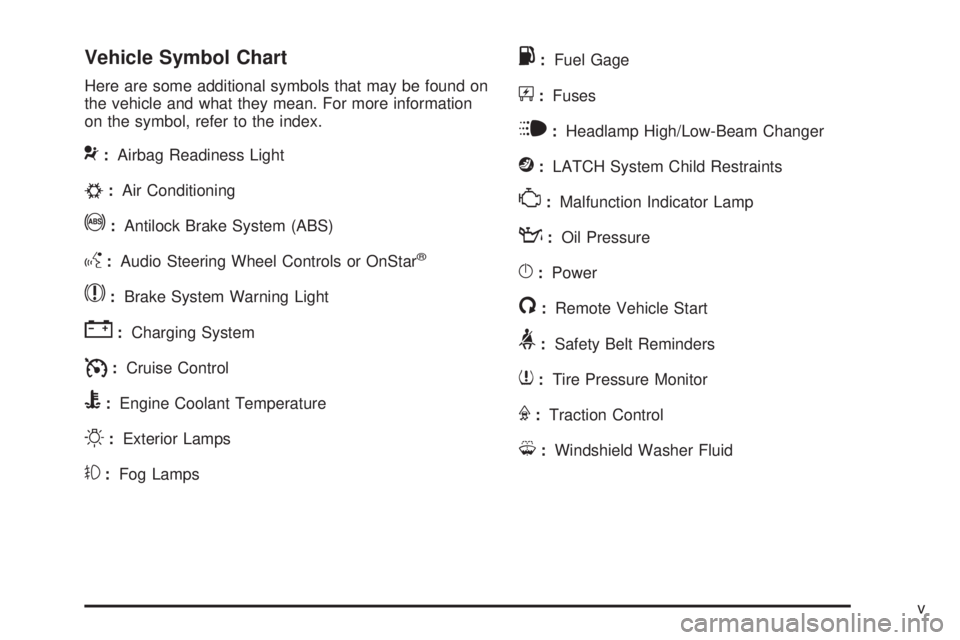
Vehicle Symbol Chart
Here are some additional symbols that may be found on
the vehicle and what they mean. For more information
on the symbol, refer to the index.
9:Airbag Readiness Light
#:Air Conditioning
!:Antilock Brake System (ABS)
g:Audio Steering Wheel Controls or OnStar®
$:Brake System Warning Light
":Charging System
I:Cruise Control
B:Engine Coolant Temperature
O:Exterior Lamps
#:Fog Lamps
.:Fuel Gage
+:Fuses
i:Headlamp High/Low-Beam Changer
j:LATCH System Child Restraints
*:Malfunction Indicator Lamp
::Oil Pressure
}:Power
/:Remote Vehicle Start
>:Safety Belt Reminders
7:Tire Pressure Monitor
F:Traction Control
M:Windshield Washer Fluid
v
Page 15 of 422
Head Restraint Adjustment
Head Restraints
Do not drive until the head restraints for all occupants are
installed and adjusted properly.
SeeHead Restraints on page 2-7 .
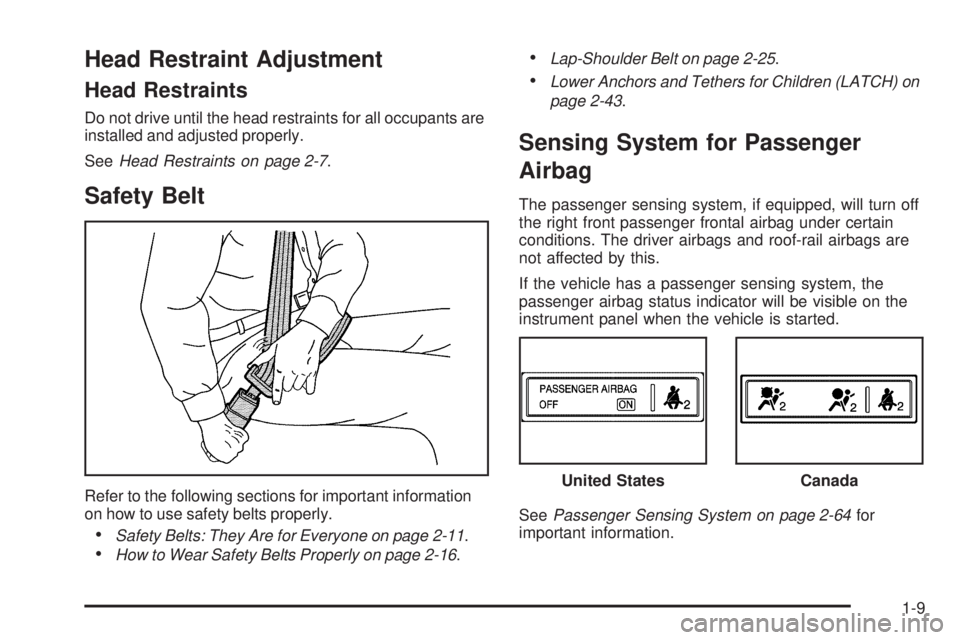
Safety Belt
Refer to the following sections for important information
on how to use safety belts properly.
•Safety Belts: They Are for Everyone on page 2-11 .
•How to Wear Safety Belts Properly on page 2-16.
•Lap-Shoulder Belt on page 2-25.
•Lower Anchors and Tethers for Children (LATCH) on
page 2-43.
Sensing System for Passenger
Airbag
The passenger sensing system, if equipped, will turn off
the right front passenger frontal airbag under certain
conditions. The driver airbags and roof-rail airbags are
not affected by this.
If the vehicle has a passenger sensing system, the
passenger airbag status indicator will be visible on the
instrument panel when the vehicle is started.
SeePassenger Sensing System on page 2-64 for
important information.
United StatesCanada
1-9
Page 20 of 422
Climate Controls
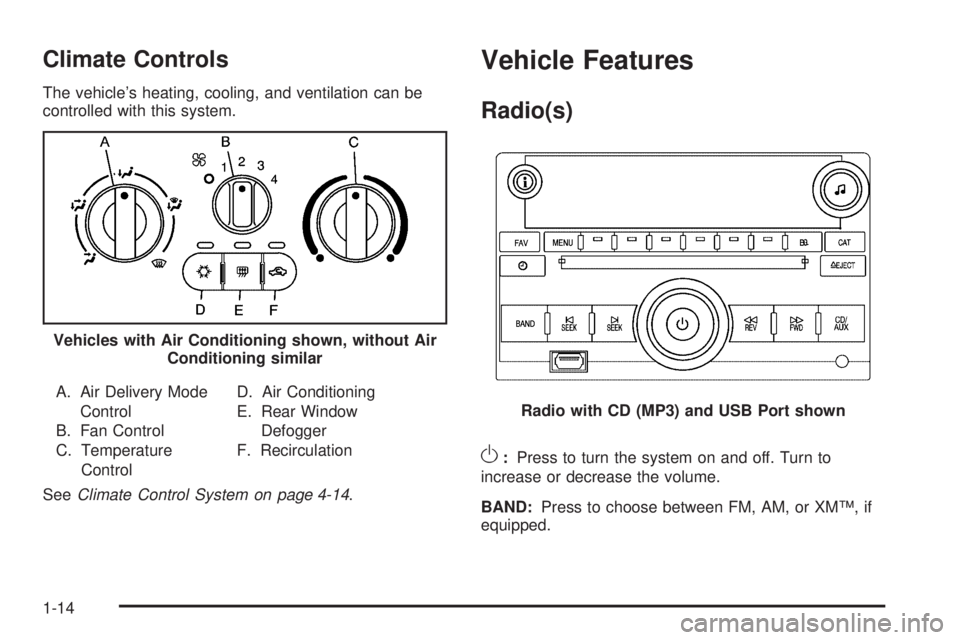
The vehicle’s heating, cooling, and ventilation can be
controlled with this system.A. Air Delivery Mode Control
B. Fan Control
C. Temperature Control D. Air Conditioning
E. Rear Window
Defogger
F. Recirculation
See Climate Control System on page 4-14 .
Vehicle Features
Radio(s)
O:Press to turn the system on and off. Turn to
increase or decrease the volume.
BAND: Press to choose between FM, AM, or XM™, if
equipped.
Vehicles with Air Conditioning shown, without Air
Conditioning similar
Radio with CD (MP3) and USB Port shown
1-14
Page 27 of 422

Driving for Better Fuel Economy
Driving habits can affect fuel mileage. Here are some
driving tips to get the best fuel economy possible.
•Avoid fast starts and accelerate smoothly.
•Brake gradually and avoid abrupt stops.
•Avoid idling the engine for long periods of time.
•When road and weather conditions are appropriate,
use cruise control, if equipped.
•Always follow posted speed limits or drive more
slowly when conditions require.
•Keep vehicle tires properly inflated.
•Combine several trips into a single trip.
•Replace the vehicle’s tires with the same TPC Spec
number molded into the tire’s sidewall near the size.
•Follow recommended scheduled maintenance.
Roadside Assistance Program
U.S.:1-800-ROADSIDE (762-3743)
TTY Users: 1-888-889-2438
Canada: 1-800-268-6800
As the owner of a new Pontiac, you are automatically
enrolled in the Roadside Assistance program. This
program provides technically trained advisors who are
available 24 hours a day, 365 days a year, minor repair
information or towing arrangements.
Roadside Assistance and OnStar
If you have a current OnStar subscription, press the
OnStar button and the current GPS location will be sent
to an OnStar Advisor who will assess your problem,
contact Roadside Assistance, and relay exact location to
get you the help you need.
Online Owner Center
The Online Owner Center is a complimentary service
that includes online service reminders, vehicle
maintenance tips, online owner manual, special
privileges and more.
Sign up today at: www.gmownercenter.com/pontiac
(U.S.) or www.gm.ca (Canada).
1-21
Page 58 of 422
Safety Belt Pretensioners
This vehicle has safety belt pretensioners for front
outboard occupants. Although the safety belt
pretensioners cannot be seen, they are part of the
safety belt assembly. They can help tighten the safety
belts during the early stages of a moderate to severe
frontal or near frontal crash if the threshold conditions for
pretensioner activation are met. And, if the vehicle
has side impact airbags, safety belt pretensioners can
help tighten the safety belts in a side crash.
Pretensioners work only once. If the pretensioners
activate in a crash, they will need to be replaced, and
probably other new parts for the vehicle’s safety
belt system. SeeReplacing Restraint System Parts
After a Crash on page 2-72.
Rear Safety Belt Comfort Guides
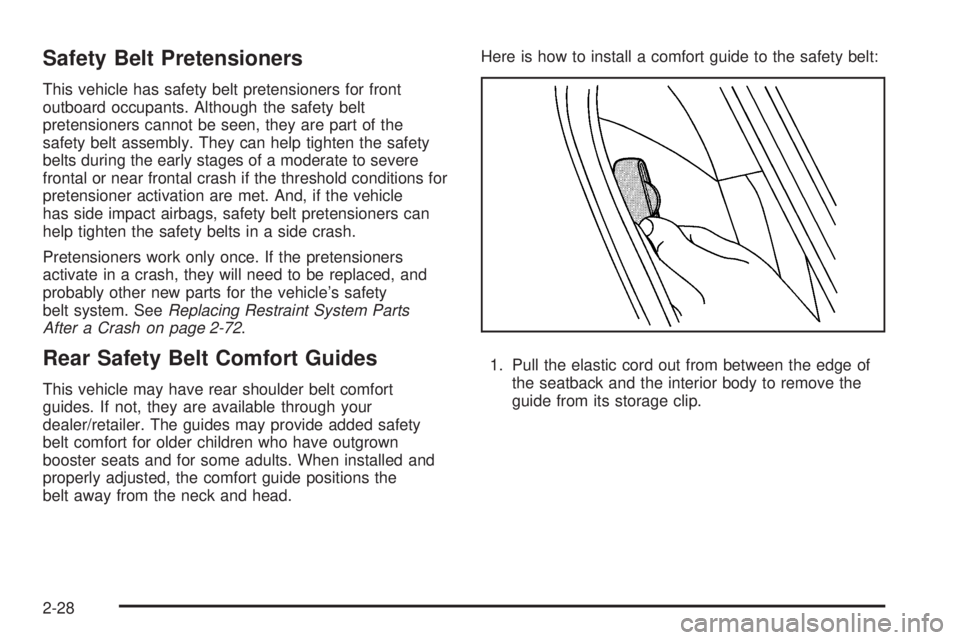
This vehicle may have rear shoulder belt comfort
guides. If not, they are available through your
dealer/retailer. The guides may provide added safety
belt comfort for older children who have outgrown
booster seats and for some adults. When installed and
properly adjusted, the comfort guide positions the
belt away from the neck and head. Here is how to install a comfort guide to the safety belt:
1. Pull the elastic cord out from between the edge of the seatback and the interior body to remove the
guide from its storage clip.
2-28
Page 72 of 422
A label on the sun visor says, “Never put a rear-facing
child restraint in the front.” This is because the risk
to the rear-facing child is so great, if the airbag deploys.
{WARNING:
A child in a rear-facing child restraint can be
seriously injured or killed if the right front
passenger airbag inflates. This is because the
back of the rear-facing child restraint would be
very close to the inflating airbag. A child in a
forward-facing child restraint can be seriously
injured or killed if the right front passenger airbag
inflates and the passenger seat is in a forward
position.
The vehicle may have a passenger sensing
system which is designed to turn off the right front
passenger frontal airbag under certain conditions.WARNING: (Continued)
WARNING: (Continued)
Even if the passenger sensing system, if
equipped, has turned off the right front passenger
frontal airbag, no system is fail-safe. No one can
guarantee that an airbag will not deploy under
some unusual circumstance, even though it is
turned off.
Secure rear-facing child restraints in a rear seat,
even if the airbag is off. If you secure a
forward-facing child restraint in the right front seat,
always move the front passenger seat as far back
as it will go. It is better to secure the child restraint
in a rear seat.
SeePassenger Sensing System on page 2-64 for
additional information.
When securing a child restraint in a rear seating
position, study the instructions that came with the child
restraint to make sure it is compatible with this
vehicle.
Wherever a child restraint is installed, be sure to secure
the child restraint properly.
2-42
Page 82 of 422
Securing a Child Restraint in the
Right Front Seat Position
The vehicle has airbags. A rear seat is a safer place to
secure a forward-facing child restraint. See Where to
Put the Restraint.
In addition, the vehicle may have a passenger sensing
system which is designed to turn off the right front
passenger frontal airbag under certain conditions. See
Passenger Sensing System and Passenger Airbag
Status Indicator for more information on this, including
important safety information.
A label on your sun visor says, “Never put a rear-facing
child seat in the front.” This is because the risk to the
rear-facing child is so great, if the airbag deploys.
{WARNING:
A child in a rear-facing child restraint can be
seriously injured or killed if the right front
passenger airbag inflates. This is because the
back of the rear-facing child restraint would be
very close to the inflating airbag. A child in aWARNING: (Continued)
WARNING: (Continued)
forward-facing child restraint can be seriously
injured or killed if the right front passenger airbag
inflates and the passenger seat is in a forward
position.
The vehicle may have a passenger sensing
system which is designed to turn off the right front
passenger frontal airbag under certain conditions.
Even if the passenger sensing system, if
equipped, has turned off the right front passenger
frontal airbag, no system is fail-safe. No one can
guarantee that an airbag will not deploy under
some unusual circumstance, even though it is
turned off.
Secure rear-facing child restraints in a rear seat,
even if the airbag is off. If you secure a
forward-facing child restraint in the right front seat,
always move the front passenger seat as far back
as it will go. It is better to secure the child restraint
in a rear seat.
SeePassenger Sensing System on page 2-64 for
additional information.
2-52
Page 94 of 422

Passenger Sensing System
If the vehicle has one of the passenger airbag status
indicators pictured in the following illustrations, then the
vehicle has a passenger sensing system for the right
front passenger position. If equipped, the passenger
airbag status indicator is visible on the instrument panel
when the vehicle is started.
In addition, if the vehicle has a passenger sensing
system for the right front passenger position, the label
on the vehicle’s sun visors refer to “ADVANCED
AIRBAGS”.
The words ON and OFF, or the symbol for on and off,
will be visible during the system check. If you are
using remote start to start the vehicle from a distance, if
equipped, you may not see the system check. When
the system check is complete, either the word ON or the
word OFF, or the symbol for on or off, will be visible.
SeePassenger Airbag Status Indicator on page 4-24 .The passenger sensing system will turn off the right
front passenger frontal airbag under certain conditions.
The driver airbag and roof-rail airbags are not affected
by the passenger sensing system.
The passenger sensing system works with sensors that
are part of the right front passenger seat. The sensors
are designed to detect the presence of a properly-seated
occupant and determine if the right front passenger
frontal airbag should be enabled (may inflate) or not.
According to accident statistics, children are safer when
properly secured in a rear seat in the correct child
restraint for their weight and size.
We recommend that children be secured in a rear seat,
including: an infant or a child riding in a rear-facing
child restraint; a child riding in a forward-facing child
seat; an older child riding in a booster seat; and children,
who are large enough, using safety belts.
A label on the sun visor says, “Never put a rear-facing
child seat in the front.” This is because the risk to
the rear-facing child is so great, if the airbag deploys.
United States
Canada
2-64
Page 108 of 422
Remote Vehicle Start
Your vehicle may have a remote start feature. This
feature allows you to start the engine from outside the
vehicle. It may also start the vehicle’s heating or air
conditioning systems. When you start your vehicle using
the remote start feature, the climate control system
will come on and adjust the interior to the temperature
settings that you left it set to when you turned the
vehicle off.
Laws in some communities may restrict the use of
remote starters. For example, some laws may require a
person using remote start to have the vehicle in view
when doing so. Check local regulations for any
requirements on remote starting of vehicles.
Do not use the remote start feature if your vehicle is low
on fuel. Your vehicle may run out of fuel.
The remote start feature provides two separate starts
per ignition cycle, each with 10 minutes of engine
running time.
After your vehicle’s engine has been started two times
using the remote vehicle start button, the vehicle’s
ignition switch must be turned to ON/RUN and then back
to LOCK/OFF using the key before the remote start
procedure can be used again. SeeIgnition Positions on
page 3-19 for information regarding the ignition
positions on your vehicle. If your vehicle has the remote start feature, the RKE
transmitter functions will have an increased range
of operation. However, the range may be less while the
vehicle is running.
There are other conditions which can affect the
performance of the transmitter, see
Remote Keyless
Entry (RKE) System on page 3-3 for additional
information.
/(Remote Start): This button will be on the RKE
transmitter if you have remote start.
To start the vehicle using the remote start feature, do
the following:
1. Aim the transmitter at the vehicle.
2. Press and release
Q, then immediately press and
hold
/until the vehicle’s turn signal lamps flash.
When the vehicle starts, the parking lamps will turn
on and remain on while the engine is running.
The vehicle’s doors will be locked.
3. If it is the first remote start since the vehicle has been driven, repeat these steps, while the engine
is running, to extend the time by 10 minutes for the
engine to continue to run.
After entering the vehicle after a remote start, insert and
turn the key to ON/RUN to drive the vehicle.
3-6
Page 128 of 422

N (Neutral):In this position, the engine does not
connect with the wheels. To restart the engine when the
vehicle is already moving, use N (Neutral) only. Also,
use N (Neutral) when the vehicle is being towed.
{WARNING:
Shifting into a drive gear while the engine is
running at high speed is dangerous. Unless your
foot is firmly on the brake pedal, the vehicle could
move very rapidly. You could lose control and hit
people or objects. Do not shift into a drive gear
while the engine is running at high speed.
Notice: Shifting out of P (Park) or N (Neutral) with
the engine running at high speed may damage
the transmission. The repairs would not be covered
by the vehicle warranty. Be sure the engine is
not running at high speed when shifting the vehicle. D (Drive):
This position is for normal driving with the
automatic transmission. It provides the best fuel
economy. If you need more power for passing and
you are:
•Going less than about 35 mph (55 km/h), push the
accelerator pedal about halfway down.
•Going about 35 mph (55 km/h), push the accelerator
all the way down.
Downshifting the transmission in slippery road conditions
could result in skidding, see “Skidding” under Loss of
Control on page 5-15 .
I (Intermediate): This position is also used for normal
driving. However, it reduces vehicle speed without using
the brakes for slight downgrades where the vehicle
would otherwise accelerate due to steepness of grade.
If constant upshifting or downshifting occurs while
driving up steep hills, this position can be used to
prevent repetitive types of shifts. You might choose
I (Intermediate) instead of D (Drive) when driving
on hilly, winding roads and when towing a trailer, so that
there is less shifting between gears.
L (Low): This position reduces vehicle speed more
than I (Intermediate) without actually using the brakes.
You can use it on very steep hills, or in deep snow
or mud. If the shift lever is put in L (Low), the
transmission will not shift into a low gear until the
vehicle is going slowly enough.
3-26