ignition PONTIAC G6 2005 Workshop Manual
[x] Cancel search | Manufacturer: PONTIAC, Model Year: 2005, Model line: G6, Model: PONTIAC G6 2005Pages: 354, PDF Size: 2.27 MB
Page 213 of 354

{CAUTION:
Coasting downhill in NEUTRAL (N) or with the
ignition off is dangerous. Your brakes will have
to do all the work of slowing down. They could
get so hot that they would not work well. You
would then have poor braking or even none
going down a hill. You could crash. Always
have your engine running and your vehicle in
gear when you go downhill.
Know how to go uphill. Drive in the highest
gear possible.
Stay in your own lane when driving on two-lane
roads in hills or mountains. Do not swing wide
or cut across the center of the road. Drive at speeds
that let you stay in your own lane.
As you go over the top of a hill, be alert. There
could be something in your lane, like a stalled car or
an accident.
You may see highway signs on mountains that
warn of special problems. Examples are long
grades, passing or no-passing zones, a falling rocks
area, or winding roads. Be alert to these and take
appropriate action.
Winter Driving
Here are some tips for winter driving:
Have your vehicle in good shape for winter.
You may want to put winter emergency supplies in
your trunk.
Also seeTires on page 5-42.
4-25
Page 225 of 354

Dinghy Towing
To tow your vehicle with all four wheels on the ground,
follow these steps:
1. Position the vehicle to tow and then secure it.
2. Turn the ignition to OFF.
3. Set the parking brake.
4. Turn the ignition to ACC.
5. Shift your transaxle to Neutral (N).
6. Release the parking brake.
Notice:If you exceed 65 mph (105 km/h) while
towing your vehicle, it could be damaged. Never
exceed 65 mph (105 km/h) while towing your vehicle.Notice:Towing your vehicle from the rear could
damage it. Also, repairs would not be covered by
the warranty. Never have your vehicle towed from
the rear.
4-37
Page 249 of 354

After changing the engine oil, the system must be reset.
To reset the oil life system, use the following procedure:
1. Turn the ignition to ON, with the engine off.
2. Fully press and release the accelerator pedal slowly
three times within ve seconds.
When the reset is complete, the CHANGE OIL
SOON message can be cleared as described under
CHANGE OIL SOON message. SeeDIC Warnings
and Messages on page 3-40.
3. Turn the ignition to OFF.
If the CHANGE OIL SOON message comes back on
when you start your vehicle, the engine oil life system
has not reset. Repeat the procedure.
What to Do with Used Oil
Used engine oil contains certain elements that may be
unhealthy for your skin and could even cause cancer.
Do not let used oil stay on your skin for very long. Clean
your skin and nails with soap and water, or a good
hand cleaner. Wash or properly dispose of clothing or
rags containing used engine oil. See the manufacturer’s
warnings about the use and disposal of oil products.Used oil can be a threat to the environment. If you
change your own oil, be sure to drain all the oil from the
lter before disposal. Never dispose of oil by putting it in
the trash, pouring it on the ground, into sewers, or into
streams or bodies of water. Instead, recycle it by taking it
to a place that collects used oil. If you have a problem
properly disposing of your used oil, ask your dealer, a
service station or a local recycling center for help.
Engine Air Cleaner/Filter
SeeEngine Compartment Overview on page 5-12for
the location of the engine air cleaner/lter.
5-17
Page 266 of 354

Jump Starting
If your battery has run down, you may want to use
another vehicle and some jumper cables to start your
vehicle. Be sure to use the following steps to do it safely.
{CAUTION:
Batteries can hurt you. They can be dangerous
because:
They contain acid that can burn you.
They contain gas that can explode
or ignite.
They contain enough electricity to
burn you.
If you do not follow these steps exactly, some
or all of these things can hurt you.
Notice:Ignoring these steps could result in costly
damage to your vehicle that would not be covered
by your warranty.
Trying to start your vehicle by pushing or pulling it
will not work, and it could damage your vehicle.
1. Check the other vehicle. It must have a 12-volt
battery with a negative ground system.Notice:If the other vehicle’s system is not a 12-volt
system with a negative ground, both vehicles can
be damaged. Only use vehicles with 12-volt systems
with negative grounds to jump start your vehicle.
2. Get the vehicles close enough so the jumper cables
can reach, but be sure the vehicles are not touching
each other. If they are, it could cause a ground
connection you do not want. You would not be able
to start your vehicle, and the bad grounding
could damage the electrical systems.
To avoid the possibility of the vehicles rolling, set
the parking brake rmly on both vehicles involved in
the jump start procedure. Put an automatic
transaxle in PARK (P) or a manual transaxle in
NEUTRAL before setting the parking brake.
Notice:If you leave your radio or other accessories
on during the jump starting procedure, they could
be damaged. The repairs would not be covered
by your warranty. Always turn off your radio and
other accessories when jump starting your vehicle.
3. Turn off the ignition on both vehicles. Unplug
unnecessary accessories plugged into the cigarette
lighter or the accessory power outlet. Turn off
the radio and all lamps that are not needed. This
will avoid sparks and help save both batteries. And
it could save the radio!
5-34
Page 309 of 354
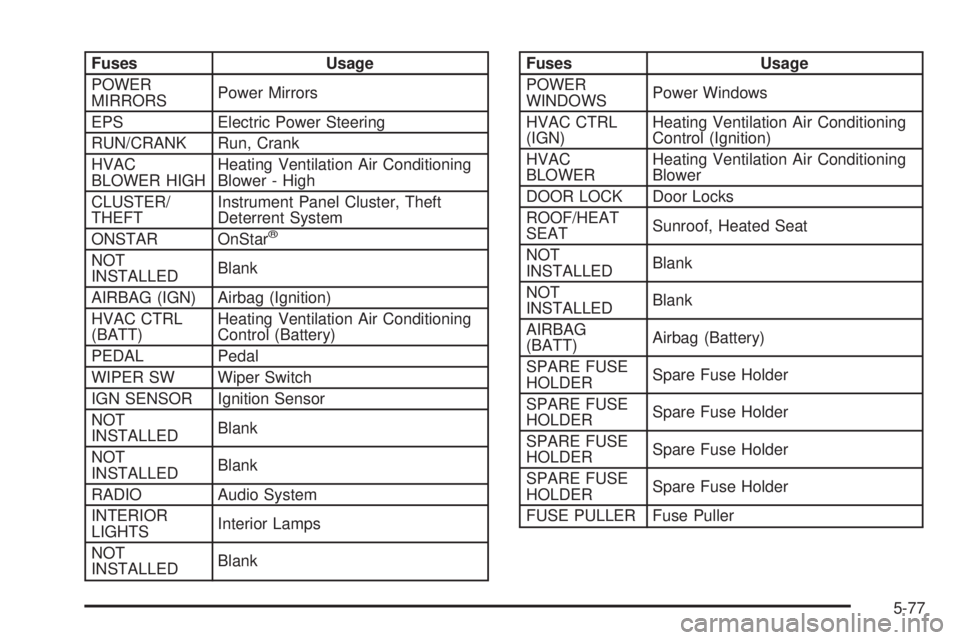
Fuses Usage
POWER
MIRRORSPower Mirrors
EPS Electric Power Steering
RUN/CRANK Run, Crank
HVAC
BLOWER HIGHHeating Ventilation Air Conditioning
Blower - High
CLUSTER/
THEFTInstrument Panel Cluster, Theft
Deterrent System
ONSTAR OnStar
®
NOT
INSTALLEDBlank
AIRBAG (IGN) Airbag (Ignition)
HVAC CTRL
(BATT)Heating Ventilation Air Conditioning
Control (Battery)
PEDAL Pedal
WIPER SW Wiper Switch
IGN SENSOR Ignition Sensor
NOT
INSTALLEDBlank
NOT
INSTALLEDBlank
RADIO Audio System
INTERIOR
LIGHTSInterior Lamps
NOT
INSTALLEDBlank
Fuses Usage
POWER
WINDOWSPower Windows
HVAC CTRL
(IGN)Heating Ventilation Air Conditioning
Control (Ignition)
HVAC
BLOWERHeating Ventilation Air Conditioning
Blower
DOOR LOCK Door Locks
ROOF/HEAT
SEATSunroof, Heated Seat
NOT
INSTALLEDBlank
NOT
INSTALLEDBlank
AIRBAG
(BATT)Airbag (Battery)
SPARE FUSE
HOLDERSpare Fuse Holder
SPARE FUSE
HOLDERSpare Fuse Holder
SPARE FUSE
HOLDERSpare Fuse Holder
SPARE FUSE
HOLDERSpare Fuse Holder
FUSE PULLER Fuse Puller
5-77
Page 310 of 354

Engine Compartment Fuse Block
Your vehicle may not be equipped with all the fuses and
features listed.
The engine compartment fuse block is located on the
driver’s side of the engine compartment, near the
battery.
Fuses Usage
1 Air Conditioner Clutch
2 Electronic Throttle Control
3 Ignition 1
4 Transaxle
5 Injector
6 Emission
Fuses Usage
7 Left Headlamp Low Beam
8 Horn
9 Right Headlamp Low Beam
10 Front Fog Lamps
11 Left Headlamp High Beam
12 Right Headlamp High Beam
13 Powertrain Control Module
14 Windshield Wiper
15 Anti-lock Brake System
16 Powertrain Control Module Ignition 1
17 Cooling Fan 1
18 Cooling Fan 2
19 Run Relay
20 Body Control Module 1
21 Body Control Module Run/Crank
22 Electrical Center 1
23 Electrical Center 2
24 Anti-lock Brake System
25 Body Control Module 2
26 Starter
42 Daytime Running Lamps
44 Stop Lamp
5-78
Page 324 of 354

Automatic Transaxle Shift Lock Control
System Check
{CAUTION:
When you are doing this inspection, the
vehicle could move suddenly. If the vehicle
moves, you or others could be injured.
1. Before you start, be sure you have enough room
around the vehicle. It should be parked on a level
surface.
2. Firmly apply the parking brake. SeeParking Brake
on page 2-28if necessary.
Be ready to apply the regular brake immediately if
the vehicle begins to move.3. With the engine off, turn the ignition to ON, but do
not start the engine. Without applying the regular
brake, try to move the shift lever out of PARK (P)
with normal effort. If the shift lever moves out
of PARK (P), contact your GM Goodwrench
®dealer
for service.
Ignition Transaxle Lock Check
While parked, and with the parking brake set, try to turn
the ignition to OFF in each shift lever position.
The ignition should turn to OFF only when the shift
lever is in PARK (P).
The key should come out only in OFF.
Contact your GM Goodwrench
®dealer if service is
required.
6-10
Page 348 of 354

Heated Seats................................................... 1-4
Heater...........................................................3-19
Highbeam On Light.........................................3-35
Highway Hypnosis...........................................4-23
Hill and Mountain Roads..................................4-24
HomeLink
®Transmitter....................................2-37
HomeLink®Transmitter, Programming................2-38
Hood
Checking Things Under................................5-10
Release.....................................................5-11
Horn............................................................... 3-6
How to Use This Manual...................................... ii
How to Wear Safety Belts Properly...................1-13
I
Ignition Positions.............................................2-20
Infants and Young Children, Restraints...............1-31
Ination -- Tire Pressure..................................5-48
Instrument Panel
Brightness..................................................3-16
Cluster.......................................................3-24
Overview..................................................... 3-4
J
Jump Starting.................................................5-34
K
Keyless Entry System....................................... 2-3
Keys............................................................... 2-2
L
Labelling, Tire Sidewall....................................5-43
Lamps
Battery Run-Down Protection.........................3-17
Dome........................................................3-16
Fog ...........................................................3-16
Overhead Console Reading..........................3-17
Trunk.........................................................3-17
LATCH System
Child Restraints...........................................1-39
Securing a Child Restraint Designed for the
LATCH System........................................1-41
Lift Seat, Power............................................... 1-6
Light
Airbag Readiness........................................3-27
Anti-Lock Brake System Warning...................3-29
Brake System Warning.................................3-28
Charging System.........................................3-28
Cruise Control.............................................3-35
Highbeam On.............................................3-35
Low Fuel Warning.......................................3-36
Malfunction Indicator....................................3-31
6