brake PONTIAC G6 2006 Owner's Manual
[x] Cancel search | Manufacturer: PONTIAC, Model Year: 2006, Model line: G6, Model: PONTIAC G6 2006Pages: 416, PDF Size: 2.66 MB
Page 146 of 416
Automatic Headlamp System
When it is dark enough outside, your automatic
headlamp system will turn on your headlamps at the
normal brightness along with other lamps such as
the taillamps, sidemarker, parking lamps and the
instrument panel lights. The radio lights will also be dim.
Your vehicle is equipped with a light sensor on top of
the middle part of the instrument panel, so be sure it is
not covered which will cause the automatic headlamp
system to be on whenever the ignition is on.
The automatic headlamp system may also be on when
driving through a parking garage, heavy overcast
weather or a tunnel. This is normal.
There is a delay in the transition between the daytime
and nighttime operation of the DRL and the automatic
headlamp systems so that driving under bridges or
bright overhead street lights does not affect the system.
The DRL and automatic headlamp systems will only
be affected when the light sensor sees a change
in lighting lasting longer than this delay.If you start your vehicle in a dark garage, the automatic
headlamp system will come on immediately. Once
you leave the garage, it will take approximately
one minute for the automatic headlamp system to
change to DRL if it is light outside. During that delay,
your instrument panel cluster may not be as bright
as usual. Make sure your instrument panel brightness
control is in the full bright position. See “Instrument
Panel Brightness Control” underInstrument Panel
Brightness on page 3-17.
To idle your vehicle with the automatic headlamp
system off, turn the ignition on and set the exterior light
switch to the off/on position. For Canadian vehicles,
the transaxle must stay in PARK (P) (automatic
transaxle) or the parking brake must be set (manual
transaxle) for this function.
As with any vehicle, you should turn on the regular
headlamps when you need them.
3-16
Page 166 of 416
Charging System Light
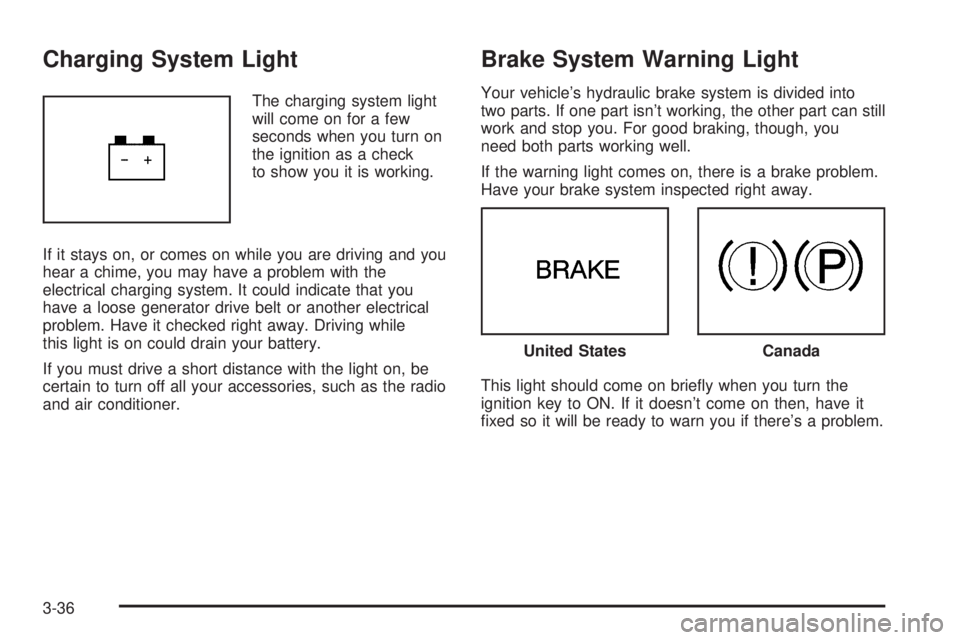
The charging system light
will come on for a few
seconds when you turn on
the ignition as a check
to show you it is working.
If it stays on, or comes on while you are driving and you
hear a chime, you may have a problem with the
electrical charging system. It could indicate that you
have a loose generator drive belt or another electrical
problem. Have it checked right away. Driving while
this light is on could drain your battery.
If you must drive a short distance with the light on, be
certain to turn off all your accessories, such as the radio
and air conditioner.
Brake System Warning Light
Your vehicle’s hydraulic brake system is divided into
two parts. If one part isn’t working, the other part can still
work and stop you. For good braking, though, you
need both parts working well.
If the warning light comes on, there is a brake problem.
Have your brake system inspected right away.
This light should come on briey when you turn the
ignition key to ON. If it doesn’t come on then, have it
xed so it will be ready to warn you if there’s a problem.
United StatesCanada
3-36
Page 167 of 416
When the ignition is on, the brake system warning light
will also come on when you set your parking brake.
The light will stay on if your parking brake doesn’t
release fully. If it stays on after your parking brake is
fully released, it means you have a brake problem.
If the light comes on while you are driving, pull off the
road and stop carefully. You may notice that the pedal is
harder to push. Or, the pedal may go closer to the
oor. It may take longer to stop. If the light is still on,
have the vehicle towed for service. SeeTowing
Your Vehicle on page 4-38.
{CAUTION:
Your brake system may not be working
properly if the brake system warning light is
on. Driving with the brake system warning light
on can lead to an accident. If the light is still
on after you have pulled off the road and
stopped carefully, have the vehicle towed
for service.
Anti-Lock Brake System
Warning Light
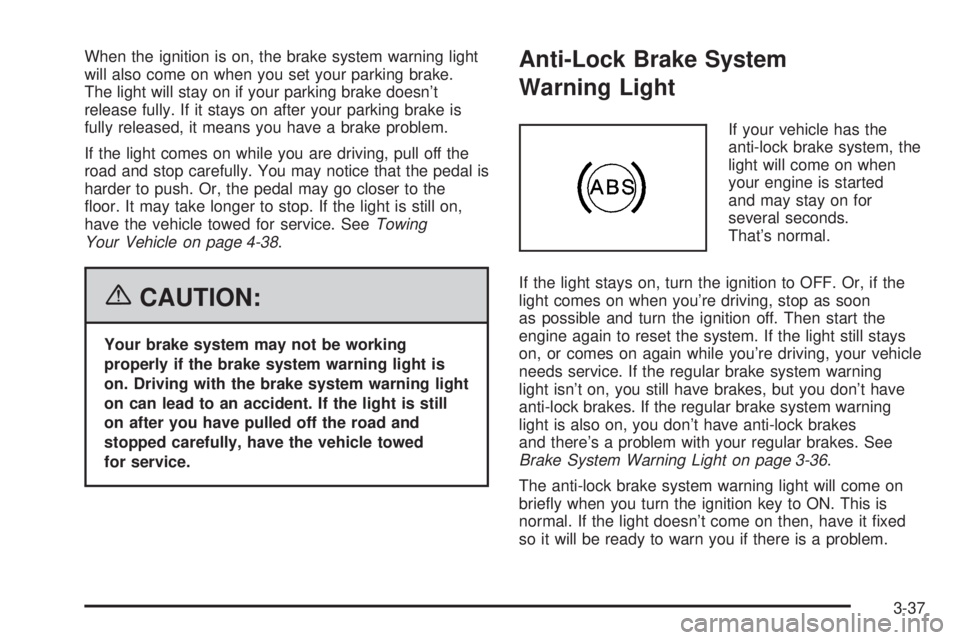
If your vehicle has the
anti-lock brake system, the
light will come on when
your engine is started
and may stay on for
several seconds.
That’s normal.
If the light stays on, turn the ignition to OFF. Or, if the
light comes on when you’re driving, stop as soon
as possible and turn the ignition off. Then start the
engine again to reset the system. If the light still stays
on, or comes on again while you’re driving, your vehicle
needs service. If the regular brake system warning
light isn’t on, you still have brakes, but you don’t have
anti-lock brakes. If the regular brake system warning
light is also on, you don’t have anti-lock brakes
and there’s a problem with your regular brakes. See
Brake System Warning Light on page 3-36.
The anti-lock brake system warning light will come on
briey when you turn the ignition key to ON. This is
normal. If the light doesn’t come on then, have it xed
so it will be ready to warn you if there is a problem.
3-37
Page 178 of 416
When the desired option is reached, press the enter
button to toggle between the modes of that option. To
make a selection, press the MENU button again.
If no selection is made within 10 seconds, the display
will revert back to the previous information displayed.
The MENU mode is exited when the information button
is pressed, a 10 second time period has elapsed,
the ignition is turned to OFF, or the end of the MENU
list is reached.
SeeDIC Vehicle Personalization on page 3-52for more
information on the personalization options.
Enter
ENTER/r(Enter):Press this button to reset certain
functions and to turn off or acknowledge messages
on the DIC display. This button also toggles through the
options available in each personalization menu.
DIC Warnings and Messages
These messages will appear if there is a problem
detected in one of your vehicle’s systems.
Any message will clear when the vehicle’s condition
is no longer present. To acknowledge a message
and clear it from the display, press any of the
three DIC buttons. The warning message will come
back on the next time the vehicle is turned off and back
on if the condition is still present. With most messages,
a warning chime will sound when the message is
displayed. Your vehicle may have other warning
messages.
AUTO (Automatic) LIGHTS OFF:This message will
display if the automatic headlamp system is disabled
with the headlamp switch.
AUTO (Automatic) LIGHTS ON:This message will
display if the automatic headlamp system is enabled
with the headlamp switch.
BRAKE FLUID:This message will display to inform the
driver that the brake uid level is low while the ignition
is in ON. Have the brake system serviced by your
GM dealer as soon as possible.
3-48
Page 180 of 416

LOW OIL LEVEL:This message may display on some
vehicles. For correct operation of the low oil sensing
system, your vehicle should be on a level surface.
A false LOW OIL LEVEL message may appear if the
vehicle is parked on a grade. The oil level sensing
system does not check for actual oil level if the engine
has been off for a short period of time, and the oil
level is never checked while the engine is running. If the
LOW OIL LEVEL message appears, and your vehicle
has been parked on level ground with the engine off for
at least 30 minutes, the oil level should be checked
by observing the oil dipstick. Prior to checking the
oil level, be sure the engine has been off for a few
minutes and your vehicle is on a level surface. Then
check the dipstick and add oil if necessary. SeeEngine
Oil on page 5-17.
LOW WASHER FLUID:This message will display
when your vehicle is low on windshield washer uid. You
should rell the windshield washer uid reservoir as
soon as possible. See “Adding Washer Fluid” under
Windshield Washer Fluid on page 5-38.
PARKING BRAKE:This message will display if the
parking brake is left engaged and you try to drive away.
SeeParking Brake on page 2-33for more information.
POWER STEERING:This message will display if
a problem has been detected with the electric power
steering, if equipped. Have your vehicle serviced
immediately by your GM dealer.SERVICE AIR BAG:There is a problem with the airbag
system when this message appears. Have your
vehicle serviced immediately by your GM dealer.
STABIL (StabiliTrak
®) NOT READY:When you rst
start your vehicle and drive away, especially during cold
winter weather, this message may display. This is
normal. The StabiliTrak
®performance is affected until
this message automatically clears from the DIC display.
If you acknowledge and clear this message by
pressing one of the DIC buttons, the StabiliTrak
®
system will not be ready. The system will only be ready
when this message clears from the DIC display on
its own. SeeStabiliTrak
®System on page 4-12for
more information.
TOP FAILED:If your vehicle has a retractable hardtop,
this message will display after ve unsuccessful
attempts at retractable hardtop operation. See your
GM dealer for service. SeeLowering the Retractable
Hardtop on page 2-49andRaising the Retractable
Hardtop on page 2-51for more information.
Top Inop (Inoperative) – Trunk:If your vehicle has a
retractable hardtop, this message will display if the
trunk lid is not completely closed when operating the
retractable hardtop. Make sure that the trunk lid is
closed when operating the retractable hardtop. See
Trunk on page 2-14,Lowering the Retractable Hardtop
on page 2-49, andRaising the Retractable Hardtop
on page 2-51for more information.
3-50
Page 181 of 416
TOP MOVE COMPLT (Complete):If your vehicle has
a retractable hardtop, this message will display when
the retractable hardtop has lowered or raised
completely. SeeLowering the Retractable Hardtop on
page 2-49andRaising the Retractable Hardtop on
page 2-51for more information.
Top Not Allowed:If your vehicle has a retractable
hardtop with an automatic transaxle, this message will
display if the retractable hardtop button is pressed while
the vehicle is not in PARK (P). Make sure that the
vehicle is in PARK (P) when operating the retractable
hardtop. SeeLowering the Retractable Hardtop on
page 2-49andRaising the Retractable Hardtop
on page 2-51for more information.
If your vehicle has a retractable hardtop with a manual
transaxle, this message will display if the retractable
hardtop button is pressed while the parking brake is not
set and/or the vehicle’s speed is greater than 2 mph
(3 km/h). Make sure that the parking brake is set and the
vehicle’s speed is lowered or the vehicle is stopped
when operating the retractable hardtop. SeeLowering
the Retractable Hardtop on page 2-49andRaising
the Retractable Hardtop on page 2-51for more
information.
TOP NOT SECURE:If your vehicle has a retractable
hardtop, this message will display when the retractable
hardtop button is released before the top open orclose operation is complete. Press and hold the
retractable hardtop button to fully open or close the top.
SeeLowering the Retractable Hardtop on page 2-49
andRaising the Retractable Hardtop on page 2-51
for more information.
TOP OVER TEMP (Temperature):If your vehicle has
a retractable hardtop, this message will display when
the retractable hardtop button is pressed and the
hardtop pump motor temperature is too hot. Wait for the
hardtop pump motor to cool down before using the
retractable hardtop. SeeLowering the Retractable
Hardtop on page 2-49andRaising the Retractable
Hardtop on page 2-51for more information.
TOP TOO COLD:If your vehicle has a retractable
hardtop, this message will display when the retractable
hardtop button is pressed and the hardtop pump
motor temperature is too cold. Wait for the hardtop
pump motor to warm up before using the retractable
hardtop. SeeLowering the Retractable Hardtop on
page 2-49andRaising the Retractable Hardtop
on page 2-51for more information.
TRUNK AJAR:This message will display when the
trunk lid of your vehicle is not closed completely.
You should make sure that the trunk lid is closed
completely. SeeTrunk on page 2-14for more
information.
3-51
Page 221 of 416
Your Driving, the Road, and Your Vehicle..........4-2
Defensive Driving...........................................4-2
Drunken Driving.............................................4-3
Control of a Vehicle........................................4-5
Braking.........................................................4-6
Anti-Lock Brake System (ABS).........................4-7
Braking in Emergencies...................................4-8
Traction Control System (TCS).........................4-9
Enhanced Traction System (ETS)....................4-11
StabiliTrak
®System......................................4-12
Steering......................................................4-13
Off-Road Recovery.......................................4-15
Passing.......................................................4-16
Loss of Control.............................................4-17
Driving at Night............................................4-18
Driving in Rain and on Wet Roads..................4-20City Driving..................................................4-22
Freeway Driving...........................................4-23
Before Leaving on a Long Trip.......................4-24
Highway Hypnosis........................................4-25
Hill and Mountain Roads................................4-26
Winter Driving..............................................4-27
If Your Vehicle is Stuck in Sand, Mud,
Ice or Snow..............................................4-32
Rocking Your Vehicle to Get It Out.................4-32
Loading Your Vehicle....................................4-33
Towing..........................................................4-38
Towing Your Vehicle.....................................4-38
Recreational Vehicle Towing...........................4-38
Towing a Trailer...........................................4-40
Section 4 Driving Your Vehicle
4-1
Page 222 of 416
Your Driving, the Road, and
Your Vehicle
Defensive Driving
The best advice anyone can give about driving is: Drive
defensively.
Please start with a very important safety device in your
vehicle: Buckle up. SeeSafety Belts: They Are for
Everyone on page 1-10.
{CAUTION:
Defensive driving really means “be ready for
anything.” On city streets, rural roads, or
expressways, it means “always expect the
unexpected.”
Assume that pedestrians or other drivers are
going to be careless and make mistakes.
Anticipate what they might do. Be ready for
their mistakes.
CAUTION: (Continued)
CAUTION: (Continued)
Rear-end collisions are about the most
preventable of accidents. Yet they are
common. Allow enough following distance. It
is the best defensive driving maneuver, in both
city and rural driving. You never know when
the vehicle in front of you is going to brake or
turn suddenly.
Defensive driving requires that a driver
concentrate on the driving task. Anything that
distracts from the driving task — such as
concentrating on a cellular telephone call,
reading, reaching for something on the oor,
adjusting settings, or programming vehicle
systems — makes proper defensive driving
more difficult and can even cause a collision,
with resulting injury. Ask a passenger to help
do these things, or pull off the road in a safe
place to do them. These simple defensive
driving techniques could save your life.
4-2
Page 225 of 416

What if there is an emergency, a need to take sudden
action, as when a child darts into the street? A person
with even a moderate BAC might not be able to react
quickly enough to avoid the collision.
There is something else about drinking and driving that
many people do not know. Medical research shows that
alcohol in a person’s system can make crash injuries
worse, especially injuries to the brain, spinal cord, or
heart. This means that when anyone who has been
drinking — driver or passenger — is in a crash, that
person’s chance of being killed or permanently disabled
is higher than if the person had not been drinking.
{CAUTION:
Drinking and then driving is very dangerous.
Your reexes, perceptions, attentiveness, and
judgment can be affected by even a small
amount of alcohol. You can have a serious — or
even fatal — collision if you drive after drinking.
Please do not drink and drive or ride with a
driver who has been drinking. Ride home in a
cab; or if you are with a group, designate a
driver who will not drink.
Control of a Vehicle
You have three systems that make your vehicle go where
you want it to go. They are the brakes, the steering, and
the accelerator. All three systems have to do their work at
the places where the tires meet the road.
Sometimes, as when you are driving on snow or ice, it
is easy to ask more of those control systems than
the tires and road can provide. That means you can lose
control of your vehicle. SeeTraction Control System
(TCS) on page 4-9,Enhanced Traction System (ETS) on
page 4-11andStabiliTrak
®System on page 4-12.
Adding non-GM accessories can affect your vehicle’s
performance. SeeAccessories and Modications
on page 5-3.
4-5
Page 226 of 416
Braking
Braking action involves perception time and
reaction time.
First, you have to decide to push on the brake pedal.
That is perception time. Then you have to bring up your
foot and do it. That is reaction time.
Average reaction time is about three-fourths of a
second. But that is only an average. It might be less
with one driver and as long as two or three seconds or
more with another. Age, physical condition, alertness,
coordination, and eyesight all play a part. So do alcohol,
drugs, and frustration. But even in three-fourths of a
second, a vehicle moving at 60 mph (100 km/h) travels
66 feet (20 m). That could be a lot of distance in an
emergency, so keeping enough space between
your vehicle and others is important.
And, of course, actual stopping distances vary greatly
with the surface of the road, whether it is pavement
or gravel; the condition of the road, whether it is
wet, dry, or icy; tire tread; the condition of your brakes;
the weight of the vehicle; and the amount of brake
force applied.Avoid needless heavy braking. Some people drive in
spurts — heavy acceleration followed by heavy
braking — rather than keeping pace with traffic. This is
a mistake. Your brakes may not have time to cool
between hard stops. Your brakes will wear out much
faster if you do a lot of heavy braking. If you keep pace
with the traffic and allow realistic following distances,
you will eliminate a lot of unnecessary braking.
That means better braking and longer brake life.
If your engine ever stops while you are driving, brake
normally but do not pump your brakes. If you do,
the pedal may get harder to push down. If your engine
stops, you will still have some power brake assist.
But you will use it when you brake. Once the power
assist is used up, it may take longer to stop and
the brake pedal will be harder to push.
Adding non-GM accessories can affect your vehicle’s
performance. SeeAccessories and Modications
on page 5-3.
4-6