brake PONTIAC G6 2006 Service Manual
[x] Cancel search | Manufacturer: PONTIAC, Model Year: 2006, Model line: G6, Model: PONTIAC G6 2006Pages: 416, PDF Size: 2.66 MB
Page 249 of 416
But wet ice can be even more trouble because it may
offer the least traction of all. You can get wet ice when it is
about freezing, 32°F (0°C), and freezing rain begins to
fall. Try to avoid driving on wet ice until salt and sand
crews can get there.
Whatever the condition — smooth ice, packed, blowing,
or loose snow — drive with caution.
If you have a traction system, it will improve your ability
to accelerate when driving on a slippery road. Even
though your vehicle has a traction system, you will want
to slow down and adjust your driving to the road
conditions. Under certain conditions, you may want to
turn the traction system off, such as when driving
through deep snow and loose gravel, to help maintain
vehicle motion at lower speeds. SeeTraction Control
System (TCS) on page 4-9,Enhanced Traction System
(ETS) on page 4-11,orStabiliTrak
®System on
page 4-12.
Unless you have the anti-lock braking system (ABS),
you will want to brake very gently, too. If you do
have ABS, seeAnti-Lock Brake System (ABS) on
page 4-7. ABS improves your vehicle’s stability when
you make a hard stop on a slippery road. Whether you
have ABS or not, you will want to begin stopping
sooner than you would on dry pavement. Without ABS,
if you feel your vehicle begin to slide, let up on the
brakes a little. Push the brake pedal down steadily to
get the most traction you can.Remember, unless you have ABS, if you brake so hard
that your wheels stop rolling, you will just slide. Brake
so your wheels always keep rolling and you can
still steer.
Whatever your braking system, allow greater
following distance on any slippery road.
Watch for slippery spots. The road might be ne
until you hit a spot that is covered with ice. On
an otherwise clear road, ice patches may appear in
shaded areas where the sun cannot reach, such
as around clumps of trees, behind buildings,
or under bridges. Sometimes the surface of a curve
or an overpass may remain icy when the
surrounding roads are clear. If you see a patch of
ice ahead of you, brake before you are on it. Try not
to brake while you are actually on the ice, and
avoid sudden steering maneuvers.
4-29
Page 259 of 416

1. Position the vehicle to tow and then secure it.
2. Turn the ignition to OFF.
3. Set the parking brake.
4. To prevent your battery from draining while the
vehicle is being towed, remove the following
fuse from the engine compartment fuse block:
(20 BCM 1). SeeRocking Your Vehicle to Get It
Out on page 4-32for more information.
5. Turn the ignition to ACC.
6. Shift your transaxle to Neutral (N).
7. Release the parking brake.Notice:If you exceed 65 mph (105 km/h) while
towing your vehicle, it could be damaged. Never
exceed 65 mph (105 km/h) while towing your vehicle.
Notice:Towing your vehicle from the rear could
damage it. Also, repairs would not be covered by
the warranty. Never have your vehicle towed from
the rear.
4-39
Page 260 of 416
Dolly Towing
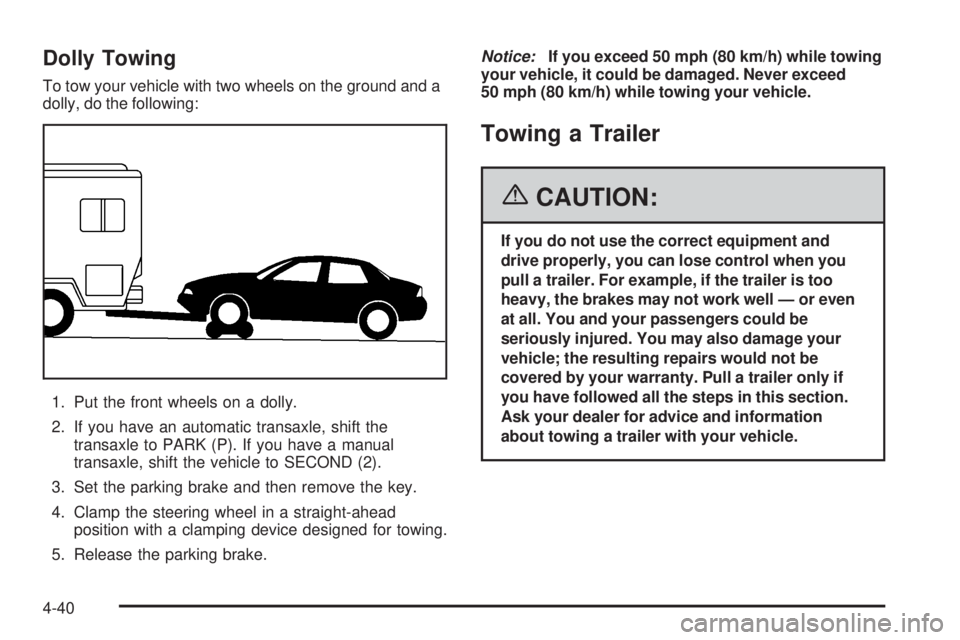
To tow your vehicle with two wheels on the ground and a
dolly, do the following:
1. Put the front wheels on a dolly.
2. If you have an automatic transaxle, shift the
transaxle to PARK (P). If you have a manual
transaxle, shift the vehicle to SECOND (2).
3. Set the parking brake and then remove the key.
4. Clamp the steering wheel in a straight-ahead
position with a clamping device designed for towing.
5. Release the parking brake.Notice:If you exceed 50 mph (80 km/h) while towing
your vehicle, it could be damaged. Never exceed
50 mph (80 km/h) while towing your vehicle.
Towing a Trailer
{CAUTION:
If you do not use the correct equipment and
drive properly, you can lose control when you
pull a trailer. For example, if the trailer is too
heavy, the brakes may not work well — or even
at all. You and your passengers could be
seriously injured. You may also damage your
vehicle; the resulting repairs would not be
covered by your warranty. Pull a trailer only if
you have followed all the steps in this section.
Ask your dealer for advice and information
about towing a trailer with your vehicle.
4-40
Page 264 of 416

Hitches
It is important to have the correct hitch equipment.
Crosswinds, large trucks going by and rough roads are a
few reasons why you’ll need the right hitch. Here are
some rules to follow:
The rear bumper on your vehicle is not intended for
hitches. Do not attach rental hitches or other
bumper-type hitches to it. Use only a frame-mounted
hitch that does not attach to the bumper.
Will you have to make any holes in the body of your
vehicle when you install a trailer hitch? If you do, then
be sure to seal the holes later when you remove the
hitch. If you do not seal them, deadly carbon
monoxide (CO) from your exhaust can get into your
vehicle. SeeEngine Exhaust on page 2-37. Dirt and
water can, too.
Safety Chains
You should always attach chains between your vehicle
and your trailer. Cross the safety chains under the tongue
of the trailer so that the tongue will not drop to the road if
it becomes separated from the hitch. Instructions about
safety chains may be provided by the hitch manufacturer
or by the trailer manufacturer. Follow the manufacturer’s
recommendation for attaching safety chains and do not
attach them to the bumper. Always leave just enough
slack so you can turn with your rig. And, never allow
safety chains to drag on the ground.
Trailer Brakes
Does your trailer have its own brakes?
Be sure to read and follow the instructions for the trailer
brakes so you will be able to install, adjust and
maintain them properly. And because you may have
anti-lock brakes, do not try to tap into your vehicle’s
brake system. If you do, both systems will not work well,
or at all.
Driving with a Trailer
Towing a trailer requires a certain amount of experience.
Before setting out for the open road, you will want to
get to know your rig. Acquaint yourself with the feel of
handling and braking with the added weight of the trailer.
And always keep in mind that the vehicle you are
driving is now a good deal longer and not nearly as
responsive as your vehicle is by itself.
Before you start, check all trailer hitch parts and
attachments, safety chains, electrical connector, lamps,
tires and mirror adjustment. If the trailer has electric
brakes, start your vehicle and trailer moving and then
apply the trailer brake controller by hand to be sure
the brakes are working. This lets you check your
electrical connection at the same time.
During your trip, check occasionally to be sure that the
load is secure, and that the lamps and any trailer
brakes are still working.
4-44
Page 266 of 416

Driving On Grades
When towing a trailer on long uphill grades and the
outside temperature is above 85°F (29°C), reduce your
vehicle speed to 45 mph (72 km/h) to avoid overheating
the engine cooling system.
Reduce speed and shift to a lower gearbeforeyou start
down a long or steep downgrade. If you do not shift
down, you might have to use your brakes so much that
they would get hot and no longer work well.
Parking on Hills
{CAUTION:
You really should not park your vehicle, with a
trailer attached, on a hill. If something goes
wrong, your rig could start to move. People
can be injured, and both your vehicle and the
trailer can be damaged.But if you ever have to park your rig on a hill, here is
how to do it:
1. Apply your regular brakes, but do not shift into
PARK (P) for an automatic transaxle or into
gear for a manual transaxle. When parking uphill,
turn your wheels away from the curb. When parking
downhill, turn your wheels into the curb.
2. Have someone place chocks under the trailer
wheels.
3. When the chocks are in place, release the regular
brakes until the chocks absorb the load.
4. Reapply the regular brakes. Then apply your
parking brake and shift into PARK (P).
5. Release the regular brakes.
4-46
Page 267 of 416

When You Are Ready to Leave After
Parking on a Hill
1. Apply your regular brakes and hold the pedal down
while you:
start your engine,
shift into a gear, and
release the parking brake.
2. Let up on the brake pedal.
3. Drive slowly until the trailer is clear of the chocks.
4. Stop and have someone pick up and store the
chocks.
Maintenance When Trailer Towing
Your vehicle will need service more often when you are
pulling a trailer. See the Maintenance Schedule for
more on this. Things that are especially important in
trailer operation are automatic transaxle uid (do
not overll), engine oil, drive belt, cooling system and
brake system. Each of these is covered in this manual,
and the Index will help you nd them quickly. If you
are trailering, it is a good idea to review this information
before you start your trip.
Check periodically to see that all hitch nuts and bolts
are tight.
Engine Cooling When Trailer Towing
Your cooling system may temporarily overheat during
severe operating conditions. SeeEngine Overheating on
page 5-30.
4-47
Page 269 of 416

Service............................................................5-3
Accessories and Modications..........................5-3
California Proposition 65 Warning.....................5-3
Doing Your Own Service Work.........................5-4
Adding Equipment to the Outside of
Your Vehicle..............................................5-5
Fuel................................................................5-5
Gasoline Octane............................................5-5
Gasoline Specications....................................5-5
California Fuel...............................................5-6
Additives.......................................................5-6
Fuels in Foreign Countries...............................5-7
Filling the Tank..............................................5-8
Filling a Portable Fuel Container.....................5-10
Checking Things Under the Hood....................5-10
Hood Release..............................................5-11
Engine Compartment Overview.......................5-12
Engine Oil...................................................5-17
Engine Oil Life System..................................5-20
Engine Air Cleaner/Filter................................5-22
Automatic Transaxle Fluid (2.4L LE5 and
3.5L LX9 Engines).....................................5-23
Automatic Transaxle Fluid (3.9L LZ9 Engine). . . .5-24
Manual Transaxle Fluid..................................5-26
Hydraulic Clutch...........................................5-26
Engine Coolant.............................................5-27Coolant Surge Tank Pressure Cap..................5-30
Engine Overheating.......................................5-30
Overheated Engine Protection
Operating Mode........................................5-32
Cooling System............................................5-32
Power Steering Fluid.....................................5-37
Windshield Washer Fluid................................5-38
Brakes........................................................5-39
Battery........................................................5-42
Jump Starting...............................................5-42
Headlamp Aiming...........................................5-47
Bulb Replacement..........................................5-49
Halogen Bulbs..............................................5-49
Headlamps, Front Turn Signal, Sidemarker,
and Parking Lamps....................................5-50
Center High-Mounted Stoplamp (CHMSL)
(Sedan)...................................................5-51
Center High-Mounted Stoplamp (CHMSL)
(Retractable Hardtop and Coupe).................5-51
Taillamps, Turn Signal, Sidemarker, Stoplamps
and Back-up Lamps (Sedan).......................5-52
Taillamps, Turn Signal, Sidemarker, Stoplamps
and Back-up Lamps (Coupe).......................5-53
Taillamps, Turn Signal, Sidemarker, Stoplamps
and Back-up Lamps (Retractable Hardtop). . . .5-54
Replacement Bulbs.......................................5-55
Section 5 Service and Appearance Care
5-1
Page 278 of 416

Filling a Portable Fuel Container
{CAUTION:
Never ll a portable fuel container while it is in
your vehicle. Static electricity discharge from
the container can ignite the gasoline vapor.
You can be badly burned and your vehicle
damaged if this occurs. To help avoid injury
to you and others:
Dispense gasoline only into approved
containers.
Do not ll a container while it is inside a
vehicle, in a vehicle’s trunk, pickup bed,
or on any surface other than the ground.
Bring the ll nozzle in contact with the
inside of the ll opening before operating
the nozzle. Contact should be maintained
until the lling is complete.
Do not smoke while pumping gasoline.
Checking Things Under
the Hood
{CAUTION:
An electric fan under the hood can start up
and injure you even when the engine is not
running. Keep hands, clothing and tools away
from any underhood electric fan.
{CAUTION:
Things that burn can get on hot engine parts
and start a re. These include liquids like fuel,
oil, coolant, brake uid, windshield washer
and other uids, and plastic or rubber. You or
others could be burned. Be careful not to drop
or spill things that will burn onto a hot engine.
5-10
Page 281 of 416

A. Engine Air Cleaner/Filter. SeeEngine Air
Cleaner/Filter on page 5-22.
B. Engine Oil Fill Cap. See “When to Add Engine Oil”
underEngine Oil on page 5-17.
C. Engine Oil Dipstick. See “Checking Engine Oil”
underEngine Oil on page 5-17.
D. Engine Coolant Reservoir. SeeEngine Coolant
on page 5-27.E. Brake Fluid Reservoir. See “Brake Fluid” under
Brakes on page 5-39.
F. Battery. SeeBattery on page 5-42.
G. Windshield Washer Fluid Reservoir. See “Adding
Washer Fluid” underWindshield Washer Fluid
on page 5-38.
H. Engine Compartment Fuse Block. SeeEngine
Compartment Fuse Block on page 5-100.
5-13
Page 283 of 416

A. Engine Air Cleaner/Filter. SeeEngine Air
Cleaner/Filter on page 5-22.
B. Engine Oil Fill Cap. See “When to Add Engine Oil”
underEngine Oil on page 5-17.
C. Engine Oil Dipstick. See “Checking Engine Oil”
underEngine Oil on page 5-17.
D. Engine Coolant Reservoir. SeeEngine Coolant
on page 5-27.E. Brake Fluid Reservoir. See “Brake Fluid” under
Brakes on page 5-39.
F. Battery. SeeBattery on page 5-42.
G. Engine Compartment Fuse Block. SeeEngine
Compartment Fuse Block on page 5-100.
H. Windshield Washer Fluid Reservoir. See “Adding
Washer Fluid” underWindshield Washer Fluid
on page 5-38.
5-15