ECU PONTIAC G6 2007 User Guide
[x] Cancel search | Manufacturer: PONTIAC, Model Year: 2007, Model line: G6, Model: PONTIAC G6 2007Pages: 486, PDF Size: 2.78 MB
Page 56 of 486
Securing an Add-on Child Restraint in
the Vehicle
{CAUTION:
A child can be seriously injured or killed
in a crash if the child restraint is not
properly secured in the vehicle. Make sure
the child restraint is properly installed in
the vehicle using the vehicle’s safety belt
or LATCH system, following the
instructions that came with that restraint,
and also the instructions in this manual.
To help reduce the chance of injury, the child
restraint must be secured in the vehicle. Child
restraint systems must be secured in vehicle seats
by lap belts or the lap belt portion of a lap-shoulder
belt, or by the LATCH system.SeeLower Anchors and Tethers for Children
(LATCH) on page 60for more information. A child
can be endangered in a crash if the child
restraint is not properly secured in the vehicle.
When securing an add-on child restraint, refer to
the instructions that come with the restraint
which may be on the restraint itself or in a booklet,
or both, and to this manual. The child restraint
instructions are important, so if they are not
available, obtain a replacement copy from the
manufacturer.
Keep in mind that an unsecured child restraint can
move around in a collision or sudden stop and
injure people in the vehicle. Be sure to properly
secure any child restraint in your vehicle — even
when no child is in it.
56
Page 57 of 486
Securing the Child Within the Child
Restraint
There are several systems for securing the child
within the child restraint. One system, the
three-point harness, has straps that come down
over each of the infant’s shoulders and buckle
together at the crotch. The ve-point harness
system has two shoulder straps, two hip straps, and
a crotch strap. A shield may take the place of hip
straps. A T-shaped shield has shoulder straps that
are attached to a at pad which rests low against
the child’s body. A shelf- or armrest-type shield has
straps that are attached to a wide, shelf-like shield
that swings up or to the side.
{CAUTION:
A child can be seriously injured or killed
in a crash if the child is not properly
secured in the child restraint. Make sure
the child is properly secured, following
the instructions that came with that
restraint.
Because there are different systems, it is important
to refer to the instructions that come with the
restraint. A child can be endangered in a crash if
the child is not properly secured in the child
restraint.
57
Page 58 of 486
Where to Put the Restraint
Accident statistics show that children are safer if
they are restrained in the rear rather than the front
seat. We recommend that child restraints be
secured in a rear seat, including an infant riding in
a rear-facing infant seat, a child riding in a
forward-facing child seat and an older child riding
in a booster seat.
Your vehicle has a rear seat that will accommodate
a rear-facing child restraint. A label on your sun
visor says, “Never put a rear-facing child seat
in the front.” This is because the risk to the
rear-facing child is so great, if the airbag deploys.
{CAUTION:
A child in a rear-facing child restraint can
be seriously injured or killed if the right
front passenger’s airbag inates. This is
because the back of the rear-facing child
restraint would be very close to the
inating airbag.
CAUTION: (Continued)
CAUTION: (Continued)
Even though the passenger sensing
system is designed to turn off the
passenger’s frontal airbag if the system
detects a rear-facing child restraint, no
system is fail-safe, and no one can
guarantee that an airbag will not deploy
under some unusual circumstance, even
though it is turned off. We recommend
that rear-facing child restraints be secured
in the rear seat, even if the airbag is off.
If you need to secure a forward-facing
child restraint in the right front seat,
always move the front passenger seat as
far back as it will go. It is better to secure
the child restraint in a rear seat.
Wherever you install a child restraint, be sure to
secure the child restraint properly.
58
Page 59 of 486
Keep in mind that an unsecured child restraint can
move around in a collision or sudden stop and
injure people in the vehicle. Be sure to properly
secure any child restraint in your vehicle — even
when no child is in it.
If you need to secure more than one child restraint
in the rear seat, review the following illustrations.
Depending on where you place the child restraint,
you may not be able to access certain safety
belt assemblies or LATCH anchors for additional
passengers or child restraints.
Congurations for Use of Child
Restraints (Sedan Only)
A. Child restraint using
LATCH
B. Child restraint or
occupant using
safety beltA. Occupant prohibited
B. Child restraint using
LATCH
A. Child restraint using
LATCH
B. Occupant prohibited
C. Child restraint
using safety belt or
LATCH or occupant
using safety belt
59
Page 60 of 486
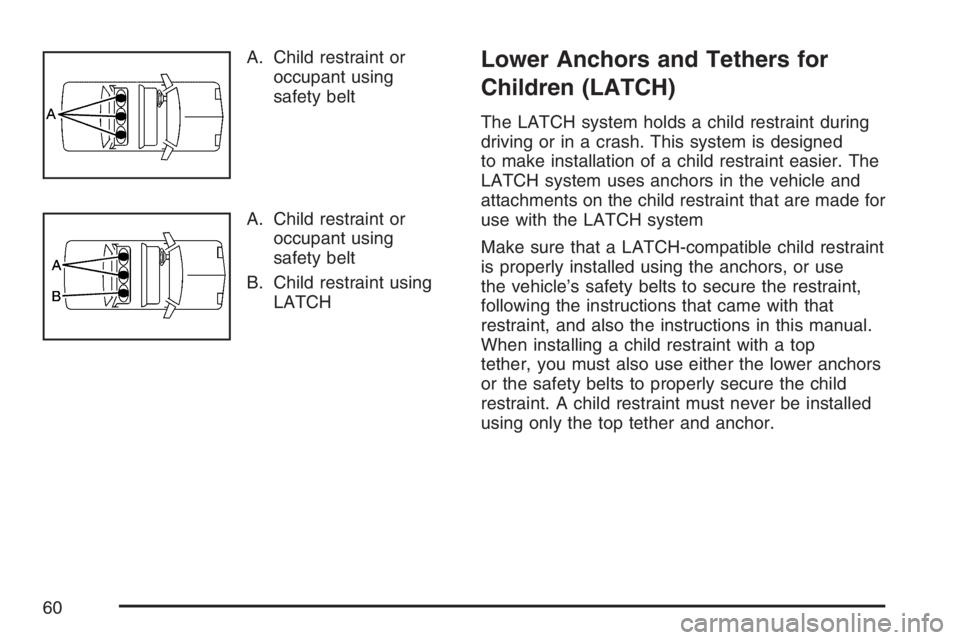
A. Child restraint or
occupant using
safety belt
A. Child restraint or
occupant using
safety belt
B. Child restraint using
LATCHLower Anchors and Tethers for
Children (LATCH)
The LATCH system holds a child restraint during
driving or in a crash. This system is designed
to make installation of a child restraint easier. The
LATCH system uses anchors in the vehicle and
attachments on the child restraint that are made for
use with the LATCH system
Make sure that a LATCH-compatible child restraint
is properly installed using the anchors, or use
the vehicle’s safety belts to secure the restraint,
following the instructions that came with that
restraint, and also the instructions in this manual.
When installing a child restraint with a top
tether, you must also use either the lower anchors
or the safety belts to properly secure the child
restraint. A child restraint must never be installed
using only the top tether and anchor.
60
Page 62 of 486
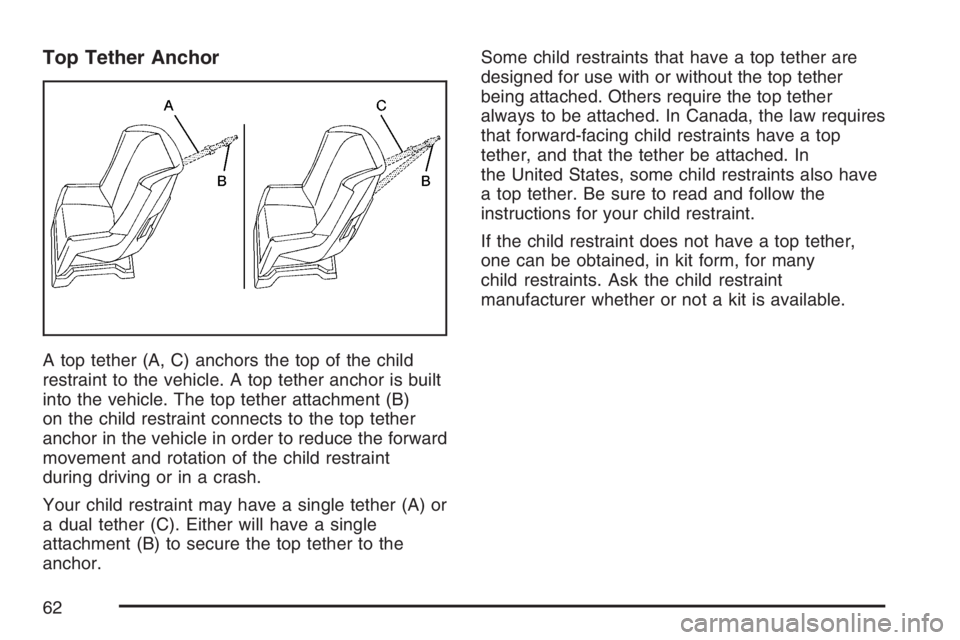
Top Tether Anchor
A top tether (A, C) anchors the top of the child
restraint to the vehicle. A top tether anchor is built
into the vehicle. The top tether attachment (B)
on the child restraint connects to the top tether
anchor in the vehicle in order to reduce the forward
movement and rotation of the child restraint
during driving or in a crash.
Your child restraint may have a single tether (A) or
a dual tether (C). Either will have a single
attachment (B) to secure the top tether to the
anchor.Some child restraints that have a top tether are
designed for use with or without the top tether
being attached. Others require the top tether
always to be attached. In Canada, the law requires
that forward-facing child restraints have a top
tether, and that the tether be attached. In
the United States, some child restraints also have
a top tether. Be sure to read and follow the
instructions for your child restraint.
If the child restraint does not have a top tether,
one can be obtained, in kit form, for many
child restraints. Ask the child restraint
manufacturer whether or not a kit is available.
62
Page 64 of 486
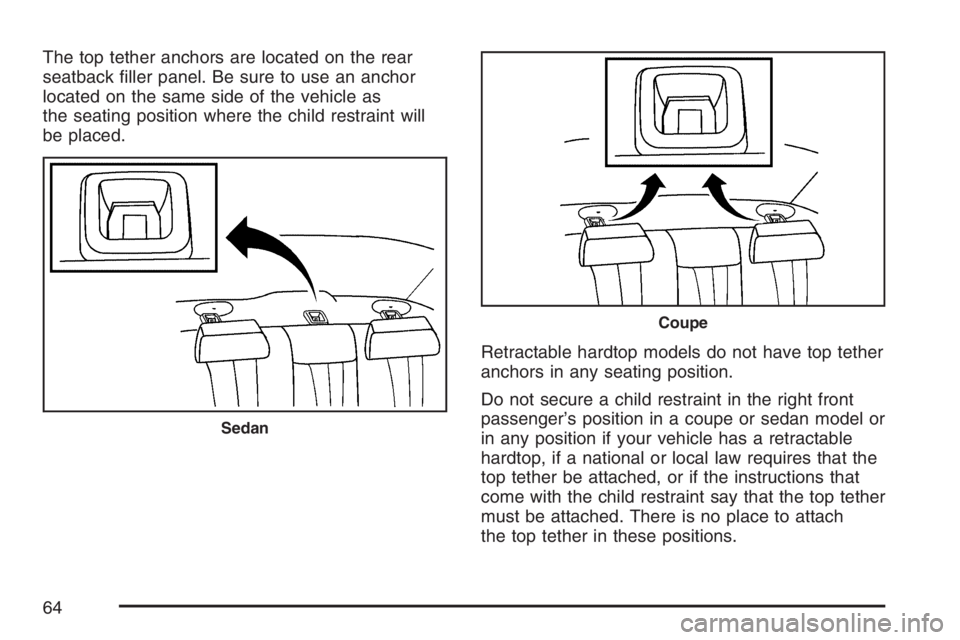
The top tether anchors are located on the rear
seatback ller panel. Be sure to use an anchor
located on the same side of the vehicle as
the seating position where the child restraint will
be placed.
Retractable hardtop models do not have top tether
anchors in any seating position.
Do not secure a child restraint in the right front
passenger’s position in a coupe or sedan model or
in any position if your vehicle has a retractable
hardtop, if a national or local law requires that the
top tether be attached, or if the instructions that
come with the child restraint say that the top tether
must be attached. There is no place to attach
the top tether in these positions.
Sedan
Coupe
64
Page 65 of 486
Accident statistics show that children are safer if
they are restrained in the rear rather than the front
seat. SeeWhere to Put the Restraint on page 58
for additional information.
Securing a Child Restraint Designed for
the LATCH System
{CAUTION:
If a LATCH-type child restraint is not
attached to anchors, the restraint will not
be able to protect the child correctly. In a
crash, the child could be seriously injured
or killed. Make sure that a LATCH-type
child restraint is properly installed using
the anchors, or use the vehicle’s safety
belts to secure the restraint, following the
instructions that came with that restraint,
and also the instructions in this manual.
{CAUTION:
Each top tether anchor and lower anchor
in the vehicle is designed to hold only one
child restraint. Attaching more than one
child restraint to a single anchor could
cause the anchor or attachment to come
loose or even break during a crash. A
child or others could be injured if this
happens. To help prevent injury to people
and damage to your vehicle, attach only
one child restraint per anchor.
65
Page 66 of 486
{CAUTION:
Children can be seriously injured or
strangled if a shoulder belt is wrapped
around their neck and the safety belt
continues to tighten. Secure any unused
safety belts behind the child restraint so
children cannot reach them. Pull the
shoulder belt all the way out of the
retractor to set the lock, if your vehicle
has one, after the child restraint has been
installed. Be sure to follow the
instructions of the child restraint
manufacturer.
Notice:Contact between the child restraint or
the LATCH attachment parts and the vehicle’s
safety belt assembly may cause damage to
these parts. Make sure when securing unused
safety belts behind the child restraint that
there is no contact between the child restraint
or the LATCH attachment parts and the
vehicle’s safety belt assembly.Folding an empty rear seat with the safety
belts secured may cause damage to the safety
belt or the seat. When removing the child
restraint, always remember to return the safety
belts to their normal, stowed position before
folding the rear seat.
Sedan Models
If you need to secure more than one child restraint
in the rear seat, seeWhere to Put the Restraint
on page 58. Depending on where you place
the child restraint, you may not be able to access
certain safety belt assemblies or LATCH
anchors for additional passengers or child
restraints.
You cannot secure three child restraints using the
LATCH anchors in the rear seat at the same
time, but you can install two of them. If you want
to do this, install one LATCH child restraint in
the passenger-side position, and install the other
one either in the driver’s-side position or in
the center position. Refer to the following
illustration to learn which anchors to use.
66
Page 67 of 486
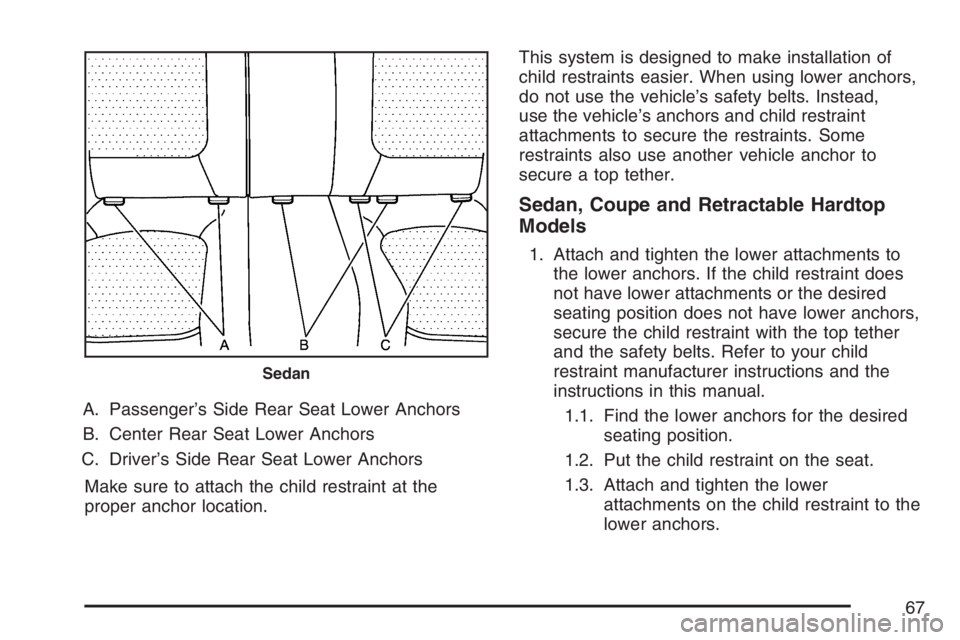
A. Passenger’s Side Rear Seat Lower Anchors
B. Center Rear Seat Lower Anchors
C. Driver’s Side Rear Seat Lower Anchors
Make sure to attach the child restraint at the
proper anchor location.This system is designed to make installation of
child restraints easier. When using lower anchors,
do not use the vehicle’s safety belts. Instead,
use the vehicle’s anchors and child restraint
attachments to secure the restraints. Some
restraints also use another vehicle anchor to
secure a top tether.
Sedan, Coupe and Retractable Hardtop
Models
1. Attach and tighten the lower attachments to
the lower anchors. If the child restraint does
not have lower attachments or the desired
seating position does not have lower anchors,
secure the child restraint with the top tether
and the safety belts. Refer to your child
restraint manufacturer instructions and the
instructions in this manual.
1.1. Find the lower anchors for the desired
seating position.
1.2. Put the child restraint on the seat.
1.3. Attach and tighten the lower
attachments on the child restraint to the
lower anchors.
Sedan
67