ECU PONTIAC G6 2007 Workshop Manual
[x] Cancel search | Manufacturer: PONTIAC, Model Year: 2007, Model line: G6, Model: PONTIAC G6 2007Pages: 486, PDF Size: 2.78 MB
Page 293 of 486
{CAUTION:
Things you put inside your vehicle can
strike and injure people in a sudden stop
or turn, or in a crash.
Put things in the trunk or rear area of
your vehicle. In a trunk, put them as
far forward as you can. Try to spread
the weight evenly. If you have
fold-down rear seats, you will nd four
anchors on the back wall of your
trunk. You can use these anchors to
tie down lighter loads. They are not
strong enough for heavy things,
however, so put them as far forward
as you can in the trunk or rear area.
Never stack heavier things, like
suitcases, inside the vehicle so that
some of them are above the tops of
the seats.
CAUTION: (Continued)
CAUTION: (Continued)
Do not leave an unsecured child
restraint in your vehicle.
When you carry something inside the
vehicle, secure it whenever you can.
Do not leave a seat folded down
unless you need to.
Towing
Towing Your Vehicle
Consult your dealer or a professional towing
service if you need to have your disabled vehicle
towed. SeeRoadside Assistance Program on
page 456.
If you want to tow your vehicle behind another
vehicle for recreational purposes (such as behind
a motorhome), see “Recreational Vehicle
Towing” following.
293
Page 295 of 486

For vehicles that can be dinghy towed with all
four wheels on the ground, follow these steps:
1. Position the vehicle to tow and then secure it.
2. Turn the ignition to OFF.
3. Set the parking brake.
4. To prevent your battery from draining while
the vehicle is being towed, remove the
following fuse from the instrument panel fuse
block: (IGN SENSOR). SeeInstrument
Panel Fuse Block on page 416for more
information.5. Turn the ignition to ACC.
6. Shift your transaxle to NEUTRAL (N).
7. Release the parking brake.
Notice:If you exceed 65 mph (105 km/h) while
towing your vehicle, it could be damaged.
Never exceed 65 mph (105 km/h) while towing
your vehicle.
Notice:Towing your vehicle from the rear
could damage it. Also, repairs would not
be covered by the warranty. Never have your
vehicle towed from the rear.
295
Page 301 of 486
Driving with a Trailer
Towing a trailer requires a certain amount of
experience. Before setting out for the open road,
you will want to get to know your rig. Acquaint
yourself with the feel of handling and braking with
the added weight of the trailer. And always
keep in mind that the vehicle you are driving is
now a good deal longer and not nearly as
responsive as your vehicle is by itself.
Before you start, check all trailer hitch parts and
attachments, safety chains, electrical connector,
lamps, tires and mirror adjustment. If the trailer has
electric brakes, start your vehicle and trailer
moving and then apply the trailer brake controller
by hand to be sure the brakes are working.
This lets you check your electrical connection at
the same time.
During your trip, check occasionally to be sure
that the load is secure, and that the lamps and any
trailer brakes are still working.
Following Distance
Stay at least twice as far behind the vehicle ahead
as you would when driving your vehicle without
a trailer. This can help you avoid situations
that require heavy braking and sudden turns.
Passing
You will need more passing distance up ahead
when you are towing a trailer. And, because you’re
a good deal longer, you’ll need to go much
farther beyond the passed vehicle before you can
return to your lane.
Backing Up
Hold the bottom of the steering wheel with
one hand. Then, to move the trailer to the left, just
move that hand to the left. To move the trailer
to the right, move your hand to the right. Always
back up slowly and, if possible, have someone
guide you.
301
Page 342 of 486

Adding Coolant
If you need more coolant, add the proper
DEX-COOL®coolant mixture at the surge tank,
but only when the engine is cool. If the surge tank
is empty, a special ll procedure is necessary.
SeeEngine Overheating on page 342andCooling
System on page 345.
{CAUTION:
You can be burned if you spill coolant
on hot engine parts. Coolant contains
ethylene glycol, and it will burn if the
engine parts are hot enough. Do not spill
coolant on a hot engine.
When replacing the pressure cap, make sure it is
hand-tight and fully seated.
Pressure Cap
Notice:If the pressure cap is not tightly
installed, coolant loss and possible engine
damage may occur. Be sure the cap is properly
and tightly secured.
SeeEngine Compartment Overview on page 318
for more information on location.
Engine Overheating
You will nd an engine coolant temperature gage
on your vehicle’s instrument panel. SeeEngine
Coolant Temperature Gage on page 203.
342
Page 360 of 486

8. Now connect the black negative (−) cable to
the negative (−) terminal of the good battery.
Use a remote negative (−) terminal if the
vehicle has one.
Do not let the other end touch anything until the
next step. The other end of the negative (−)
cable does not go to the dead battery. It goes to
a heavy, unpainted metal engine part or to a
remote negative (−) terminal on the vehicle with
the dead battery.
9. Connect the other end of the negative (−) cable
at least 18 inches (45 cm) away from the dead
battery, but not near engine parts that move.
The electrical connection is just as good there,
and the chance of sparks getting back to the
battery is much less.
If the security light ashes, wait until the light
stops ashing.
10. Now start the vehicle with the good battery
and run the engine for a while.
11. Try to start the vehicle that had the dead
battery. If it will not start after a few tries,
it probably needs service.Notice:If the jumper cables are connected or
removed in the wrong order, electrical shorting
may occur and damage the vehicle. The repairs
would not be covered by your warranty. Always
connect and remove the jumper cables in the
correct order, making sure that the cables do
not touch each other or other metal.
A. Heavy, Unpainted Metal Engine Part
B. Good Battery
C. Dead Battery
Jumper Cable Removal
360
Page 362 of 486

Headlamps, Front Turn Signal,
Sidemarker, and Parking Lamps
A. Front Sidemarker
B. Front Turn Signal/Parking Lamp
C. Low-Beam Headlamp
D. High-Beam HeadlampTo replace one of these bulbs, do the following:
1. Remove the two screws that secure the
headlamp assembly.
2. Loosen the front fascia by removing the
plastic push pins along the top of the tie bar
by prying under the fasteners with a tool.
362
Page 401 of 486
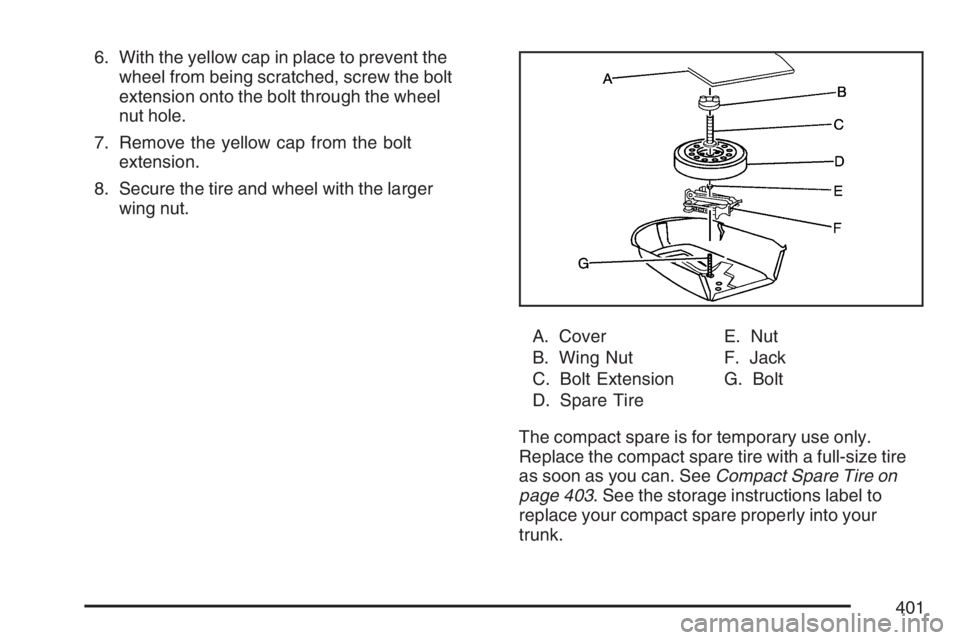
6. With the yellow cap in place to prevent the
wheel from being scratched, screw the bolt
extension onto the bolt through the wheel
nut hole.
7. Remove the yellow cap from the bolt
extension.
8. Secure the tire and wheel with the larger
wing nut.
A. Cover
B. Wing Nut
C. Bolt Extension
D. Spare TireE. Nut
F. Jack
G. Bolt
The compact spare is for temporary use only.
Replace the compact spare tire with a full-size tire
as soon as you can. SeeCompact Spare Tire on
page 403. See the storage instructions label to
replace your compact spare properly into your
trunk.
401
Page 402 of 486
GTP and Retractable Hardtop Models
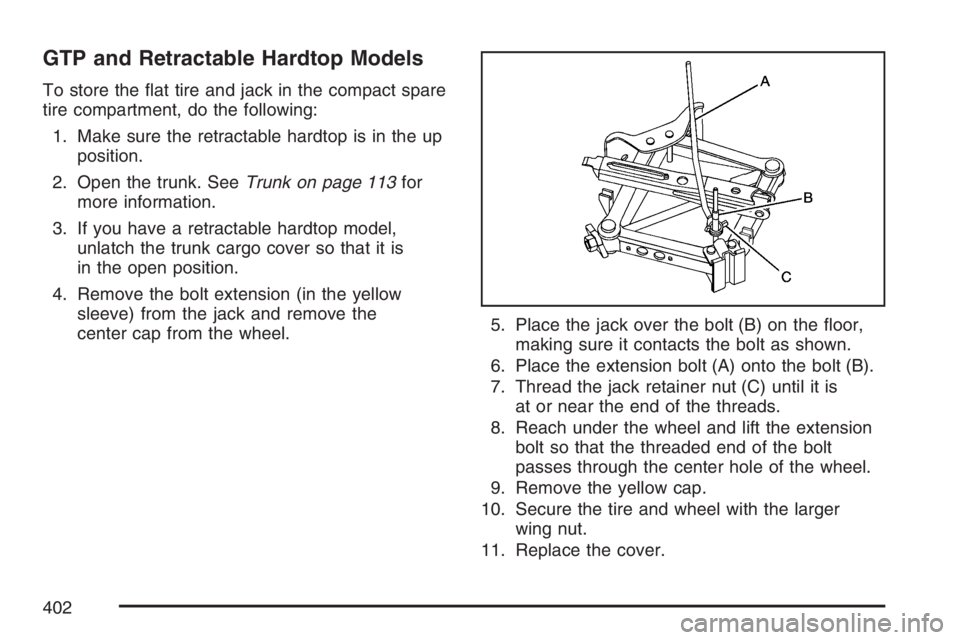
To store the at tire and jack in the compact spare
tire compartment, do the following:
1. Make sure the retractable hardtop is in the up
position.
2. Open the trunk. SeeTrunk on page 113for
more information.
3. If you have a retractable hardtop model,
unlatch the trunk cargo cover so that it is
in the open position.
4. Remove the bolt extension (in the yellow
sleeve) from the jack and remove the
center cap from the wheel.5. Place the jack over the bolt (B) on the oor,
making sure it contacts the bolt as shown.
6. Place the extension bolt (A) onto the bolt (B).
7. Thread the jack retainer nut (C) until it is
at or near the end of the threads.
8. Reach under the wheel and lift the extension
bolt so that the threaded end of the bolt
passes through the center hole of the wheel.
9. Remove the yellow cap.
10. Secure the tire and wheel with the larger
wing nut.
11. Replace the cover.
402
Page 438 of 486

Owner Checks and Services
These owner checks and services should be
performed at the intervals specied to help ensure
the safety, dependability, and emission control
performance of your vehicle. Your GM
Goodwrench
®dealer can assist you with these
checks and services.
Be sure any necessary repairs are completed at
once. Whenever any uids or lubricants are added
to your vehicle, make sure they are the proper
ones, as shown inRecommended Fluids and
Lubricants on page 442.
At Each Fuel Fill
It is important to perform these underhood checks
at each fuel ll.
Engine Oil Level Check
Check the engine oil level and add the proper oil if
necessary. SeeEngine Oil on page 325for
further details.Notice:It is important to check your oil
regularly and keep it at the proper level. Failure
to keep your engine oil at the proper level
can cause damage to your engine not covered
by your warranty.
Engine Coolant Level Check
Check the engine coolant level and add
DEX-COOL®coolant mixture if necessary. See
Engine Coolant on page 339for further details.
Windshield Washer Fluid Level Check
Check the windshield washer uid level in
the windshield washer uid reservoir and add the
proper uid if necessary.
At Least Once a Month
Tire Ination Check
Visually inspect your vehicle’s tires and make sure
they are inated to the correct pressures. Do not
forget to check the spare tire. SeeInation - Tire
Pressure on page 379. Check to make sure the
spare tire is stored securely. SeeChanging a Flat
Tire on page 390.
438
Page 456 of 486
Roadside Assistance Program
In the U.S., call1-800-ROADSIDE (762-3743)
In Canada, call1-800-268-6800
Service available 24 hours a day, 365 days a year.
As the owner of a new Pontiac vehicle, you are
automatically enrolled in the Pontiac Roadside
Assistance program. This value-added service is
intended to provide you with peace of mind as you
drive in the city or travel the open road.
Who is Covered?
Roadside Assistance coverage is for the vehicle
operator, regardless of ownership. A person driving
this vehicle without the consent of the owner is
not eligible for coverage.The following services are provided in the U.S.
during the Bumper-to-Bumper warranty period and,
in Canada, during the Base Warranty coverage
period of the New Vehicle Limited Warranty, up to
a maximum coverage of $100.
Fuel Delivery:Delivery of enough fuel for the
customer to get to the nearest service station
(approximately $5 in the U.S. and 10 litres
in Canada). Service to provide diesel may be
restricted. For safety reasons, propane
and other alternative fuels will not be provided
through this service.
Lock-out Service:To ensure security, the
driver must present the vehicle registration and
personal ID before lock-out service is provided.
Lock-out service will be covered at no charge if
you are unable to gain entry into your vehicle. If
your vehicle will not start, Roadside
Assistance will arrange to have your vehicle
towed to the nearest authorized dealership. In
the U.S., replacement keys made at the
customer’s expense will be covered within
10 miles (16 km).
456