fuel PONTIAC G6 2007 Owner's Guide
[x] Cancel search | Manufacturer: PONTIAC, Model Year: 2007, Model line: G6, Model: PONTIAC G6 2007Pages: 486, PDF Size: 2.78 MB
Page 379 of 486

Vehicle Maximum Load on the Tire:Load on an
individual tire due to curb weight, accessory weight,
occupant weight, and cargo weight.
Vehicle Placard:A label permanently attached to
a vehicle showing the vehicle’s capacity weight and
the original equipment tire size and recommended
ination pressure. See “Tire and Loading
Information Label” underLoading Your Vehicle
on page 288.
Ination - Tire Pressure
Tires need the correct amount of air pressure to
operate effectively.
Notice:Do not let anyone tell you that
under-ination or over-ination is all right.
It is not. If your tires do not have enough air
(under-ination), you can get the following:
Too much exing
Too much heat
Tire overloading
Premature or irregular wear
Poor handling
Reduced fuel economyIf your tires have too much air (over-ination),
you can get the following:
Unusual wear
Poor handling
Rough ride
Needless damage from road hazards
A Tire and Loading Information label is attached to
the vehicle’s center pillar (B-pillar). This label shows
your vehicle’s original equipment tires and the
correct ination pressures for your tires when they
are cold. The recommended cold tire ination
pressure, shown on the label, is the minimum
amount of air pressure needed to support your
vehicle’s maximum load carrying capacity.
For additional information regarding how much
weight your vehicle can carry, and an example of
the tire and loading information label, seeLoading
Your Vehicle on page 288. How you load your
vehicle affects vehicle handling and ride comfort,
never load your vehicle with more weight than it
was designed to carry.
379
Page 412 of 486
Underbody Maintenance
Chemicals used for ice and snow removal and dust
control can collect on the underbody. If these are
not removed, corrosion and rust can develop on the
underbody parts such as fuel lines, frame, oor pan,
and exhaust system even though they have
corrosion protection.
At least every spring, ush these materials from the
underbody with plain water. Clean any areas where
mud and debris can collect. Dirt packed in close
areas of the frame should be loosened before being
ushed. Your dealer or an underbody car washing
system can do this for you.
Chemical Paint Spotting
Some weather and atmospheric conditions can
create a chemical fallout. Airborne pollutants can
fall upon and attack painted surfaces on the vehicle.
This damage can take two forms: blotchy,
ring-shaped discolorations, and small, irregular
dark spots etched into the paint surface.
Although no defect in the paint job causes this, GM
will repair, at no charge to the owner, the surfaces
of new vehicles damaged by this fallout condition
within 12 months or 12,000 miles (20 000 km) of
purchase, whichever occurs rst.
412
Page 423 of 486

Fuses Usage
7 Not Used
8 Not Used
9 Sliding Panel Roof
10 Sunroof Controls
11 Not Used
12 Retractable Hardtop Controller
13 Audio Amplier
14 Heated Seat Controls
15 Not Used
16Remote Keyless Entry System,
XM Satellite Radio
17 Back-up Lamps
18 Not Used
19 Not Used
20Cigarette Lighter, Auxiliary Power
Outlet
21 Not Used
22 Trunk ReleaseFuses Usage
23 Rear Defog
24 Not Used
25 Fuel Pump
Relays Usage
26 Rear Window Defogger
27 Park Lamps
28 Not Used
29 Not Used
30 Not Used
31 Not Used
32 Not Used
33 Back-up Lamps
34 Not Used
35 Not Used
36 Trunk Release
37 Fuel Pump
38 (Diode) Cargo Lamp
423
Page 425 of 486
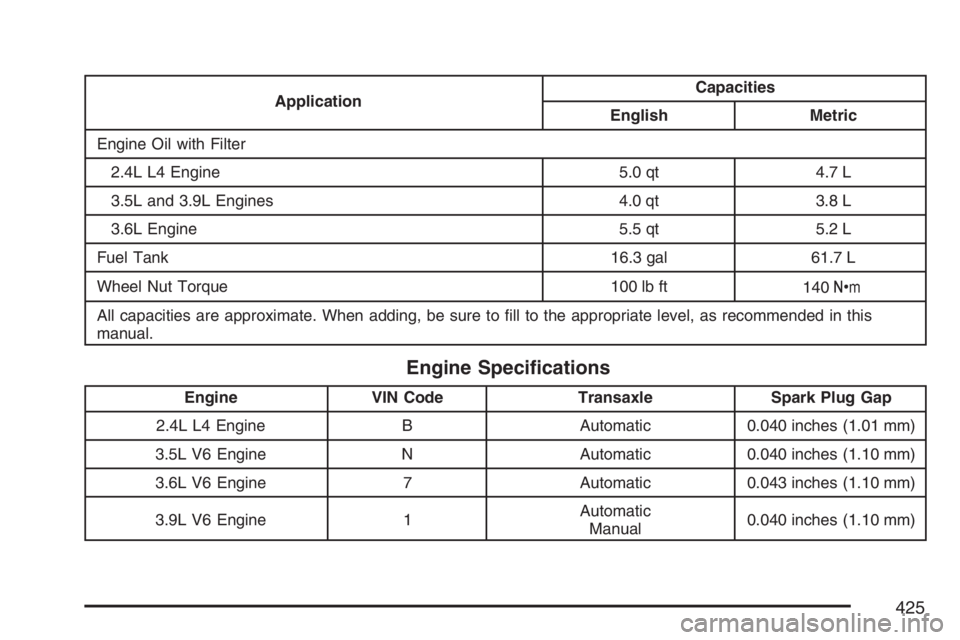
ApplicationCapacities
English Metric
Engine Oil with Filter
2.4L L4 Engine 5.0 qt 4.7 L
3.5L and 3.9L Engines 4.0 qt 3.8 L
3.6L Engine 5.5 qt 5.2 L
Fuel Tank 16.3 gal 61.7 L
Wheel Nut Torque 100 lb ft
140Y
All capacities are approximate. When adding, be sure to ll to the appropriate level, as recommended in this
manual.
Engine Specications
Engine VIN Code Transaxle Spark Plug Gap
2.4L L4 Engine B Automatic 0.040 inches (1.01 mm)
3.5L V6 Engine N Automatic 0.040 inches (1.10 mm)
3.6L V6 Engine 7 Automatic 0.043 inches (1.10 mm)
3.9L V6 Engine 1Automatic
Manual0.040 inches (1.10 mm)
425
Page 427 of 486

Maintenance Schedule................................ 428
Introduction............................................... 428
Maintenance Requirements........................ 428
Your Vehicle and the Environment............ 428
Using the Maintenance Schedule............... 429
Scheduled Maintenance............................. 431
Additional Required Services..................... 434
Maintenance Footnotes.............................. 436Owner Checks and Services..................... 438
At Each Fuel Fill....................................... 438
At Least Once a Month............................. 438
At Least Once a Year............................... 439
Recommended Fluids and Lubricants........ 442
Normal Maintenance Replacement Parts..... 443
Engine Drive Belt Routing......................... 444
Maintenance Record.................................. 446
Section 6 Maintenance Schedule
427
Page 429 of 486
Using the Maintenance Schedule
We at General Motors want to help you keep your
vehicle in good working condition. But we do not
know exactly how you will drive it. You may drive
very short distances only a few times a week. Or
you may drive long distances all the time in very
hot, dusty weather. You may use your vehicle in
making deliveries. Or you may drive it to work, to
do errands, or in many other ways.Because of all the different ways people use their
vehicles, maintenance needs vary. You may need
more frequent checks and replacements. So please
read the following and note how you drive. If you
have any questions on how to keep your vehicle in
good condition, see your GM Goodwrench
®dealer.
This schedule is for vehicles that:
carry passengers and cargo within
recommended limits. You will nd these limits
on the Tire and Loading Information label. See
Loading Your Vehicle on page 288.
are driven on reasonable road surfaces within
legal driving limits.
use the recommended fuel. SeeGasoline
Octane on page 310.
429
Page 434 of 486

Additional Required Services
The following services should be performed at the rst maintenance service (IorII) after the indicated
miles (kilometers) shown for each item.
Additional Required Services
Service and Miles (Kilometers)25,000
(40 000)50,000
(80 000)75,000
(120 000)100,000
(160 000)125,000
(200 000)150,000
(240 000)
Inspect fuel system for damage or
leaks.• •••••
Inspect exhaust system for loose or
damaged components.• •••••
Replace engine air cleaner lter. See
Engine Air Cleaner/Filter on page 330.•••
2.4L (Code B) L4 and 3.5L (Code N)
V6 Engines Only: Change automatic
transaxle uid and lter (severe service
only).See footnote (h).•••
3.9L (Code 1) V6 Engine Only: Change
automatic transaxle uid and lter
(severe service).See footnote (h).•••
3.9L (Code 1) V6 Engine Only: Change
automatic transaxle uid and lter
(normal service).•
3.6L (Code 7) V6 Engine Only: Change
automatic transaxle uid (severe
service).See footnote (l).•••
434
Page 438 of 486

Owner Checks and Services
These owner checks and services should be
performed at the intervals specied to help ensure
the safety, dependability, and emission control
performance of your vehicle. Your GM
Goodwrench
®dealer can assist you with these
checks and services.
Be sure any necessary repairs are completed at
once. Whenever any uids or lubricants are added
to your vehicle, make sure they are the proper
ones, as shown inRecommended Fluids and
Lubricants on page 442.
At Each Fuel Fill
It is important to perform these underhood checks
at each fuel ll.
Engine Oil Level Check
Check the engine oil level and add the proper oil if
necessary. SeeEngine Oil on page 325for
further details.Notice:It is important to check your oil
regularly and keep it at the proper level. Failure
to keep your engine oil at the proper level
can cause damage to your engine not covered
by your warranty.
Engine Coolant Level Check
Check the engine coolant level and add
DEX-COOL®coolant mixture if necessary. See
Engine Coolant on page 339for further details.
Windshield Washer Fluid Level Check
Check the windshield washer uid level in
the windshield washer uid reservoir and add the
proper uid if necessary.
At Least Once a Month
Tire Ination Check
Visually inspect your vehicle’s tires and make sure
they are inated to the correct pressures. Do not
forget to check the spare tire. SeeInation - Tire
Pressure on page 379. Check to make sure the
spare tire is stored securely. SeeChanging a Flat
Tire on page 390.
438
Page 456 of 486
Roadside Assistance Program
In the U.S., call1-800-ROADSIDE (762-3743)
In Canada, call1-800-268-6800
Service available 24 hours a day, 365 days a year.
As the owner of a new Pontiac vehicle, you are
automatically enrolled in the Pontiac Roadside
Assistance program. This value-added service is
intended to provide you with peace of mind as you
drive in the city or travel the open road.
Who is Covered?
Roadside Assistance coverage is for the vehicle
operator, regardless of ownership. A person driving
this vehicle without the consent of the owner is
not eligible for coverage.The following services are provided in the U.S.
during the Bumper-to-Bumper warranty period and,
in Canada, during the Base Warranty coverage
period of the New Vehicle Limited Warranty, up to
a maximum coverage of $100.
Fuel Delivery:Delivery of enough fuel for the
customer to get to the nearest service station
(approximately $5 in the U.S. and 10 litres
in Canada). Service to provide diesel may be
restricted. For safety reasons, propane
and other alternative fuels will not be provided
through this service.
Lock-out Service:To ensure security, the
driver must present the vehicle registration and
personal ID before lock-out service is provided.
Lock-out service will be covered at no charge if
you are unable to gain entry into your vehicle. If
your vehicle will not start, Roadside
Assistance will arrange to have your vehicle
towed to the nearest authorized dealership. In
the U.S., replacement keys made at the
customer’s expense will be covered within
10 miles (16 km).
456
Page 460 of 486
Transportation Options
Warranty service can generally be completed
while you wait. However, if you are unable to wait,
GM helps to minimize your inconvenience by
providing several transportation options.
Depending on the circumstances, your dealer can
offer you one of the following:
Shuttle Service
Shuttle service is the preferred means of offering
Courtesy Transportation and participating
dealers can provide you with shuttle service to get
you to your destination with minimal interruption
of your daily schedule. This includes one-way
or round trip shuttle service within reasonable time
and distance parameters for the dealer’s area.
Public Transportation or Fuel
Reimbursement
If your vehicle requires overnight warranty repairs,
and public transportation is used as ‘shuttle
service,’ the reimbursement is limited to the
associated shuttle allowance and must be
supported by original receipts. In addition, for U.S.
customers, should you arrange transportation
through a friend or relative, limited reimbursementfor reasonable fuel expenses may be available.
Claim amounts should reect actual costs and be
supported by original receipts.
Courtesy Rental Vehicle
Your dealer may arrange to provide you with a
courtesy rental vehicle or reimburse you for
a rental vehicle that you obtain if your vehicle is
kept for an overnight warranty repair. Rental
reimbursement will be limited and must be
supported by original receipts. This requires that
you sign and complete a rental agreement
and meet state/provincial, local, and rental vehicle
provider requirements. Requirements vary and
may include minimum age requirements, insurance
coverage, credit card, etc. You are responsible
for fuel usage charges and may also be
responsible for taxes, levies, usage fees,
excessive mileage, or rental usage beyond the
completion of the repair.
Generally it is not possible to provide a like-vehicle
as a courtesy rental.
460