steering PONTIAC G6 2007 Owner's Guide
[x] Cancel search | Manufacturer: PONTIAC, Model Year: 2007, Model line: G6, Model: PONTIAC G6 2007Pages: 486, PDF Size: 2.78 MB
Page 288 of 486

Rocking Your Vehicle to Get It Out
First, turn the steering wheel left and right.
That will clear the area around the front wheels.
If your vehicle has a traction system, you
should turn your traction system off. SeeTraction
Control System (TCS) on page 262,Enhanced
Traction System (ETS) on page 263,or
StabiliTrak
®System on page 265. Then shift back
and forth between REVERSE (R) and a forward
gear, or with a manual transaxle, between
FIRST (1) or SECOND (2) and REVERSE (R),
spinning the wheels as little as possible. Release
the accelerator pedal while you shift, and press
lightly on the accelerator pedal when the transaxle
is in gear. By slowly spinning the wheels in the
forward and reverse directions, you will cause
a rocking motion that may free your vehicle. If that
does not get your vehicle out after a few tries, it
may need to be towed out. If your vehicle
does need to be towed out, seeTowing Your
Vehicle on page 293.
Loading Your Vehicle
It is very important to know how much weight your
vehicle can carry. This weight is called the vehicle
capacity weight and includes the weight of all
occupants, cargo and all nonfactory-installed
options. Two labels on your vehicle show how much
weight it may properly carry, the Tire and Loading
Information label and the Certication label.
{CAUTION:
Do not load your vehicle any heavier than
the Gross Vehicle Weight Rating (GVWR),
or either the maximum front or rear Gross
Axle Weight Rating (GAWR). If you do,
parts on your vehicle can break, and it
can change the way your vehicle handles.
These could cause you to lose control
and crash. Also, overloading can shorten
the life of your vehicle.
288
Page 296 of 486
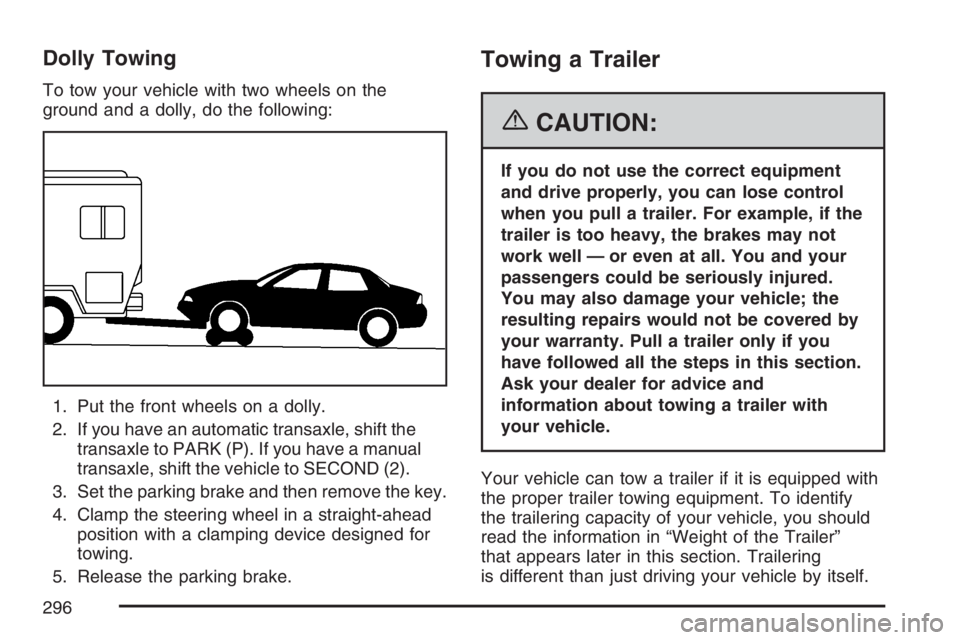
Dolly Towing
To tow your vehicle with two wheels on the
ground and a dolly, do the following:
1. Put the front wheels on a dolly.
2. If you have an automatic transaxle, shift the
transaxle to PARK (P). If you have a manual
transaxle, shift the vehicle to SECOND (2).
3. Set the parking brake and then remove the key.
4. Clamp the steering wheel in a straight-ahead
position with a clamping device designed for
towing.
5. Release the parking brake.
Towing a Trailer
{CAUTION:
If you do not use the correct equipment
and drive properly, you can lose control
when you pull a trailer. For example, if the
trailer is too heavy, the brakes may not
work well — or even at all. You and your
passengers could be seriously injured.
You may also damage your vehicle; the
resulting repairs would not be covered by
your warranty. Pull a trailer only if you
have followed all the steps in this section.
Ask your dealer for advice and
information about towing a trailer with
your vehicle.
Your vehicle can tow a trailer if it is equipped with
the proper trailer towing equipment. To identify
the trailering capacity of your vehicle, you should
read the information in “Weight of the Trailer”
that appears later in this section. Trailering
is different than just driving your vehicle by itself.
296
Page 301 of 486
Driving with a Trailer
Towing a trailer requires a certain amount of
experience. Before setting out for the open road,
you will want to get to know your rig. Acquaint
yourself with the feel of handling and braking with
the added weight of the trailer. And always
keep in mind that the vehicle you are driving is
now a good deal longer and not nearly as
responsive as your vehicle is by itself.
Before you start, check all trailer hitch parts and
attachments, safety chains, electrical connector,
lamps, tires and mirror adjustment. If the trailer has
electric brakes, start your vehicle and trailer
moving and then apply the trailer brake controller
by hand to be sure the brakes are working.
This lets you check your electrical connection at
the same time.
During your trip, check occasionally to be sure
that the load is secure, and that the lamps and any
trailer brakes are still working.
Following Distance
Stay at least twice as far behind the vehicle ahead
as you would when driving your vehicle without
a trailer. This can help you avoid situations
that require heavy braking and sudden turns.
Passing
You will need more passing distance up ahead
when you are towing a trailer. And, because you’re
a good deal longer, you’ll need to go much
farther beyond the passed vehicle before you can
return to your lane.
Backing Up
Hold the bottom of the steering wheel with
one hand. Then, to move the trailer to the left, just
move that hand to the left. To move the trailer
to the right, move your hand to the right. Always
back up slowly and, if possible, have someone
guide you.
301
Page 305 of 486
Service........................................................ 308
Accessories and Modications................... 308
California Proposition 65 Warning.............. 309
Doing Your Own Service Work.................. 309
Adding Equipment to the Outside of
Your Vehicle.......................................... 310
Fuel............................................................. 310
Gasoline Octane........................................ 310
Gasoline Specications.............................. 310
California Fuel........................................... 311
Additives................................................... 311
Fuels in Foreign Countries........................ 312
Filling the Tank......................................... 313
Filling a Portable Fuel Container............... 315
Checking Things Under
the Hood.................................................. 316
Hood Release........................................... 317
Engine Compartment Overview.................. 318
Engine Oil................................................. 325
Engine Oil Life System.............................. 328
Engine Air Cleaner/Filter............................ 330
Automatic Transaxle Fluid
(2.4L L4 and 3.5L V6 Engines).............. 332Automatic Transaxle Fluid
(3.6L Engine)......................................... 332
Automatic Transaxle Fluid
(3.9L V6 Engine).................................... 335
Manual Transaxle Fluid............................. 338
Hydraulic Clutch........................................ 338
Engine Coolant.......................................... 339
Pressure Cap............................................ 342
Engine Overheating................................... 342
Overheated Engine Protection
Operating Mode..................................... 344
Cooling System......................................... 345
Power Steering Fluid ................................. 349
Windshield Washer Fluid........................... 350
Brakes...................................................... 352
Battery...................................................... 355
Jump Starting............................................ 356
Bulb Replacement....................................... 361
Halogen Bulbs........................................... 361
Headlamps, Front Turn Signal,
Sidemarker, and Parking Lamps............. 362
Center High-Mounted
Stoplamp (CHMSL) (Sedan)................... 363
Section 5 Service and Appearance Care
305
Page 321 of 486

A. Engine Air Cleaner/Filter. SeeEngine Air
Cleaner/Filter on page 330.
B. Power Steering Fluid Reservoir. SeePower
Steering Fluid on page 349.
C. Engine Oil Fill Cap. See “When to Add Engine
Oil” underEngine Oil on page 325.
D. Engine Oil Dipstick. See “Checking Engine Oil”
underEngine Oil on page 325.
E. Engine Coolant Surge Tank. SeeEngine
Coolant on page 339.F. Pressure Cap. SeePressure Cap on page 342.
G. Brake Master Cylinder Reservoir. See “Brake
Fluid” underBrakes on page 352.
H. Battery. SeeBattery on page 355.
I. Engine Compartment Fuse Block. SeeEngine
Compartment Fuse Block on page 418.
J. Windshield Washer Fluid Reservoir. See
“Adding Washer Fluid” underWindshield
Washer Fluid on page 350.
321
Page 323 of 486

A. Engine Air Cleaner/Filter. SeeEngine Air
Cleaner/Filter on page 330.
B. Power Steering Fluid Reservoir. SeePower
Steering Fluid on page 349.
C. Engine Oil Fill Cap. See “When to Add Engine
Oil” underEngine Oil on page 325.
D. Engine Oil Dipstick. See “Checking Engine Oil”
underEngine Oil on page 325.
E. Electric Engine Cooling Fans. SeeCooling
System on page 345.
F. Engine Coolant Surge Tank. SeeEngine
Coolant on page 339.
G. Pressure Cap. SeePressure Cap on page 342.H. Brake Master Cylinder Reservoir. See “Brake
Fluid” underBrakes on page 352.
I. Automatic Transaxle Fluid Dipstick (Out of
View). See “Checking the Fluid Level” under
Automatic Transaxle Fluid (2.4L L4 and 3.5L V6
Engines) on page 332orAutomatic Transaxle
Fluid (3.6L Engine) on page 332orAutomatic
Transaxle Fluid (3.9L V6 Engine) on page 335.
J. Battery. SeeBattery on page 355.
K. Underhood Fuse Block. SeeEngine
Compartment Fuse Block on page 418.
L. Windshield Washer Fluid Reservoir. See
“Adding Washer Fluid” underWindshield
Washer Fluid on page 350.
323
Page 325 of 486

A. Engine Air Cleaner/Filter. SeeEngine Air
Cleaner/Filter on page 330.
B. Engine Coolant Bleed Valve.
C. Power Steering Fluid. SeePower Steering
Fluid on page 349.
D. Automatic Transaxle Fluid Dipstick (Out of
View). See “Checking the Fluid Level” under
Automatic Transaxle Fluid (2.4L L4 and 3.5L V6
Engines) on page 332orAutomatic Transaxle
Fluid (3.6L Engine) on page 332orAutomatic
Transaxle Fluid (3.9L V6 Engine) on page 335.
E. Engine Oil Fill Cap. See “When to Add
Engine Oil” underEngine Oil on page 325.
F. Engine Oil Dipstick. See “Checking Engine Oil”
underEngine Oil on page 325.
G. Engine Coolant Surge Tank. SeeEngine
Coolant on page 339.
H. Pressure Cap. SeePressure Cap on page 342.
I. Brake Master Cylinder Reservoir. See “Brake
Fluid” underBrakes on page 352.
J. Battery. SeeBattery on page 355.K. Windshield Washer Fluid Reservoir. See
“Adding Washer Fluid” underWindshield
Washer Fluid on page 350.
L. Engine Compartment Fuse Block. SeeEngine
Compartment Fuse Block on page 418.
Engine Oil
Checking Engine Oil
It is a good idea to check the engine oil every time
you get fuel. In order to get an accurate reading,
the oil must be warm and the vehicle must be
on level ground.
The engine oil dipstick handle is a yellow loop.
SeeEngine Compartment Overview on page 318
for the location of the engine oil dipstick.
1. Turn off the engine and give the oil several
minutes to drain back into the oil pan. If you
do not do this, the oil dipstick might not
show the actual level.
2. Pull out the dipstick and clean it with a paper
towel or cloth, then push it back in all the
way. Remove it again, keeping the tip down,
and check the level.
325
Page 349 of 486

2. Then keep turning
the pressure cap
slowly, and
remove it.
3. Fill the coolant surge tank with the proper
mixture, to the FULL COLD mark. Wait about
ve minutes, then check to see if the level is
below the mark. If the level is below the FULL
COLD mark, add additional coolant to bring the
level up to the mark. Repeat this procedure
until the level remains constant at the FULL
COLD mark for at least ve minutes.
4. With the coolant surge tank pressure cap off,
start the engine and let it run until you can
feel the upper radiator hose getting hot. Watch
out for the engine cooling fans.By this time, the coolant level inside the coolant
surge tank may be lower. If the level is lower
than the FULL COLD mark, add more of the
proper mixture to the coolant surge tank until
the level reaches the FULL COLD mark.
5. Then replace the pressure cap. Be sure the
pressure cap is hand-tight and fully seated.
Power Steering Fluid
SeeEngine
Compartment
Overview on page 318
for reservoir location.
349
Page 350 of 486

When to Check Power Steering Fluid
Power steering uid is used in all vehicles with V6
engines. Vehicles with the 4-cylinder engine have
electric power steering and do not use power
steering uid.
It is not necessary to regularly check power
steering uid unless a leak is suspected in the
system, or an unusual noise is heard. A uid loss
in this system could indicate a problem. Have
the system inspected and repaired.
How to Check Power Steering Fluid
To check the power steering uid, do the following:
1. Turn the key off and let the engine
compartment cool down.
2. Wipe the cap and the top of the reservoir
clean.
3. Unscrew the cap and wipe the dipstick with a
clean rag.
4. Replace the cap and completely tighten it.
5. Remove the cap again and look at the
uid level on the dipstick.The uid level should be within the crosshatched
area on the dipstick.
If the uid is at or below the ADD mark on the
dipstick, add just enough uid to bring the
level within the crosshatched area.
What to Use
To determine what kind of uid to use, see
Recommended Fluids and Lubricants on page 442.
Always use the proper uid. Failure to use the
proper uid can cause leaks and damage hoses
and seals.
Windshield Washer Fluid
What to Use
When you need windshield washer uid, be sure
to read the manufacturer’s instructions before
use. If you will be operating your vehicle in an area
where the temperature may fall below freezing,
use a uid that has sufficient protection against
freezing.
350
Page 376 of 486

(C) Aspect Ratio:A two-digit number that
indicates the tire height-to-width measurements.
For example, if the tire size aspect ratio is 60, as
shown in item C of the illustration, it would mean
that the tire’s sidewall is 60 percent as high as it
is wide.
(D) Construction Code:A letter code is used to
indicate the type of ply construction in the tire. The
letter R means radial ply construction; the letter D
means diagonal or bias ply construction; and the
letter B means belted-bias ply construction.
(E) Rim Diameter:Diameter of the wheel in
inches.
(F) Service Description:These characters
represent the load range and speed rating of the
tire. The load index represents the load carry
capacity a tire is certied to carry. The load index
can range from 1 to 279. The speed rating is the
maximum speed a tire is certied to carry a load.
Speed ratings range from A to Z.Tire Terminology and Denitions
Air Pressure:The amount of air inside the tire
pressing outward on each square inch of the
tire. Air pressure is expressed in pounds
per square inch (psi) or kilopascal (kPa).
Accessory Weight:This means the combined
weight of optional accessories. Some examples of
optional accessories are, automatic transmission/
transaxle, power steering, power brakes, power
windows, power seats, and air conditioning.
Aspect Ratio:The relationship of a tire’s height
to its width.
Belt:A rubber coated layer of cords that is located
between the plies and the tread. Cords may be
made from steel or other reinforcing materials.
Bead:The tire bead contains steel wires wrapped
by steel cords that hold the tire onto the rim.
Bias Ply Tire:A pneumatic tire in which the plies
are laid at alternate angles less than 90 degrees
to the centerline of the tread.
376