hood open PONTIAC G6 2007 Owners Manual
[x] Cancel search | Manufacturer: PONTIAC, Model Year: 2007, Model line: G6, Model: PONTIAC G6 2007Pages: 486, PDF Size: 2.78 MB
Page 107 of 486

The remote vehicle start feature will not operate if
any of the follow occur:
The remote start system is disabled through
the DIC.
The vehicle’s key is in the ignition.
The vehicle’s hood is open.
The hazard warning ashers are on.
The check engine light is on. SeeMalfunction
Indicator Lamp on page 204.
The engine coolant temperature is too high.
The oil pressure is low.
Two remote vehicle starts have already been
used for that ignition cycle.
Vehicles that have the remote vehicle start feature
are shipped from the factory with the remote
start system enabled. The system may be enabled
or disabled through the DIC. See “REMOTE
START” underDIC Vehicle Personalization on
page 216for additional information.
Remote Start Ready
(Automatic Transaxle Only)
If your vehicle does not have the remote vehicle
start feature, it may have the remote start ready
feature. This feature allows your dealer to add the
manufacturer’s remote vehicle start feature.
If the RKE transmitter has a plus (+) symbol on the
back cover, your vehicle has the remote start ready
feature. You can lock or unlock your vehicle from
approximately 197 feet (60 m) away.
See your dealer if you would like to add the
manufacturer’s remote vehicle start feature to
your vehicle.
107
Page 119 of 486

How the System Alarm is Activated
If the system is armed, it can be activated by:
Opening the driver’s door or trunk. This
will cause a ten second pre-alarm chirp
followed by a thirty second full alarm of horn
and lights.
Opening any other door. This will immediately
cause a full alarm of horn and lights for
thirty seconds.
Opening the hood. If the vehicle has the
remote start feature, it will activate the
full alarm.
When an alarm event has nished, the system will
re-arm itself automatically.
How to Turn Off the System Alarm
To turn off the system alarm, do one of the
following:
Press the lock button on the RKE transmitter.
The system will then re-arm itself.
Press the unlock button on the RKE
transmitter. This will also disarm the system.
Insert the key in the ignition and turn it on. This
will also disarm the system.
How to Detect a Tamper Condition
If you hear three chirps when the unlock or lock
button is pressed on the RKE transmitter, it means
that the content theft security system alarm was
previously triggered.
119
Page 128 of 486

Engine Coolant Heater
Your vehicle may have this feature. In very cold
weather, 0°F (−18°C) or colder, the engine coolant
heater can provide easier starting and better fuel
economy during engine warm-up. Usually, the
coolant heater should be plugged in a minimum
of four hours prior to starting your vehicle. At
temperatures above 32°F (0°C), use of the coolant
heater is not required. Your vehicle may also have
an internal thermostat in the plug end of the cord.
This will prevent operation of the engine coolant
heater when the temperature is at or above
0°F (−18°C) as noted on the cord.
To Use the Engine Coolant Heater
1. Turn off the engine.
2. Open the hood and unwrap the electrical cord.
On the 2.4L L4 ECOTEC
®engine, the engine
coolant heater cord is located near the air
cleaner box on the passenger’s side of the
engine compartment. On the 3.5L, 3.6L and
3.9L V6 engines, the engine coolant heater
cord is located on the driver’s side around
the battery box. SeeEngine Compartment
Overview on page 318for more information
on location.3. Plug the cord into a normal, grounded
110-volt AC outlet.
{CAUTION:
Plugging the cord into an ungrounded
outlet could cause an electrical shock.
Also, the wrong kind of extension cord
could overheat and cause a re. You
could be seriously injured. Plug the cord
into a properly grounded three-prong
110-volt AC outlet. If the cord will not
reach, use a heavy-duty three-prong
extension cord rated for at least 15 amps.
4. Before starting the engine, be sure to unplug
and store the cord as it was before to keep it
away from moving engine parts. If you do
not, it could be damaged.
How long should you keep the coolant
heater plugged in? The answer depends
on the outside temperature, the kind
of oil you have, and some other things.
128
Page 317 of 486
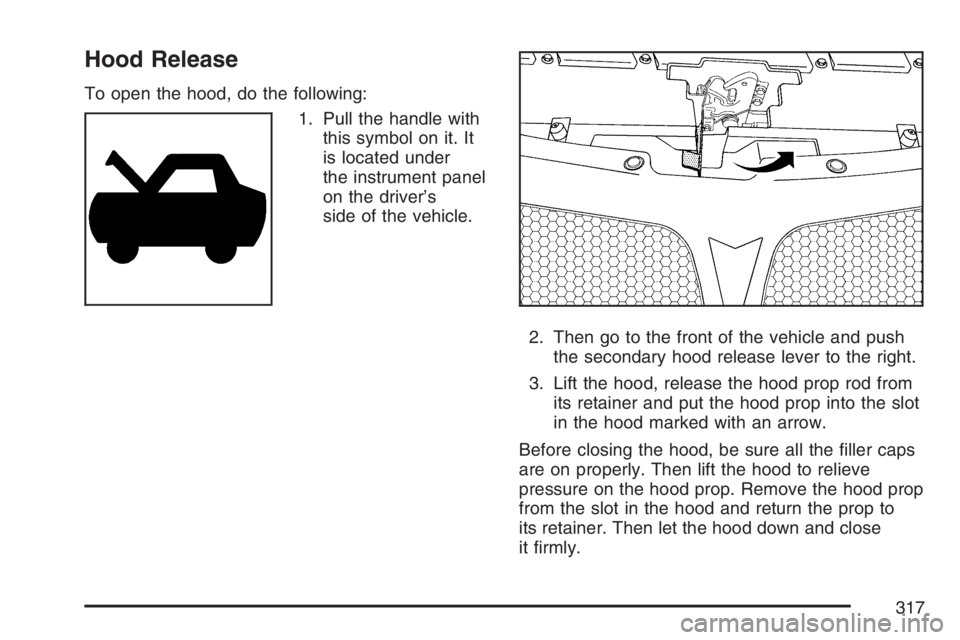
Hood Release
To open the hood, do the following:
1. Pull the handle with
this symbol on it. It
is located under
the instrument panel
on the driver’s
side of the vehicle.
2. Then go to the front of the vehicle and push
the secondary hood release lever to the right.
3. Lift the hood, release the hood prop rod from
its retainer and put the hood prop into the slot
in the hood marked with an arrow.
Before closing the hood, be sure all the ller caps
are on properly. Then lift the hood to relieve
pressure on the hood prop. Remove the hood prop
from the slot in the hood and return the prop to
its retainer. Then let the hood down and close
it rmly.
317
Page 318 of 486

Engine Compartment Overview
When you open the hood on the 2.4L L4 engine, here is what you will see:
318
Page 320 of 486

When you open the hood on the 3.5L V6 engine, here is what you will see:
320
Page 322 of 486

When you open the hood on the 3.6L V6 engine, here is what you will see:
322
Page 324 of 486

When you open the hood on the 3.9L V6 engine, here is what you will see:
324
Page 343 of 486

If Steam Is Coming From Your Engine
{CAUTION:
Steam from an overheated engine can
burn you badly, even if you just open the
hood. Stay away from the engine if you
see or hear steam coming from it. Turn it
off and get everyone away from the
vehicle until it cools down. Wait until
there is no sign of steam or coolant
before you open the hood.
If you keep driving when the vehicles
engine is overheated, the liquids in it can
catch re. You or others could be badly
burned. Stop your engine if it overheats,
and get out of the vehicle until the engine
is cool.
SeeOverheated Engine Protection
Operating Mode on page 344for
information on driving to a safe place
in an emergency.Notice:If your engine catches re because
you keep driving with no coolant, your vehicle
can be badly damaged. The costly repairs
would not be covered by your warranty. See
Overheated Engine Protection Operating Mode
on page 344for information on driving to a
safe place in an emergency.
If No Steam Is Coming From
Your Engine
If you get an engine overheat warning, but see or
hear no steam, the problem may not be too serious.
Sometimes the engine can get a little too hot
when you:
Climb a long hill on a hot day.
Stop after high-speed driving.
Idle for long periods in traffic.
Tow a trailer.
343
Page 344 of 486
If you get the overheat warning with no sign of
steam, try this for a minute or so:
1. In heavy traffic, let the engine idle in
NEUTRAL (N) while stopped. If it is safe to
do so, pull off the road, shift to PARK (P)
or NEUTRAL (N) and let the engine idle.
2. Turn on your heater to full hot at the highest fan
speed and open the windows as necessary.
If you no longer have the overheat warning, you
can drive. Just to be safe, drive slower for about
10 minutes. If the warning does not come back on,
you can drive normally.
If the warning continues, pull over, stop, and park
your vehicle right away.
If there is still no sign of steam, idle the engine for
three minutes while you are parked. If you still have
the warning, turn off the engine and get everyone
out of the vehicle until it cools down.
You may decide not to lift the hood but to get
service help right away.Overheated Engine Protection
Operating Mode
This emergency operating mode allows your
vehicle to be driven to a safe place in an emergency
situation. If an overheated engine condition exists,
an overheat protection mode which alternates ring
groups of cylinders helps prevent engine damage.
In this mode, you will notice a signicant loss in
power and engine performance. The temperature
gage will indicate an overheat condition exists.
Driving extended miles (km) and/or towing a trailer
in the overheat protection mode should be avoided.
Notice:After driving in the overheated engine
protection operating mode, to avoid engine
damage, allow the engine to cool before
attempting any repair. The engine oil will be
severely degraded. Repair the cause of coolant
loss, change the oil and reset the oil life
system. SeeEngine Oil on page 325.
344