automatic transmission PONTIAC G6 2010 User Guide
[x] Cancel search | Manufacturer: PONTIAC, Model Year: 2010, Model line: G6, Model: PONTIAC G6 2010Pages: 448, PDF Size: 2.5 MB
Page 240 of 448

This light comes on if there
is a problem with the
system or the system
has been turned off.
StabiliTrak comes on automatically whenever the
vehicle is started. To help assist with directional control
of the vehicle, the system should always be left on.
The Traction Control System (TCS) and StabiliTrak
can be turned off if needed by pressing and holding
the TCS/ESC button until the StabiliTrak/TCS Off light
comes on. Press the button again to turn StabiliTrak and
Traction Control back on. See Traction Control System
(TCS) following for more information.
If cruise control is being used when the system
activates, cruise control will automatically disengage.
Press the cruise control button to reengage when road
conditions allow. SeeCruise Control on page 4-7for
more information.Traction Control System (TCS)
The vehicle has a Traction Control System (TCS) that
limits wheel spin. This is especially useful in slippery road
conditions. The system operates only if it senses that one
or both of the front wheels are spinning or beginning to
lose traction. When this happens, the system reduces
engine power and may also upshift the transmission
to limit wheel spin. Also, the traction control system
activates the appropriate corner brakes to gain even
quicker control to limit wheel spin.
The system may be heard or felt while it is working, but
this is normal.
If cruise control is being used when TCS begins to
limit wheel spin, the cruise control will automatically
disengage. Press the cruise control button to reengage
when road conditions allow. SeeCruise Control on
page 4-7for more information.
TCS operates in all transmission shift lever positions
except park or neutral. But the system can upshift the
transmission only as high as the shift lever position that
is chosen, so use the lower gears only when necessary.
SeeAutomatic Transmission Operation on page 3-24.
5-6
Page 258 of 448
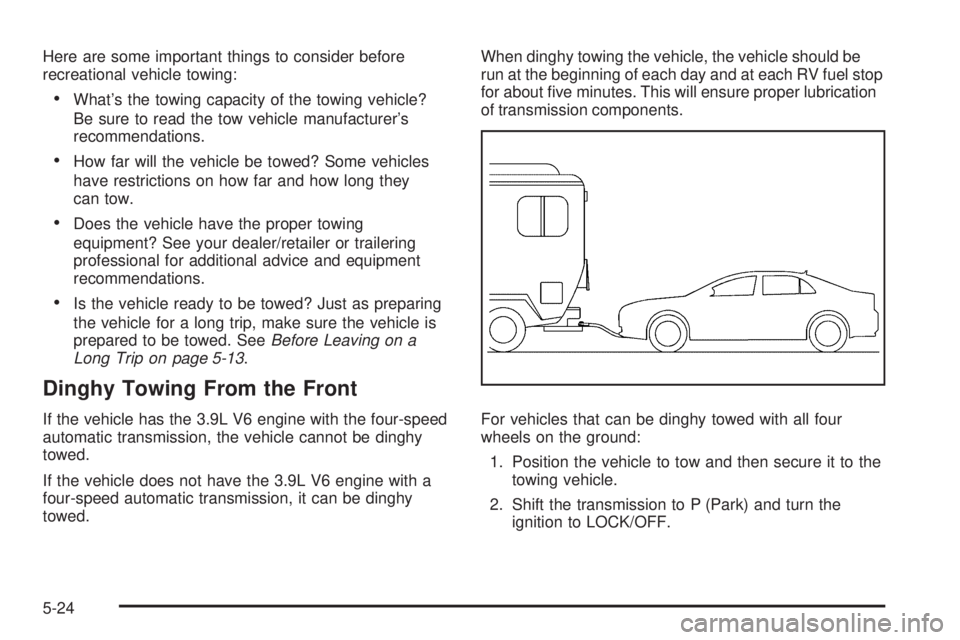
Here are some important things to consider before
recreational vehicle towing:
•What’s the towing capacity of the towing vehicle?
Be sure to read the tow vehicle manufacturer’s
recommendations.
•How far will the vehicle be towed? Some vehicles
have restrictions on how far and how long they
can tow.
•Does the vehicle have the proper towing
equipment? See your dealer/retailer or trailering
professional for additional advice and equipment
recommendations.
•Is the vehicle ready to be towed? Just as preparing
the vehicle for a long trip, make sure the vehicle is
prepared to be towed. SeeBefore Leaving on a
Long Trip on page 5-13.
Dinghy Towing From the Front
If the vehicle has the 3.9L V6 engine with the four-speed
automatic transmission, the vehicle cannot be dinghy
towed.
If the vehicle does not have the 3.9L V6 engine with a
four-speed automatic transmission, it can be dinghy
towed.When dinghy towing the vehicle, the vehicle should be
run at the beginning of each day and at each RV fuel stop
for about five minutes. This will ensure proper lubrication
of transmission components.
For vehicles that can be dinghy towed with all four
wheels on the ground:
1. Position the vehicle to tow and then secure it to the
towing vehicle.
2. Shift the transmission to P (Park) and turn the
ignition to LOCK/OFF.
5-24
Page 267 of 448

If parking the rig on a hill:
1. Press the brake pedal, but do not shift into P (Park)
yet. Turn the wheels into the curb if facing downhill
or into traffic if facing uphill.
2. Have someone place chocks under the trailer
wheels.
3. When the wheel chocks are in place, release the
brake pedal until the chocks absorb the load.
4. Reapply the brake pedal. Then apply the parking
brake and shift the transmission into P (Park).
5. Release the brake pedal.
Leaving After Parking on a Hill
1. Apply and hold the brake pedal while you:
•start the engine,
•shift into a gear, and
•release the parking brake.
2. Let up on the brake pedal.
3. Drive slowly until the trailer is clear of the chocks.
4. Stop and have someone pick up and store the
chocks.
Maintenance When Trailer Towing
The vehicle needs service more often when pulling a
trailer. SeeScheduled Maintenance on page 7-3for more
information. Things that are especially important in trailer
operation are automatic transmission fluid, engine oil,
belts, cooling system and brake system. It is a good idea
to inspect these before and during the trip.
Check periodically to see that all hitch nuts and bolts
are tight.
Engine Cooling When Trailer Towing
The cooling system may temporarily overheat during
severe operating conditions. SeeEngine Overheating
on page 6-35.
Changing a Tire When Trailer Towing
If the vehicle gets a flat tire while towing a trailer,
be sure to secure the trailer and disconnect it from
the vehicle before changing the tire.
5-33
Page 269 of 448
Service............................................................6-4
Accessories and Modifications..........................6-4
California Proposition 65 Warning.....................6-5
California Perchlorate Materials Requirements.....6-5
Doing Your Own Service Work.........................6-5
Adding Equipment to the Outside of the
Vehicle......................................................6-6
Fuel................................................................6-6
Gasoline Octane............................................6-7
Gasoline Specifications....................................6-7
California Fuel...............................................6-7
Additives.......................................................6-8
Fuel E85 (85% Ethanol)..................................6-9
Fuels in Foreign Countries.............................6-11
Filling the Tank............................................6-11
Filling a Portable Fuel Container.....................6-13
Checking Things Under the Hood....................6-14
Hood Release..............................................6-15
Engine Compartment Overview.......................6-16
Engine Oil...................................................6-21
Engine Oil Life System..................................6-24Engine Air Cleaner/Filter................................6-26
Automatic Transmission Fluid
(2.4L L4, 3.5L V6 and 3.6L V6 Engines)..........6-27
Automatic Transmission Fluid
(3.9L V6 Engine).......................................6-28
Cooling System............................................6-30
Engine Coolant.............................................6-31
Engine Overheating.......................................6-35
Overheated Engine Protection
Operating Mode........................................6-37
Power Steering Fluid.....................................6-37
Windshield Washer Fluid................................6-38
Brakes........................................................6-39
Battery........................................................6-42
Jump Starting...............................................6-43
Headlamp Aiming
...........................................6-47
Bulb Replacement..........................................6-47
Halogen Bulbs..............................................6-47
Headlamps, Front Turn Signal, Sidemarker,
and Parking Lamps....................................6-48
Center High-Mounted
Stoplamp (CHMSL) (Sedan)........................6-49
Section 6 Service and Appearance Care
6-1
Page 287 of 448
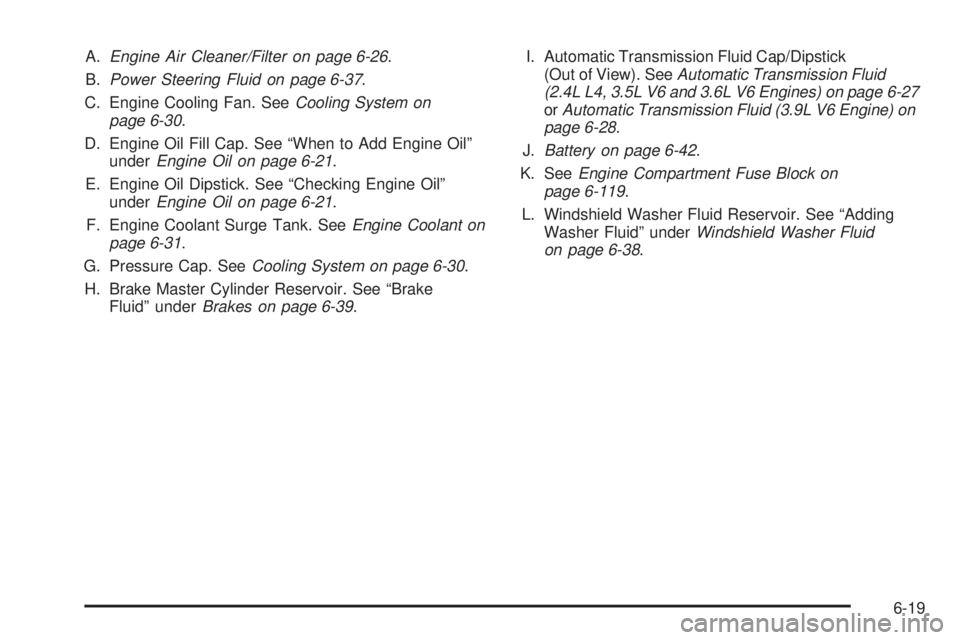
A.Engine Air Cleaner/Filter on page 6-26.
B.Power Steering Fluid on page 6-37.
C. Engine Cooling Fan. SeeCooling System on
page 6-30.
D. Engine Oil Fill Cap. See “When to Add Engine Oil”
underEngine Oil on page 6-21.
E. Engine Oil Dipstick. See “Checking Engine Oil”
underEngine Oil on page 6-21.
F. Engine Coolant Surge Tank. SeeEngine Coolant on
page 6-31.
G. Pressure Cap. SeeCooling System on page 6-30.
H. Brake Master Cylinder Reservoir. See “Brake
Fluid” underBrakes on page 6-39.I. Automatic Transmission Fluid Cap/Dipstick
(Out of View). SeeAutomatic Transmission Fluid
(2.4L L4, 3.5L V6 and 3.6L V6 Engines) on page 6-27
orAutomatic Transmission Fluid (3.9L V6 Engine) on
page 6-28.
J.Battery on page 6-42.
K. SeeEngine Compartment Fuse Block on
page 6-119.
L. Windshield Washer Fluid Reservoir. See “Adding
Washer Fluid” underWindshield Washer Fluid
on page 6-38.
6-19
Page 289 of 448
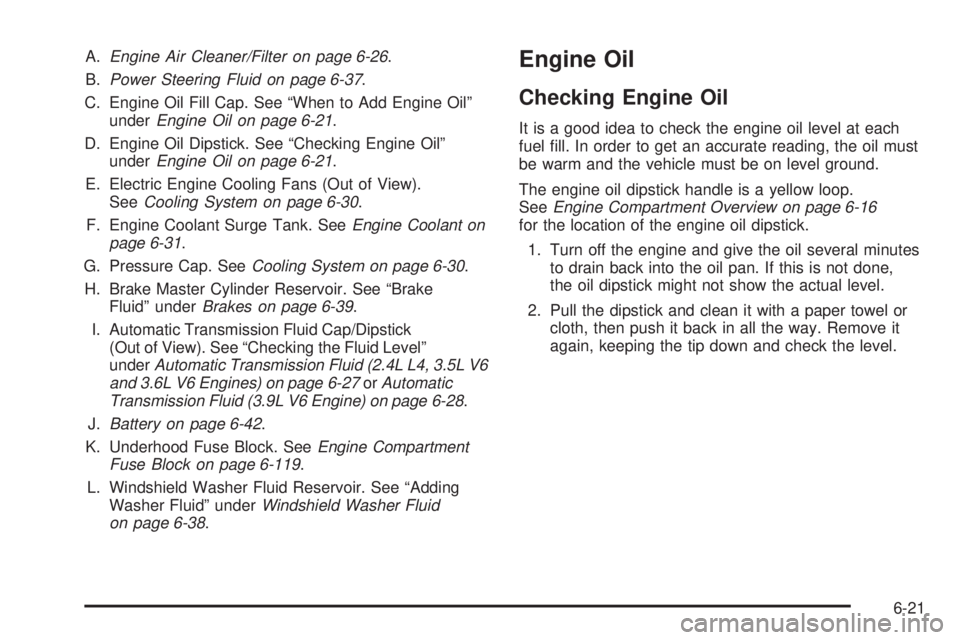
A.Engine Air Cleaner/Filter on page 6-26.
B.Power Steering Fluid on page 6-37.
C. Engine Oil Fill Cap. See “When to Add Engine Oil”
underEngine Oil on page 6-21.
D. Engine Oil Dipstick. See “Checking Engine Oil”
underEngine Oil on page 6-21.
E. Electric Engine Cooling Fans (Out of View).
SeeCooling System on page 6-30.
F. Engine Coolant Surge Tank. SeeEngine Coolant on
page 6-31.
G. Pressure Cap. SeeCooling System on page 6-30.
H. Brake Master Cylinder Reservoir. See “Brake
Fluid” underBrakes on page 6-39.
I. Automatic Transmission Fluid Cap/Dipstick
(Out of View). See “Checking the Fluid Level”
underAutomatic Transmission Fluid (2.4L L4, 3.5L V6
and 3.6L V6 Engines) on page 6-27orAutomatic
Transmission Fluid (3.9L V6 Engine) on page 6-28.
J.Battery on page 6-42.
K. Underhood Fuse Block. SeeEngine Compartment
Fuse Block on page 6-119.
L. Windshield Washer Fluid Reservoir. See “Adding
Washer Fluid” underWindshield Washer Fluid
on page 6-38.Engine Oil
Checking Engine Oil
It is a good idea to check the engine oil level at each
fuel fill. In order to get an accurate reading, the oil must
be warm and the vehicle must be on level ground.
The engine oil dipstick handle is a yellow loop.
SeeEngine Compartment Overview on page 6-16
for the location of the engine oil dipstick.
1. Turn off the engine and give the oil several minutes
to drain back into the oil pan. If this is not done,
the oil dipstick might not show the actual level.
2. Pull the dipstick and clean it with a paper towel or
cloth, then push it back in all the way. Remove it
again, keeping the tip down and check the level.
6-21
Page 295 of 448

{WARNING:
Operating the engine with the air cleaner/filter off
can cause you or others to be burned. The air
cleaner not only cleans the air; it helps to stop
flames if the engine backfires. If it is not there and
the engine backfires, you could be burned. Do not
drive with it off, and be careful working on the
engine with the air cleaner/filter off.
Notice:If the air cleaner/lter is off, a backre
can cause a damaging engine re. And, dirt can
easily get into the engine, which will damage it.
Always have the air cleaner/lter in place when you
are driving.
Automatic Transmission Fluid
(2.4L L4, 3.5L V6 and
3.6L V6 Engines)
It is not necessary to check the transmission fluid level.
A transmission fluid leak is the only reason for fluid loss.
If a leak occurs, take your vehicle to the dealer/retailer
and have it repaired as soon as possible.
Change the fluid and filter at the intervals listed in
Scheduled Maintenance on page 7-3and be sure to
use the transmission fluid listed inRecommended Fluids
and Lubricants on page 7-10.
Notice:Use of the incorrect automatic transmission
uid may damage the vehicle, and the damages
may not be covered by the vehicle’s warranty.
Always use the automatic transmission uid listed
inRecommended Fluids and Lubricants on
page 7-10.
For the 2.4 L, 3.5 L and 3.6 L engines, the transmission
fluid will not reach the end of the dipstick unless the
transmission is at operating temperature. If the
transmission fluid level must be checked, take the
vehicle to the dealer/retailer.
6-27
Page 296 of 448

Automatic Transmission Fluid
(3.9L V6 Engine)
When to Check and Change Automatic
Transmission Fluid
A good time to check the automatic transmission fluid
level is when the engine oil is changed.
Change the fluid and filter at the intervals listed in
Scheduled Maintenance on page 7-3and be sure to
use the transmission fluid listed inRecommended
Fluids and Lubricants on page 7-10.
How to Check Automatic Transmission
Fluid
Because this operation can be a little difficult, you may
choose to have this done at the dealer/retailer service
department.
If you do it yourself, be sure to follow all the instructions
here or you could get a false reading on the dipstick.Notice:Too much or too little uid can damage your
transmission. Too much can mean that some of the
uid could come out and fall on hot engine parts or
exhaust system parts, starting a re. Too little uid
could cause the transmission to overheat. Be sure
to get an accurate reading if you check your
transmission uid.
Wait at least 30 minutes before checking the
transmission fluid level if you have been driving:
•When outside temperatures are above 32°C (90°F).
•At high speed for quite a while.
•In heavy traffic — especially in hot weather.
•While pulling a trailer.
To get the right reading, the fluid should be at
normal operating temperature, which is 82°C to 93°C
(180°F to 200°F).
Get the vehicle warmed up by driving about
24 km (15 miles) when outside temperatures are
above 10°C (50°F). If it is colder than 10°C (50°F),
you may have to drive longer.
6-28
Page 298 of 448

How to Add Automatic Transmission
Fluid
Refer to the Maintenance Schedule to determine what
kind of transmission fluid to use. SeeRecommended
Fluids and Lubricants on page 7-10.
If the fluid level is low, add only enough of the proper
fluid to bring the level into the crosshatched area on
the dipstick.
1. Remove the dipstick.
2. Using a long-neck funnel, add enough fluid at the
dipstick hole to bring it to the proper level.
It does not take much fluid, generally less than a
half pint (0.24 L). Do not overfill.
Notice:Use of the incorrect automatic transmission
uid may damage the vehicle, and the damages
may not be covered by the vehicle’s warranty.
Always use the automatic transmission uid listed
inRecommended Fluids and Lubricants on
page 7-10.
3. After adding fluid, recheck the fluid level as
described under “How to Check Automatic
Transmission Fluid” earlier in this section.
4. When the correct fluid level is obtained, reinstall the
dipstick back in all the way.
Cooling System
The cooling system allows the engine to maintain the
correct working temperature.
A. Engine Cooling Fans
B. Engine Coolant Surge Tank
C. Pressure Cap3.6L V6 Engine shown, 2.4L L4, 3.5L,
3.9L Engines similar
6-30
Page 311 of 448

Jump Starting
If the vehicle’s battery has run down, you may want to
use another vehicle and some jumper cables to start
your vehicle. Be sure to use the following steps to do
it safely.
{WARNING:
Batteries can hurt you. They can be dangerous
because:
•They contain acid that can burn you.
•They contain gas that can explode or ignite.
•They contain enough electricity to burn you.
If you do not follow these steps exactly, some or
all of these things can hurt you.Notice:Ignoring these steps could result in costly
damage to the vehicle that would not be covered
by the warranty.
Trying to start the vehicle by pushing or pulling it
will not work, and it could damage the vehicle.
1. Check the other vehicle. It must have a 12-volt
battery with a negative ground system.
Notice:If the other vehicle’s system is not a 12-volt
system with a negative ground, both vehicles can
be damaged. Only use vehicles with 12-volt systems
with negative grounds to jump start your vehicle.
2. Get the vehicles close enough so the jumper cables
can reach, but be sure the vehicles are not touching
each other. If they are, it could cause a ground
connection you do not want. You would not be
able to start your vehicle, and the bad grounding
could damage the electrical systems.
To avoid the possibility of the vehicles rolling, set the
parking brake firmly on both vehicles involved in the
jump start procedure. Put an automatic transmission
in P (PARK) or a manual transmission in NEUTRAL
before setting the parking brake.
6-43