instrument panel PONTIAC G6 2010 Owners Manual
[x] Cancel search | Manufacturer: PONTIAC, Model Year: 2010, Model line: G6, Model: PONTIAC G6 2010Pages: 448, PDF Size: 2.5 MB
Page 1 of 448
In Brief........................................................... 1-1
Instrument Panel
........................................ 1-2
Initial Drive Information
............................... 1-4
Vehicle Features
......................................1-14
Performance and Maintenance
...................1-18
Seats and Restraint System............................. 2-1
Head Restraints
......................................... 2-2
Front Seats
............................................... 2-4
Rear Seats
..............................................2-13
Safety Belts
.............................................2-14
Child Restraints
.......................................2-36
Airbag System
.........................................2-59
Restraint System Check
............................2-74
Features and Controls..................................... 3-1
Keys
........................................................ 3-2
Doors and Locks
....................................... 3-8
Windows
.................................................3-13
Theft-Deterrent Systems
............................3-16
Starting and Operating Your Vehicle
...........3-20
Mirrors
....................................................3-34Storage Areas
.........................................3-37
Sunroof
..................................................3-37
Retractable Hardtop
..................................3-38
Instrument Panel............................................. 4-1
Instrument Panel Overview
.......................... 4-3
Climate Controls
......................................4-16
Warning Lights, Gages, and Indicators
........4-24
Driver Information Center (DIC)
..................4-39
Audio System(s)
.......................................4-53
Driving Your Vehicle....................................... 5-1
Your Driving, the Road, and the Vehicle
....... 5-2
Towing
...................................................5-23
Service and Appearance Care.......................... 6-1
Service
..................................................... 6-4
Fuel
......................................................... 6-6
Checking Things Under
the Hood
.............................................6-14
Headlamp Aiming
.....................................6-47
Bulb Replacement
....................................6-47
2010 Pontiac G6 Owner ManualM
Page 7 of 448
Instrument Panel..............................................1-2
Initial Drive Information....................................1-4
Remote Keyless Entry (RKE) System................1-4
Remote Vehicle Start......................................1-4
Door Locks....................................................1-5
Trunk Release...............................................1-5
Windows.......................................................1-6
Seat Adjustment.............................................1-6
Safety Belt....................................................1-9
Sensing System for Passenger Airbag...............1-9
Mirror Adjustment.........................................1-10
Steering Wheel Adjustment............................1-11
Interior Lighting............................................1-11
Exterior Lighting...........................................1-12
Windshield Wiper/Washer...............................1-12
Climate Controls...........................................1-13Vehicle Features.............................................1-14
Radio(s)......................................................1-14
Satellite Radio..............................................1-15
Portable Audio Devices..................................1-15
Steering Wheel Controls................................1-16
Bluetooth
®...................................................1-16
Cruise Control..............................................1-17
Power Outlets..............................................1-17
Performance and Maintenance.........................1-18
Traction Control System (TCS).......................1-18
Electronic Stability Control (ESC)....................1-18
Tire Pressure Monitor....................................1-19
Tire Sealant and Compressor Kit....................1-19
Engine Oil Life System..................................1-20
Fuel E85 (85% Ethanol)................................1-20
Driving for Better Fuel Economy.....................1-21
Roadside Assistance Program........................1-21
OnStar
®......................................................1-22
Section 1 In Brief
1-1
Page 8 of 448

Instrument Panel
1-2
Page 9 of 448
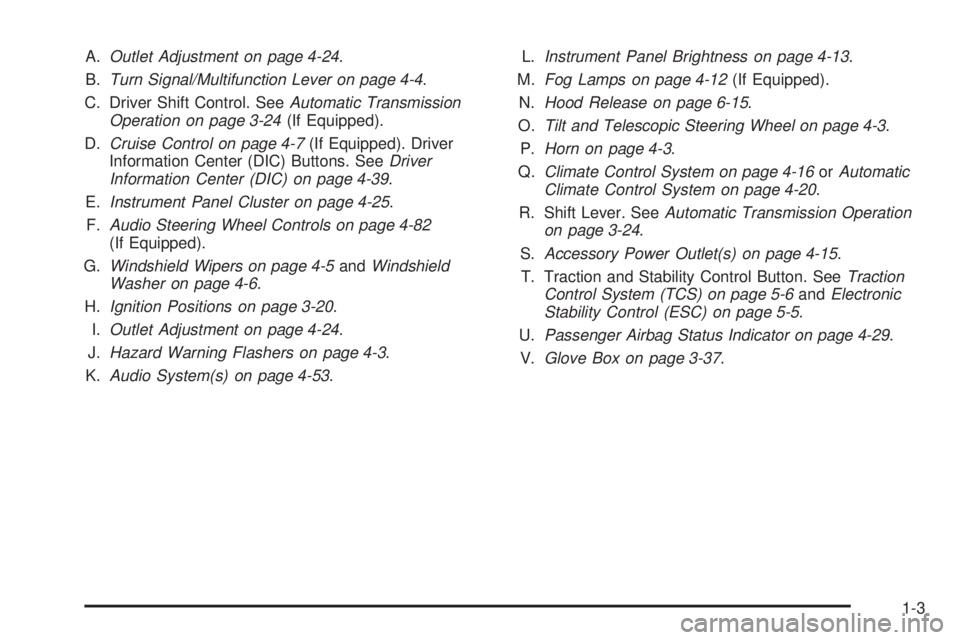
A.Outlet Adjustment on page 4-24.
B.Turn Signal/Multifunction Lever on page 4-4.
C. Driver Shift Control. SeeAutomatic Transmission
Operation on page 3-24(If Equipped).
D.Cruise Control on page 4-7(If Equipped). Driver
Information Center (DIC) Buttons. SeeDriver
Information Center (DIC) on page 4-39.
E.Instrument Panel Cluster on page 4-25.
F.Audio Steering Wheel Controls on page 4-82
(If Equipped).
G.Windshield Wipers on page 4-5andWindshield
Washer on page 4-6.
H.Ignition Positions on page 3-20.
I.Outlet Adjustment on page 4-24.
J.Hazard Warning Flashers on page 4-3.
K.Audio System(s) on page 4-53.L.Instrument Panel Brightness on page 4-13.
M.Fog Lamps on page 4-12(If Equipped).
N.Hood Release on page 6-15.
O.Tilt and Telescopic Steering Wheel on page 4-3.
P.Horn on page 4-3.
Q.Climate Control System on page 4-16orAutomatic
Climate Control System on page 4-20.
R. Shift Lever. SeeAutomatic Transmission Operation
on page 3-24.
S.Accessory Power Outlet(s) on page 4-15.
T. Traction and Stability Control Button. SeeTraction
Control System (TCS) on page 5-6andElectronic
Stability Control (ESC) on page 5-5.
U.Passenger Airbag Status Indicator on page 4-29.
V.Glove Box on page 3-37.
1-3
Page 15 of 448
Safety Belt
Refer to the following sections for important information
on how to use safety belts properly.
•Safety Belts: They Are for Everyone on page 2-14.
•How to Wear Safety Belts Properly on page 2-20.
•Lap-Shoulder Belt on page 2-28.
•Lower Anchors and Tethers for Children (LATCH)
on page 2-46.
Sensing System for Passenger
Airbag
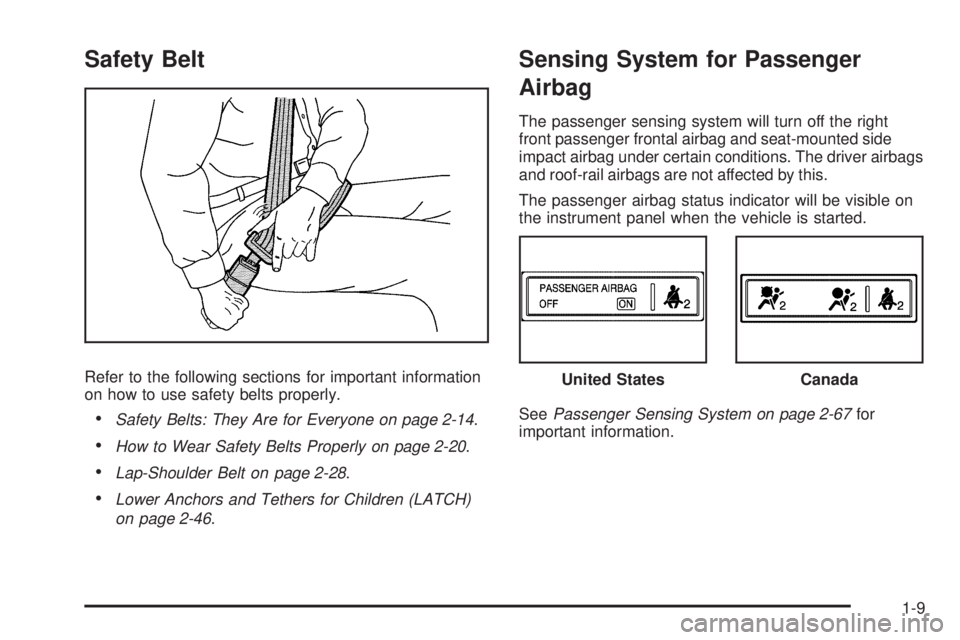
The passenger sensing system will turn off the right
front passenger frontal airbag and seat-mounted side
impact airbag under certain conditions. The driver airbags
and roof-rail airbags are not affected by this.
The passenger airbag status indicator will be visible on
the instrument panel when the vehicle is started.
SeePassenger Sensing System on page 2-67for
important information.
United StatesCanada
1-9
Page 17 of 448
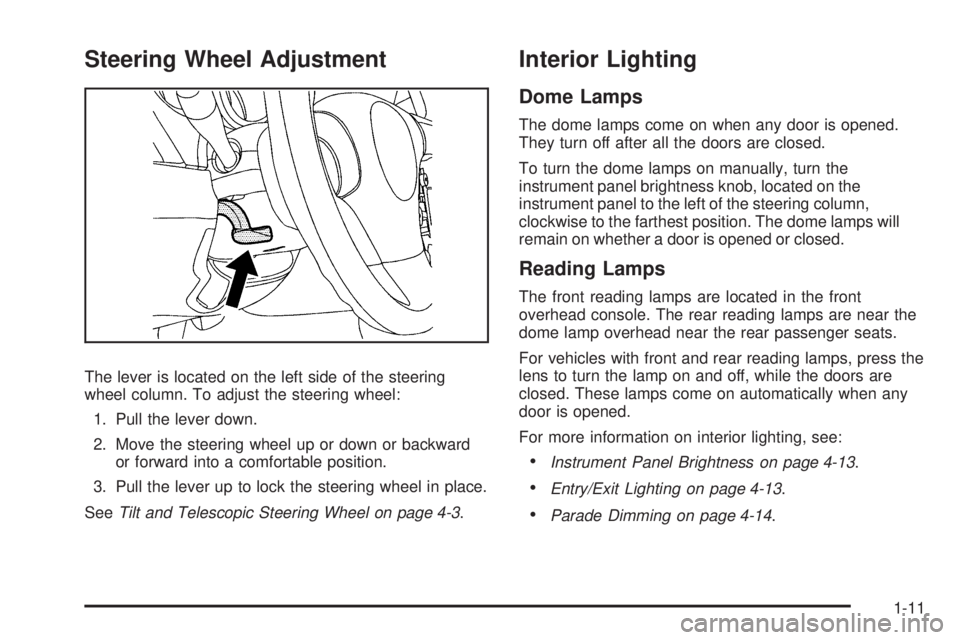
Steering Wheel Adjustment
The lever is located on the left side of the steering
wheel column. To adjust the steering wheel:
1. Pull the lever down.
2. Move the steering wheel up or down or backward
or forward into a comfortable position.
3. Pull the lever up to lock the steering wheel in place.
SeeTilt and Telescopic Steering Wheel on page 4-3.
Interior Lighting
Dome Lamps
The dome lamps come on when any door is opened.
They turn off after all the doors are closed.
To turn the dome lamps on manually, turn the
instrument panel brightness knob, located on the
instrument panel to the left of the steering column,
clockwise to the farthest position. The dome lamps will
remain on whether a door is opened or closed.
Reading Lamps
The front reading lamps are located in the front
overhead console. The rear reading lamps are near the
dome lamp overhead near the rear passenger seats.
For vehicles with front and rear reading lamps, press the
lens to turn the lamp on and off, while the doors are
closed. These lamps come on automatically when any
door is opened.
For more information on interior lighting, see:
•Instrument Panel Brightness on page 4-13.
•Entry/Exit Lighting on page 4-13.
•Parade Dimming on page 4-14.
1-11
Page 26 of 448
Engine Oil Life System
The engine oil life system calculates engine oil life
based on vehicle use and displays a DIC message when
it is necessary to change the engine oil and filter. The
oil life system should be reset to 100% only following an
oil change.
Resetting the Oil Life System
1. Turn the ignition to ON/RUN, with the engine off.
2. With the CHANGE OIL SOON message displayed,
press any of the three DIC buttons to clear the
CHANGE OIL SOON message.
3. Display OIL-LIFE RESET on the DIC.
4. Press and hold the ENTER button for at least
one second. An ACKNOWLEDGED display
message will appear for three seconds or until the
next button is pressed. This tells you the system
has been reset.
5. Turn the key to LOCK/OFF.
SeeEngine Oil Life System on page 6-24.
Fuel E85 (85% Ethanol)
The 8th digit of the Vehicle Identification Number (VIN)
shows the code letter or number that identifies the
vehicle’s engine. The VIN is at the top left of the
instrument panel. SeeVehicle Identication Number
(VIN) on page 6-114.
If the vehicle has the 2.4L L4 engine (VIN Code 0) or
the 3.5L V6 engine (VIN Code K), you can use either
unleaded gasoline or ethanol fuel containing up
to 85% ethanol (E85). SeeFuel on page 6-6. In all other
engines, use only the unleaded gasoline described under
Gasoline Octane on page 6-7.
Only vehicles that have the 2.4L L4 engine
(VIN Code 0) or the 3.5L V6 engine (VIN Code K) can
use 85% ethanol fuel (E85). We encourage the use
of E85 in vehicles that are designed to use it. The
ethanol in E85 is a “renewable” fuel, meaning it is made
from renewable sources such as corn and other crops.
1-20
Page 48 of 448

or the instrument panel... or the safety belts!
With safety belts, you slow down as the vehicle does.
You get more time to stop. You stop over more distance,
and your strongest bones take the forces. That is why
safety belts make such good sense.
2-18
Page 89 of 448

Airbag System
The vehicle has the following airbags:
•A frontal airbag for the driver.
•A frontal airbag for the right front passenger.
•A seat-mounted side impact airbag for the driver.
•A seat-mounted side impact airbag for the right front
passenger.
The vehicle may also have the following airbags:
•A roof-rail airbag for the driver and the passenger
seated directly behind the driver.
•A roof-rail airbag for the right front passenger and
the passenger seated directly behind the right
front passenger.
All of the airbags in your vehicle will have the word
AIRBAG embossed in the trim or on an attached label
near the deployment opening.
For frontal airbags, the word AIRBAG will appear on the
middle part of the steering wheel for the driver and
on the instrument panel for the right front passenger.
With seat-mounted side impact airbags, the word
AIRBAG will appear on the side of the seatback closest
to the door.
With roof-rail airbags, the word AIRBAG will appear
along the headliner or trim.Airbags are designed to supplement the protection
provided by safety belts. Even though today’s airbags
are also designed to help reduce the risk of injury
from the force of an inflating bag, all airbags must inflate
very quickly to do their job.
Here are the most important things to know about the
airbag system:
{WARNING:
You can be severely injured or killed in a crash if
you are not wearing your safety belt — even if you
have airbags. Airbags are designed to work with
safety belts, but do not replace them. Also,
airbags are not designed to deploy in every crash.
In some crashes safety belts are your only
restraint. SeeWhen Should an Airbag Inate? on
page 2-63.
Wearing your safety belt during a crash helps
reduce your chance of hitting things inside the
vehicle or being ejected from it. Airbags are
“supplemental restraints” to the safety belts.
Everyone in your vehicle should wear a safety belt
properly — whether or not there is an airbag for
that person.
2-59
Page 90 of 448

{WARNING:
Airbags inflate with great force, faster than the
blink of an eye. Anyone who is up against, or very
close to, any airbag when it inflates can be
seriously injured or killed. Do not sit unnecessarily
close to the airbag, as you would be if you were
sitting on the edge of your seat or leaning forward.
Safety belts help keep you in position before and
during a crash. Always wear your safety belt, even
with airbags. The driver should sit as far back as
possible while still maintaining control of
the vehicle.
Occupants should not lean on or sleep against the
door or side windows in seating positions with
seat-mounted side impact airbags and/or roof-rail
airbags.
{WARNING:
Children who are up against, or very close to, any
airbag when it inflates can be seriously injured or
killed. Airbags plus lap-shoulder belts offer
protection for adults and older children, but not for
young children and infants. Neither the vehicle’s
safety belt system nor its airbag system is designed
for them. Young children and infants need the
protection that a child restraint system can provide.
Always secure children properly in your vehicle.
To read how, seeOlder Children on page 2-36or
Infants and Young Children on page 2-39.
There is an airbag
readiness light on the
instrument panel, which
shows the airbag symbol.
The system checks the airbag electrical system for
malfunctions. The light tells you if there is an electrical
problem. SeeAirbag Readiness Light on page 4-28
for more information.
2-60