fuel PONTIAC G8 2008 Owner's Manual
[x] Cancel search | Manufacturer: PONTIAC, Model Year: 2008, Model line: G8, Model: PONTIAC G8 2008Pages: 334, PDF Size: 2.99 MB
Page 172 of 334
Before Leaving on a
Long Trip
To prepare your vehicle for a long
trip, consider having it serviced
by your dealer/retailer before
departing.
Things to check on your own include:
Windshield Washer Fluid:
Reservoir full? Windows
clean — inside and outside?
Wiper Blades:In good shape?
Fuel, Engine Oil, Other Fluids:
All levels checked?
Lamps:Do they all work and are
lenses clean?
Tires:Are treads good? Are tires
inated to recommended
pressure?
Weather and Maps:Safe to
travel? Have up-to-date maps?
Highway Hypnosis
Always be alert and pay attention to
your surroundings while driving.
If you become tired or sleepy, nd a
safe place to park your vehicle
and rest.
Other driving tips include:
Keep the vehicle well ventilated.
Keep interior temperature cool.
Keep your eyes moving — scan
the road ahead and to the sides.
Check the rearview mirror and
vehicle instruments often.
Hill and Mountain Roads
Driving on steep hills or through
mountains is different than driving
on at or rolling terrain. Tips for
driving in these conditions include:
Keep the vehicle serviced
and in good shape.
Check all uid levels and brakes,
tires, cooling system, and
transmission.
Going down steep or long hills,
shift to a lower gear.
{CAUTION
If you do not shift down, the
brakes could get so hot that
they would not work well. You
would then have poor braking
or even none going down a hill.
You could crash. Shift down to
let the engine assist the brakes
on a steep downhill slope.
8-24 Driving and Operating
2008 - Pontiac G8 Owner Manual
Page 175 of 334
{CAUTION
Snow can trap exhaust gases
under your vehicle. This can
cause deadly CO (carbon
monoxide) gas to get inside.
CO could overcome you and
kill you. You cannot see it or
smell it, so you might not know
it is in your vehicle. Clear away
snow from around the base of
your vehicle, especially any
that is blocking the exhaust
pipe. And check around again
from time to time to be sure
snow does not collect there.
Open a window just a little on
the side of the vehicle that is
away from the wind. This will
help keep CO out.Run your engine only as long as you
must. This saves fuel. When you run
the engine, make it go a little faster
than just idle. That is, push the
accelerator slightly. This uses less
fuel for the heat that you get and it
keeps the battery charged. You will
need a well-charged battery to
restart the vehicle, and possibly
for signaling later on with the
headlamps. Let the heater run
for a while.
Then, shut the engine off and close
the window almost all the way to
preserve the heat. Start the engine
again and repeat this only when you
feel really uncomfortable from the
cold. But do it as little as possible.
Preserve the fuel as long as you can.
To help keep warm, you can get out
of the vehicle and do some fairly
vigorous exercises every half hour or
so until help comes.
If Your Vehicle is Stuck
in Sand, Mud, Ice,
or Snow
Slowly and cautiously spin the
wheels to free the vehicle when
stuck in sand, mud, ice, or snow.
SeeRocking Your Vehicle to Get It
Out on page 8-28.
{CAUTION
If you let your vehicle’s tires
spin at high speed, they can
explode, and you or others
could be injured. The vehicle
can overheat, causing an
engine compartment re or
other damage. Spin the wheels
as little as possible and avoid
going above 35 mph (55 km/h)
as shown on the speedometer.
For information about using tire
chains on the vehicle, seeTire
Chains on page 9-62.
Driving and Operating 8-27
2008 - Pontiac G8 Owner Manual
Page 179 of 334
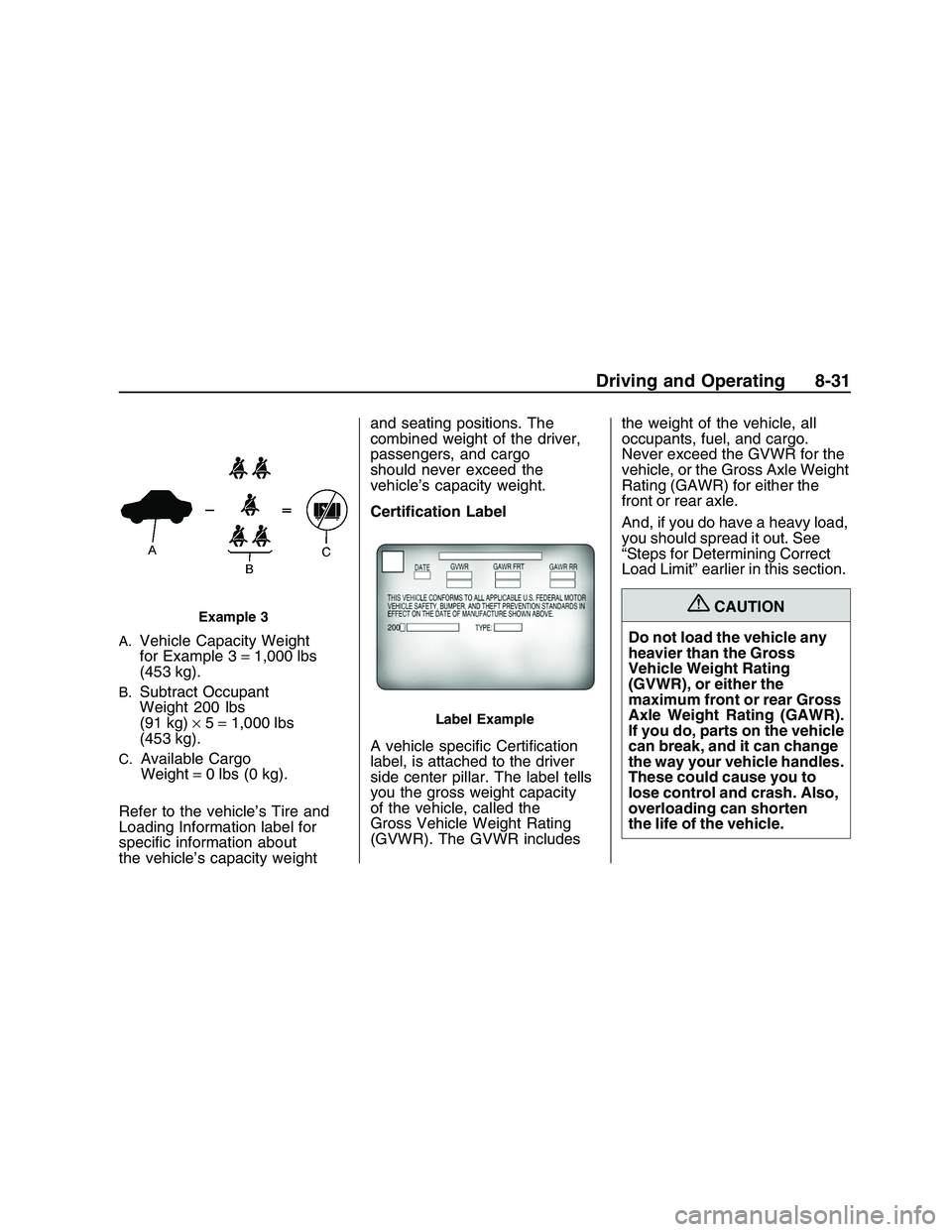
A.Vehicle Capacity Weight
for Example 3=1,000 lbs
(453 kg).
B.Subtract Occupant
Weight 200 lbs
(91 kg)×5=1,000 lbs
(453 kg).
C.Available Cargo
Weight=0 lbs (0 kg).
Refer to the vehicle’s Tire and
Loading Information label for
specic information about
the vehicle’s capacity weightand seating positions. The
combined weight of the driver,
passengers, and cargo
should never exceed the
vehicle’s capacity weight.
Certication Label
A vehicle specic Certication
label, is attached to the driver
side center pillar. The label tells
you the gross weight capacity
of the vehicle, called the
Gross Vehicle Weight Rating
(GVWR). The GVWR includesthe weight of the vehicle, all
occupants, fuel, and cargo.
Never exceed the GVWR for the
vehicle, or the Gross Axle Weight
Rating (GAWR) for either the
front or rear axle.
And, if you do have a heavy load,
you should spread it out. See
“Steps for Determining Correct
Load Limit” earlier in this section.
{CAUTION
Do not load the vehicle any
heavier than the Gross
Vehicle Weight Rating
(GVWR), or either the
maximum front or rear Gross
Axle Weight Rating (GAWR).
If you do, parts on the vehicle
can break, and it can change
the way your vehicle handles.
These could cause you to
lose control and crash. Also,
overloading can shorten
the life of the vehicle.Example 3
Label Example
Driving and Operating 8-31
2008 - Pontiac G8 Owner Manual
Page 180 of 334
If you put things inside the
vehicle — like suitcases,
tools, packages, or anything
else — they will go as fast as the
vehicle goes. If you have to
stop or turn quickly, or if there is
a crash, they will keep going.
{CAUTION
Things you put inside the
vehicle can strike and injure
people in a sudden stop or
turn, or in a crash.
Put things in the trunk of
your vehicle. In a trunk,
put them as far forward as
you can. Try to spread the
weight evenly.
(Continued)
CAUTION (Continued)
Never stack heavier
things, like suitcases,
inside the vehicle so that
some of them are above
the tops of the seats.
Do not leave an unsecured
child restraint in the
vehicle.
When you carry something
inside the vehicle, secure it
whenever you can.
Do not leave a seat folded
down unless you need to.
Fuel
Use of the recommended fuel is
an important part of the proper
maintenance of your vehicle.
To help keep the engine clean
and maintain optimum vehicle
performance, we recommend the
use of gasoline advertised as
TOP TIER Detergent Gasoline.
The 8th digit of the Vehicle
Identication Number (VIN) shows
the code letter or number that
identies your vehicle’s engine.
The VIN is at the top left of
the instrument panel. SeeVehicle
Identification Number (VIN) on
page 10-1.
8-32 Driving and Operating
2008 - Pontiac G8 Owner Manual
Page 181 of 334
Gasoline Octane
If your vehicle has a V8 engine, use
regular unleaded gasoline with a
posted octane rating of 87 or higher.
If the octane rating is less than 87,
you might notice an audible
knocking noise when you drive,
commonly referred to as spark
knock. If this occurs, use a gasoline
rated at 87 octane or higher as
soon as possible. If you are using
gasoline rated at 87 octane or higher
and you hear heavy knocking, the
engine needs service.
If your vehicle has the 3.6L V6
engine (VIN Code 7), use regular
unleaded gasoline with a posted
octane rating of 87 or higher.
For best performance or trailer
towing, you could choose to
use middle grade 89 octane
unleaded gasoline. If the octane
rating is less than 87, you might
notice an audible knocking noise
when you drive, commonly referred
to as spark knock.If this occurs, use a gasoline rated
at 87 octane or higher as soon
as possible. If you are using
gasoline rated at 87 octane or higher
and you hear heavy knocking, the
engine needs service.
Gasoline Specications
At a minimum, gasoline should
meet ASTM specication D 4814
in the United States or
CAN/CGSB-3.5 or 3.511 in Canada.
Some gasolines contain an
octane-enhancing additive called
methylcyclopentadienyl manganese
tricarbonyl (MMT). We recommend
against the use of gasolines
containing MMT. SeeAdditives on
page 8-34for additional information.
California Fuel
If your vehicle is certied to meet
California Emissions Standards, it is
designed to operate on fuels that
meet California specications.
See the underhood emission control
label. If this fuel is not available
in states adopting California
emissions standards, your vehicle
will operate satisfactorily on
fuels meeting federal specications,
but emission control system
performance might be affected.
The malfunction indicator lamp could
turn on and your vehicle might fail
a smog-check test. SeeMalfunction
Indicator Lamp on page 4-18.
If this occurs, return to your
authorized dealer/retailer for
diagnosis. If it is determined that the
condition is caused by the type of
fuel used, repairs might not be
covered by the vehicle warranty.
Driving and Operating 8-33
2008 - Pontiac G8 Owner Manual
Page 182 of 334
Additives
To provide cleaner air, all gasolines
in the United States are now required
to contain additives that help prevent
engine and fuel system deposits
from forming, allowing the emission
control system to work properly.
In most cases, you should not have
to add anything to the fuel. However,
some gasolines contain only the
minimum amount of additive required
to meet U.S. Environmental
Protection Agency regulations.
To help keep fuel injectors and intake
valves clean, or if your vehicle
experiences problems due to dirty
injectors or valves, look for gasoline
that is advertised as TOP TIER
Detergent Gasoline. Also, your
dealer/retailer has additives that will
help correct and prevent most
deposit-related problems.
Gasolines containing oxygenates,
such as ethers and ethanol, and
reformulated gasolines might
be available in your area.We recommend that you use these
gasolines, if they comply with the
specications described earlier.
However, E85 (85% ethanol) and
other fuels containing more than
10% ethanol must not be used in
vehicles that were not designed
for those fuels.
Notice:Your vehicle was not
designed for fuel that contains
methanol. Do not use fuel
containing methanol. It can
corrode metal parts in the fuel
system and also damage plastic
and rubber parts. That damage
would not be covered under your
warranty.
Some gasolines that are not
reformulated for low emissions can
contain an octane-enhancing additive
called methylcyclopentadienyl
manganese tricarbonyl (MMT); ask
the attendant where you buy gasoline
whether the fuel contains MMT.We recommend against the use of
such gasolines. Fuels containing
MMT can reduce the life of spark
plugs and the performance of the
emission control system could be
affected. The malfunction indicator
lamp might turn on. If this occurs,
return to your dealer/retailer for
service.
Fuels in Foreign
Countries
If you plan on driving in another
country outside the United States or
Canada, the proper fuel might be
hard to nd. Never use leaded
gasoline or any other fuel not
recommended in the previous text
on fuel. Costly repairs caused
by use of improper fuel would not
be covered by your warranty.
To check the fuel availability, ask an
auto club, or contact a major oil
company that does business in the
country where you will be driving.
8-34 Driving and Operating
2008 - Pontiac G8 Owner Manual
Page 183 of 334
Filling the Tank
{CAUTION
Fuel vapor burns violently and
a fuel re can cause bad
injuries. To help avoid injuries
to you and others, read and
follow all the instructions on
the pump island. Turn off your
engine when you are refueling.
Do not smoke if you are near
fuel or refueling your vehicle.
Do not use cellular phones.
Keep sparks, ames, and
smoking materials away from
fuel. Do not leave the fuel pump
unattended when refueling your
vehicle. This is against the law
in some places. Do not re-enter
the vehicle while pumping fuel.
Keep children away from the
fuel pump; never let children
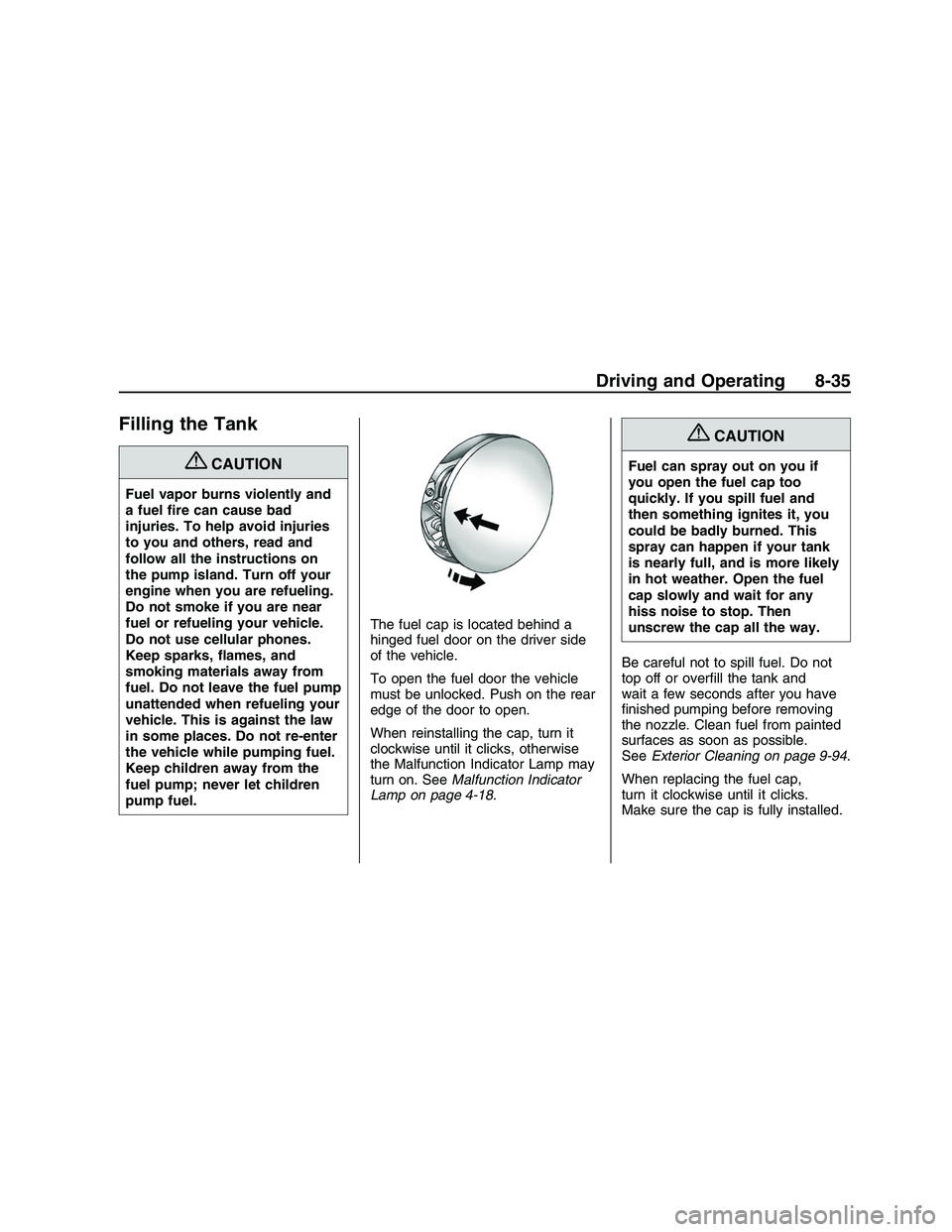
pump fuel.The fuel cap is located behind a
hinged fuel door on the driver side
of the vehicle.
To open the fuel door the vehicle
must be unlocked. Push on the rear
edge of the door to open.
When reinstalling the cap, turn it
clockwise until it clicks, otherwise
the Malfunction Indicator Lamp may
turn on. SeeMalfunction Indicator
Lamp on page 4-18.
{CAUTION
Fuel can spray out on you if
you open the fuel cap too
quickly. If you spill fuel and
then something ignites it, you
could be badly burned. This
spray can happen if your tank
is nearly full, and is more likely
in hot weather. Open the fuel
cap slowly and wait for any
hiss noise to stop. Then
unscrew the cap all the way.
Be careful not to spill fuel. Do not
top off or overll the tank and
wait a few seconds after you have
nished pumping before removing
the nozzle. Clean fuel from painted
surfaces as soon as possible.
SeeExterior Cleaning on page 9-94.
When replacing the fuel cap,
turn it clockwise until it clicks.
Make sure the cap is fully installed.
Driving and Operating 8-35
2008 - Pontiac G8 Owner Manual
Page 184 of 334
The diagnostic system can
determine if the fuel cap has been
left off or improperly installed. This
would allow fuel to evaporate into
the atmosphere. SeeMalfunction
Indicator Lamp on page 4-18.
{CAUTION
If a re starts while you are
refueling, do not remove the
nozzle. Shut off the ow of fuel
by shutting off the pump or by
notifying the station attendant.
Leave the area immediately.
Notice:If you need a new fuel
cap, be sure to get the right type.
Your dealer/retailer can get one for
you. If you get the wrong type, it
may not t properly. This may
cause your malfunction indicator
lamp to light and may damage
your fuel tank and emissions
system. SeeMalfunction Indicator
Lamp on page 4-18.
Filling a Portable Fuel
Container
{CAUTION
Never ll a portable fuel
container while it is in your
vehicle. Static electricity
discharge from the container
can ignite the fuel vapor. You
can be badly burned and your
vehicle damaged if this occurs.
To help avoid injury to you and
others:
Dispense fuel only into
approved containers.
Do not ll a container while it
is inside a vehicle, in a
vehicle’s trunk, pickup bed,
or on any surface other than
the ground.
(Continued)
CAUTION (Continued)
Bring the ll nozzle in
contact with the inside of the
ll opening before operating
the nozzle. Contact should be
maintained until the lling is
complete.
Do not smoke while
pumping fuel.
Do not use a cellular phone
while pumping fuel.
8-36 Driving and Operating
2008 - Pontiac G8 Owner Manual
Page 188 of 334
Doing Your Own
Service Work
{CAUTION
You can be injured and your
vehicle could be damaged if
you try to do service work on
a vehicle without knowing
enough about it.
Be sure you have sufficient
knowledge, experience, the
proper replacement parts, and
tools before you attempt any
vehicle maintenance task.
Be sure to use the proper
nuts, bolts, and other
fasteners. English and
metric fasteners can be
easily confused. If you use
the wrong fasteners, parts
can later break or fall off.
You could be hurt.If you want to do some of your own
service work, you should use the
proper service manual. It tells
you much more about how to
service your vehicle than this
manual can. To order the proper
service manual, seeService
Publications Ordering Information on
page 12-15.
Your vehicle has an airbag system.
Before attempting to do your
own service work, seeAirbag
System Check on page 1-31.
You should keep a record with all
parts receipts and list the mileage
and the date of any service
work you perform. SeeMaintenance
Record on page 11-15.
Adding Equipment to the
Outside of the Vehicle
Things you might add to the outside
of your vehicle can affect the
airow around it. This can cause
wind noise and can affect fuel
economy and windshield washer
performance. Check with your
dealer/retailer before adding
equipment to the outside of your
vehicle.
9-4 Vehicle Service and Care
2008 - Pontiac G8 Owner Manual
Page 189 of 334
Owner Checks
{CAUTION
An electric fan under the hood
can start up and injure you
even when the engine is not
running. Keep hands, clothing,
and tools away from any
underhood electric fan.
{CAUTION
Things that burn can get on hot
engine parts and start a re.
These include liquids like fuel,
oil, coolant, brake uid,
windshield washer and other
uids, and plastic or rubber.
You or others could be burned.
Be careful not to drop or spill
things that will burn onto a hot
engine.
Hood Release
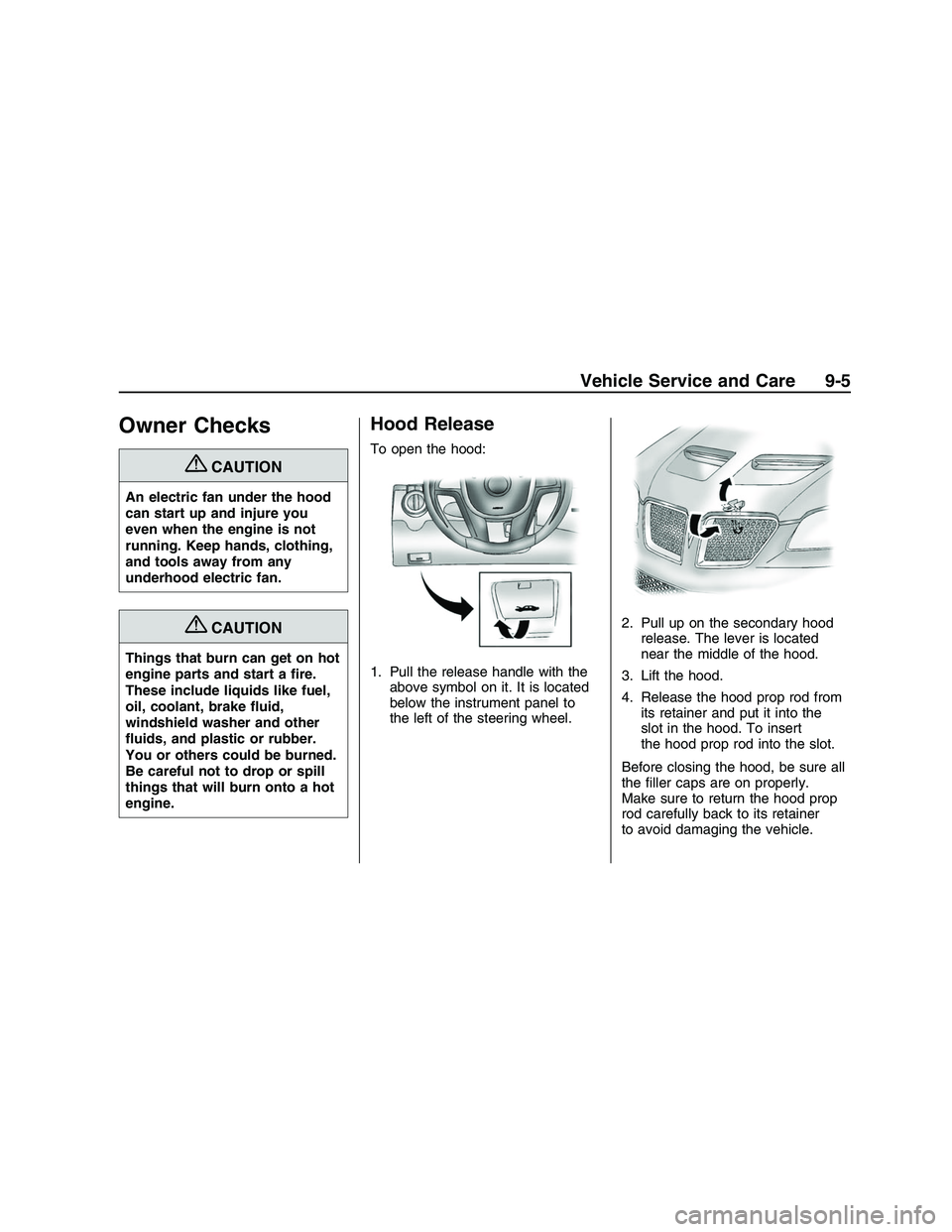
To open the hood:
1. Pull the release handle with the
above symbol on it. It is located
below the instrument panel to
the left of the steering wheel.2. Pull up on the secondary hood
release. The lever is located
near the middle of the hood.
3. Lift the hood.
4. Release the hood prop rod from
its retainer and put it into the
slot in the hood. To insert
the hood prop rod into the slot.
Before closing the hood, be sure all
the ller caps are on properly.
Make sure to return the hood prop
rod carefully back to its retainer
to avoid damaging the vehicle.
Vehicle Service and Care 9-5
2008 - Pontiac G8 Owner Manual