warning light PONTIAC G8 2008 Owner's Manual
[x] Cancel search | Manufacturer: PONTIAC, Model Year: 2008, Model line: G8, Model: PONTIAC G8 2008Pages: 334, PDF Size: 2.99 MB
Page 170 of 334
While driving on a surface with
reduced traction, try your best to
avoid sudden steering, acceleration,
or braking, including reducing
vehicle speed by shifting to a lower
gear. Any sudden changes could
cause the tires to slide. You
might not realize the surface is
slippery until your vehicle is
skidding. Learn to recognize warning
clues — such as enough water,
ice, or packed snow on the road to
make a mirrored surface — and
slow down when you have any
doubt.
Remember: Any Antilock Brake
System (ABS) helps avoid only the
braking skid.Driving at Night
Night driving is more dangerous than
day driving because some drivers
are likely to be impaired — by alcohol
or drugs, with night vision problems,
or by fatigue.
Night driving tips include:
Drive defensively.
Do not drink and drive.
Reduce headlamp glare by
adjusting the inside rearview
mirror.
Slow down and keep more space
between you and other vehicles
because headlamps can only
light up so much road ahead.
Watch for animals.
When tired, pull off the road.
Do not wear sunglasses.
Avoid staring directly into
approaching headlamps.
Keep the windshield and all glass
on your vehicle clean — inside
and out.
Keep your eyes moving,
especially during turns or curves.
No one can see as well at night as
in the daytime. But, as we get
older, these differences increase.
A 50-year-old driver might need
at least twice as much light to see
the same thing at night as a
20-year-old.
8-22 Driving and Operating
2008 - Pontiac G8 Owner Manual
Page 171 of 334
Driving in Rain and on
Wet Roads
Rain and wet roads can reduce
vehicle traction and affect your
ability to stop and accelerate.
Always drive slower in these types
of driving conditions and avoid
driving through large puddles and
deep-standing or owing water.
{CAUTION
Wet brakes can cause crashes.
They might not work as well in
a quick stop and could cause
pulling to one side. You could
lose control of the vehicle.
After driving through a large
puddle of water or a car/vehicle
wash, lightly apply the brake
pedal until the brakes work
normally.
(Continued)
CAUTION (Continued)
Flowing or rushing water
creates strong forces. Driving
through owing water could
cause your vehicle to be
carried away. If this happens,
you and other vehicle
occupants could drown. Do not
ignore police warnings and be
very cautious about trying to
drive through owing water.
Hydroplaning
Hydroplaning is dangerous. Water
can build up under your vehicle’s
tires so they actually ride on the
water. This can happen if the road
is wet enough and you are going
fast enough. When your vehicle is
hydroplaning, it has little or no
contact with the road.There is no hard and fast rule about
hydroplaning. The best advice is
to slow down when the road is wet.
Other Rainy Weather Tips
Besides slowing down, other wet
weather driving tips include:
Allow extra following distance.
Pass with caution.
Keep windshield wiping
equipment in good shape.
Keep the windshield washer uid
reservoir lled.
Have good tires with proper tread
depth. SeeTires on page 9-39.
Turn off cruise control,
if equipped.
Driving and Operating 8-23
2008 - Pontiac G8 Owner Manual
Page 173 of 334
{CAUTION
Coasting downhill in N (Neutral)
or with the ignition off is
dangerous. The brakes will
have to do all the work of
slowing down and they could
get so hot that they would not
work well. You would then have
poor braking or even none
going down a hill. You could
crash. Always have the engine
running and the vehicle in gear
when going downhill.
Stay in your own lane. Do not
swing wide or cut across the
center of the road. Drive at
speeds that let you stay in your
own lane.
Top of hills: Be alert — something
could be in your lane (stalled car,
accident).
Pay attention to special road
signs (falling rocks area, winding
roads, long grades, passing or
no-passing zones) and take
appropriate action.
Winter Driving
Here are some tips for winter driving:
Have your vehicle in good shape
for winter.
You might want to put winter
emergency supplies in your
vehicle.
Include an ice scraper, a small
brush or broom, a supply of
windshield washer uid, a rag,
some winter outer clothing, a small
shovel, a ashlight, a red cloth,
and reective warning triangles.
And, if you will be driving under
severe conditions, include a small
bag of sand, a piece of old carpet, or
a couple of burlap bags to help
provide traction. Be sure you
properly secure these items in
your vehicle.
Also seeTires on page 9-39.
Driving and Operating 8-25
2008 - Pontiac G8 Owner Manual
Page 197 of 334
Notice:If the air cleaner/lter is
off, a backre can cause a
damaging engine re. And, dirt
can easily get into your engine,
which will damage it. Always have
the air cleaner/lter in place
when you are driving.
Automatic Transmission
Fluid
It is not necessary to check the
transmission uid level. A
transmission uid leak is the only
reason for uid loss. If a leak occurs,
take your vehicle to a dealer/retailer
and have it repaired as soon as
possible.
Change the uid and lter at the
intervals listed in the Maintenance
Schedule. SeeScheduled
Maintenance on page 11-4. Be sure
to use the transmission uid
listed inRecommended Fluids and
Lubricants on page 11-12.Notice:Use of the incorrect
automatic transmission uid may
damage your vehicle, and the
damages may not be covered by
your warranty. Always use the
automatic transmission uid
listed inRecommended Fluids
and Lubricants on page 11-12.
Engine Coolant
The cooling system in your vehicle is
lled with DEX-COOL®engine
coolant. This coolant is designed to
remain in your vehicle for ve years
or 150,000 miles (240 000 km),
whichever occurs rst, if you add
only DEX-COOL
®extended life
coolant.
The following explains your cooling
system and how to add coolant
when it is low. If you have a problem
with engine overheating, see
Engine Overheating on page 9-16.A 50/50 mixture of clean, drinkable
water and DEX-COOL
®coolant will:
Give freezing protection down
to−34°F (−37°C).
Give boiling protection up to
265°F (129°C).
Protect against rust and
corrosion.
Help keep the proper engine
temperature.
Let the warning lights and gages
work as they should.
Notice:Using coolant other than
DEX-COOL
®can cause premature
engine, heater core, or radiator
corrosion. In addition, the engine
coolant may require changing
sooner, at the rst maintenance
service after each 30,000 miles
(50 000 km) or 24 months,
whichever occurs rst. Any
repairs would not be covered by
the vehicle warranty. Always
use DEX-COOL
®(silicate-free)
coolant in the vehicle.
Vehicle Service and Care 9-13
2008 - Pontiac G8 Owner Manual
Page 200 of 334
Engine Overheating
There is an engine coolant
temperature warning light on your
vehicle’s instrument panel. See
Engine Coolant Temperature Gage
on page 4-17.
If Steam Is Coming From Your
Engine
{CAUTION
Steam from an overheated
engine can burn you badly,
even if you just open the hood.
Stay away from the engine if
you see or hear steam coming
from it. Just turn it off and get
everyone away from the vehicle
until it cools down. Wait until
there is no sign of steam or
coolant before you open
the hood.
(Continued)
CAUTION (Continued)
If you keep driving when your
engine is overheated, the
liquids in it can catch re. You
or others could be badly
burned. Stop your engine if it
overheats, and get out of the
vehicle until the engine is cool.
Notice:If the engine catches re
because of being driven with
no coolant, your vehicle can be
badly damaged. The costly
repairs would not be covered by
the vehicle warranty.
If No Steam Is Coming From
Your Engine
An engine coolant temperature
warning can indicate a serious
problem. SeeEngine Coolant
Temperature Gage on page 4-17.If you get an engine coolant
temperature warning, but see or hear
no steam, the problem may not be
too serious. Sometimes the engine
can get a little too hot when you:
Climb a long hill on a hot day.
Stop after high-speed driving.
Idle for long periods in traffic.
If you get the engine coolant
temperature warning with no sign of
steam, try this for a minute or so:
1. If your air conditioner is on, turn
it off.
2. In heavy traffic, let the engine idle
in N (Neutral) while stopped. If it
is safe to do so, pull off the road,
shift to P (Park) or N (Neutral) and
let the engine idle.
3. Turn on your heater to full hot at
the highest fan speed and open
the windows as necessary.
9-16 Vehicle Service and Care
2008 - Pontiac G8 Owner Manual
Page 208 of 334
Brakes
Brake Fluid
The brake master cylinder reservoir
is lled with DOT-4 brake uid.
There are only two reasons why the
brake uid level in the reservoir
might go down. The rst is that the
brake uid goes down to an
acceptable level during normal
brake lining wear. When new linings
are put in, the uid level goes
back up. The other reason is that
uid is leaking out of the brake
hydraulic system. If it is, have the
brake hydraulic system xed,
since a leak means that sooner or
later the brakes will not work well.It is not a good idea to top off the
brake uid. Adding brake uid
will not correct a leak. If uid is
added when the linings are worn,
there will be too much uid
when new brake linings are
installed. Add or remove brake uid,
as necessary, only when work is
done on the brake hydraulic system.{CAUTION
If your vehicle has too much
brake uid, it can spill on the
engine. The uid will burn if the
engine is hot enough. You or
others could be burned, and
your vehicle could be damaged.
Add brake uid only when work
is done on the brake hydraulic
system.
When the brake uid falls to a low
level, the brake warning light
will come on. SeeBrake System
Warning Light on page 4-16.
What to Add
When you do need brake uid, use
only DOT-4 brake uid. It is
recommended that you ush the
brake hydraulic system and rell it
with new DOT-4 uid at a regular
maintenance service every two
years. See “Additional Required
Services” in the Maintenance
Schedule. Use new brake uid from
a sealed container only. See
“Recommended Fluids and
Lubricants” in the Maintenance
Schedule.
Always clean the brake uid reservoir
cap and the area around the cap
before removing it. This helps keep
dirt from entering the reservoir.
{CAUTION
With the wrong kind of uid in
the brake hydraulic system, the
brakes might not work well. This
could cause a crash. Always use
the proper brake uid.
9-24 Vehicle Service and Care
2008 - Pontiac G8 Owner Manual
Page 209 of 334
Notice:
Using the wrong uid can
badly damage brake hydraulic
system parts. For example,
just a few drops of
mineral-based oil, such as
engine oil, in the brake
hydraulic system can damage
brake hydraulic system
parts so badly that they will
have to be replaced. Do not let
someone put in the wrong
kind of uid.
If you spill brake uid on your
vehicle’s painted surfaces, the
paint nish can be damaged.
Be careful not to spill brake
uid on your vehicle. If you do,
wash it off immediately. See
Exterior Cleaning on page 9-94.
Brake Wear
Your vehicle has disc brakes. Disc
brake pads have built-in wear
indicators that make a high-pitched
warning sound when the brake pads
are worn and new pads are needed.
The sound can come and go or be
heard all the time your vehicle is
moving, except when you are
pushing on the brake pedal rmly.
{CAUTION
The brake wear warning sound
means that soon the brakes will
not work well. That could lead
to an accident. When you hear
the brake wear warning sound,
have your vehicle serviced.
Notice:Continuing to drive with
worn-out brake pads could
result in costly brake repair.Some driving conditions or climates
can cause a brake squeal when
the brakes are rst applied or lightly
applied. This does not mean
something is wrong with the brakes.
Properly torqued wheel nuts are
necessary to help prevent
brake pulsation. When tires are
rotated, inspect brake pads for wear
and evenly tighten wheel nuts in
the proper sequence to torque
specications inCapacities and
Specifications on page 10-2.
Brake linings should always be
replaced as complete axle sets.
Brake Pedal Travel
See your dealer/retailer if the brake
pedal does not return to normal
height, or if there is a rapid increase
in pedal travel. This could be a sign
that brake service might be required.
Brake Adjustment
Every time you apply the brakes,
with or without the vehicle moving,
the brakes adjust for wear.
Vehicle Service and Care 9-25
2008 - Pontiac G8 Owner Manual
Page 235 of 334
The TPMS operates on a radio
frequency and complies with
RSS-210 of Industry and Science
Canada. Operation is subject to the
following two conditions:
1. This device may not cause
interference.
2. This device must accept any
interference received, including
interference that may cause
undesired operation of the
device.
Changes or modications to this
system by other than an authorized
service facility could void
authorization to use this equipment.Tire Pressure Monitor
Operation
The Tire Pressure Monitor System
(TPMS) is designed to warn the
driver when a low tire pressure
condition exists. TPMS sensors are
mounted onto each tire and
wheel assembly, excluding the
spare tire and wheel assembly. The
TPMS sensors monitor the air
pressure in the vehicle’s tires and
transmit the tire pressure readings to
a receiver located in the vehicle.
When a low tire pressure condition is
detected, the TPMS turns on the
7
low tire pressure warning light.
At the same time a message to
check the pressure in a specic tire
appears on the Driver Information
Center (DIC) display. The low
tire pressure warning light and the
DIC warning message come on
at each ignition cycle until the tires
are inated to the correct ination
pressure. Using the DIC, tire
pressure levels can be viewed bythe driver. For additional information
and details about the DIC operation
and displays seeDIC Operation
and Displays on page 4-23andDIC
Warnings and Messages on
page 4-27.
The low tire pressure warning light
may come on in cool weather
when the vehicle is rst started, and
then turn off as you start to drive.
This could be an early indicator that
the air pressure in the tire(s) are
getting low and need to be inated
to the proper pressure.
A Tire and Loading Information label
shows the size of the vehicle’s
original equipment tires and
the correct ination pressure for the
vehicle’s tires when they are
cold. SeeLoading the Vehicle on
page 8-28, for an example of
the Tire and Loading Information
label and its location on the vehicle.
Also seeInflation - Tire Pressure
on page 9-46.
Vehicle Service and Care 9-51
2008 - Pontiac G8 Owner Manual
Page 236 of 334
The vehicle’s TPMS system can
warn about a low tire pressure
condition but it does not replace
normal tire maintenance. See
Tire Inspection and Rotation on
page 9-54andTires on page 9-39.
Notice:Using non-approved
tire sealants could damage
the Tire Pressure Monitor System
(TPMS) sensors. TPMS sensor
damage caused by using an
incorrect tire sealant is not
covered by the vehicle warranty.
Always use the GM approved
tire sealant available through your
dealer/retailer.
TPMS Malfunction Light and
Message
The TPMS will not function properly
if one or more of the TPMS
sensors are missing or not
operating.
When the system detects a
malfunction, the
7low tire warning
light ashes for about one minute
and then stays on for the remainderof the ignition cycle. A DIC warning
message also displays. The low tire
warning light and DIC warning
message come on at each ignition
cycle until the problem is corrected.
Some of the conditions that can
cause the malfunction light and DIC
message to come on are:
One of the road tires has been
replaced with the spare tire. The
spare tire does not have a TPMS
sensor. The TPMS malfunction
light and DIC message should go
off once the road tire containing
the TPMS sensor is re-installed.
The TPMS sensor matching
process was started but not
completed or not completed
successfully after installing
replacement tires or rotating the
vehicle’s tires. The DIC message
and TPMS malfunction light
should go off once the TPMS
sensor matching process is
performed successfully.
One or more TPMS sensors are
missing or damaged. The DIC
message and the TPMS
malfunction light should go off
when the TPMS sensors are
installed and the sensor matching
process is performed
successfully. See the dealer/
retailer for service.
Replacement tires or wheels do
not match the vehicle’s original
equipment tires or wheels. Tires
and wheels other than those
recommended for the vehicle
could prevent the TPMS from
functioning properly. SeeBuying
New Tires on page 9-56.
Operating electronic devices or
being near facilities using radio
wave frequencies similar to the
TPMS could cause the TPMS
sensors to malfunction.
9-52 Vehicle Service and Care
2008 - Pontiac G8 Owner Manual
Page 266 of 334
Notice:If you leave your radio or
other accessories on during the
jump starting procedure, they
could be damaged. The repairs
would not be covered by your
warranty. Always turn off
your radio and other accessories
when jump starting your
vehicle.
4. Turn the ignition to LOCK/OFF
and switch off all lights and
accessories in both vehicles,
except the hazard warning
ashers if needed.
{CAUTION
An electric fan can start up
even when the engine is not
running and can injure you.
Keep hands, clothing and tools
away from any underhood
electric fan.
{CAUTION
Using a match near a battery
can cause battery gas to
explode. People have been hurt
doing this, and some have been
blinded. Use a ashlight if you
need more light.
Be sure the battery has enough
water. You do not need to add
water to the battery installed in
your new vehicle. But if a
battery has ller caps, be sure
the right amount of uid is
there. If it is low, add water to
take care of that rst. If you
don’t, explosive gas could be
present.
Battery uid contains acid that
can burn you. Do not get it on
you. If you accidentally get it in
your eyes or on your skin, ush
the place with water and get
medical help immediately.
{CAUTION
Fans or other moving engine
parts can injure you badly.
Keep your hands away from
moving parts once the engine
is running.
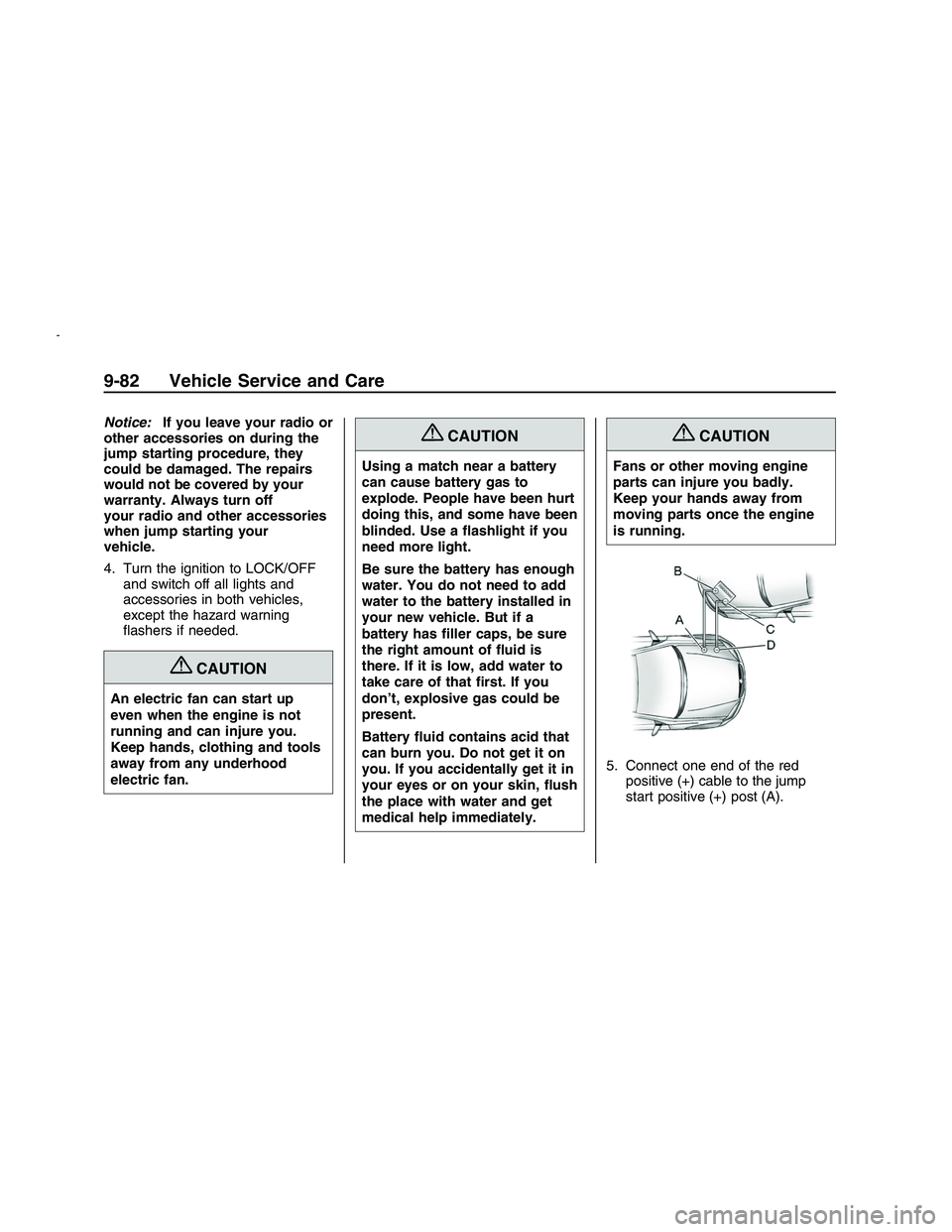
5. Connect one end of the red
positive (+) cable to the jump
start positive (+) post (A).
9-82 Vehicle Service and Care
2008 - Pontiac G8 Owner Manual